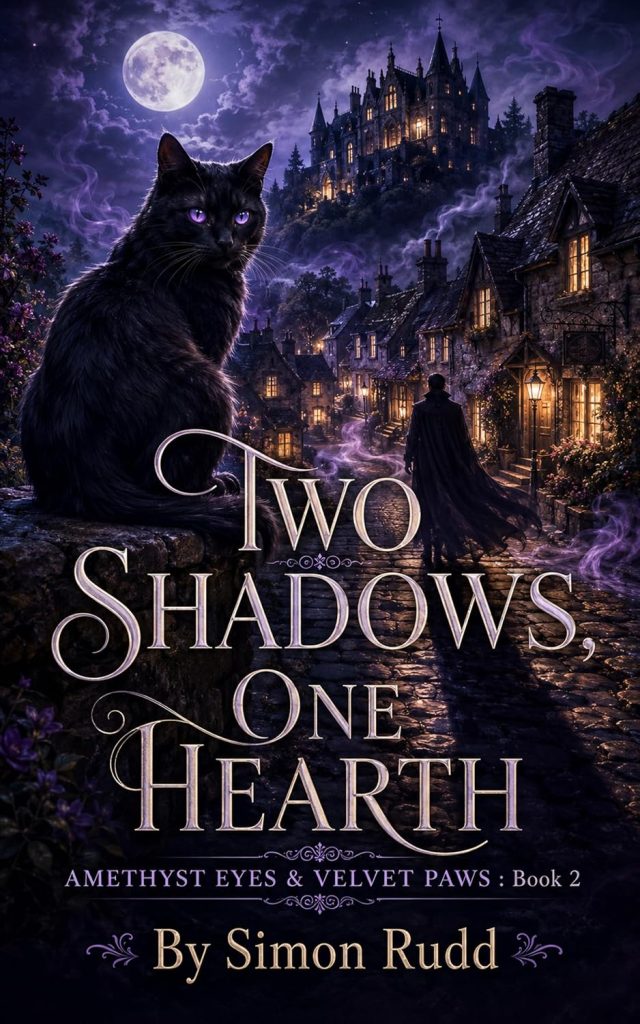
Count Alaric Dracula is no longer the loneliest thing in Cobblestones.
He has friends now. A village that knows what he is and keeps him anyway. Tuesday teas with the librarian, warm bread on his doorstep, and a small grey kitten who has appointed herself his familiar without consulting him. After four hundred years of running, the reluctant Night Watchman has almost — almost — learned how to stay.
Then Vladislav arrives.
Three hundred and fifty years old. Ember-eyed, exhausted, and cruel in the way of a creature who has never once been given a reason not to be. He has crossed a continent to challenge the vampire who supposedly found what he never could: a home. And he brings with him a loneliness deep enough to wake the thing sleeping beneath the village well.
Because the Gloom was never truly beaten. It was only quieted. And it is made of exactly the sorrow these two creatures have spent centuries refusing to set down.
Two lonelinesses. One well. And a darkness rising faster than anything Alaric has ever faced — one that cannot be fought with claws or silver, because it is made of the very thing that binds him to the monster at his door.
To save Cobblestones, Alaric must do something more frightening than battle: he must offer his rival the one thing nobody ever offered him. And he must finally answer the question that has haunted him since the day the village first took him in — whether being accepted is the same as being known, and whether he has the courage to find out.
Two Shadows, One Hearth is the second book in the cosy gothic fantasy trilogy Amethyst Eyes & Velvet Paws — a story about grief, second chances, honesty that costs something, and the stubborn, casserole-bearing love of a village that refuses to let anyone be lonely alone.
Some hearths are big enough for two shadows.
Read the first chapter
Chapter One — Night Watchman
The first thing Count Alaric Dracula noticed that particular Tuesday evening was the lint.
Not spectral lint — the purple-grey wisps of supernatural corruption that the Gloom left behind like calling cards, the kind he'd spent fifteen years swatting from rooftops and picking from salt lines and occasionally extracting from Thomas the baker's sourdough starter. No. This was ordinary, mundane, perfectly natural lint — the kind that accumulated on emerald velvet waistcoats when one spent too much time curled in a favourite reading chair, absorbed in a particularly gripping treatise on fifteenth-century Wallachian politics.
He plucked it from his lapel with fastidious precision — thumb and forefinger meeting in the practised pinch of someone who had spent four centuries maintaining standards — and held it up to the lamplight. Grey. Utterly mundane. No shimmer, no ethereal glow, no tendency to dissolve into wisps of malevolent smoke.
Perfect.
He did not flick it into the fire. That was new — a habit less than a year old, and one he could not entirely account for. Somewhere in the previous autumn he had stopped waging war on his own lapel and started, instead, keeping a small dish on the side table for the day's findings, because he had learned — the hard way, at the bottom of a well — that the lint on a waistcoat was not the residue of an enemy but the residue of a life, and that a life with things settling on it was, on the whole, a considerable improvement on the alternative. He set the grey wisp in the dish. Across the library, Tabitha — the small grey kitten who had appeared on his doorstep six months ago and appointed herself his unofficial familiar, despite his repeated protests that he was not the type of vampire who needed a familiar, thank you very much — opened one mismatched eye and yawned with impressive feline disdain before returning to her nap atop a first edition of Carmilla.
Half past nine. Nearly time for patrol.
The thought arrived with comfortable familiarity, settling into its usual place in the evening's rhythm like a key turning in a well-oiled lock. Rise. Dress. Drink the reserve. Transform. Patrol. Return. Sleep. Repeat. He'd been doing this for fifteen years now — longer than he'd stayed anywhere since the eighteenth century — and the routine had worn grooves in his existence so deep and smooth that some nights he barely had to think at all.
That should have pleased him. It did please him, mostly. But lately, in the quiet moments between one task and the next, he'd caught himself wondering whether comfortable and complacent shared more than their first syllable. Whether the vampire who'd once tracked Gloom manifestations with the razor focus of a born predator had imperceptibly become the vampire who kept a dish for his lint and worried about his reading backlog.
Fifteen years of peace could do that to a creature. Soften the edges. Dull the instincts. Turn a guardian into a gentleman and leave him wondering which one the village actually needed.
He pushed the thought aside. Unhelpful. Besides, the Gloom had been genuinely quiet since the night they'd sealed the well — the whole village gathered in the square with water and salt and iron, claiming their home out loud, driving the corruption back down below the reinforced rim. Contained, Mina was always careful to say, never cured; she kept the distinction in her ledger the way she kept everything, precisely, and she was right to. The wisps still came. A few residual sprites still manifested in pantries and gardens, and once or twice a night, still, a single thread of purple-grey found its way to his lapel from the direction of the square, faint and patient, as though the thing beneath the stone had not forgotten whose it was. But it required nothing more than a quick swat and a stern look. The peace was earned. He was allowed to enjoy it.
Wasn't he?
The library door opened with a whisper of well-oiled hinges. Renfield appeared, carrying a silver tray bearing a crystal glass of deep crimson liquid that caught the firelight like a ruby. His silver hair was immaculate, his dark suit pressed to knife-edge perfection, his expression one of studied neutrality that meant he had Opinions about something but was being professional about it.
"Your reserve, Master." He set the tray on the side table with the precise placement of thirty years' practice — slightly left of centre, angled so the glass caught the warmth of the fire. "Thomas has adjusted the recipe again. Extra iron for 'stamina during the dark season.' His words, not mine."
Alaric picked up the glass and swirled it gently. The scent rose: iron and earth, with undertones of rosemary and something Thomas swore was "robust seasoning" but which Alaric strongly suspected was garlic. It was nothing like the blood he'd consumed in his youth: no heat, no chase, no terror sharpening the flavour like copper on the tongue.
The memory surfaced unbidden — a cobblestoned square in Vienna, 1743, the scream cut short, the warmth flooding his mouth. He swallowed against the recollection and took a sip of the reserve instead. Rich. Smooth. Civilised.
Once, that memory would have been the whole of the guilt. He'd spent the better part of four centuries believing that the worst of himself was the taking — the lives cut short, the terror, the copper on the tongue. It had taken a village, and a well, and a night on the floor of his own study with his purr in pieces, to teach him that he'd been misreading his own history all along. The taking had been terrible, and he did not excuse it. But it had never been the root. It had been a symptom — the thing a creature does when it has decided, in advance and forever, that it will let no one close enough to be anything but prey. Underneath the Vienna square and the copper warmth was the older, quieter fact he'd fled from across three centuries and finally turned to face in Cobblestones: he had been, for four hundred years, unspeakably alone, and had called the aloneness safety, and had done a great deal of harm in its name.
You don't deserve them, whispered a voice he'd spent years trying to silence, and that spoke, these days, with markedly less conviction than it used to. Not after what you were.
Perhaps not, he answered it, which was also new. But they have decided otherwise, and they were there, and they get a vote.
"Also," Renfield continued, mercifully interrupting Alaric's internal archaeology, "Mina left a basket on the back porch. Fresh cream, bread, and what she described as 'anti-Gloom potpourri.' I believe it contains lavender, salt, and possibly hellfire, if the smell is any indication."
Alaric smiled despite himself. Mina Murray — the village librarian who had somehow become his closest friend, though he suspected she'd describe the arrangement as "managing a slightly eccentric neighbour who happens to be immortal" — had a gift for making the supernatural feel domestic. The villagers all knew what he was now, had known since the night at the well, and their collective response had been less pitchforks-and-torches and more cream-and-horseshoes.
He was, at last, most of the way to believing he'd been allowed to keep it.
"I'll inspect the potpourri," he said. "Though if it contains actual hellfire, I may have concerns about fire safety."
"Quite understandable, sir." Renfield paused. "Will you be conducting your usual patrol?"
"Of course. The Gloom has been quiet, but that's precisely when it tends to get ambitious."
"Indeed." Another pause — longer this time, weighted. "Though I wonder if you've noticed—"
He stopped. His head tilted slightly, as if listening to something beyond normal human hearing. Renfield was refreshingly, determinedly human, but thirty years in the employ of a vampire had given him instincts born of close attention rather than supernatural ability.
"Noticed what?" Alaric prompted, though his stomach had already begun to tighten.
"The air," Renfield said slowly. "It tastes... different. Like metal. Like—"
"Like old blood," Alaric finished.
His contentment didn't just evaporate. It curdled — creamery warmth souring to something cold and sharp — because he had noticed. Had been noticing for two days, in fact, catching traces of it on the evening wind and dismissing each one as imagination, as paranoia, as the overactive instincts of a vampire who'd gone too long without a genuine threat.
Dismissal, he realised now, was just cowardice wearing a sensible hat.
He moved to the window and pushed it open. The cold autumn air rushed in, carrying the layered scents of Cobblestones at evening: woodsmoke from banked fires, the yeast-and-flour warmth of Thomas's bakery, dead leaves composting in garden beds, the mineral tang of the well where Edith kept her patient watch.
His village. His territory. His people, sleeping behind his salt lines. The possessiveness flared through him with a force that should have alarmed him — and, a beat later, did. He'd learned to mistrust that particular heat. He had built nothing here by owning it; he had built it, on the contrary, by belonging to it, and the distinction had cost him fifteen years and nearly his life to grasp. He let the possessive flare rise, acknowledged it, and set it down. Not mine to own. Mine to keep watch over. Different thing.
And underneath all those familiar scents, threading through them like a wire through wool, was something that didn't belong.
Metal. Snow. The sharp tang that came from things that had witnessed ancient violence — battlefields ploughed under centuries ago, winters that had killed thousands, the iron-and-ash residue of a life lived by taking from others. A life lived, he understood now with a clarity he had not possessed the last time he'd smelled it on himself, by a creature that had never once let anyone close.
Dread hit him like a physical blow — not the manageable anxiety of Gloom manifestations and garden sprites, but the deep, primal recognition of a predator sensing another predator. His fangs extended before he could stop them. His fingers dug into the windowsill hard enough to crack the wood.
Because underneath the metal and snow and ancient violence was something he knew with visceral certainty.
The scent of another vampire.
"Sir?" Renfield's voice was carefully neutral, but Alaric had known him long enough to hear the fear beneath it — not fear of the scent, which Renfield couldn't detect at that level, but fear of what he saw in Alaric's face.
"We have a visitor." Alaric turned from the window. His voice sounded strange to his own ears — flat and controlled, the voice of the creature he'd been before Cobblestones had taught him softer registers. "Or we will, soon. Someone who knows what I am. Someone who's been travelling a long time."
Someone who still smelled of the old ways. The hunting ways. Ways Alaric had spent a decade and a half trying to forget and the centuries before that perfecting.
Renfield moved to the weapons cabinet — the ornate mahogany affair that officially contained Alaric's collection of historical curiosities but unofficially housed implements that had nothing to do with curiosity and everything to do with survival. "Should I prepare the silver?"
"Not yet. If they meant immediate violence, they wouldn't announce themselves so obviously. The scent is a calling card. A courtesy, of sorts."
Though what sort of courtesy involved approaching another vampire's territory smelling of old battlefields, Alaric could think of several answers, and none of them were pleasant.
He shrugged into his coat — the long black one, because if one was going to be a vampire one might as well commit to the aesthetic — and paused at the door. Tabitha had woken and was watching him with those mismatched eyes, tail twitching with sudden interest.
"Keep Renfield company," he told her solemnly. "And if anything happens to me, make sure he doesn't rearrange the entire library."
"I make no promises," Renfield said dryly, but there was worry in his eyes. Real worry — the kind that came from three decades of watching someone you cared about walk into darkness.
The night air hit Alaric as he crossed the threshold, and the transformation took him — shadow and intention reshaping bone and muscle, the world tilting and sharpening as four legs replaced two and his senses bloomed. A sleek black cat the size of a small panther stood where a man had been, white chest medallion gleaming like a cravat made of starlight, amethyst eyes cutting through the darkness.
He leaped to the garden wall, then the stable roof, then higher, moving through the village with the fluid certainty of someone who'd made this journey hundreds of times. And he made, as he always made now, the small detour he had never once made in his first fourteen years and could no longer imagine skipping: down Mill Lane, to the low stone wall behind the Sullivan cottage.
The lamp was dark. He noted it the way he noted everything — without comment, and with a small quiet warmth. A year ago the lamp had burned at half three every night, and a woman had sat behind it turning a locket in her fingers and staring at an empty grate. She was not mended; that word had never fit a loss the size of hers, and he'd stopped expecting it to. But the lamp went out before midnight now, most nights, and Margot Sullivan slept, and by day she kept the churchyard flowers with Mrs. Higgins and let the garden club talk her into things, and had, he'd heard, begun to laugh again — rarely, and as though surprised each time to find she still could. She carried her grief among people now instead of alone behind a lamp. It was, he had come to understand, the whole of the difference that could be made, and it was not nothing.
He checked the wall, as he always did, and the window, and drove back the one thin thread of purple-grey that had drifted from the direction of the square to hang, close and still, at the dark glass — the way it always drifted to Margot's window, the way it had drifted there a year ago, gathering rather than lunging, patient rather than cruel. He had never understood it. He had given up, mostly, trying to. It went where the grief was; that much he knew; and it kept, around Margot Sullivan, a stillness he had long ago stopped being able to read as hunger and had never managed to read as anything else. He scattered it, and it went without protest, and he moved on. Some questions, he had learned, waited. This one had been waiting a year. It could wait longer.
From the church steeple's highest point, all of Cobblestones lay visible, and the metallic scent was stronger here — much stronger, carried on the wind from the north road that wound through the heath and over the hills. Coming closer. Steadily, deliberately closer.
Alaric settled onto the ancient stone, tail wrapped around his paws, and felt the comfortable grooves of his routine crack beneath him like ice on a warming river. Whatever was approaching, it was old. Powerful. And it carried in its scent the ghost of a life Alaric had spent years trying to outrun — the life he'd lived before Cobblestones, before cream and kindness and a kitten who'd decided he was worth claiming, before he'd learned that a monster could choose to be something else.
What if you didn't really choose? whispered the voice he couldn't quite silence. What if you just got tired? What if the monster is still in there, waiting, and all it takes is the right provocation?
He shut the thought down — and answered it, too, with a thing he had not had the last time the fear came calling. If it is still in there, then it will have to contend with the fact that I am no longer alone in here with it. He patrolled until dawn lightened the eastern sky. The visitor didn't show themselves. The scent lingered at the edges of his territory like a question he wasn't ready to answer.
• • •
He'd been back an hour, still restless, still in feline form at the library window, when the knock came. Not Renfield — his was three sharp raps followed by a pause. This was gentler. More hesitant.
Mina.
He transformed and reached for his dressing gown before calling her in. She entered laden with a wicker basket that smelled of fresh bread, flour dusting one sleeve and a smudge of jam on her collar. She set the basket on his desk with the casual confidence of someone who'd been doing this for years, because she had — every Tuesday without fail, as if feeding an ancient vampire were simply another item on the weekly schedule.
"You look terrible," she said, with the bluntness of true friendship. "When was the last time you actually rested?"
"I rested yesterday," Alaric said — which was technically true if you counted lying in his coffin staring at the lid while his mind raced through four centuries of worst-case scenarios.
Mina tore off a piece of bread, slathered it with cream, and handed it to him with the air of a general deploying troops. "Sit. Eat. And tell me what has you prowling the rooftops like the village is about to be invaded."
He sat. He ate. The bread was warm and yeasty, the cream rich with iron — grounding flavours that pulled him back to the present. And the words came before he'd decided to share them.
"There's another vampire. Approaching the village. Old — very old. The scent has that edge that comes from centuries of battles and predation. This isn't someone who's learned to live on beet-and-liver cream." He paused, the next words tasting like a confession. "This is someone who still remembers what it was like to hunt. And to travel alone, and stay nowhere, and let no one close. Which I recognise rather better than I'd like."
The way I was, until this village refused to let me be it any longer, he didn't quite say. But the silence held the shape of it.
Mina's hand paused mid-reach for her own piece of bread — a slight tightening around her eyes, a barely perceptible straightening of the spine. She was quiet for a moment, processing with the methodical calm of someone who catalogued books for a living and approached existential threats the same way.
"Well," she said finally. "Then I suppose we'll have to remind them that even creatures of the night need a place to belong. And that you've already found one." She fixed him with a look, at once stern and gentle. "You spent fifteen years thinking the strongest thing you could do was carry everything alone. You were wrong, and it nearly killed you, and the whole village watched you learn better. So when this other vampire arrives, remember that you're not defending territory. You're defending the place where people know your name and leave you offerings and worry about whether you're getting enough rest. That's not weakness, Alaric. It's the thing you have that he doesn't. Now get some actual sleep."
She left before he could formulate a suitably dignified response. Alaric stood at the window a moment longer, watching the village stir to life below. Thomas kneading dough, visible through his bakery window. Mrs. Jennings' perpetually confused rooster crowing a full hour late. Artie Holmwood emerging to collect his milk with his magnificent moustache already waxed for the day.
Ordinary. Precious. Held.
And somewhere beyond the hills, on the north road that wound through the heath, a figure was walking steadily toward Cobblestones. The scent was stronger than last night. Closer. And underneath the metal and snow and old violence, it carried something new.
Anticipation. Whoever was coming, they were looking forward to this.
Alaric drew the curtains against the rising sun and let exhaustion pull him toward sleep. But behind his closed eyes, his centuries-old instincts kept circling the same truths, each one sharper than the last. This wasn't about territory. This was personal. Someone from the old past — the Vienna-and-blood past, the alone past — had found him. And the fierce, protective part of him that had learned, at last, the difference between owning a place and belonging to it would do whatever was necessary to keep the village safe.
But if this visitor had known the Alaric of two centuries ago, they'd have found a monster worthy of the name — a creature exactly as lonely as they were, and exactly as good at pretending the loneliness was strength.
What they'd find now was a vampire who kept a dish for his lint, worried about sourdough, and detoured past a grieving woman's cottage every night to make sure her lamp had gone out.
He was no longer sure which version of himself would prove more useful in the days ahead. But for the first time in four hundred years, he knew which one he'd rather be — and that, he suspected, was going to turn out to matter a great deal more than he could yet see.