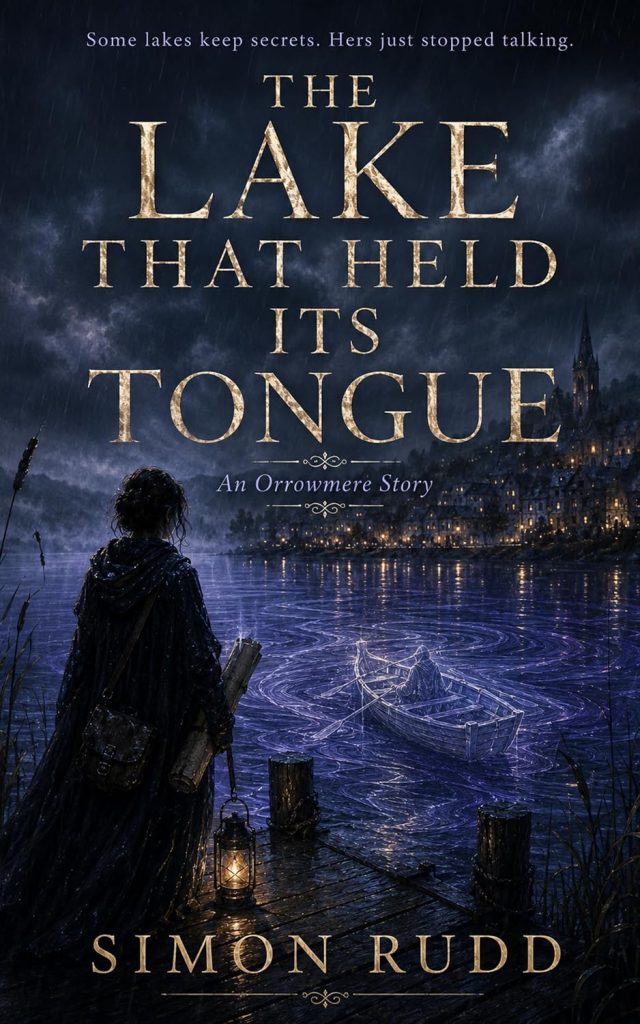
Some lakes keep secrets. Hers just stopped talking.
In Caldmere, the lake stopped talking. And everyone agreed it was Bryda's fault.
Bryda Sael has spent her whole life as a pair of hands — painting the boards other people designed, finishing the work other people decided, never once trusted to judge for herself. So when her town's lake fell silent, she had no authority to blame and every share of the blame anyway. Now she's walked clear across the country to Orrowmere, the one lake that still answers, to find out what went wrong with hers.
What she finds is a village that refuses to decide things for her.
Orrowmere keeps its record open — hand a stranger a pen and three blank lines and trust them to write down what's true. It's the opposite of everything Caldmere did. And as Bryda reads the water, paints a board that is finally hers, and edges toward a diagnosis nobody wants to hear, she starts to suspect that the tidy, careful system meant to protect a lake might be the very thing that strangles it — and that the cure is the one thing she's never been allowed to do: trust her own eye.
But Orrowmere's water is beginning to dim, too. And the answer Bryda is circling will mean contradicting the woman who taught her everything, in front of everyone, with no one left to tell her she's right.
Warm, wry, and quietly wondrous, The Lake That Held Its Tongue is a standalone cozy fantasy set in the world of The Lake That Painted Back — perfect for readers of Travis Baldree's Legends & Lattes, Heather Fawcett's Emily Wilde, and Sarah Beth Durst's The Spellshop.
A gentle, standalone-friendly return to Orrowmere — no cliffhangers, no grimness, just a stranger learning to trust herself in a town built on trust. Read it after The Lake That Painted Back or entirely on its own.
Read the first chapter
Chapter 1 — Arrival in the Rain
By the third day of rain, Bryda Sael had stopped trying to keep herself dry and put all of it into keeping the board so.
It rode under her arm, wrapped in oiled cloth and a length of reed twine she had tied in Caldmere and not undone since, and she had carried it that way over four passes and through a ford that came up past the cart’s axle without once letting it travel with the rest of the luggage. The cart could keep her clothes. The cart could keep her brushes — no, not her brushes; those were in the satchel against her ribs — but it could keep her spare boots and her comb and the bag of oatcakes gone soft as poultice. The board it could not have. She did not let herself look too long at the question of why a thing she could not bear to see was also a thing she would not set down.
“You will hold that into the lake itself, at this rate,” Hobb said from the front of the cart, not turning round. He had been saying versions of this since the second ford. He had the manner of a man who had spent his life delivering things to people who were not ready for them, and had made his peace with arriving anyway.
“It keeps the weather off,” Bryda said. “If that’s all right.”
“It’s your arm.”
It was, in fact, going numb. She shifted the board to the other side and tucked her cold hand under her thigh, where the seat had stayed almost dry, and watched the road unspool behind them in a long brown ribbon of water. They had walked the first day out of Caldmere because no one there would lend a boat to what the harbourmaster had called, to her face and with some satisfaction, a fool’s errand. Hobb had found them on the western shore road on the second morning, sitting on Ilsa’s cases under a dripping thorn, and had looked at the two of them for a while, totting up a sum he plainly already disliked, then jerked his head at the cart and said nothing further about it. He had complained instead about the load, the mule, the rain, the state of the bridge at Lower Fenn, and the general decline of people who set out on foot in the damp season as though the season were a matter of opinion.
Beside her, Ilsa sat very straight. She had kept the ledger-case on her knees the whole way, both hands flat upon it, and the rain had not been allowed to touch it; she had a square of waxed linen for it that she had not produced for herself. Her hood had slipped back and she had not fixed it, so the water ran down her temple in a thin steady line, and she let it, because fixing it would have meant moving a hand from the case.
“How much further?” Ilsa asked. Her voice was the one she used for the Caldmere council — composed, finished, each word set down whole and squared at the corners.
“Over the ridge,” said Hobb. “Then down. Then it depends what mood the lane’s in.”
“The lane has moods.”
“Everything in Orrowmere has moods. It’s the wet. Gets into the disposition.” He clicked his tongue at the mule, who flicked one ear to register a complaint of its own. “You’ll want to mind the colour on the way down. First-timers do a thing with their faces.”
Bryda’s stomach moved. “What thing?”
“You’ll see. Or you’ll do it. Same outcome.”
The road climbed through wet orchard rows and low walls gone soft and green with moss, and the rain thinned for a moment into something closer to mist, the kind that did not fall so much as occupy the air and wait. At the top of the ridge the mule stopped without being told, the way animals do at the place where every cart has stopped before them, and below them the village lay curled around its water in a wet half-moon — slate roofs, pale smoke pressed flat by the rain, shutters painted in a dozen blues, lanes darkened nearly to black.
And the lake was the wrong colour.
It should have been pewter. The sky was pewter, the reeds were a drowned grey-green, the hills behind the far shore sat under cloud with the patient misery of damp sheep, and a lake with any sense would have given all of that back unaltered. This one had drawn the colour inward instead and was holding it: a blue-violet that no grey day had any business producing, lavender ground into lapis and stirred across the whole still surface by a hand that did not stop when the wind crossed it. The ripples broke the colour and did not scatter it.
Bryda looked at her own knees.
She studied them with great attention. The wet wool, the place where the dye had run, a thread coming loose at the seam that she could fix tonight if there was light and a needle. She catalogued her knees the way she had once been taught to catalogue a surface before priming it, and she did not lift her eyes, and her face — she could feel it — did the thing Hobb had promised, which was nothing at all, very hard.
“There it is,” said Hobb, satisfied. “Knew you’d do the other one.”
“The other what?”
“Some look. Some look away. Catalogue woman who came through years back near fell out the cart trying to write it down.” He set the brake and let the cart roll the last of the slope on its own weight. “You’re a looker-away. Caldmere all over.”
Ilsa said nothing. Her hands had gone white at the knuckle on the case, and she was watching the water with an expression Bryda knew from the long winter the lake at home had stopped — a careful, emptied attention, the face of someone checking a familiar room for a sound that used to be there and was not. Then she remembered herself and arranged her features into the council face, and that was almost worse to see, because Bryda had learned that face by copying it.
The road became a lane, and the lane became a narrow wet street where the houses leaned close enough to drip into one another’s affairs. Shutters in milk-blue, storm-blue, an old indigo rubbed thin at the edges; here and there an older layer showing through where the weather had lifted the new. A board-painter’s eye took the layers in without being asked and filed them — repainted, that one, twice, and the underpaint a warmer blue than the town used now — and Bryda was annoyed at her eye for doing it, because her eye was the part of her she trusted least and it never knew this about itself.
People were about, despite the rain, because the rain was simply the condition under which Orrowmere conducted its life. A woman crossed the lane under a reed cape with a covered basket and did not look at the cart, which was how Bryda knew she had looked at the cart, taken its measure, counted the cases, weighed the two strangers, and moved on, all in the space it took to step over a running gutter. A man mending a shutter glanced up, glanced down, and went on mending with a concentration that had arrived only the moment they came into view. At a doorway, an older man with a ring of keys at his belt watched the mule go past with soft, worried eyes and lifted a hand that might have been a greeting or might have been the start of a thought he then thought better of.
“They’re all staring,” Bryda said, low.
“No one’s staring,” said Hobb. “That’s the whole skill of the place.”
Down a side lane a child of perhaps seven was crouched at the edge of a gutter stream, launching a paper boat with the gravity of a harbourmaster despatching a fleet. The boat caught the current, turned a neat circle, and set off down the slope toward the water, and the child watched it go with their fists on their knees and then turned and looked directly at the cart — at Bryda specifically, with the frank, total assessment that small children and weather give to outsiders.
“New people,” the child announced, to the lane in general.
“Visiting people,” Ilsa corrected, gently.
The child considered the cases. “That’s a lot of visiting.”
Hobb made a sound in his throat that in a kinder man would have been a cough, and turned the cart into the open mouth of the square, where a swinging sign showed a round loaf with a wave curling through it, the blue letters built up so many times by repair that the paint stood proud of the wood like enamel. Crumb’s, it said, and under it, Lakefront, and the warmth came out of the open door to meet them before the man did: bread, woodsmoke, the brown sweetness of crust, a heat that put a hand flat against Bryda’s chest and pushed.
The man who came out wiping his hands on a cloth was broad through the shoulders, with flour worked permanently into one cheekbone and an expression of profound, unsurprised acceptance, as though the rain had promised to deliver him an inconvenience and had, as ever, kept its word.
“Hobb,” he said.
“Tovan.”
“You’ve brought weather.”
“I’ve brought worse than weather. I’ve brought two from the west and a cart that’s been complaining since Lower Fenn.” Hobb set the brake for good. “They walked the first day. On purpose.”
Tovan looked at them — at Ilsa straight-backed with her case, at Bryda braced on the seat with the wrapped board held to her side like a splinted arm — and whatever he made of it he kept behind the flour and the cloth and the steady unhurried way he had of standing in his own doorway as if the doorway had been built around him.
“You’ll be wet through,” he said. It was not a question, and it was not, Bryda understood after a moment, an opening to any question either. “Come in before you ask me anything and before I ask you anything. There’s a fire and there’s the morning’s second bake, which is better than the first, and you can be people who are dry and fed first, and people with business after. The business will keep. It always does. It’s the one thing in this village that has the patience.”
“We don’t want to put you to —“ Bryda began.
“You’re not putting me to anything. You’re putting yourselves to a bench by the fire. Different verb.” He stood aside from the door. “In.”
Inside, three narrow tables, a scarred counter, a fire that had clearly been kept for the kind of person who would arrive needing it. Ilsa hesitated at the threshold — her composure was a structure she had to carry across rooms, and this one had a narrow door — and then she set the ledger-case down on the end of the counter — set it down, Bryda saw, with enormous care, as a thing being temporarily and reluctantly released — and let her shoulders come down a finger’s width. Bryda kept the board. She sat where Tovan pointed, near enough to the fire to steam, and held the board on her knees with both hands, and felt the heat begin to find her through the wet wool the way the rain had found her over three days, slowly, thoroughly, and without asking.
The board sat on her knees; the satchel sat against her ribs. Inside the satchel, wrapped in its own square of chamois and tied with a ribbon gone grey at the folds, was the brush roll, and her hand found it now the way another person’s hand might go to a charm at the throat. She did not take it out. She did not need to. She knew the order the brushes lay in — the broad lake-wash flat, the two liners, the worn fan she should have retired three winters ago and would not — and she knew that every one of them was clean, dried tip-up, the ferrules wiped, not a hair splayed, because the brushes were the one part of the work that had never once let her down. A brush did what it was told. A brush decided nothing. You could trust a brush with your whole life and it would give back only the line your hand had asked for, and if the line was wrong then the brush was blameless, and so, she had come to believe, was everything in the chain except the hand and the eye that guided it. Both of those were hers. She kept her brushes immaculate and her own judgement rolled up and unopened, and she had never once put the two facts beside each other long enough to be troubled by them.
Tovan brought bread without being asked what they wanted, because the question of what they wanted was, in his view, not yet relevant; what was relevant was that they were cold. The loaf came already torn, still warm enough to give under the thumb, scored on top with a mark Bryda did not at first take in — three waves, simple cut lines, the baker’s device — and butter that the heat softened on contact, and a crock of something dark and sweet, and small beer in two cups, and he put it all down and went away again to the bake room as though feeding two soaked strangers were a chore on a list he was relieved to have reached.
The bread was very good. Bryda had not eaten anything warm since Caldmere, and the first mouthful undid something in her shoulders that she had not known was tied, and for a moment she did the unforgivable thing of having no thoughts at all.
Then she saw the crust.
She had torn her piece across the wave mark, and along the broken edge, where the crumb showed pale and steaming, a thread of colour had risen into the torn surface — not painted on, not a trick of the firelight, but come up from inside the bread itself, the same impossible blue-violet that was out there holding steady on the whole face of the lake. It sat in the broken crust no wider than a hair and did not fade as she watched. It was, she understood with a cold and entirely professional clarity, the lake. The lake was in the bread. The lake answered in any water that would hold it, and there was water enough in a fresh loaf, and the loaf had a thing to say and had said it across the place where her own thumb had torn it open.
She did not look at what it showed. She set the piece down, mark-side to the table, very gently, the way she had once set down a board she had finished without leave on a morning she would spend the rest of her life walking away from.
Across the table, Ilsa was eating in small composed bites and watching the door to the bake room, and had not seen, and Bryda did not tell her, because there was nothing to tell that Ilsa did not already carry in her own ledger-case, and because the colour was already settling back into the crumb as the bread cooled, the way Orrowmere settled colour back once it had been seen and acknowledged enough — a thing she knew in her hands, without ever having decided to learn it.
When Tovan came back through, drying a tray, he glanced at the torn loaf on the table — at the mark-side-down piece, specifically, which she had thought she had set down to look like nothing — and his face did not change at all, which she would later understand was the most that Orrowmere ever admitted to having noticed.
“Crust came up,” he said, to no one, to the tray. “It does, this season. Means the water’s talking. Better than the alternative.”
“What’s the alternative?” Bryda asked, before she could weigh whether asking was hers to do.
Tovan considered the question as though it were a loaf he was deciding whether to sell. “Quiet,” he said. “You’ll have met that.”
She had. She had walked three days from it. It sat in her arms now, wrapped in oiled cloth, the colour the lake at home had stopped making, the thing she could not look at and could not put down, and she had carried it across four passes to a town whose bread blushed blue at a torn edge, to ask a woman she had not yet met why one lake spoke and another had gone silent — and she felt, sitting steaming by Tovan’s fire with a question already loose in her mouth that she had not been given permission to ask, that she had walked into the answer and would spend a long time understanding that she had.
“You’ll want the keeper,” Tovan said. “When you’re dry. Not before. She’s up the lane past the hall, and she’ll have her own opinion about visiting people, which she’ll keep to herself until she’s decided it, which is more than most of us manage.” He set the tray on its shelf. “Eat first. The lake’s not going anywhere. It’s the one thing about it you can rely on.”
Outside, the rain went on with the patience of something that had all season, and in the gutter by Crumb’s door a small paper boat that had run the whole slope of the lane fetched up against the step and turned, and turned, and held there in a thread of water that ran blue-violet at its edge — and on the loaf the colour faded into the crumb, and the fire steamed the road off Bryda’s hem, and the village around her went about the considerable work of not looking at her while taking, in full, her measure.
She had not looked at the lake. She had got all the way to the heart of it and not once looked at it directly. It did not appear to matter. The water had a way of arriving at a person regardless — in a gutter, in a crust, in the colour at the edge of a paper boat that had earned its crumbs and would, by the ruling of children, have to be reviewed. She was here. Whatever else was undecided — whether she would be allowed to stay, whether the keeper would send her home, whether the thing wrapped under her arm was her fault — that much had stopped being a question somewhere on the ridge.
She was here, and the water already knew it.