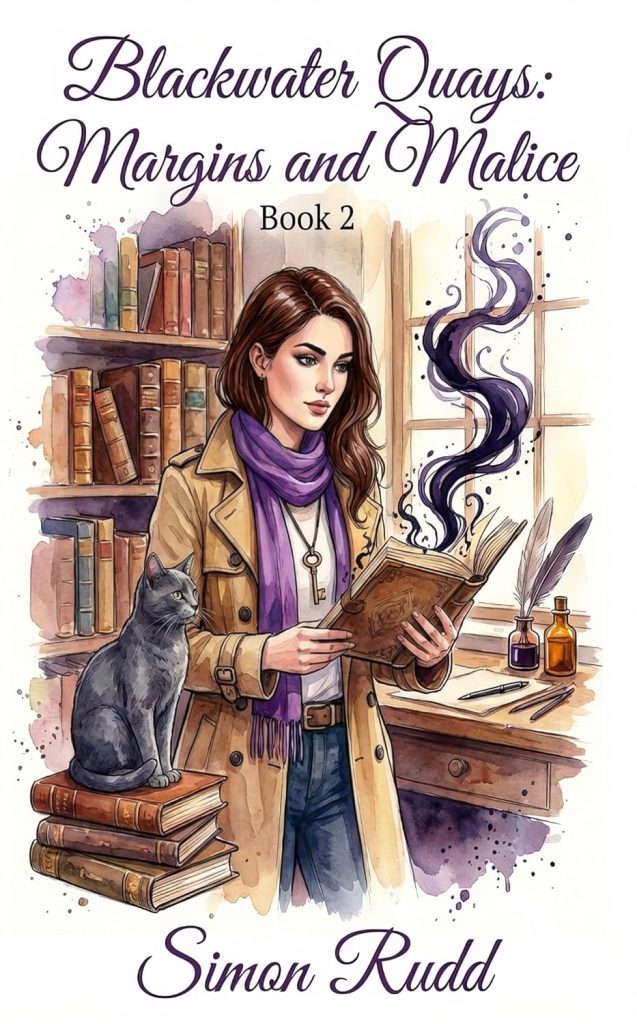
Someone is sending letters through Blackwater Quay. The words are factual. The damage is not.
Elowen Finch has spent three months settling into Finch & Fable — the shop, the cat, the gift she's still learning to trust. Then one of the letters reaches her — a routine harbour-fundraiser notice — and the shame flooding off the paper is ten times what it should be. Someone has taken a rare and careful technique — one her great-aunt Marigold spent decades perfecting — and turned it into a weapon. These letters don't just sting. They're engineered.
As the residents of Blackwater begin to crack under the weight of their manufactured guilt, the investigation points firmly to one person: Clara Whitcombe, whose mother was driven from the town by the same people now receiving letters. The evidence fits. The profile fits. Even Clara's behaviour, at a public meeting most of Blackwater witnesses, fits.
Elowen isn't convinced. Because the letters don't feel like grief. They feel like craft. And the emotional signature of the person who wrote them — cold, precise, quietly pleased with the work — belongs to someone who has been sitting at the heart of the investigation from the start.
With Atlas keeping a professionally sceptical eye on everyone who enters the shop, Detective Inspector Rowan Hale navigating the uncomfortable territory between what the evidence shows and what Elowen knows, and Benji arriving at intervals with baked goods and strong opinions, Elowen must prove not just who is guilty — but what kind of guilt this actually is.
Margins & Malice is the second book in The Blackwater Quay Mysteries, a cozy mystery series that's darker and more interior than the first — but with the same dry humour, the same Cornish harbour atmosphere, and the same conviction that the most important evidence is always the kind that can't be submitted to court. Perfect for fans of Janice Hallett, T. Kingfisher, and Jacqueline Winspear.
Read the first chapter
Chapter 1: The Wrong Weight of Ink
The brass key had grown warm against Elowen’s collarbone during the walk to the shop. Three months she’d been wearing it, since finding it in the cigar box in Marigold’s restoration room — one more question her great-aunt had left without an answer. Some mornings it felt heavier than others.
This was one of those mornings.
Tuesday had come in clear and bright over Blackwater Quay, the harbour sparkling, gulls already at it. The town had spent three months recovering from the property fraud revelations and the return to ordinary life had felt hard-won, worth being careful with. Elowen had grown grateful for unremarkable mornings.
She should have known better.
The back door to the restoration room stood ajar.
She stopped on the narrow path between Finch & Fable and the tea shop next door, hand halfway to the doorknob. The brass handle caught the sun. The door itself hung open perhaps three inches.
She’d locked it. She knew she’d locked it. Checking the locks had become habit after the spring — front door, restoration room, rare books cabinet, in that order, every night. She’d done it so many times the sequence had stopped requiring thought.
And yet.
She pushed the door open slowly. The hinges were silent.
“Atlas?”
A yowl from behind Marigold’s desk, and then Atlas himself — fur bristled to twice its normal volume, amber eyes wide, pacing tight circles with his tail lashing. She’d seen him sit perfectly still through things that would have sent any sensible animal under the furniture. She’d never seen him like this.
The restoration room had been gone through. Books from the bottom shelf lay face-down on the floor. The desk drawers stood open, their contents — receipts, order forms, catalogues — scattered across the surface. The ink cabinet stood with its doors ajar, bottles pushed aside and rearranged.
She made herself take stock. The restoration inks were all there. The gold leaf sat untouched in its wooden box. Marigold’s antique binding tools still hung in their proper order on the wall.
Nothing appeared to be missing.
And then she saw the cigar box.
It lay on the floor beneath the desk, lid open, brass hinges catching the light from the window. The box she’d put back behind the loose baseboard after finding the key. The hiding place she’d thought safe.
They’d found it. They’d looked.
Her hand went to her throat. The key was still there.
Atlas wound between her ankles and she bent to pick him up. His heart was going very fast against her chest. She stood holding him while he communicated his feelings in low sustained growls.
“They’re gone,” she said.
He didn’t seem convinced.
She went through the rest of the shop. The front was undisturbed — shelves in order, the local history display still in the window, the rare books cabinet locked and untouched. The floorboard by the biography section hit its note as she stepped on it, the same F-sharp it had always been. Everything as it should be. She went back and counted Marigold’s working journals: nineteen leather-spined volumes, all present. She checked two of them, flicking through pages of her great-aunt’s precise handwriting. Ink recipes. Notes on paper acidity. Nothing torn, nothing removed.
The journals would tell a different story later. Pages had been cut from two of the volumes with a blade so fine the remaining pages lay flush against each other. Specific formulas. Specific techniques. Already gone.
Elowen got her phone out and rang Rowan.
He arrived in under ten minutes, still in civilian clothes, which meant he’d been off-duty. The moment he stepped through the back door his attention changed — less Rowan, more DI Hale.
“Don’t touch anything else. Tell me what you did when you arrived.”
She walked him through it. He moved through the room methodically, photographing things with his phone, crouching to examine the door lock with the same focused attention he’d brought to the forged harbour documents in the spring.
“No forced entry,” he said, straightening. “Lock was picked — cleanly, no scratches, no damage to the mechanism. Gloves throughout, so no prints.” He looked at the room. “They went straight here. Bypassed the main shop, didn’t touch the rare books cabinet.”
“So they knew what they wanted.”
“Looks that way.” He met her eyes. “What’s kept in here, El? What would someone want?”
“Restoration supplies,” she said. “Marigold’s working journals. Conservation materials, tools for book repair. Nothing valuable outside the trade.”
“Family documents? Financial records?”
“Business paperwork. Invoices, tax records. Fairly mundane.”
Rowan nodded, but not entirely. She watched him file the evasion away without comment, the way he did.
“They were after information, not valuables,” he said. “The search is too targeted — drawers, the cabinet, even that box under the desk. They wanted something specific.” He turned the brass doorknob, testing it with his thumb. “They might come back, if they didn’t find it.”
“Will you file a report?”
“Already am. Get better locks today if you can — I’ll sort increased patrols on this street. And call me if anything seems off. Small things.”
“Be careful?”
“I was going to say that next, yes.”
After he’d gone Elowen stood in the restoration room. The new deadbolts were solid. The brass key pressed against her collarbone. She should tell him. About the key, about what it might open, about why someone would know to look for it.
But she’d have to explain everything behind it, and what she’d be left with was a shop owner insisting her great-aunt’s trade secrets were worth breaking in for, which was true but not in any way she could demonstrate.
She put the cigar box back behind the baseboard, straightened the books from the floor, and got the shop open three hours late.
Atlas didn’t settle all afternoon. He kept going back to the restoration room, checking the corners, registering his dissatisfaction in low periodic mutters. Elowen watched him between customers and thought he was managing this better than she was.
The mail arrived at half two. Malcolm delivered it with his usual commentary about the weather and a question about some mystery novels he’d ordered. Elowen sorted through the stack while he talked — bills, a distributor catalogue, community announcements.
And an envelope from the harbour preservation fundraiser.
She opened it without thinking. A form letter: donation tiers, event details, the standard language of community organisation.
The moment her fingers touched the paper something went wrong.
She dropped it and stepped back. Atlas was on his feet before she’d registered moving, fur up, a sound building in his chest that had no good name.
Stillness first. Then she picked up the letter, carried it to the restoration room, and laid it flat on Marigold’s desk.
She placed her fingertips at the edge. Barely touching. Just enough.
It should have been faint — a form letter, impersonal, handled by dozens of people through production and post. What it was instead hit her like a shove: anger, shame, fear, all of it far beyond anything that should have been there. Concentrated. Someone had taken the subtle thing ink did naturally and forced it through a lens until it burned.
Someone had used the technique the wrong way around.
She reached for her phone. Rowan needed to know about this — or as much of it as she could put into words he could use. She was still working out what that was when Atlas hissed, sharp and sudden, facing the window.
The path between the shops was empty. Just afternoon light and the distant sound of the harbour.
She called Rowan anyway.