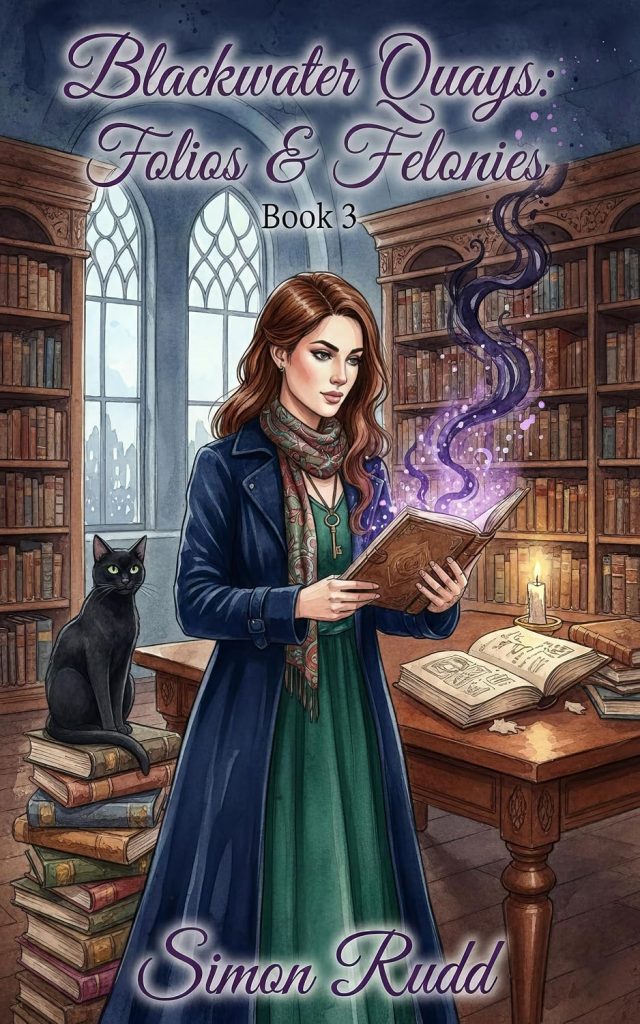
A dead woman's research. A trust buried for over a century. And a bookshop cat who knows more than he's letting on.
When retired schoolteacher Nora Castwell is found dead at the foot of her stairs, the coroner calls it an accident. Elowen Finch isn't so sure.
Nora's books have been donated to Finch & Fable, the antiquarian bookshop Elowen inherited two years ago on the Cornish coast — along with the gift that runs in the Finch line, the one that lets her feel what the past has pressed into paper and stone. Among Nora's boxes is something that won't stay quiet: a cloth-bound folio holding thirty years of painstaking research into a Victorian charitable trust, one meant to provide for the widows and children of fishermen lost at sea. A trust that was quietly stolen by the executor and never spoken of again.
The executor's family is still in Blackwater. Still prominent. Still on the harbour committee.
As Elowen digs deeper, she finds her own family name in a witness column dated 1851 — and a document sealed with something far older and stranger than ink. The deeper she reads, the louder the dead become, until the only way to prove what was done is to let the past speak through her. With her sharp-eyed shop cat Atlas, her café-owner best friend Benji, and DI Rowan Hale beside her, she begins to unravel a fraud that has shaped her town for generations.
But someone knew what Nora had found. And they've already killed to keep it buried.
Folios & Felonies is the third book in the Blackwater Quays series — a cosy mystery with a thread of the uncanny, set in a Cornish harbour town, featuring an antiquarian bookshop, a cat with opinions, and a slow-burn romance that finally catches fire.
Perfect for fans of: Victoria Laurie's Psychic Eye Mysteries, the Cat in the Stacks series, and anyone who believes some crimes are solved between the shelves — and others only by listening to the dead.
Read the first chapter
Chapter One: Returning Season
Finch & Fable. A Tuesday morning in late September.
The tourists were gone.
Not all at once — they never went all at once, the way summer visitors tended to imagine they would, a great retreating tide. It was more gradual than that: the B&Bs began to clear, the ice cream queue at the harbour wall grew manageable and then disappeared, the gift shop on the corner reduced its hours. The car park by the seafront, which in August could bring Elowen to the brink of actual misanthropy, breathed itself back to ordinary proportions. By the third week of September, Blackwater Quay was Blackwater Quay again, and Elowen Finch found she had been holding her shoulders somewhere near her ears for three months and had only just noticed.
She was cataloguing a new delivery — three boxes from an estate sale in Dorset, mostly nineteenth-century travel writing and a scattering of agricultural pamphlets that were either useless or extraordinarily niche, she hadn’t yet determined which. Atlas had claimed his autumn spot in the left-hand window, the one that caught the low September light from ten until half past noon, and was arranged across a small display of coastal walking guides with the practised authority of a cat who believed all furniture existed in relationship to himself.
The delivery had come in slightly damp at the corners. She was working through each volume with a dry cloth before inspection — very careful, or slightly excessive, depending on who you asked. Marigold’s voice, wherever it lived now, would probably say careful. Her predecessor’s margins had been full of care.
Elowen set down a copy of Murray’s Handbook for Travellers in Southern Italy and rolled her neck until something cracked with unseemly satisfaction. Outside the window, the harbour glittered in the thin, clear light that only appeared after the summer crowds had gone — as if the town had exhaled and the light had sharpened in response. Two fishing boats sat at the lower quay. A woman she recognised vaguely from the Tuesday market was walking a dog the size of a small sofa. The church clock said twenty past ten.
She had lived in Blackwater for two years. She had inherited Finch & Fable two years ago and spent the first several months quietly terrified of nearly everything in it — the gift, the responsibility, the brass key on its chain that had turned out to open a bracket in the restoration room wall where her grandmother had hidden something that mattered very much. She touched the key now without thinking, a habit from sometime in the spring she’d decided not to examine. It rested warm against her collarbone. It didn’t open anything anymore. It was just a key, and she wore it anyway.
The bell above the door rang.
Rowan Hale ducked slightly as he came in — not because he needed to; the door was a perfectly adequate height — but he’d done it since approximately the third time he’d visited and she had decided it was a threshold habit, a physical reminder that he was entering a space with different rules. He was carrying a book.
“Back to its rightful home,” he said, and set it on the counter. Philip Howard’s The Long View. She’d lent it to him in July when he’d mentioned offhandedly that he was thinking about the difference between history and memory, and she’d said she had exactly the book for that.
“Did it help?”
“It raised about seven new questions for every one it answered.”
“That’s what it’s supposed to do.”
He smiled — that dry look of his — and glanced around the shop with the ease of a man who’d been here often enough to be comfortable. Three months ago that ease would have been more deliberate, more performed. Now it was real.
She made tea. His without sugar, noted somewhere in April alongside other things she knew about Rowan Hale she hadn’t consciously set out to collect: that he kept a road atlas in his car that was twelve years out of date and used it anyway; that he was entirely unreadable when thinking hard and entirely legible when trying not to show he was worried; that he made very good decisions under pressure and somewhat worse ones about his own life.
They talked about nothing for a few minutes. The delivery from Dorset. A mildew problem she’d had to address in the restoration room that had turned out to be less serious than feared. He asked how Mrs. Tilling was getting on.
“Better,” Elowen said. “I’m going to see her Thursday. She’s been asking about the folio she lent me in the spring — she wants it back when I’m finished, which I think means she’s bored and needs something to annotate.”
“A good sign.”
“The best sign, for her.”
Agnes Tilling had spent a week in hospital following the events of the previous spring and a further six weeks being, in her own words, intolerably supervised by her daughter. She was recovering well. The fact that she had been caught up in something to do with Julian Harcourt had not, as far as Elowen could tell, shaken her in the least. She had the pragmatic serenity of a woman who had been watching Blackwater’s undercurrents for eighty years and found very little about human dishonesty surprising.
Julian Harcourt. The name still landed with weight.
She watched Rowan set down his cup and pick it back up and set it down again. He had something he was deciding how to say.
“Trial date’s been set,” he said. “January the nineteenth.”
Elowen absorbed this. January. Four months away, which felt both distant and terrifyingly close. The case against Harcourt was solid — Rowan’s team had been meticulous, and the documents she’d helped identify, her grandmother’s own authentication among them, had formed a chain of evidence that his legal team had been attempting to unpick since March and had not managed to unpick. She thought, briefly and without wanting to, about the pages torn from Marigold’s journal. About the letters Julian had sent to five people who had never harmed him, weaponising their private shames with the clinical precision of a man who considered human vulnerability a material to be worked with. About Clara’s art therapy sessions and Mrs. Tilling’s week in hospital and the things you could not take back once someone had been made to read them. He would be tried. The process of it would take some time, but the direction was not in doubt.
“Right,” she said.
“Just so you know. There may be requests for statements in the run-up. Paperwork.”
“I know.”
He nodded. Then he said, in a slightly different register, “I also have a decision to make at some point. Nothing to do with the trial. I’m still — thinking it through.”
She waited for more. He did not provide more. He drank his tea with the air of a man who had said exactly as much as he meant to.
She let it go. Pushing wouldn’t be useful, and she had learnt, against her instincts, to let Rowan Hale arrive at things in his own time.
He had been gone for forty minutes and she was back with the Dorset delivery when Benji appeared.
Benjamin Trevelyan owned the Lighthouse Café two streets from the harbour and had appointed himself something between her closest friend and unofficial intelligence service — positions she’d never formally assigned and he’d never waited to be given. He was carrying two cups of coffee from his own café. He only did that when what he had to say would require sitting down.
“For you,” he said, setting one on the counter. “Oat milk, no sugar. I remembered.”
“You always remember.”
“I do. One of my best qualities.” He dropped himself onto the stool she kept behind the counter for customers who weren’t sure they were allowed to sit, which Benji had long since claimed as his own. Atlas regarded him from the window with an expression that was, from Atlas, something close to warmth. “Have you heard about Nora Castwell?”
Elowen looked up. “No. What’s happened?”
Benji wrapped his hands around his cup. “She died. Last Friday, they think, though the neighbour didn’t find her until Saturday morning. A fall on the stairs at home.”
The shop held the news for a moment. Outside, a gull made a long, trailing sound over the harbour.
“I didn’t know her well,” Elowen said slowly. “She used to come in. Local history, mostly. Occasionally something on archival research methods.” She searched her memory: a small woman, seventies, precise in the way that some people became more precise as they aged, as if the years had concentrated rather than depleted them. Silver hair, always neatly pinned. She had read the condition of the books she’d purchased with a careful eye — a reader’s, not just a buyer’s. “She was kind. Quiet.”
“Lived alone up on Pencarrow Lane. No family close by, from what I hear. Her nephew’s been contacted, apparently, but he’s not local.” Benji turned his cup between his palms. “It’s sad. She’d been a schoolteacher for thirty years. She seemed like someone who knew things, if you know what I mean. The proper kind of local knowledge. Not gossip. Just — continuity.”
Elowen knew what he meant. Blackwater had several such people, holders of long memory — Mrs. Tilling was another — and they were irreplaceable in the way of things no one thinks to name until they’re not there anymore.
“Apparently peaceful,” she said, more to herself than to Benji.
“Yes.” He paused. “Although.”
She raised an eyebrow.
“Nothing official. Just that my cousin’s friend works in the same office as the woman who found her, and she mentioned it seemed a strange place to fall. Nora Castwell had lived in that cottage for over thirty years, is the thing. Apparently knew it like the back of her hand. Anyway.” He lifted one shoulder. “Accidents don’t know how well you know your own house, do they.”
Apparently.
Elowen filed the word. Set it aside.
Before Benji left, he mentioned, almost as an afterthought — Benji’s almost-afterthoughts were usually the actual point — that Nora Castwell’s estate was being cleared.
“There’s quite a collection of books, apparently. The estate agent coordinating the clearance was asking around about the best place for them, and someone mentioned Finch & Fable. Would that be something you’d be interested in taking a look at?”
Elowen considered. Donations were part of the shop’s life — private collections cleared after deaths, libraries reduced by circumstance, the natural redistribution of books through the hands of the living. She had taken in three estate collections this year alone, and most of what arrived was quietly absorbed into stock, finding its way to the right shelves with the unhurried reliability of things that belonged somewhere and were in transit.
“Yes,” she said. “Tell them to get in touch.”
Atlas, in the window, shifted slightly. His tail moved once, deliberately. He was paying attention to something she hadn’t noticed yet.
She glanced at him. He looked back at her with amber eyes that gave nothing away — which was, with Atlas, its own kind of information.
She turned back to the Dorset delivery and a copy of T. B. Johnston’s The Gazetteer of the British Isles, 1863, which had been misfiled somewhere in the nineteen-nineties under Modern Reference and needed to go home.
The rest of the Tuesday was quiet in the good way: two customers in the morning, a father and daughter who spent an hour in the children’s section and left with four books and an expression of mild guilt at not buying more, and a retired man she knew vaguely who came in every few weeks to browse the military history shelves and always, always, rearranged them slightly more to his liking before he left. She had stopped minding. She had started leaving a small gap in the arrangement where he would inevitably put something — a private hospitality he would never know about.
In the late afternoon, she did what she often did in the slower hours: went through to the restoration room and worked on a commission that had been sitting at the careful stage for two weeks, a Victorian commonplace book whose owner wanted a specialist assessment before considering conservation treatment. She turned the pages in gloves, reading the residue the way she would read a room — not searching for anything specific, just open to what was there.
Contentment, mostly. The satisfaction of a person who had spent years putting things into a book and felt the better for it. A few layers of something more complicated, further in — grief, she thought, or possibly the complex emotion that arrived on the other side of grief, which didn’t have quite the right name in English. The book had lived in different hands than its creator’s.
She was more confident now, reading. That was the Harcourt case’s gift to her, if you could call what Julian Harcourt had put her through a gift: she had been pushed past the boundaries of her training and had not broken. The Harcourt case had shown her the gift had edges she hadn’t known were there — and that she could reach them and come back.
The new deadbolts on the restoration room door were Rowan’s idea — practical and uncharacteristic of him. She had thanked him once and not made a thing of it, and he had accepted this without comment. The room felt right now. Her room, her work, the ink and the paper and the silence that had accumulated in it from years of careful attention.
She set the commonplace book down and stretched. The light through the small window was going golden — the late-September gold, lower and more horizontal than August, less interested in enthusiasm. The harbour would be catching it right now.
She thought, briefly, about Rowan’s decision.
Then she thought about Nora Castwell, who had known her own cottage for thirty years.
Apparently.
She went back into the shop. Atlas was watching the door with the steady, patient focus he brought to things he believed were about to arrive.
Nothing arrived that evening. She locked up at half past five, fed Atlas, and made supper in the flat upstairs with the windows open to the harbour air: salt and woodsmoke and the first true edge of autumn, the temperature having finally committed to a direction. She ate at the kitchen table and read four pages of a novel she’d been trying to finish since July, which was the state of a bookseller’s reading life.
The brass key caught the kitchen light when she moved. She tucked it back inside her collar.
January, she thought. The trial in January.
Then: Nora Castwell’s books. Coming here. Perhaps later this week, or next.
Then: whatever Rowan’s decision was, turning somewhere quietly in the dark, waiting for its moment.
She was, she thought, fairly good at waiting.
She closed her novel at a sensible point, which was not the same as a good stopping point but was what was available, and went to bed.
Outside, Blackwater Quay settled into its autumn self: the lights of the Lighthouse Café going off at nine, the harbour wall catching the last of the western sky, the town drawing inward as it did every year at this turning of the season, more itself with fewer people in it.
In the window of Finch & Fable, the display of coastal walking guides sat slightly rearranged from how Elowen had set them up that morning.
Atlas had had thoughts.
He always did, at this time of year.