The Oz Protocol
Book 1
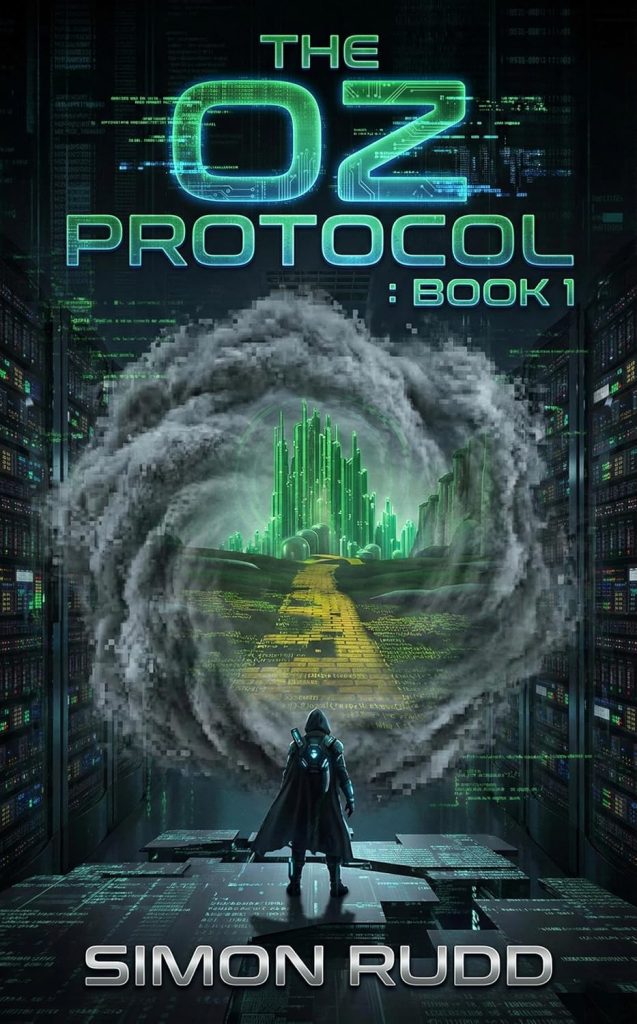
The silver shoes were never magic.
Oz was never a dream.
And Dorothy was never supposed to remember.
The door is open.
Light pours through it—green and impossible—and Dorothy knows, with a certainty that makes her stomach twist, that this time it isn’t a cyclone.
It’s an invitation.
Beyond the threshold waits Oz.
Not the story she was told as a child—but a place built on code, control, and carefully edited memories. A world designed to keep its inhabitants safe, compliant… and forever unaware.
Dorothy has lived her life believing Oz was nothing more than a hallucination, a childhood fantasy she survived and left behind. But when the system that hides Oz begins to fail, the truth comes clawing back through the cracks—and Dorothy is pulled into a version of the Emerald City that shouldn’t exist anymore.
Here, the Yellow Brick Road is a network.
The Scarecrow remembers things he was programmed to forget.
And the ruler of Oz is willing to sacrifice anyone to keep the illusion alive.
As Dorothy uncovers what Oz was built to be—and what it has become—she must decide whether the truth is worth destroying a world that still believes in its own safety.
Because once the lie is broken, there’s no going home.
And this time, Oz is watching her back.
Perfect for readers who love:
✔️ Dystopian novels for teens and young adults
✔️ Dark Wizard of Oz retellings and reimaginings
✔️ Science fiction with moral and philosophical depth
✔️ Stories about simulated worlds, hidden systems, and false utopias
✔️ Female-led speculative fiction
✔️ Books that blend classic stories with modern dystopian themes
Book One of The Oz Protocol
Read the first chapter
CHAPTER 1 — The Gray Mass
Dorothy Gale stood in the doorway of what used to be a farmhouse and looked at nothing.
She was forty-six years old. The prairie in front of her had been gray for as long as the gray had mattered — first the droughts that cracked the earth open, then the data-storms that fried every circuit and server and desperate thing people built to hold the world together. Then the silence, which was the worst of the three because it had nothing to push against. The silence just was. The gray just was. Dorothy, standing in the doorway each morning looking at neither, just was.
The sun had baked everything to the same colour. Ground, grass, sky — a palette so consistent it stopped registering as colour at all. The world looked like an old photograph left in the weather. Heat came off the dust in a flat shimmer that blurred the horizon, and a fine grit hung in the air that she could taste on her back teeth if she breathed through her mouth. She had stopped noticing any of it years ago. The numbness had become its own kind of weather.
Behind her, inside the bunker that passed for home, Uncle Henry was moving. She could hear him by the work he was doing, never by anything he said. The clank of a wrench against the filtration housing. His footsteps when he was checking the solar panel connections — heavier on the left, pausing at each junction box — different from the shuffle when he was checking seals, different again from the slow, weighted crossing when he was carrying water. Gray beard. Gray face. A man who had replaced conversation with maintenance and had not regretted the trade.
Aunt Em had been dead for three years. Lung infection, probably. Could have been a dozen things. They didn't have hospitals anymore. They didn't have enough of anything anymore, except time, which they had too much of, and silence, which they had in abundance.
Dorothy shifted her weight. The compass dug into her hip — it always sat wrong in the pocket of her tactical pants, the casing too wide for the seam. She pulled it out. The needle had been spinning uselessly since the data-storms took the magnetic infrastructure — spinning or frozen, she was never sure which, just that it didn't point to anything. The glass was cracked across one quadrant. She ran her thumb over the crack and put it back.
She let her gaze settle on the wasteland. Wake up. Check the perimeter. Ration the food. Repair whatever broke overnight. Do it again tomorrow. The routine had a weight to it that was different from purpose. She could feel it in her arms when she moved through the tasks — a heaviness that had nothing to do with the work.
She'd stopped having the dreams. That had been a relief, for a long time. The dreams were the last thing that connected her to before, and over the years the connection had turned cruel — less comfort than reminder, less reminder than measurement of everything that had closed behind her. She'd been glad when the dreams stopped.
They had started again last night.
Not the bright place she remembered from childhood. This Oz was wrong. The emerald city had flickered like a bad hologram, its green light stuttering in and out of existence. The Scarecrow's painted face had been cracked and peeling, and when he spoke, his voice sounded like grinding metal. She'd woken with her hand at her forehead, pressing the spot where the mark was, pressing hard enough to leave a dent in the skin.
She had been twelve when Oz happened. Before the data-storms, before the collapse, when the world still believed in things. She'd learned what she'd learned there and she'd come back and she'd spent thirty-four years not knowing what to do with it. The knowing sat in her like a stone she'd swallowed.
She was about to go back inside when she saw it.
A glint of silver, half-buried in the dust near the old cyclone cellar. The trap door hadn't been opened in years — rusted, half-collapsed, dangerous. But there, right next to it, catching the flat light in a way that nothing in Kansas caught light anymore: one of the silver shoes.
Dorothy looked at it for a long moment without moving.
She'd put those shoes in a box. Locked the box. Shoved it under her bunk. She hadn't touched them since the first time — since she'd come back, since she'd decided that whatever Oz was, it was behind her and would stay behind her. She could not remember opening the footlocker. She could not remember moving the box. And yet.
She walked over slowly. Crouched down. Her knees protested — forty-six years of protest accumulated in the joints — and she picked the shoe up.
Cold. Heavy. Heavier than any shoe had a right to be, as if the metal held something denser than silver.
The silver was humming.
A vibration she felt in her hands, then her arms, then her chest. The air around the shoe shimmered, and for a moment — less than a breath — she caught a smell that didn't belong in this world. Green and sweet and alive, like flowers and fresh grass and rain on warm earth. Things that hadn't existed in Kansas for years.
She stood. Her hand wouldn't let go. The humming was growing, and the mark on her forehead — the round, shining mark where a witch had kissed her goodbye thirty-four years ago — began to pulse with a faint green light.
Dorothy touched her forehead. Her fingers came away glowing.
She looked at the shoe. Looked at the prairie. The green on her fingers and the gray in front of her and no good reason to connect them except the humming in her chest that was making the connection for her.
The wind picked up. Dust swirled in patterns that looked almost deliberate — like code, if code could be written in air. In the distance, something she hadn't heard in decades: a low wail that used the wind the way a voice uses breath.
"Dorothy." Uncle Henry, from inside the bunker. "Get in here. Storm's coming."
She didn't move. The gray sky was beginning to flicker with streaks of green — the kind of green that came from somewhere else entirely.
Uncle Henry's footsteps behind her. He reached the doorway and stopped. She could feel him seeing the light.
"That ain't a normal storm," he said. Flat. Certain. He'd seen enough abnormal things to stop being surprised by them and had settled for being precise.
"No," Dorothy agreed. Her knuckles were white around the shoe. "It's not."
The green light spread across the prairie. Not like light — like cracks. As if the gray surface of the world was a shell and something underneath was pressing through. The shoe in her hand burned. The humming became a roar that she felt in her teeth and her spine and the mark on her forehead.
Uncle Henry said something else. She didn't hear it.
The data-storm hit.
And Dorothy was taken.