A Superhero Survival Horror Novel
The Standing Line Book 2
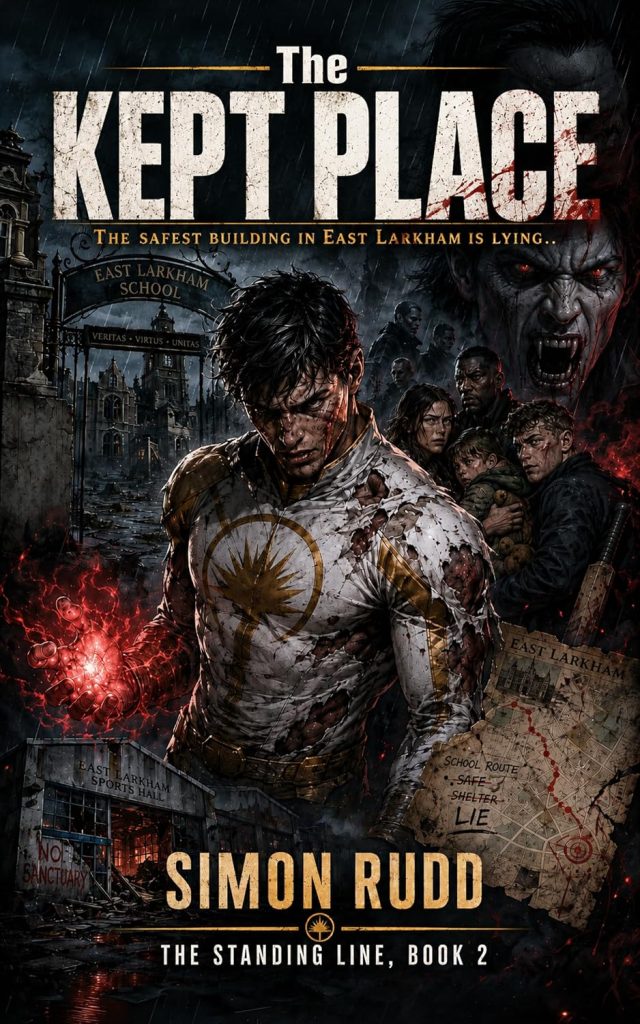
The shelter is gone. The city is awake. And the safest building in East Larkham is lying.
Ten years after vampires took Britain, Tobin Anstey — the burned-out hero the monsters call False Dawn — has one job left: keep fifty-three exhausted survivors alive until somewhere becomes safe.
Nowhere is safe.
With the stadium in ashes behind them and night coming on fast, the survivors find an old school and leisure centre that looks empty enough to save them. Walls. Water. Doors that close.
Then Dawn hears the heartbeats under the floor.
The school is a kept place — a larder defended by the Young, teenage vampires who don't need to break doors. They wear borrowed voices. They cry like lost children. They wait for kindness to do the work.
The old ones break doors. The young ones make you open them.
Now Dawn must pull thirteen strangers out of a trap built to catch rescuers — while the only thing keeping him on his feet is a line he swore he'd never go near: blood. Not human blood. Never that. But what he's drinking is changing him, the school is listening, and somewhere above the rain, something that once saved people is circling.
The Kept Place is the second novel in The False Dawn series — British survival horror about fallen heroes, monstrous children, and the terrible arithmetic of who gets carried. For readers of M. R. Carey and Justin Cronin, and anyone who ever wondered what happens to a superhero after the city stops believing in dawn.
They don't kneel. They don't answer the crying. And they never, ever look up.
Read the first chapter
Chapter 1 — Water Before Names
The stadium burned behind them without flame now.
That was worse.
Flame had a voice. It cracked, tore air apart, told the living where not to stand. Smoke told them less. Smoke wandered, followed, and made the ruined city look as if it had learned to breathe through a wound.
Dawn kept the survivors moving across the service road beyond the old west car park, where rainwater had gathered in long black strips between the broken white lines. Fifty-three people, close enough to count without turning his head.
He had the number before he had asked for it. He had been carrying it for ten years, the way a man carries the weight of his own coat and stops calling it weight.
He counted again, because the first count had come too easily.
Fifty-one.
He counted a third time. His hands were not steady and he had not eaten, and a body that could not be trusted with a pencil could not be trusted with a number.
Fifty-one. Fifty-one, counting the child Merrit carried on her hip because the child had stopped pretending her ankle did not hurt.
Fifty-one, and Ivo was not in it.
Kit had already counted Ivo once. Dawn had seen it.
They walked with the water records tucked under one arm, pencil tied to string around their wrist, Ivo’s grey jumper cuff knotted below it. The cuff was dark from smoke and finger grease. Twice, Kit had written a number, stopped, pressed the pencil so hard the point snapped, then scored a line through the second measure.
No one commented. They had learned, under the stadium, that grief made noise if people touched it too soon.
The trouble was that fifty-three had not been a mistake. It had been a habit with a body in it.
Rina Bell he could take out. Rina Bell was in the ladder cage on the tower four route, and a person who is somewhere can be subtracted from the people who are here.
Harlan was not anywhere. Dawn’s arithmetic had spent six days learning to include a man who was still standing on the sixth, and had never been given a place to set him down. So the count reached for him, and found the space where he went, and closed over it, and came up wrong.
Merrit had watched him count three times.
She said nothing, and went on walking, and her face gave away exactly as much as it always did.
In the middle of the shape, where the children were kept, Edden Bell walked.
He had walked out of the stadium and he had walked through the dark and he was walking now. He had not said anything since the ladder cage. In his coat pocket there was a twist of cloth with a small wooden weight inside it, and it knocked against his hip at every step, and he did not put his hand on it to stop it.
Talla Reeve walked at his left shoulder, half a step back. Close enough that their sleeves touched.
Dawn counted them both. He counted them the way he counted the wounded and the tall ones and the woman with the bad hip: as heat, as heart, as one, as one.
“Keep wide,” Dawn said.
His voice scraped more than it should have. The false dawn had burned through his throat as well as his hands, through the old light and the bad light and whatever remained between them. Every word felt as if it came up past ash.
Jory moved near the front with the old biscuit tin under his coat. It held names, torn map pieces, route marks copied from walls that no longer stood, and the folded list of those who had made it out from beneath the mural. He had a metal ruler in one hand and a strip of cloth in the other, using both to point without raising his voice.
“Not the loading bay,” Jory told the people behind him. “Too many doors. Around the coach park. Keep the little ones between adults.”
Clem Hordern gave a short, humourless sound. “Listen to him. He’s had all of six minutes of being in charge of not dying.”
Jory did not look back. “Seven.”
A few people laughed because they were too tired not to. The laugh came out thin and wrong, then died quickly in the open air.
Dawn let it pass.
Open ground was not safe. Nothing was safe. But open ground at least let a person see which direction death had chosen. Buildings hid too much: stairwells, lockers, under-crofts, staff entrances, storage rooms, toilet blocks, mouths pretending to be doors. After ten years, the city’s walls had learned to hold their breath.
The survivors crossed the coach park in a loose, ugly shape. Not a line, because lines were too easy to follow. Not a crowd, because crowds made panic travel fast. They moved as Merrit had told them to move: wounded in the middle, children passed hand to hand when they stumbled, strongest adults on the edges, no one more than three steps from someone who knew their name.
Names mattered. Names also slowed people down.
Dawn smelled blood before he saw the limp.
“Left edge,” he said.
Merrit heard him and was already turning. She was small under three coats, her grey hair pinned so tightly that the smoke had made a black rim around her face. One of her sleeves had burned away during the escape, and she had wrapped the bare forearm in a child’s scarf. The scarf had little yellow ducks on it. Most of the ducks were brown now.
“Who?” she asked.
“Bex’s boy.”
Something crossed Merrit’s face and did not stay long enough to be read.
“Which foot?” she said.
Dawn’s teeth hurt. “Right. He’s trying not to show it.”
Merrit swore under her breath and pushed through the moving group. “Tomas. Don’t make me chase you. I’m old and full of bad temper.”
Tomas Bex stopped pretending before she reached him. That saved time.
The daylight lay weak over East Larkham, thin as dirty water. Clouds pressed low over the city. The sun had risen somewhere behind them, but the smoke from the stadium and the weather between ruined tower blocks had turned it into a pale bruise. It was enough to keep the fresh dead under cover, not enough to make the day belong to the living.
The safest hours for humans were his weakest. That had always been the joke his body told him: a bright hero, ruined by daylight.
Bloodlight shifted under the skin of his palms, not flaring, only remembering. His fingers trembled. He curled them before anyone saw the worst of it. The cracks across his scars had sealed badly during the flight from the stadium. Now every step pulled them open again in tiny, wet lines. He could smell himself through the smoke: burned skin, old infection, rat blood gone sour in his gut, and something worse beneath it, patient and bright and hungry.
A woman called Ell Starling was watching him. She looked away when his head turned.
Dawn knew that look. He had worn it on other faces for ten years. Gratitude with a knife under it. Fear of the thing that had saved them. Fear that the cost had not finished being paid.
“Don’t stare at him,” someone whispered.
“I wasn’t.”
“You were.”
“I said I wasn’t.”
“Both of you,” Clem said from behind them. “Save your breath for running.”
That was useful. Harsh, but useful.
Across the road, the flats stood with broken balconies and curtains pressed flat against glass from the inside. A child’s plastic chair lay overturned on a sixth-floor walkway. Two pigeons perched on a satellite dish and did not fly when fifty-one humans crossed open ground below them.
Birds were not always warnings.
Still, Dawn watched the windows.
The old him would have gone up. The thought arrived as movement before memory: his body wanting height, speed, the clean snap of light under the ribs. He could almost feel the old route through air. Up the side of the leisure centre. One foot on concrete. One palm to a window frame. Light pushed hard through muscle. A clean leap, a flare, a cheer from below because people used to cheer when he made gravity look negotiable.
The present body gave him three steps of pain for the memory.
He stumbled.
Jory saw. Of course Jory saw.
“You need to stop,” he said quietly.
“No.”
“Not long. Forty seconds.”
“No.”
“Thirty.”
Dawn did not look at him. “Keep them moving.”
Jory matched his pace. “They move better if they think you can.”
“They don’t need to think. They need to walk.”
“That’s a nice thing to say if you’re trying to sound dead.”
Dawn’s mouth twitched. It was not a smile. His face had forgotten how to make those cleanly.
Ahead, the ring road opened into a wide retail park. It had once been bright with shopfronts, Sunday traffic, cheap furniture, pet supplies, fast food wrappers, people arguing over parking spaces as if space was something the world owed them. Now the signs hung loose over shuttered doors. Weeds grew through the painted arrows on the tarmac. Rain had gathered in the trolley bays. A red plastic basket sat in the road with a skull inside it.
No one went near the basket.
Dawn lifted one hand. The group slowed.
“Car park,” he said. “Across the middle. Not near the shops.”
Clem came up on his right, carrying a crowbar and a child’s backpack that was not his. Wendy walked in his shadow with her hand through his belt loop. Tess walked in Wendy’s. “Middle’s exposed.”
“Good.”
“Good, he says.”
“Buildings are worse.”
Clem looked at the shuttered fronts. The old names of shops had been peeled away or weathered until they looked like missing teeth. “Everything with a doorway is worse now.”
Dawn looked at him.
Clem shrugged. “What? I can be right and miserable at the same time.”
“Stay on the edge. Watch the service doors.”
“I was planning to watch the sky, but since you ask.”
The word sky made Rill glance up too fast. Rill belonged to nobody in particular and so belonged, in the way of such children, to whoever happened to be nearest.
Dawn noticed. He noticed everything he had no strength to fix.
“Eyes level,” he said.
Rill dropped her gaze.
The open park gave them room. That was something. People breathed more easily when no wall leaned over them. The wounded could spread out. Merrit could see who was fading. Jory could guide without whispering through a tunnel. Kit could count bottles as they were passed down the line.
“Water after the crossing,” Kit said. Their voice was hoarse but steady. “Mouthful only. Children first. Anyone bleeding gets checked before they drink too much.”
A man near the back said, “I’ve got my own bottle.”
Kit turned on him with a stillness that made Dawn look twice.
“No one has their own bottle now.”
The man opened his mouth, then saw the grey cuff on Kit’s wrist and closed it again.
Good, Dawn thought.
Then he hated that he had thought it as a calculation.
The stadium had taught them bad lessons. The city would teach worse ones if they let it. Survival liked to dress cruelty in practical clothes. One bottle. One injured person. One name dropped because a route mattered more. One stranger left because the group already had enough grief to carry.
He could feel how easy it would be. That was the infection no one could bandage.
They moved across the retail park under the pale morning and the slow fall of ash.
At first Dawn thought it was only the stadium behind them. Smoke could carry a long way. Burned plastic. Seat foam. Old banners. Human things reduced to powder. Ash had been in his hair since they escaped. It lay on shoulders, lashes, children’s coats, Merrit’s duck scarf, Jory’s tin, Kit’s knotted cuff.
Then a flake of it moved against the wind.
Dawn stopped.
The group did not. Jory had trained them better than that. One person stopping did not stop the body. The living stream bent around him, slow and tense, but it kept moving.
Another twist of ash crossed the tarmac from right to left.
The wind was going the other way.
Dawn listened.
Heartbeats. Too many, too close, all human. Fear made them loud. The city beyond them held its usual quiet: pigeons, distant water, a loose sign knocking somewhere, something small moving under a car. No vampire pulse. No dead stillness gathering behind glass.
A third line of ash dragged itself over a painted disabled bay. Not blown. Dragged.
Fen Alder saw it.
Fen was six, maybe seven. No one had agreed on her age because her father had died before anyone asked him properly, and her older brother kept changing his answer as if a number might protect her.
“That bit’s walking,” Fen said.
Every adult close enough to hear her went silent.
Dawn crossed the tarmac in three strides and put his boot down in front of the ash before anyone could follow it too far with their eyes.
It stopped.
So did he.
For one second, the retail park was the stadium again. Smoke. Heat. Floodlight. The mural behind him. Bodies moving through red-white glare. Something at the edge of the fire that had not screamed like vampires screamed. Something that had moved where only burned things should have fallen.
Jory was beside him.
Of course Jory was beside him.
“Don’t,” Dawn said.
“I haven’t said anything.”
“You were about to.”
Jory held the biscuit tin tight against his ribs. “Fen said it first.”
“Fen is six.”
“Maybe seven.”
“Jory.”
“I’m just saying we don’t know what came out with us.”
Dawn scraped the ash with the side of his boot. It smeared across the wet paint and became nothing but grey paste. Ordinary. Dead. Easy to dismiss, if a person needed the world to be smaller than it was.
“No names,” Dawn said. “Not for smoke.”
Jory’s jaw tightened. “Ash isn’t smoke.”
“No names until we know.”
Behind them, Fen whispered to her brother, “It was walking.”
Her brother whispered back, “Don’t tell it that.”
Dawn heard. He wished he had not.
They crossed the rest of the retail park faster.
By the old drive-through, Merrit called for a water stop. Dawn wanted to refuse. The sun was already thinning behind cloud and smoke. Every minute spent still became a minute the city could use to arrange itself around them. But two people were shaking. Tomas Bex’s foot had left dark marks on the tarmac. One of the older women had started blinking too slowly, her mouth white at the corners.
Merrit met Dawn’s eyes across the group.
He gave one short nod.
“Three minutes,” he said.
“Five,” Merrit said.
“Three.”
“Four, because I’m not negotiating with a martyr who smells like burned pennies.”
A few people looked down quickly. Not because Merrit had insulted him. Because she had done it like a person talking to another person.
That still unsettled them.
“Four,” Dawn said.
The survivors crouched or leaned against abandoned cars rather than sitting fully down. Sitting made people believe in staying. Kit moved through them with the water list and half a bottle in one hand. Jory marked the stop on a strip of old map. Clem checked under cars with the crowbar before allowing Wendy and Tess near any of them. He did it to every car. He did it to the ones he had already done.
Dawn stood between the group and the shuttered restaurants. He did not drink.
Merrit came to him anyway, because Merrit had built her life out of coming to people anyway.
“Hands,” she said.
“No.”
“I wasn’t asking if you liked the idea.”
“They need you.”
“You are included in that annoying little word.”
Dawn gave her his left hand.
Merrit unwrapped the cloth from his palm without softening her face. Softness wasted time and made people feel required to be grateful. The wound beneath was black at the edges and red in the cracks. Not infected in the human way. Not healing in the human way either.
“That,” she said quietly, “is not closing.”
“It will.”
“No. It will pretend.”
He flexed his fingers. Bloodlight prickled under the broken skin. Merrit’s pupils narrowed, but she did not pull back.
“Rat blood?” she asked.
“Gone.”
“All of it?”
“Enough of it.”
“That means all of it.”
“It means keep your voice down.”
“It means you’re walking fifty-one people across East Larkham on fumes and stubbornness.”
Dawn said nothing.
Merrit’s expression changed.
Dawn looked away.
He had been holding fifty-two behind his teeth. He had been holding it since the coach park, ready, the way you hold a correction for someone you are fond of. Merrit had reached the number first and reached it right, and the whole of the difference between them was one man with nowhere to be set down.
There was nothing to correct. He did not know whether the thing in his chest was relief that she had counted, or shame that she had counted better.
Both possibilities made him sick.
Merrit rewrapped his palm. Once, twice, tight enough to hurt. “Do not turn grief into arithmetic where Kit can hear you.”
“I know.”
“Do you?”
He let that sit between them. It deserved the space.
From the group, Kit’s pencil scratched over paper.
Merrit followed his gaze. “They heard?”
“I don’t know.”
“You usually do.”
That was true. He hated that too.
Jory came back with the map strip. “There’s a school north-east. Secondary, I think. Attached leisure centre. Playing fields. Big sports hall if it’s still standing.”
Clem was close enough to hear and gave the building line a suspicious glance, though the school itself was not yet visible. “No.”
Jory ignored him. “It’s on the old emergency route plans. It might have water tanks.”
“No,” Clem said again.
Merrit kept tying Dawn’s bandage. “How far?”
“Less than a mile if we cut through the service road behind the old cinema.”
Clem laughed once. “Behind the cinema. Lovely. Why not through the mouth of a wolf while we’re feeling nostalgic?”
“The cinema’s too enclosed,” Dawn said. “We go around.”
“The school’s enclosed too.”
“It has grounds.”
“It has doors.”
“Everything has doors.”
“Then we stay outside.”
Merrit finished the knot and stood. “Two of mine won’t make another mile after that. Tomas might, if he stops being brave and lets someone carry him. Edra won’t. Her pulse is skipping.”
“People can skip,” Clem said. “Dead people don’t.”
Merrit turned to him. “Say that again and I’ll give you the privilege of carrying her when she drops.”
Clem shut his mouth.
Jory looked at Dawn. “The school might be empty.”
The whole group listened without looking as if they were listening. Another stadium habit. People under threat became excellent at pretending choices were not being made above their heads.
“Empty things don’t stay empty,” Clem said.
“No,” Dawn said. “They don’t.”
Jory’s face fell a little.
Dawn looked past him to the line of low buildings beyond the retail park, to the road curving out between dead shrubs and a bus shelter cracked into glittering pieces. Beyond that, somewhere behind the weather and the smoke, was the school. Walls. Water, maybe. Space for Merrit to lay people down. Doors they could brace. Roof access if they needed sightlines. Grounds wide enough to leave at first light.
A useful place.
Too useful, maybe.
He listened again.
For a moment there was only the group. Fifty-one living heartbeats. He did not go looking for a fifty-second. One irregular. One too fast. Three children trying not to cry. Clem’s heart angry with fear. Merrit’s steady through exhaustion. Jory’s quick, always quick when there was a choice to make. Kit’s controlled so tightly it seemed quieter than grief should allow.
Beyond them, the city waited.
No command voice now. No Kneeler. No Our Lord pressing calm into bones. But East Larkham had not needed a lord to become hungry.
The smoke shifted. A weak opening in the clouds let a pale blade of light touch the road ahead. Dawn flinched before he could stop himself. His body hated the light it had once made.
Jory saw that too, and said nothing.
Good.
Some kindnesses were just silence with discipline.
Dawn stepped away from the abandoned cars.
“Water stop over,” he said.
A few people groaned. No one argued loudly.
Kit capped the bottle they were holding and marked the page. “Children had first mouthful. Wounded checked. Two bottles left from north store. One cracked. We need water before dark.”
“We need walls before dark,” Merrit said.
“We need walls that don’t already belong to something else,” Clem said.
Dawn looked towards the service road.
Ash crossed it in a thin, grey thread.
This time, no child spoke.
The thread moved against the wind, found a puddle, broke apart on the surface and vanished into rainwater.
Dawn waited until it was gone.
Then he said, “We go to the school.”
Clem closed his eyes. “Of course we do.”
“We stay in the open as long as we can. No one enters until I scout the outer edge. Jory, you take front-left. Clem, rear-right. Merrit, middle with the wounded. Kit, water and count. No one says a name louder than a whisper unless I ask. No one opens a door because something cries behind it.”
Jory looked up sharply at the last line. “Why that?”
Dawn did not know.
The answer had come before thought. A pressure behind the bite scar. A taste of static in the back of his throat. Perhaps only instinct. Perhaps the city. Perhaps the old warning systems in him misfiring after the false dawn. Perhaps smoke learning to spell.
Merrit noticed his pause.
Dawn gave them the only truth useful enough to move with.
“Because if something wants us to open a door, it can wait until morning.”
They began walking again.
Behind them, the stadium smoked. Ahead of them, East Larkham opened into roads, fields, fences and low grey roofs. The survivors crossed the service road under weak daylight, fifty-one people moving because stopping was worse, because walls were danger and also need, because grief could not be allowed to sit down yet.
Dawn walked at the front until Jory drew level with him.
For a while, neither spoke.
Then Jory said, “I wrote fifty-three.”
Dawn kept his eyes on the road. “I know.”
“I crossed two out.”
“I know.”
Jory walked a while with the tin under his coat. “Ivo isn’t in the fifty-three. He was never in the fifty-three. He’s in the tin.”
Dawn nodded once.
Jory swallowed. “That doesn’t mean he isn’t carried.”
“No.”
“Kit knows that, too.”
Dawn’s bandaged hand curled.
The light hurt. The smoke followed. The ash did what ash should not do. Somewhere ahead, a school waited behind fences and playing fields and old signs made for children who had once been told where to line up in case of fire.
Dawn listened for vampires.
He heard only the living.
For now, that was enough to frighten him.