A Superhero vs Vampires Survival Horror Novel
The Standing Line Book 5
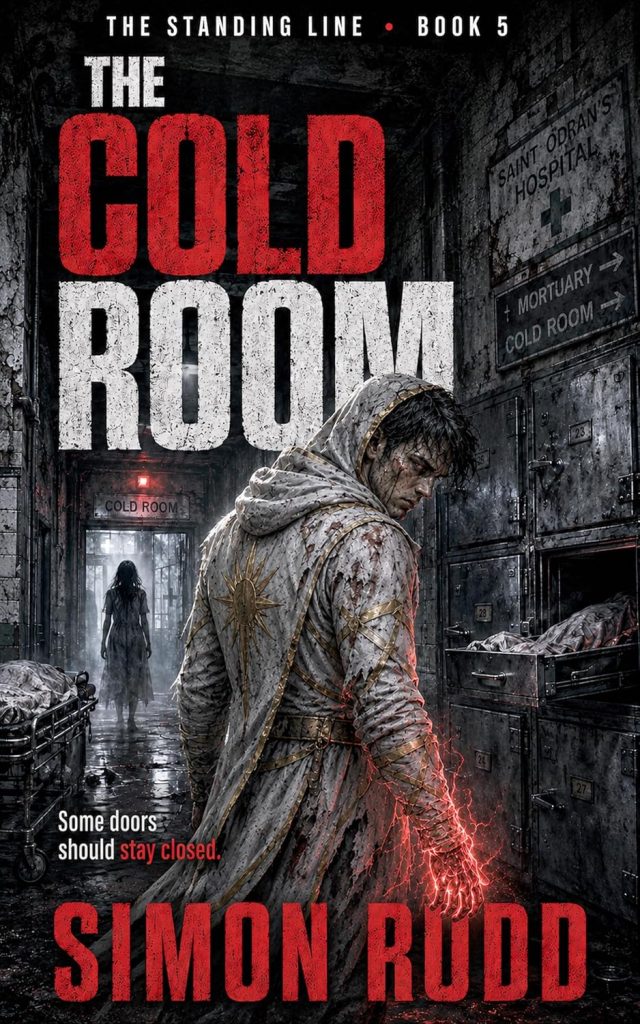
Ten years into the dark, the only cure left is locked inside a dead hospital.
Dawn is failing. The light that once made him East Larkham's hero now flickers and bleeds, and the half-turned body he's fought to control since the night he was bitten is finally losing. There is one chance left: an emergency stabiliser called HLS-3, somewhere inside Saint Odran's — a ruined district general hospital that kept following its own rules long after the rules stopped keeping anyone alive.
Merrit leads them in. Jory counts the living. Kit turns fear into routine, because in Saint Odran's the rules are short and the price of breaking one is your name scratched quietly off a list. No empty bed is empty until it's counted. No one goes anywhere alone. Trust the witness before the record.
But the hospital keeps its worst truth in the cold. Past the wards, the blood bank and the mortuary corridor lies the Cold Room — and the answer to where the whole nightmare began. Not with a monster. With a doctor. With a husband she couldn't let die. With blood.
Saint Odran's didn't turn evil. It turned procedural. And the thing it once filed away as a casualty is awake now, carrying a name nobody marked, walking back toward the man it loves.
Care became containment. Containment became hunger. Hunger learned to find its way home.
The Cold Room is Book 5 of The False Dawn / The Standing Line — bleak British vampire horror about what survives when heroes don't.
Read the first chapter
Chapter 1 — What Came Through
The route spat them out without giving them the dignity of arrival.
One moment there had been red glass, heat, screaming metal, the impossible angle of Noah Kest’s last corridor holding open by will or blood or whatever Redglass had become at the end. The next, there was rain, broken concrete, a loading yard that had forgotten its purpose, and survivors falling onto wet ground as if the city had dropped them there by mistake.
No one stood properly.
That was the first mercy.
Standing made people think they had finished something.
Jory Hale hit the ground on one knee with the biscuit tin clamped under his coat and his other hand already reaching for the pencil tied at his wrist. Kit came through beside him, half-falling, half-hauling a child by the back of a coat. Merrit landed hard against a cracked kerb, swore once, and used the swear to get upright. Morna rolled onto one shoulder with a length of pipe still trapped under her arm. Clem came through backwards, swinging a crowbar at a doorway that was no longer there.
Then Dawn came through.
Not walking. Not leaping. Not even falling in a way that suggested his body had agreed to gravity.
He staggered out of the red angle with both hands pressed against his own ribs, bloodlight leaking through the gaps between his fingers. For one breath, he looked almost bright enough to frighten hope into people.
Then his knees buckled.
Merrit saw him before anyone shouted.
“Dawn.”
He caught himself on one hand. The concrete steamed where his palm struck. Rain hissed around his fingers. Red light crawled under the skin of his wrist, not clean, not high, not heroic. Painful. Hungry. Working too hard.
“I’m up,” he said.
“You are demonstrably not.”
“I’m not down.”
“That’s not a medical category.”
Clem, still pointing the crowbar at air, looked over his shoulder. “It is now. We’re having a difficult morning.”
“Shut up and count,” Kit said.
Their voice cut through the yard.
Not loud. Loud was waste. Loud was a flare. But clear enough that the scattered bodies remembered the shape of themselves.
“Count,” Kit said again. “Low. Hands where I can see them. No one follows the red. No one looks for a door that isn’t there. Jory.”
Jory was already writing.
The loading yard sat between two long ruined buildings, one with its roof slumped in, the other with bricked windows and a faded sign for refrigerated storage. Rain had pooled in the tyre tracks. Broken pallets lay near a roller shutter. A delivery cage leaned on one wheel beside a wall dark with mould. The place had the dead usefulness of somewhere that had once expected lorries, clipboards, impatient men with cigarettes, and pallets moved before tea went cold.
Now it had them.
Too many of them.
Not enough of them.
Jory crouched by the wall because crouching made his hand steadier. The card in front of him had gone soft at the edges from rain and old sweat. He wrote names in columns, not because columns made anything safer, but because terror loved a list with no order.
“Kit,” he said.
“Here.”
“Merrit.”
“Here. Don’t put me in the dead column yet.”
“I haven’t got a dead column.”
“Good.”
“Dawn.”
Dawn drew breath. The sound caught.
“Here.”
Merrit was beside him before the word finished. She took his wrist without asking and turned his palm upward.
The bandage had fused to the wound in places. Blood, black at the edges and red where the light pushed through, soaked the cloth. The skin around it had closed badly in thin ridges, then split again from inside. His body kept trying to decide whether to heal, burn, feed or reject itself.
Merrit’s mouth tightened.
Dawn looked past her, not at her face.
“That bad?”
“No,” she said. “It’s worse than bad. Bad has manners.”
“Merrit.”
“Don’t Merrit me. Your hand is closing like a door with someone trapped in it.”
He tried to pull away.
She tightened her grip.
“Do that again,” she said, “and I start using the words I save for people with more courage than sense.”
Clem, from two yards away, said, “How many words is that?”
“All of them.”
“Comforting.”
“Clem,” Jory said.
“Here. Offended, damp, structurally intact.”
Jory wrote.
“Morna.”
“Here.”
“Rhea.”
No answer.
The yard became smaller.
Rain ticked on metal. Someone coughed and swallowed the second cough before it became panic. Kit lifted one hand and held the group down with a gesture.
“Rhea,” Jory said again, lower.
A patch of wet air beside the delivery cage hesitated.
Then Rhea Sallow appeared.
Not all at once. Shoulder first. Then hair dark with rain. Then one hand gripping the cage so hard her knuckles had gone white. The bruising at her throat had faded from purple into something uglier, a shadow that looked older than the injury. Her eyes were fixed on the puddle at her feet, where rain broke her reflection into pieces.
“Here,” she said.
Jory wrote, but he did not look away until she made herself stay visible.
Kit saw that too.
“Visible for count,” they said.
Rhea’s mouth moved once. Not quite agreement. Not quite refusal.
“I vanish,” she said.
“I know.”
“I am not removed.”
“I know,” Kit said. “That’s why you answer.”
Rhea nodded once.
Dawn heard the words go through the group like a rule finding somewhere to live.
I vanish. I am not removed.
Good.
Terrible that they needed it.
Good.
Jory continued.
“Trewin.”
A soaked shape shifted near the shutter. “Here.”
“Records?”
Trewin pressed one hand over the wrapped case under his coat. “Here.”
“Not the same question,” Clem said.
“In this instance, it is close.”
“No it isn’t.”
Jory wrote both.
Trewin — here. Records — here.
The pencil paused at the next name.
Cinder Saint lay on his side near the mouth of the broken route.
At first he had looked like one of the burned things the city sometimes left behind after a bad dawn. Ash-black coat. Grey skin. Hair clotted with soot and rain. One arm bent under him at an angle that made several people look away before they had permission. Red glass dust had settled over his shoulder and cheek like ground brick. A thin line of smoke rose from his ribs and vanished in the rain.
But his eyes were open.
Ash moved around him in tiny corrections, not blown by wind. It clung where the rain should have washed it away. It gathered along the edge of his mouth, retreated, gathered again.
Jory swallowed.
“Cinder.”
Cinder blinked.
For a moment, nothing else moved.
Then his mouth opened.
“Here,” he said.
The word came out ruined but present.
Half the yard breathed.
Merrit looked over sharply. Dawn did too, and the movement cost him. His shoulder dipped. Bloodlight flared under the bandage. He bit down on a sound before anyone could decide what it meant.
Cinder’s head turned towards him by fractions.
“Still leaking?” Cinder asked.
Dawn gave a breath that might have become a laugh in another world.
“Still smoking?”
“Professional disagreement.”
“Between you and fire?”
“Between me and finishing.”
Clem stared at him. “That is the most horrible way anyone has ever said they’re alive.”
Cinder tried to smile.
The ash at the corner of his mouth cracked.
“Good,” he said.
Merrit left Dawn with a look that promised punishment later and crossed to Cinder. She knelt beside him, assessed the bent arm, the smoking ribs, the patch of ash at his throat.
“Can you move?”
“Regrettably.”
“Can you stand?”
“Not usefully.”
“That’s honest enough to worry me.”
“Good.”
“There is nothing good about any of this.”
Cinder’s eyes flicked towards the empty red angle.
“Noah?” he asked.
The yard did not answer.
Rhea’s hand slipped on the delivery cage.
Dawn turned towards the place the route had been.
There was no door now. No red pane. No shining line cut through air. Only a damp brick wall with old white paint peeling from it and a drainpipe running down one side. Red glass dust glittered on the ground for a few feet, then thinned into ordinary grit. Four ash marks lay near the wall, each no larger than a fingernail.
Noah Kest had held open impossible things.
Now the wall held nothing.
Jory’s pencil stayed above the card.
“Noah Kest,” he said.
No one answered.
Rain filled the gap.
“Noah Kest,” Jory said again, because names deserved repetition before they were moved.
Rhea closed her eyes.
The delivery cage creaked under her hand.
Dawn took one step towards the wall.
Merrit saw and turned from Cinder. “No.”
He stopped.
Not because she had ordered him.
Because Kit had moved into his path.
“Don’t,” Kit said.
“It might still—”
“No.”
“We don’t know.”
“We know enough.”
Dawn looked down at them. In the old days, the height difference would have meant nothing. People had stood in front of him then too, but usually for photographs, questions, thanks, rescue. Kit stood there now with rain running down their face and Ivo’s old grey cuff tied beneath the pencil string on their board, and made themselves smaller than him without being less than him.
“No return alone,” Kit said.
The words were not yet a formal rule.
They were close.
Dawn’s jaw worked.
“I wasn’t returning.”
“You were beginning to think like it.”
Clem lowered the crowbar slightly. “That does count with him.”
Dawn did not answer.
Jory wrote Noah’s name carefully. Then he did not put a mark beside it.
That was worse than a cross.
A cross was a decision.
This was a held space.
Merrit touched Cinder’s shoulder. “Noah didn’t come through.”
Cinder’s gaze stayed on the wall.
“Redglass routes don’t always end where they’re supposed to,” Trewin said, then seemed to regret every part of the sentence.
Rhea looked at him.
The air around her thinned.
Trewin swallowed. “I mean—”
“I know what you mean,” she said.
Her voice did not rise. That made it worse.
Jory looked at the card. “Noah Kest. Not through.”
“Not recovered,” Kit said.
Jory changed it.
Noah Kest — not recovered.
That was kinder.
It still cut.
The counting continued because grief could not be allowed to stand in the road holding everyone by the throat.
“Mabli.”
“Here.”
“Jack.”
“Here.”
“Fen.”
A small hand lifted from behind Morna’s coat. “Here.”
“Rill.”
“Here.”
“Shaan.”
“Here.”
“Sophie.”
“Here.”
“Tomas.”
“Here,” came a voice tight with pain.
Tomas had come through with the rear of them, quiet as he had been since the school, one arm held wrong and no complaint in him louder than breath.
“Sandra?”
Silence.
Jory frowned, then remembered. “No. Not yet.”
He crossed nothing out. There was nothing to cross.
The count was short.
Not by the dead. The dead had cards. Short by the living who should have answered here and had not.
Redglass routes did not always end where they were supposed to. A corridor that scattered a group across a city was not a corridor that killed one. It was not kinder, either.
Jory wrote the two he could not close:
Saff — not through here.
Lysa Corren — not through here.
Both had crossed into the red beside the others and come out where no count could reach. He left room beneath each name. Room was the only honest thing a keeper could give a person who might still be walking somewhere with no one to answer to.
Then the two he had watched the red take.
Bram — gone in the crossing.
Richard — gone in the crossing.
Not scattered. Not elsewhere. He had seen the corridor close over both when Noah’s will thinned, and a keeper did not write not through here over a thing his own eyes had already named.
Dawn watched his hand.
That was how mistakes began. A name expected too early. A body assumed in the wrong group. A person counted by habit instead of sight. Paper could be clean while the living were already wrong.
His vision tilted.
Merrit noticed from across the yard. “Dawn, sit.”
“No.”
“Then lean.”
“No.”
“Collapse, then. Save us the debate.”
“I’m fine.”
Kit did not look at him. “Nobody believes that.”
The route behind them gave one final sound.
Not opening.
Not calling.
A small inward crack, like glass cooling after heat.
Rhea went fully visible.
Everyone saw her then: wet, shaking, furious at being seen and needing to be. She stepped past Kit and Dawn and went to the wall. Not close enough to touch. Close enough to stare at the place where red had been.
“Noah,” she said.
Nothing answered.
No face in the brick. No red line. No hand behind impossible glass. No ash rearranging itself into proof.
Only rain.
Cinder tried to push himself upright.
Merrit put a hand on his chest. “Don’t.”
“He held,” Cinder said.
“I know.”
“No. You don’t.”
Merrit’s face changed, briefly. Her anger did not leave. It made room.
“Then tell me later,” she said. “When your ribs are less decorative.”
Cinder shut his eyes.
“Later is arrogant.”
“Then be arrogant.”
The ash at his throat shifted as if he might laugh, but only a cough came. Black flecks stained his lips.
Merrit looked at them.
Dawn saw her see them.
Another thing wrong.
Too many wrong things for one yard.
Jory reached the end of the first count and stared at the card.
Kit came to him. “Number.”
Jory did not answer.
“Jory.”
He counted again with his lips moving. Then again, touching each name with the pencil tip.
“Number,” Kit repeated.
Jory looked up.
“Correct,” he said.
Clem’s face tightened. “That isn’t how people normally say good news.”
“It matches the expected survivor count from the route, minus Noah.”
“Expected by whom?”
“By us. By the crossing. By who I saw enter.”
“Then say that.”
Jory looked at the card again. “It matches who I saw.”
Kit took the card, not from mistrust, but because no count belonged to one pair of eyes.
Their finger moved down the list. Their lips shaped names. They looked up after every few, checking bodies.
“Again,” they said.
Jory nodded.
The second count began.
People shifted under it. Not restlessly. Carefully. A survivor who moved at the wrong time could become someone else’s error. Names passed down the crouched group in murmurs. Hands lifted. Faces turned low. Children were counted by sight and touch, not voice alone. The wounded were checked where they lay. Trewin answered twice, once for himself and once when Clem snapped that the records case did not get a pulse.
Dawn stayed standing because sitting might mean not rising.
The yard’s far gate hung half-open.
Beyond it, a service lane ran between dead brick and the back of some old commercial building. A row of bins lay on their sides, lids gone. Black weeds climbed through the chain-link fence. The sky above was low, grey, and streaked with smoke from somewhere too far to smell properly.
East Larkham had not waited while they crossed through red glass.
The city was still hunting.
Dawn listened past the rain.
Ordinary dead somewhere beyond the lane. Not close. Not moving fast. Human hearts in the yard. Ragged. Too many. Not enough. Cinder’s heart—
He stopped.
That was a strange sound.
Not absent. Not steady. Not like any living pulse he knew. Cinder had always been an argument with ending, but now the rhythm came late, then early, then not at all for three breaths before starting again with a soft internal flare that made Dawn’s hunger recoil.
Cinder opened one eye.
“Don’t listen to me like that,” he said.
Dawn looked away.
“Sorry.”
“You should be.”
Merrit looked between them. “What?”
“His face,” Cinder said. “He was doing the medical face.”
“I do not have a medical face.”
“You have several. None reassuring.”
Clem nodded. “He also has a martyr face, a door face, and a face that means we’re about to crawl through something wet.”
Jory, still counting, said, “We just did that recently.”
“Exactly. I recognise the warning signs.”
The small sound that moved through the yard was not laughter. It was the memory of laughter finding one unbroken rib.
Merrit allowed it for half a second.
Then Dawn coughed blood.
Not much.
Enough.
The red hit his palm, bright against rainwater, then darkened too quickly. Bloodlight moved inside it, a faint thread trying to crawl back towards him.
Merrit saw.
The yard did too.
Dawn closed his fist.
“Don’t,” Merrit said.
“I’m not.”
“You just hid evidence from a nurse.”
“Former nurse.”
“Current nightmare. Open your hand.”
He did.
The blood on his palm had already sunk into the split bandage. The wound beneath pulsed once, red and white and wrong.
Merrit’s anger thinned into something colder.
“How long?”
“It started during the crossing.”
“That is not an answer.”
“Since the route began breaking.”
“And you thought not mentioning it would help?”
“I thought getting through would help.”
“Different thing.”
“I know.”
“Do you?”
The same question again.
The whole series of their lives seemed to have narrowed to people asking him if he knew the cost of what he was doing.
He knew.
That was the worst of it.
He knew and still kept choosing the nearest door, the first strike, the last position, the place where his body could be spent before anyone else’s had to be.
Kit was right.
He did not own first.
He did not know what to do with the possibility that he did not own last either.
Merrit stripped the bandage from his palm.
This time the cloth came away wet.
The wound underneath had not closed. Not properly. It had sealed at the edges and opened in the centre, as if his body had built a red eye in his hand and then failed to shut it. Pale old light flickered under the skin, trapped beneath the bloodlight’s red pressure.
Jory stopped counting.
Merrit did not look at him. “Continue.”
He continued.
Dawn looked over Merrit’s shoulder at the wall where Noah had not returned.
Rhea had not moved away from it.
The rain ran down her face. Her outline flickered now and then, not vanishing, failing at the edges like a badly tuned signal. She kept one hand near the brick without touching it.
“No red?” Dawn asked.
She shook her head.
“No glass?”
“No.”
“Noah?”
Her mouth tightened.
“No.”
The word was small enough to survive.
Jory finished the second count.
Kit finished theirs three breaths later.
“Same number,” Kit said.
“Same bodies,” Jory said.
“Say it fully.”
Jory swallowed. “All survivors who entered the final Redglass route are accounted for here, except Noah Kest, not recovered.”
Clem looked at him. “I hate when the careful version is worse.”
Morna had been watching the gate. “We can’t stay in this yard.”
“No,” Kit said.
“Dead beyond the lane,” Dawn said. “Not close yet.”
“How many?” Clem asked.
“Enough.”
“Your estimates continue to be poetry written by someone I dislike.”
Merrit wrapped Dawn’s palm with fresh cloth. “He shouldn’t move.”
“He has to,” Kit said.
“I know.”
“I’m right here,” Dawn said.
“Yes,” Merrit replied. “That’s the problem. You keep being right here while bits of you are elsewhere.”
Cinder made a faint sound.
Dawn looked at him.
“What?”
Cinder’s eyes had shifted from the wall to the puddles beneath it. Rain broke the surface into quick silver scars. Red glass dust, almost gone now, clung to the edge of one tyre track.
“She didn’t come,” Cinder said.
The yard stilled again.
Merrit’s hands stopped on Dawn’s bandage.
Rhea turned fully.
“Who?” Jory asked, though his voice already knew.
Cinder tried to sit up. This time Merrit let him only because Morna moved behind him and braced his shoulder.
He looked at the wall, then at the yard, then at the count card in Jory’s hand.
“Null Patient,” Cinder said.
No one liked the name.
Names were meant to hold shape. That one marked a place where shape had failed.
“She wasn’t in the route,” Kit said.
“Not at the end,” Cinder said.
Dawn remembered: cold pressure in the red corridor, a blankness moving behind glass without needing to reflect, the feeling of someone finding absence not as a hiding place but as a road.
“She escaped before the break,” he said.
Rhea’s fingers curled.
“Where?” Jory asked.
Cinder looked at him.
Rainwater ran black from his hairline down his cheek. For a moment, under ash and blood and red dust, he looked older than his own deaths.
“Elsewhere,” he said.
Clem closed his eyes. “I preferred every previous answer we’ve had today.”
Jory looked down at the count.
His pencil hovered.
The number was correct.
The bodies were correct.
The people in the yard were who the paper said they were.
And still the count was wrong.
Not because someone had vanished.
Because something had not been contained by the place they were counting.
Kit saw it land in him. “Write it.”
Jory’s hand tightened. “What?”
“The count is correct here.”
He wrote.
Kit waited.
Jory looked at the words, then added beneath them:
THE COUNT DOES NOT INCLUDE WHERE SHE WENT.
Dawn read the line.
His hand throbbed. The hunger under his ribs turned towards the thought of Null Patient moving somewhere else through the ruined city, uncounted by bodies, unwitnessed by paper, no longer behind them in any useful direction.
Merrit tied the final knot.
“Move,” she said.
No one argued.
The survivors gathered themselves from the loading yard. The wounded were lifted. The children were placed between adults. Cinder was hauled upright between Morna and Clem, complaining once with enough dryness to prove he still had a voice. Rhea stepped away from the blank wall. Jory tucked the count card inside his coat, but not before touching the last line with one finger.
The route had ended.
The problem had not.
Dawn looked once at the brick where red glass had been.
No Noah. No door. No return.
Only the mark of a route that had saved them badly.
Then Kit raised the water board and pointed towards the service lane.
“Low,” they said.
The group moved.
Behind them, rain washed the red dust thinner and thinner until the loading yard looked almost ordinary.
That was how East Larkham hid the worst things.
Not by making them disappear.
By leaving just enough behind for the careful to know something had passed through, and not enough for anyone else to believe them.