A Weird Western of First Contact
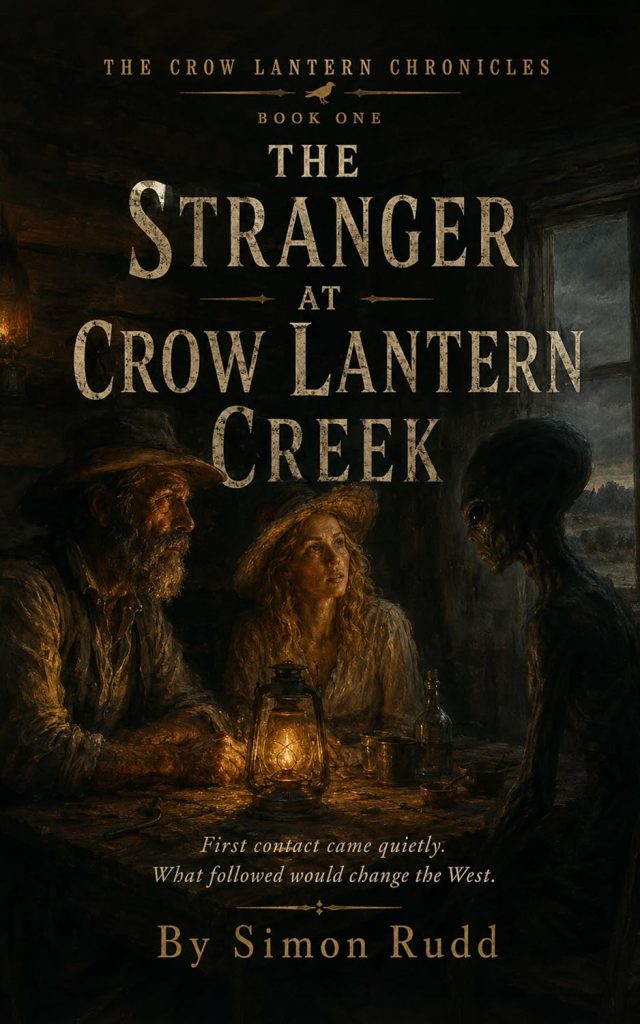
The light crossed the sky without a sound. That was the first wrong thing.
1878. Eight miles from the nearest town, on a stretch of Southwestern territory that keeps its own counsel, Jonah Latch has spent years making his world small enough to defend. Clara Sayers has spent those same years trying to make it larger — with a pencil, an account ledger, and a notebook she has been told not to keep.
Then something falls beyond the ridge.
No thunder. No fire. Only birds lifting in silence, horses that will not look away, and a light that turned before it came down.
What they find in the dry wash is broken, terrified, and not human. It has a handful of words and no way to explain them. It flinches from iron. It says one word over and over — Ravun — and Clara writes it down, because writing things down is the only power she has ever had.
She should not have written it down.
In Kettle Cross, a land agent named Elias Kedge has already sent a wire. A preacher has already named the sign. And beneath the old Glassfall workings, something buried has begun to answer — a beacon that has waited a long time to be woken, calling across a distance no one in 1878 has words for.
Clara's notebook is the only true record of what is happening.
It is also the trail.
And somewhere above the ridge, something is following the record home.
The Stranger at Crow Lantern Creek is the first book of The Crow Lantern Chronicles — a slow-burn weird western in which the frontier is taken not by gunfighters but by survey stakes, telegrams, and paper with a seal on it, and where the most dangerous thing anyone owns is an accurate account.
For readers who like their first contact quiet, their history dusty, and their aliens genuinely alien.
Read the first chapter
Chapter 1 - The Light Beyond the Ridge
By late afternoon, the cabin had gone quiet in the way Clara hated most.
Not peaceful. Not restful. Just small.
The stove ticked as the fire settled low. A fly worried itself against the windowpane above the table, knocking again and again at glass that would not become sky no matter how fiercely it believed in the attempt. Outside, the dry wash lay pale and empty under the westering sun. Beyond it, the ridges lifted in rust-coloured folds towards the old Glassfall road, where scrub and stone and bad memories kept most sensible people away.
Clara Sayers stood at the table with her sleeves pushed above her wrists and Jonah’s old accounts spread before her. Flour. Coffee. Salt. Lamp oil. Shot. Wire. Nails. One length of good rope, bought three months ago and still written down as if the paper itself might keep it from fraying.
She dipped the pen and wrote lamp oil again, darker this time, though she had already written it once.
The fly struck the window.
“You’ll knock your head hollow before you find sense that way,” Clara told it.
The fly did not improve.
She turned the page over and began sketching the ridge from memory in the corner where Jonah would claim she had wasted paper. She knew the line of it better than she knew most faces in Kettle Cross. Low tooth of rock at the east shoulder. A split notch like a broken thumb. The darker run of mesquite where the ground dropped towards the creek. She shaded that part too heavily, then rubbed at it with the side of her finger until the graphite smeared.
Eight miles to town. Eight miles back. One road out, if a person called it a road. One creek that ran when it felt charitable. One cabin with two rooms, one loft, one tired stove, and one man who could make the whole wide territory feel as if it ended at the door latch.
The horse in the lean-to gave a sudden hard stamp.
Clara stopped rubbing at the drawing.
Another stamp came, sharper. Then the lower, restless sound of an animal pulling at its tie.
She went to the door and opened it a hand’s width.
The evening air slipped in cold under the day’s heat, carrying dust, horse sweat, and the faint mineral smell that sometimes drifted down from the Glassfall hills. The yard lay empty. The water barrel sat in its usual place by the wall. Jonah’s chopping block threw a long black shadow towards the wash. Above the creek, a scatter of small birds lifted from the scrub all at once and moved east, silent as thrown ash.
Clara frowned.
Birds usually made some complaint when disturbed. These did not.
The horse stamped again.
“All right,” Clara said, though to whom she could not have said.
She stepped outside, wiping ink from her fingers on her apron. The sun hung low and red, setting the cabin wall afire. The ridge beyond the creek looked close enough to touch and far enough to keep every promise ever made on the other side of it.
The horse, Mercy, stood with her ears pinned forward, not back. Not fear of snake or coyote, then. She was looking uphill, past the dry wash, past the thorn scrub, towards the old claim track Jonah had taken that morning.
Clara laid a hand on the mare’s neck. The flesh jumped under her palm.
“What is it?”
Mercy blew hard through her nose.
Clara followed the mare’s stare.
Nothing moved.
The hills held themselves still. Too still, perhaps, but Clara had lived most of her life around people who made too much of signs and too little of what stood plain in front of them. Reverend Brome in Kettle Cross could turn a cracked egg into a sermon if the shell broke in a shape he fancied. Jonah said a man who saw God in every dust devil had likely never had to mend a roof in a windstorm.
Still, the birds had flown without sound.
She looked towards the Glassfall road.
Jonah should have been back an hour ago.
He had gone to check an old fence line, or so he said. Jonah’s reasons were often shaped like tools: plain, hard, and fit for one purpose only. But Clara had seen him put the rifle across his saddle before he left. A fence line did not usually require a rifle unless the fence had learned to shoot back.
She shaded her eyes.
At first, the trail showed only dust and heat-waver. Then the dun shape of Jonah’s horse came out from between two shelves of stone, moving slow.
Clara’s shoulders loosened before she could stop them.
Jonah Latch rode like a man who considered showmanship a disease. He sat deep and plain in the saddle, hat low, shoulders loose, one hand on the reins. From a distance he looked cut from the same weathered stuff as the hills: brown coat, grey beard, sun-dark face, and the kind of stillness that made other men talk too much.
Mercy whickered.
Jonah’s horse did not answer.
Clara felt that, too.
She walked out past the chopping block. “You’re late.”
Jonah did not reply until he had brought the horse into the yard and swung down. “Sun’s still up.”
“That is not the same as not being late.”
“It is near enough for government work.”
“We are not the government.”
“Then we’re ahead of schedule.”
He loosened the cinch, and only then did Clara see the blood on the back of his left hand. Not much, but enough to have dried dark between the knuckles.
She crossed the yard. “What happened?”
“Rock happened.”
“Rocks are known for throwing themselves at men’s hands.”
“This one was provoked.”
“By your face?”
Jonah glanced at her, and one corner of his mouth shifted almost far enough to be called amusement. “By the pick.”
Clara took his wrist before he could turn away.
He let her, which told her more than the blood did.
The skin across his knuckles had been scraped raw. There was a shallow cut near the thumb, and grit clung in it. Not a serious wound. An ordinary one. But Jonah had wrapped it badly with a strip torn from flour sacking, and Jonah did not do anything badly unless he had done it quickly.
“You went up to Glassfall,” she said.
“I went near.”
“That is how people say yes when they are trying not to.”
He drew his hand back. “Put water on to heat.”
“I asked what happened.”
“And I heard you.”
“That is another way of not answering.”
Jonah pulled the saddle free and set it over the rail. The horse’s flanks were dark with sweat, though the day had cooled. “Old ground shifted after the last wind. I wanted to see if the north cut had opened.”
Clara looked past him to the hills. “And had it?”
“No.”
“Then why is your horse half-lathered?”
“Because he’s a fool.”
“He belongs to you.”
“That was my first clue.”
Clara folded her arms. “Jonah.”
He paused with one hand on the saddle blanket.
The light had thinned around him. The lines beside his mouth looked deeper than they had that morning, and the dust on his coat had a pale glitter to it, as though he had brushed against powdered glass.
“Nothing worth putting fear into,” he said.
“I did not say I was afraid.”
“No,” Jonah said. “You generally wait till there’s cause, then skip straight past sense.”
The words should have stung. Usually they would have. But the horse shifted again behind him, uneasy, and Jonah’s eyes went to the ridge before he stopped them.
Clara saw it.
“There is cause,” she said.
He turned towards the water barrel. “There’s always cause. Most of it doesn’t improve with talk.”
She wanted to ask again. She wanted, with a force that embarrassed her, to seize the truth out of him and lay it flat between them like one of his old maps. Instead she went inside and put water on the stove, because Jonah would sit bleeding in the yard all night before he admitted that someone else had won an argument.
When he came in, he ducked slightly under the lintel, though he had not needed to for years. Habit from other doors, other rooms, other times. He hung his hat on the peg and set the rifle beside the jamb, not above the door where it belonged.
Clara noticed that too.
“Expecting trouble to knock politely?” she asked.
Jonah looked at the rifle, then at her. “Trouble hardly ever does. That’s why it’s trouble.”
He sat at the table. The fly, finally exhausted by its war with the window, crawled along the sill.
Clara brought the basin, clean rag, and a little of the precious soap shaving she had been saving for laundry. Jonah saw it and gave her the look he used when he meant to object on grounds of economy.
“Bleed into your own supper, then,” she said.
He closed his mouth.
She cleaned the cuts. He did not flinch, though grit came free and turned the water rust-grey. His hands were broad, scarred, and square-fingered, made older than the rest of him by rope, reins, weather, and work. Clara had known those hands all her remembered life: lifting her down from a wagon when she was small, showing her how to hold a knife safely, taking matches away when she had been too young and then giving them back when she was old enough to be trusted with fire but not with leaving.
She wrapped the hand more neatly than he had.
“There,” she said. “Now if a rock challenges you again, you can conduct yourself with dignity.”
“Never cared for dignity. Too much upkeep.”
“You would know, having neglected it all these years.”
This time the amusement reached his eyes, but only for a breath.
Clara sat opposite him. Between them lay her account sheet and the small sketch of the ridge half-hidden beneath the flour list. Jonah glanced down and touched the corner of the paper with one finger.
“Need lamp oil,” he said.
“I wrote it twice. That means we need it twice as badly.”
“Means you’re wasting lead.”
“It is my pencil.”
“It was my pencil before you claimed it.”
“It was abandoned property.”
“It was on my shelf.”
“Neglected property, then.”
Jonah leaned back, chair creaking under him. Outside, one of the horses gave another restless stamp. Jonah’s gaze moved to the door.
Clara lowered her voice. “What did you see up there?”
“Ground.”
“Jonah.”
“Rabbits. Old timber. One dead rattler.”
“What killed it?”
“That interested you more than the rabbits.”
“Rabbits don’t usually die mysteriously in stories.”
“We’re not in a story.”
Clara looked around at the cabin: the smoke-blackened stones behind the stove, the patched roof, the spare blanket folded by the trunk, the rifle by the door, the little shelf of books Jonah had bought for her over the years and pretended were useful manuals. “No. We are in a list of purchases that keeps getting shorter.”
That made him look at her properly.
She regretted it and did not regret it.
Jonah’s face settled into that careful plainness he used when feeling approached too close. “There are worse things than short lists.”
“There are better things too.”
“Mostly sold by men who want your money before you learn the difference.”
“Kettle Cross is not the whole world.”
“No,” he said. “And if you had seen more of the world, you might stop saying that like it recommends the rest.”
Clara pushed the account paper away. “You think wanting something beyond this cabin is the same as ignorance.”
“I think wanting beyond what you can carry gets people killed.”
“I can carry more than you think.”
“You can carry what you can carry. The world won’t ask your opinion first.”
That was Jonah’s way. A warning built as a wall and offered as kindness.
Clara rose too quickly. The chair scraped. “I am not asking the world. I am asking you.”
Jonah’s jaw shifted.
For one moment she thought he might answer plainly. Might say he feared losing her as he had lost others, though he rarely named the dead. Might say the cabin had become too quiet for him too, except when he was busy making it quieter. Might say he had gone to the Glassfall road because some old trouble was stirring.
Instead, he said, “Fetch the beans before they burn.”
Clara laughed once, sharp and without humour. “There speaks the grand philosopher of Crow Lantern Creek.”
“Beans burn in all known philosophies.”
She took the pot from the stove harder than she needed to.
They ate in a silence that had edges.
Outside, the sun dropped.
The cabin changed by degrees as daylight left it. Familiar things grew more certain and less friendly. The rifle by the door became a dark vertical line. The window turned black and gave back the room in dull reflection: Jonah at the table, Clara near the stove, the lamp between them not yet lit. Beyond the glass, the yard vanished first, then the wash, then the lower scrub. The ridge held longest, a black seam against a sky going from copper to violet.
Clara lit the lamp.
The flame rose, steadied, and threw a soft circle over the table.
Jonah had not eaten much. He was listening. Not obviously. Anyone else might have thought him tired. Clara knew the difference. His right hand rested near the table edge, loose enough to seem idle, close enough to reach the rifle if the chair went over.
She kept her voice low. “You hear it too.”
“Hear what?”
“Nothing.”
His eyes met hers.
The fly on the sill had stopped moving. No crickets sang in the scrub. No night birds called. Even the horses had gone quiet, though not calm. The silence outside was not empty. It had weight to it.
Jonah stood.
Clara did not ask this time. She followed him to the door.
He took the rifle.
That frightened her more than anything he had said.
The night air entered cold when he opened the door. It smelled of dust and old stone. Above the yard, the first stars had come out, hard and distant. Mercy and Jonah’s gelding stood in the lean-to with their heads high, ears fixed eastward. Neither moved.
Jonah stepped onto the packed dirt.
Clara came after him and wrapped her shawl tighter.
“Stay by the door,” he said.
“No.”
“Clara.”
“If something is close enough for me to see from the door, it is close enough for me to be useful.”
“That is not how usefulness works.”
“It is how doors work.”
Jonah’s mouth tightened, but he did not send her back inside. That was as close as she was likely to get to victory.
They stood side by side in the yard.
The creek lay below them, unseen but not unheard; a thin thread of water moved among stones with a dry whispering sound. Beyond it, the land climbed in broken shelves towards Glassfall. The old workings could not be seen from the cabin, but Clara knew where they were. Everyone did. Children in Kettle Cross used the name to dare one another. Men said the mine was played out, cursed, gassy, worthless, dangerous, depending on what lesson they wanted drawn from another man’s failure.
Jonah said the place was only a hole in the ground.
He had also forbidden her from going there alone.
A pale flicker showed above the ridge.
Clara caught her breath.
It came and went so quickly she might have mistaken it for lightning, except the sky was clear.
Jonah lifted the rifle a fraction.
“There,” Clara whispered.
“I saw.”
“What is it?”
“Could be heat lightning.”
“There are no clouds.”
“Lightning does not always ask permission.”
Another flicker came.
This one was brighter. White at the heart, green at the edge. It did not fork or spread. It pulsed, small and contained, as if a star had opened one eye behind the ridge and closed it again.
The horses jerked against their ties.
Jonah stepped towards them.
Then the sky split.
The light crossed from north to south in a long, low arc, not falling like a stone but driving, deliberate, too near the earth. It made no thunder. That was the worst of it. A thing that bright should have torn sound after it, should have cracked the night open and sent rocks rolling. Instead, it passed in dreadful silence, white-green and fierce, staining the cabin wall, the water barrel, Jonah’s face, Clara’s lifted hands.
For one impossible second, the yard had shadows pointing the wrong way.
Clara saw the line of the creek shine like wire.
The light dipped beyond the ridge.
Only then did the sound arrive.
Not thunder. Not explosion. A deep, distant blow passed through the ground, through the soles of Clara’s boots, up into her teeth. The cabin timbers groaned. The lamp flame inside bent flat against the glass chimney and nearly died. From the hills came a grinding answer, rock shifting against rock.
Then darkness rushed back.
Mercy screamed.
Jonah was already moving.
He caught the mare’s bridle before she could break the tie, speaking low into her panic. The gelding fought the rail, eyes rolling white. Clara ran to him, because fear in an animal made sense and could be touched, unlike the thing that had crossed the sky. She gripped the rope below the knot, talking nonsense because the tone mattered more than words.
“It’s all right. Easy. Easy now. I know. I saw it too.”
The gelding shuddered under her hand. Crowbait, Jonah called him, for what the birds would make of him if he ever stood still long enough to let them try. It was a joke he had been making for years. The horse had never once found it funny.
Across the yard, Jonah held Mercy steady with his bad hand and did not seem to feel the fresh blood showing through the bandage.
Clara looked uphill.
A faint glow lingered beyond the ridge, low and sickly, then faded as if swallowed.
“What was that?” she asked.
Jonah did not answer.
“Jonah.”
“Meteor,” he said.
“No.”
“Army flare, then.”
“There is no fort close enough.”
“Mining powder.”
“At night? In the sky?”
“I’m offering choices, not marrying any of them.”
“That thing turned.”
He looked at her then.
She wished he had not, because she saw that he knew.
The same fear stood in him that stood in her, only older and better disciplined. He had hidden many things behind practicality, but not this. Not quickly enough.
“It fell near Glassfall,” Clara said.
“It fell beyond the ridge.”
“Near Glassfall.”
“Could be farther.”
“It was low.”
“Distance plays tricks at night.”
“So do men who are trying to keep girls ignorant.”
His expression sharpened. “You are not a girl.”
The words took some of the anger from her, because he had not said them softly. He had said them as if the fact itself were troublesome and undeniable.
“All right,” she said. “Then do not speak to me like one.”
The horses quieted by inches. The gelding still trembled, but he had stopped pulling. Mercy blew and stamped, sides heaving.
Jonah looked towards the ridge again. “We wait till morning.”
Clara stared at him. “Morning?”
“Dark hides holes. Snakes. Broken ground. Men with poor intentions. Whatever came down will not improve because we walk blind towards it.”
“What if someone is hurt?”
“If someone came down in that, hurt is likely the kindest word for them.”
“Then we should go.”
“We should not make two bodies where there may already be one.”
It was a hard sentence. Sensible. Cruel in the way sense often was.
Clara turned away from the horse. “I heard something before.”
Jonah stilled. “Before what?”
“Before you came back. The birds lifted. Mercy stared towards Glassfall.”
“Horses stare.”
“Not like that.”
“What did you hear?”
She almost said nothing. Pride urged it. Fear stopped her.
“I don’t know,” she said. “A thin sound. Not animal. Not wind.”
The darkness beyond the creek seemed to lean closer.
Jonah’s grip changed on the rifle. “From where?”
“Past the wash. Towards the old road.”
“When?”
“Before sundown.”
He looked at the ridge, then at the ground, then at the cabin, measuring distances as if the night had become a map only he could read.
“We go in,” he said.
“But—”
“Now, Clara.”
His voice carried no anger. That made her obey.
Inside, the cabin looked too bright, too human, too easily broken. Jonah shut the door and set the bar across it. Then he moved to the window and pinched the lamp wick lower until the room became amber and shadow.
Clara stood beside the table, pulse still hard in her throat. “If it was a meteor, you would not bar the door.”
“If it was a meteor, the door won’t mind.”
He checked the rifle, then set it across the table. His bandage had spotted red. Neither of them mentioned it.
Outside, the silence returned slowly, not whole but in pieces. A cricket began, stopped, began again. Far off, a stone fell somewhere on the ridge, clicking down through emptiness until the sound vanished. The horses shifted under the lean-to.
Clara took up her pencil because her hands needed something to do. On the account sheet, below lamp oil and salt, she wrote:
White-green light. Low. Silent until after. Ground struck after fall.
Jonah watched her. “That won’t make it plainer.”
“It might later.”
“Later has enough troubles without you inviting more.”
“I am not inviting. I am recording.”
He gave a low sound that might almost have been approval if approval had been dragged unwillingly through gravel.
She wrote: Horses knew first.
Then: Birds silent.
Then, after a pause: Jonah afraid.
His hand came down over the page.
Clara looked up.
“That,” he said, “is speculation.”
“You taught me to mark tracks as I found them.”
“Fear is not a track.”
“It leaves marks.”
For a long moment, neither of them moved.
Then Jonah lifted his hand.
Clara did not cross the words out.
The night deepened. The cold worked through the chinks despite the rag-stuffed gaps. Jonah stood watch by the window with the rifle loose in his hands. Clara sat at the table, pretending to warm herself around a cup she had not drunk from.
Time stretched thin.
Then it came.
Not the ground-blow. Not falling stone. Not horse or coyote or night bird.
A sound rose from beyond the creek, so faint at first Clara thought it might be memory. It threaded through the dark and found the cabin. High, broken, almost like metal drawn lightly across glass. Then it changed. It became something closer to a voice, though no human throat had shaped it.
Three notes.
A pause.
Then two.
Clara’s pencil rolled from her fingers.
Jonah turned from the window.
The sound came again, thinner now. Far away. Hurt.
Not calling a name.
Calling because there was nothing else left to do.
Clara stood before she knew she meant to. “You heard that.”
Jonah’s face had gone hard and pale in the lamplight.
This time, he did not offer weather, army, meteor, powder, or any other sensible lie.
Beyond the door, across the creek, something cried once more in the dark.