The weird old west is being hunted
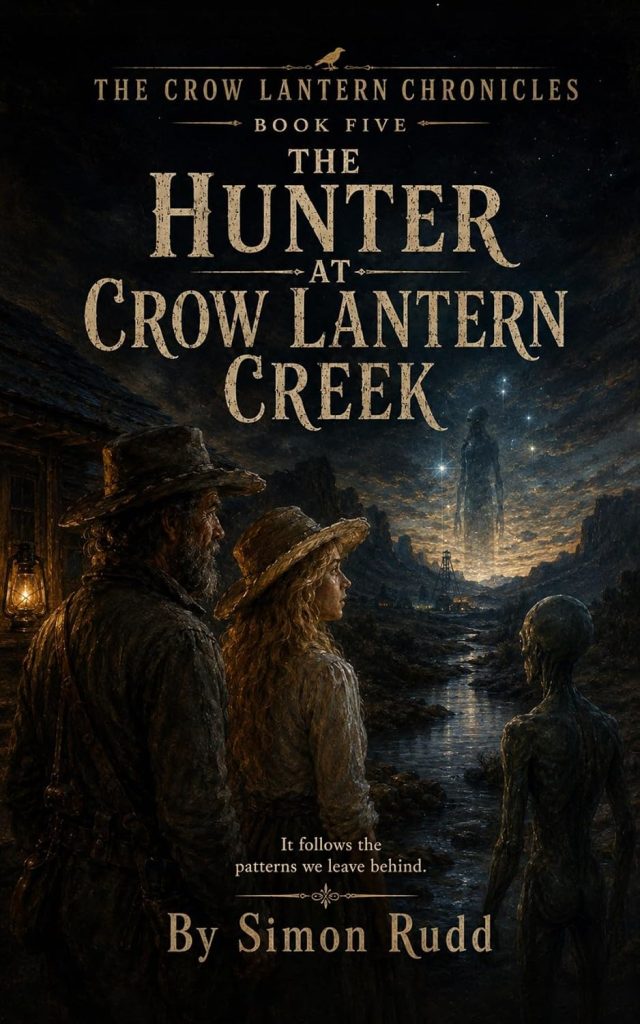
It has the word now. And the word is a name.
Clara Sayers wakes at Jonah Latch's table to find a single word written on a clean page — in her own hand, with the leaning R and the lifted final stroke she has made since she was a child. She did not write it. Outside, the horse is screaming.
Ravun is not a door, not a road, not a thing sleeping under a hill. Ravun hunts. It has been coming since Glassfall, and now it has an address.
It does not track by scent or sign. It tracks by relation — by the shape of what people are to one another, by habit and route and repetition, by every careful copy of every careful account. Clara has spent three months proving that the truth must be written down. Ravun has spent three months reading the record.
Then it starts using their voices. The preacher's cadence without his hunger for certainty. The doctor's threat, polished into performance. A schoolgirl's cleverness with the child-breath taken out of it. And at last Jonah's voice, saying Clara's name — nearly true, because it has learned precisely what that name weighs in his mouth when danger stands close enough to hear.
There is no wire to send down, no seal to close, no authority left to appeal to. There is only Crow Lantern Creek, a handful of people who know too much to be safe and too little to be certain, and a hunter that cannot be barred out because it comes in along the lines they drew themselves.
To end it, they will have to go back to where it began — to Glassfall, where a stranger fell out of the sky and a girl opened a notebook — and offer the hunter the one thing it has never been given.
The Hunter at Crow Lantern Creek is the fifth and final volume of The Crow Lantern Chronicles.
The series begins with Book One: The Light Beyond the Ridge.
Read the first chapter
Chapter 1 - The Word in Her Hand
Clara woke with her cheek against paper.
Something had woken her. She did not know what. The cabin held the particular ringing quiet of a room a sound has just left.
For one loose, foolish moment she thought she had fallen asleep while copying the Cinder account again, and that Jonah would make some dry remark about scholars being less use than a sack of oats once the lamp burned low. Then the table came into focus beneath her: Jonah’s scarred boards, the ink bottle with its cork set beside it, the stub of pencil she had sharpened with his knife, the grey smear of ash along her cuff.
The lamp had burned almost dry.
Its flame stood small and yellow behind a skin of dirty glass, no more than a bent bead of light. It made the cabin seem farther away than it was, as if the walls had drawn back in the night and left her at a table set under a wide, listening sky.
Clara did not move at first.
Her fingers were stiff. Her right hand ached as if she had written for hours. Graphite had greyed the side of her middle finger and the edge of her thumb. The smell of lamp oil sat thick in the air, threaded with cold ash and old smoke from the stove.
Jonah sat in the chair by the door with his hat tipped low and his rifle across his knees.
He was not asleep.
She knew it by the set of his shoulders. Jonah Latch could look carved out of weathered pine and still be listening to a mouse cross the floor. His eyes lifted under the brim as soon as her breath changed.
“You were meant to rest,” he said.
His voice was low. It did not scold. That made it worse.
“So were you,” Clara said.
“Didn’t claim I was sensible.”
“Something woke me.”
“Crowbait.” He did not take his eyes off the door. “Screamed once, out in the lean-to. Then stopped like a hand had gone across his mouth.”
Clara’s skin tightened. That horse complained the way other horses breathed. Complaint was not the same animal as that.
“You didn’t go out.”
“Been out three times since midnight.” He said it flatly, the way a man reports a decision he intends to keep arguing with. “Not after that. Whatever puts that sound in a horse, I’m not meeting it in the dark with a lamp in my hand and you asleep at the table.”
She pushed herself upright. The room tilted a little, then steadied. Her back hurt from sleeping crooked. Her mouth tasted of cold coffee and fear.
Eli lay on the narrow pallet near the inner wall, wrapped in the blanket Mara had sent and the older horse blanket Jonah pretended not to fuss over. In the lamp’s poor light, his skin held the faint dull sheen of river stone under frost. The device rested beside him, wrapped in cloth, dark for once. After Cinder, even its silence felt exhausted.
Cinder.
The word brought the last night back in pieces: black stone under hard stars, Pierce’s ordered voice breaking at the edges, Clara’s own hands tearing sense out of a map without tearing truth from it. Eli’s weight against Jonah’s arm. The one absent star that had not returned. The strange page at the end of the account.
No.
Clara looked down.
Her notebook lay open beneath her.
Not the Cinder account. Not the protected copy with its gaps and witness marks. Not the page where she had written names, dates, symptoms, and warnings in language careful enough to preserve and blunt enough not to instruct.
A blank page had been used after that, and it was no longer blank. One word stood in the centre of it.
Ravun.
Clara stared until the letters lost shape and became strokes of dark on cream. The R leaned a little too far forward, the way hers did when she wrote quickly. The second stroke was bitten at the end, where the pencil had dragged against rough paper. The final n lifted. She knew that lift. It was the impatient little mark Jonah had once said looked like a horse deciding not to take a gate.
Her own hand. Not copied, not forged.
Hers.
The cabin seemed to grow cold around the word.
“Clara,” Jonah said.
She had not realised he had stood.
She put one hand flat beside the notebook, careful not to smudge it. “Did I write this?”
Jonah came to the table. He moved with the slow care of a man approaching a rattlesnake under a flour sack.
“I heard you stir once,” he said. “Thought you were turning in the chair. Didn’t hear pencil.”
“It’s hours old.”
“That supposed to comfort either of us?”
She lifted the page by its lower corner and bent close to the lamp. The lead had taken the dull silver shine that came to pencil after hours and not after minutes. The pressure had gone deep in the paper. She could see the ghost of the word raised against the underside when she held it slant.
Her wrist remembered nothing.
That frightened her more than the word.
At Cinder, things had vanished from paper because the world was trying to keep a path from being repeated. Names had thinned. Turns had slipped. Messages had lost words like coins through broken fingers.
This had not vanished.
This had arrived.
Eli made a sound.
It was small, but every person in the room heard it.
Clara turned.
Eli had pushed himself half upright, one long hand gripping the blanket so tightly the fabric strained between his fingers. His eyes were fixed on the notebook. Not on Clara. Not on Jonah. On the word.
His face had changed.
Clara had seen Eli afraid before. She had seen him flinch from guns and flame, from Brome’s shouting, from Pierce’s clean maps, from the black wrongness of Cinder Notch. She had seen grief in him, and pain, and that terrible watchfulness he carried when human speech moved too fast around danger.
This was colder.
This was recognition.
“Eli,” she said softly.
He shook his head once. Not denial, not confusion.
Warning.
Jonah reached for the notebook.
Clara closed her hand over the page before he could take it.
“No,” she said.
His eyes snapped to hers. “You don’t know what that is.”
“That is why we do not burn it before we look.”
“I didn’t say burn.”
“You were thinking it.”
Jonah’s jaw worked.
He was tired enough that the truth showed through before the answer did. His face had the grey, drawn look of a man who had ridden too far, slept too little, and kept one more impossible thing alive through sheer meanness.
“Clara,” he said, “that book has been trouble since the first mark you put in it.”
“That book is why we knew Cinder was not a road.”
“It’s why Pierce knew there was something worth taking.”
“It’s why Gideon Prowse did not vanish entirely from the world.”
Jonah looked away at that.
The name settled between them, one of the names Clara had refused to surrender to absence. Gideon Prowse. Hugh Brindle. Men half-eaten by an impossible defence because official certainty had mistaken a seal for a puzzle.
She lowered her voice. “If I wrote this and do not remember writing it, that matters. If Eli knows it, that matters. If it is a warning, burning it may be burning the only warning we have.”
“And if it’s not warning?”
The lamp flame bent. Just a little.
There was no wind. The door was shut. The window cloth did not stir.
Clara watched the flame straighten again.
Jonah saw it too. He moved at once, rifle in hand, crossing to the door without a sound. He set his ear near the boards, then looked through the narrow gap in the shutter. He checked the latch, the lower brace, the rawhide loop he had added after Ashspur. Then he moved to the rear window, the corner where the wall had been repaired, the place behind the stove where cold sometimes slipped in.
A practical circuit. Doors. Windows. Fire. Horses.
That was Jonah’s answer to terror. Count the things that could kill you in the order they could reach you.
“Nothing at the door,” he said.
“Nothing human?”
He did not answer.
Eli made another sound, more breath than word.
Clara turned back to him. “What does it mean?”
Eli’s gaze moved from the notebook to her face. The effort of that simple motion seemed to cost him. He touched his own chest with two fingers.
“Eli,” he said.
Help. Hear me. Witness me.
Then he reached towards the page.
Jonah took half a step. Clara lifted her palm to stop him, though her own heart was beating so hard she felt it in her teeth.
Eli’s fingers hovered above the written word. He did not touch it at first. His hand trembled. When he finally set one fingertip to the paper, the lamp hissed.
Clara smelled hot oil.
Eli withdrew sharply and clutched his hand to his chest. Not burned. Not exactly. His pain showed differently, in the tightening of his throat and the sudden stillness of his limbs.
“Kesh?” Clara asked.
Pain. Broken body.
Eli shut his eyes and gave one small, strained nod.
Jonah came back to the table. “Enough. Shut it.”
“Wait.”
“No.”
“Jonah—”
“No, Clara.” His voice stayed low, but it had iron in it. “We just kept one place closed by not writing it plain. Now you wake up with a word in your hand that hurts him to touch and makes lamps twitch. I am all done giving paper the benefit of the doubt.”
Clara felt her temper rise, sharp and welcome because it was cleaner than fear.
“And I am all done mistaking ignorance for safety.”
Jonah stared at her.
The words had come too hard. She knew it as soon as they left her. Jonah had not been ignorant. Jonah had kept Eli alive when everyone else would have handed him over, shot him, prayed at him, sold him, or cut him open in the name of truth. He had stood between Clara’s notebook and men with orders. He had trusted her when trusting her looked like folly.
But she could not take it back without making it less true.
At last Jonah said, “There’s ignorance, and there’s not handing a loaded gun to a child because you want the history of guns preserved.”
“This is not a gun.”
“You sure?”
Clara looked at the word.
No. She was not.
That was the trouble with truth. It did not stop being true because it could wound.
She drew the notebook closer, careful, and turned it so Eli could see without needing to lean. Then she picked up the pencil rather than the pen. Pencil could be rubbed down. Pencil did not bite the page as deeply.
“I’m not copying it,” she said. “I’m making distinctions.”
Jonah muttered something that might have been a curse and might have been a prayer, though Clara doubted he had much use for either at the moment.
She wrote beneath the word, small and slanting:
Not Cinder?
Then below it:
Not Veyr?
Eli watched. His breath quickened at Veyr, but he shook his head.
Not seal. Not held closed.
Clara wrote:
Not Velar?
Eli’s answer came faster. A sharper shake. His fingers pressed into the blanket.
Not path.
“Not a road,” Clara murmured.
Jonah’s mouth tightened. “Good. We’ve had enough roads.”
She wrote:
Not Maeth?
Eli hesitated.
That hesitation chilled her.
Maeth. Gone. Cannot return. Must not be erased. The word had always carried more weight than any single English sense would hold. At Hollow Star it had been grief. At Cinder it had been warning. It was what remained when a thing could not come back and what must not be rubbed out merely because it hurt.
“Not Maeth?” Clara asked again.
Eli’s eyes moved to the page, then to Clara’s ink-stained hand. He shook his head slowly.
No. Not gone, not absence. Something present.
Something coming.
The cabin timbers creaked softly as the cold shifted outside.
Clara swallowed. “Raesh?”
Danger approaching.
Eli breathed in, then out. Not a nod. Not enough.
He reached for the pencil.
Clara gave it to him.
His grip was awkward. Human pencil, human fingers not made like his, human paper that had already betrayed them all. He did not try to write the word again. Instead he made three marks beneath Clara’s questions.
First, a small circle.
He touched his chest.
Eli.
Second, a set of uneven lines like pages or folded paper.
He touched Clara’s notebook.
Third, after a long pause, he drew a jagged mark that made Clara’s stomach tighten before she knew why.
Glassfall.
Not perfectly. Not as a map. Eli knew better than that now. But she recognised the slant of the old workings, the broken angle of the place where the world had first reached up and dragged him down.
Jonah recognised it too.
“No,” he said.
The word came out flat.
Eli tapped the first mark, then the second, then the third.
Then he touched Ravun.
Clara looked at the sequence.
Living witness.
Human record.
Buried remnant.
The thought did not arrive whole. It gathered, piece by piece, like riders emerging through dust.
“What is it?” Jonah asked.
“I don’t know yet.”
“That’s not the same as knowing nothing.”
“No.”
Eli took back the pencil. His hand shook harder now. He drew one more mark, above the three.
A long, bent stroke, and then another crossing it.
No body. No claws. No face. Nothing Clara could have called creature or man. Yet the shape made her think of a rider seen only by the shadow of the horse; of something known by what fled before it.
Eli pointed to it and then to the word.
“Ravun,” he said.
The lamp flame shrank. Jonah lifted his rifle.
Clara held very still.
The word sounded different in Eli’s mouth. Not like her attempt would sound. Not like a word only. It had direction in it. Hunger. Not animal hunger. Worse than that. A patient seeking. A thing following a line because the line had been made true enough to follow.
“Hunter,” Clara whispered.
Eli’s gaze fixed on her.
Not agreement exactly. But close enough to hurt.
Jonah’s face changed in a way she had rarely seen. Not fear alone. Not anger alone. The look of a man watching the fence fail and counting who stood on the wrong side of it.
“Hunter of what?” he asked.
Eli touched his own chest again.
Then the notebook.
Then he pointed towards the wall beyond the stove, beyond the yard, beyond the dry washes and stony ridges.
Towards Glassfall.
Clara’s hand tightened on the pencil. “No.”
Jonah gave a humourless sound. “That was my line.”
“It cannot be Glassfall.”
“Seems the night’s taking requests poorly.”
“Glassfall warned. It pulled Eli down. It was the beginning.”
Eli made a soft sound, and Clara stopped.
The beginning.
Yes. And a beginning was also an address, if enough people kept pointing back to it.
She thought of Duskline reports moving from hand to hand. Pierce’s damaged official copy. Milton Waye’s clean lines. Ruth Bellamy’s careful wire records. Her own notebooks, safer than the official versions because they held doubt, but still written in her hand, by her habit, in the same words, around the same centre.
Crow Lantern Creek.
Glassfall Workings.
Eli.
Witness me.
What if witness itself could become a trail?
The thought made her stomach turn.
Jonah had gone to the window again. “Horses are standing wrong.”
Clara rose too quickly and had to grip the table. “Wrong how?”
“Quiet.”
“That is wrong?”
“For them, tonight, yes.”
He unbarred the door before she could stop him.
Cold entered the cabin like a hand.
The world outside lay under the last dark before dawn. Stars crowded the sky, hard and pitilessly bright. No cloud moved. No wind crossed the yard. The creek made its thin, ordinary sound somewhere beyond the cottonwoods.
Ordinary.
Clara had learned to distrust that word most of all.
Jonah stepped onto the threshold but did not leave it. The rifle rested ready, not aimed. His head tilted, listening.
Clara came behind him with the lamp. Eli made a warning sound from the pallet.
“I’m not going out,” Jonah said without turning. “Not yet.”
Crowbait stood at the rail with the dun beside him, both facing the same direction.
Not towards the cabin.
Not towards the creek.
Towards the low blackness of the ridge that lay between Crow Lantern and Glassfall.
Their ears were forward. Their bodies were still. Too still. Clara had seen horses shy from rattlers, from storm scent, from Eli when they first knew him as wrongness in a blanket. This was not panic. This was recognition.
One of them exhaled.
The sound steamed pale and vanished.
Jonah shut the door and barred it.
For a few breaths nobody spoke.
Then Clara returned the lamp to the table. Her hands were steady now. She was glad of that. She did not feel steady, but hands could lie kindly when needed.
She looked at the page again.
Ravun.
Not route.
Not seal.
Not gone.
Hunter.
Jonah stood across from her, the rifle still in one hand. “Say nothing more of it tonight.”
“We need to understand—”
“Say nothing more of it tonight,” he repeated. “Not aloud.”
That time, she understood.
Words had mattered at Hollow Star. Missing words had mattered at Cinder. If this thing followed witness, repetition, recognition — if that was even partly true — then speaking its name might be more than sound.
Clara looked at Eli.
He had sunk back against the wall, spent by the effort of warning them. But his eyes remained open, fixed not on the door now, not on the page, but on Clara.
There was apology in his face.
That hurt worse than fear.
“No,” she said to him, quietly. “Not yours alone.”
Eli’s fingers moved weakly against the blanket.
Tavren. Witness.
Or perhaps plea.
Clara took the pencil and, beneath the marks Eli had drawn, wrote one line in the smallest hand she could manage.
Not to be copied clean.
Jonah watched her.
She set the pencil down.
“I won’t write more tonight,” she said.
“Good.”
“I won’t burn it either.”
“Didn’t figure you would.”
“That was almost generous.”
“Don’t get accustomed.”
The dry edge of it nearly steadied her.
Nearly.
Outside, the horses remained silent. The cabin held its breath around the table, around the page, around the alien word written in her hand while she slept.
Clara leaned closer to the lamp, meaning to lower the wick before it guttered out.
Before her fingers touched the little brass wheel, Eli whispered the word once more.
Not loud.
Not even fully formed.
“Ravun.”
The flame bent towards him.
Then away.
Then, with no wind at the door and no hand on the lamp, it flickered once.
Like an answer.