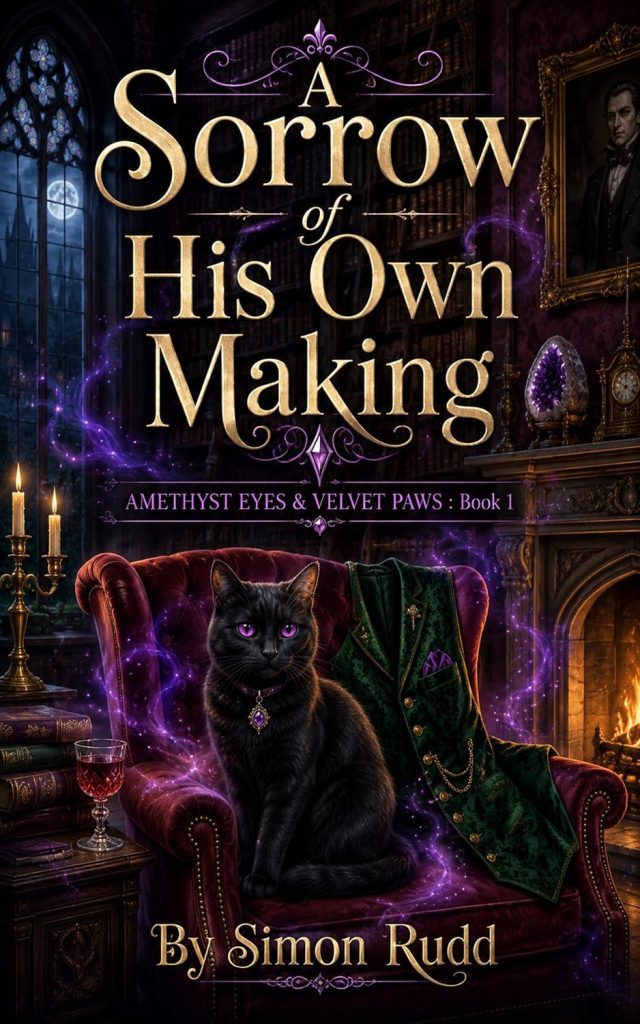
For four hundred years, Count Alaric Dracula has been running.
From villages that feared him. From cities that hunted him. From anyone unwise enough to get close. Then, fifteen years ago, he stopped in a little place called Cobblestones — just for a while, just until the next torch-lit mob — and somehow never left.
Now he spends his nights as the village’s Night Watchman: prowling the rooftops in the shape of a large black cat, keeping the dark at bay, and pretending not to enjoy the cinnamon rolls the baker leaves on his doorstep. Against every one of his instincts, it has become almost a life.
Then the Gloom comes.
A creeping violet mist has begun to gather in Cobblestones — pooling at gravesides, thickening at lonely windows, feeding on the village’s quietest sorrows. Alaric has faced a great many terrible things in four centuries. But when he and the sharp-eyed village librarian trace the Gloom to its source, he meets the one enemy he has never once been able to outrun:
Himself.
The Gloom is made of his own loneliness — four hundred years of it, poured into the ground beneath the village, given shape and hunger and a voice that speaks in his own. And there is only one way to send it home. A way that will ask the proudest, most solitary creature in Cobblestones to do the single thing he has spent four centuries refusing to do:
To stop running. To be seen. To let himself be kept.
Amethyst Eyes & Velvet Paws is a cosy gothic fantasy about found family, second chances, and the slow, terrifying courage it takes to let people love you — full of meddling neighbours, warm bread, a well that remembers, and one supremely unimpressed cat.
Come for the reluctant vampire. Stay for the village that refuses to let him be lonely.
Read the first chapter
Chapter One — The Lint of Lost Souls
Count Alaric Dracula, known to the local census and the occasional overly-bold mailman as the Count of Cobblestones, sat enthroned in his favourite wingback chair and waged a quiet war against his lapel.
The ancient leather creaked beneath him with the satisfied sigh of a well-loved companion, its burgundy surface worn smooth by four centuries of restless nights. Around him, the library of his estate rose like a cathedral of leather-bound secrets and cedarwood scent, each shelf a testimony to collected knowledge that predated most of the village families by generations. First editions in languages both living and dead lined the walls from floor to vaulted ceiling, and Alaric knew the location of every one — not from any catalogue, but from the weight each volume carried in his memory, bound up with the century in which he’d acquired it.
The hearth crackled with perpetual warmth, fed by embers that seemed to regenerate through sheer force of will, or perhaps something older and less explicable. Orange light danced across gold-leaf spines and caught on the crystal decanters arranged on the sideboard, scattering ruby light across the Persian carpet. Outside, beyond curtains specially woven with blackout lining, the English countryside was settling into a November night. Inside, time had no particular jurisdiction.
Alaric was the very picture of a wealthy, if slightly eccentric, recluse — or so the village believed. His attire was a testament to an era of elegance he refused to abandon: a high-collared shirt of Egyptian cotton, starched to perfection, beneath an emerald velvet waistcoat that shimmered like moss under a full moon. The fabric was so fine it seemed to absorb and reflect light simultaneously, a quality he suspected had less to do with the tailoring than with four centuries of proximity to his own skin. His dark trousers were perfectly pressed, his shoes hand-made in London by a cobbler who had learned not to ask why his client only booked evening fittings.
However, his refined aesthetic was currently under siege.
With long, pale fingers — fingers that had once signed treaties and gripped swords, but now devoted themselves to more domestic concerns, he fastidiously picked a piece of glowing, translucent fluff from his lapel. The wisp clung stubbornly to the velvet pile before surrendering to his persistent grooming. It shimmered with an otherworldly luminescence, casting faint purple shadows against his palm.
“Spectral lint,” Alaric murmured to the empty room, his voice a smooth baritone that carried the faint accent of a dozen forgotten kingdoms. He flicked the shimmering wisp toward the fireplace with a gesture both elegant and weary, watching as it sailed through the air and vanished with a faint, indignant pop—the death rattle of something that had never truly been alive.
There had been more of it lately. Over the past few months, the lint had changed, shifting from the ordinary dust of an old house to something that glowed with faint purple-grey light and clung with almost personal malice. He’d mentioned it to no one, filed it under the category of minor supernatural phenomena that were beneath the dignity of serious concern. An occupational hazard, nothing more.
The occupation in question was his unofficial role as the village’s guardian. A position he had never applied for, certainly never been appointed to, yet had somehow inherited through a combination of circumstance, proximity, and an inability to simply not care about the mortals who lived below his hill. While the residents of Cobblestones slept, tucked safely behind iron horseshoes and salt-lined windowsills, Alaric spent his nights prowling the rooftops in a form considerably less refined than this one.
To the public, he was merely a rich eccentric who stayed up far too late, ordering obscure books from dealers in Berlin and Prague, subsisting on what the village gossips assumed was a trust fund from somewhere foreign. They speculated about his diet of rare imports, his aversion to morning social calls, and his peculiar habit of tipping generously anyone brave enough to deliver packages after dark. His smartphone, which he used exclusively for ordering books online, was the sole concession to the twenty-first century in the entire estate.
But to the shadows — to the things that crept between the cobblestones and pressed against windowpanes in the dead hours before dawn, he was something else entirely. Something older. Something that made even the malevolent sprites think twice before souring the baker’s milk or tangling a child’s hair into knots.
He reached for the crystal glass resting on the side table. Venetian, probably worth more than the table it sat upon, etched with a pattern of ivy that seemed to move in the firelight. Inside was his evening reserve — a thick, deep-red concoction that Thomas the baker prepared each day with the care of a master craftsman. Beet and liver, blended and strained until it achieved a consistency and colour that, in certain light, might alarm a casual observer. But the taste was complex, earthy, rich with iron, and it dulled the ancient hunger enough to keep him civilised.
He took a slow, appreciative sip. Domestic, he thought. The word still surprised him. Four centuries of existence, and he had somehow arrived at domestic.
As he savoured the reserve, a phantom urge to scratch behind his own ears nagged at him, a lingering sensation from his nightly shifts into a much more feline form. The boundaries between his shapes had been growing more permeable in recent years. He’d caught himself purring during a phone call with his book dealer last week. The week before that, he’d very nearly knocked a stack of first editions off his desk with an involuntary tail-swish that he didn’t, technically, have at the time.
He resisted the urge now, barely, and instead ran his fingers through his dark hair, which was perpetually on the verge of falling into his eyes. Another thing he should attend to. Another small concession to propriety he kept postponing because, really, who was there to impress?
Across the room, the heavy oak door creaked open. The sound was deliberate — Renfield was perfectly capable of silence when the situation required it, but he’d learned long ago that startling a vampire, even a domesticated one, was an excellent way to end up with claw marks in the wallpaper.
The estate’s manager stepped in with the practised grace of a man who had spent three decades navigating the peculiarities of supernatural employment. Lean and angular, dressed in a crisp black suit that he wore like armour against the absurd, Renfield moved with an economy of motion that belied the silver in his hair. His dark eyes held the calm competence of someone who had seen enough strangeness to be permanently unflappable, a composure that could only be earned, never taught.
He carried a fresh stack of heated velvet blankets toward the east wing — the converted crypt that Alaric had spent considerable time and money transforming into something between a luxury hotel suite and a very comfortable coffin. The blankets were midnight blue, specially ordered from a textile merchant in Brussels who asked no questions as long as payment cleared.
“The village is quiet tonight, Master?” Renfield asked, his voice low, modulated to maintain the calm they both valued. He didn’t need to ask, Alaric’s relaxed posture told him everything — but the ritual question was part of their nightly routine. A way of marking the transition from duty to rest.
“Quiet enough,” Alaric replied, his amethyst-coloured eyes tracking another stray bit of lint on his cuff. He plucked it free, examined the faint purple glow, and consigned it to the flames. “Though the lint is getting worse. I pulled six pieces off my waistcoat during tonight’s patrol. Six. That’s double what it was a month ago.”
Renfield paused in the doorway, blankets balanced against his chest. “The mist has been thicker in the village as well, Master. Mrs. Pemberton mentioned it at the post office. Purple-grey, she said. Unusual for November.”
Alaric filed that away but didn’t respond. He wasn’t ready to think about what it might mean.
“The baker left a saucer out again,” he said instead, steering toward safer ground.
Thomas the baker, a round, flour-dusted man who made the best sourdough Alaric had tasted in centuries — had taken to leaving a small ceramic saucer on his back step each night. The same beet-and-liver reserve, prepared fresh, a gift for the mysterious black cat that sat on the garden walls and kept the nightmares at bay.
Thomas didn’t know the cat and the Count were the same entity. To him, the Lucky Void was simply a very large, very punctual stray who had appointed himself the village’s protector. And the Count was just the eccentric nobleman on the hill who ordered strange supplies and kept odd hours.
“It was excellent tonight,” Alaric added, allowing himself a small, private smile. “He’s adjusted the recipe again. More iron. I think he noticed the cat looking tired.”
The thoughtfulness of it, a baker tweaking a recipe for a cat he’d never pet, based on nothing but observation and care — made something complicated happen in Alaric’s chest. He chose not to examine it.
Renfield, who noticed everything and commented on very little, simply nodded. “I’ll ensure the morning preparations are complete. Miss Murray is expected at seven-thirty.”
He withdrew with the blankets, and the library settled back into its familiar quiet. Fire, clock, the whisper of old wood breathing. Alaric leaned into the wingback’s embrace and let his eyes drift half-closed.
For a creature once feared across half of Europe, this simple moment of domestic peace felt improbable. The warmth of a quiet library. The loyalty of a companion who’d stayed for thirty years without compulsion or enchantment. The knowledge that the village below slept safely because he had made it so.
It felt like something he’d stopped allowing himself to name a long time ago.
The clock in the hallway struck three. Somewhere in the village, a dog barked once and fell silent. And Count Alaric Dracula picked another piece of spectral lint from his emerald waistcoat, noting, with a frown he didn’t let form fully, that this one glowed brighter than the last — and allowed himself to believe, just for a moment, that he might be allowed to stay.
• • •
Morning light touched the heavy curtains when a crisp knock echoed from the front door. Three raps, a pause, two more. The rhythm was as reliable as the sunrise and considerably more welcome.
Tuesday. Seven-thirty. Mina.
Alaric was still in the library, he’d lingered past his usual retreat to the east wing, reluctant to leave the warmth of the fire for the solitude of his sleeping quarters. The first golden rays were beginning to probe at the edges of the blackout curtains, and he felt the sun’s presence the way a sailor felt an approaching storm: a prickling awareness that made his skin feel too tight, a gentle reminder that his time in this form was finite.
Renfield moved to answer. The soft click of the lock, the whisper of well-oiled hinges, and then a voice, bright and warm as morning toast — a voice that made you feel you’d been offered a seat by the fire before a single word of substance had been spoken.
“Ah, Miss Murray.” Alaric rose from his chair with a grace that he carefully modulated to appear merely athletic rather than predatory. He plucked a final stubborn speck of lint from his shoulder and flicked it toward the dying embers. “You are early. Or I am merely lingering.”
“Both, I imagine,” Mina Murray said, stepping into the foyer and bringing the outside world with her.
She brought the crisp November air, still sharp with the remnants of frost. She brought the sound of birdsong filtering through before Renfield could close the door. And she brought the mingled scent of Thomas’s bakery and old books — yeast and butter braided through the musty perfume of cracked spines, a combination that was, Alaric had privately decided, the most dangerous fragrance in Cobblestones.
Her dark curls were pinned back with a fountain pen — a Waterman with a gold nib, jammed haphazardly through the twist because she’d been cataloguing new arrivals when she’d noticed the time and grabbed the nearest implement. She wore an oversized knit sweater in a shade of green that reminded Alaric of forests in early spring, hand-knit with the slight irregularities that marked it as the work of human hands rather than machines. It dwarfed her small frame and made her look, he thought, not for the first time — like a particularly cozy hobbit who had wandered into the wrong story.
She held a heavy ceramic jar against her chest, cradling it the way one might handle a sleeping infant or a particularly volatile chemical experiment.
“The baker finished the new batch of reserve at dawn,” she said, handing the jar to Renfield with the easy trust of long practice. “Extra beet and liver this time. He said the Night Watchman looked like he’d had a rough few weeks.”
Something in the way she said Night Watchman caught Alaric’s attention, the insider’s term, used only by those who understood what the village’s beloved Lucky Void actually was. Most of Cobblestones knew the big black cat by his public name, and loved him for it. But Mina had always preferred the title that acknowledged the man inside the fur. The ghost of a smile at the corner of her mouth confirmed it. She knew. Not everything, perhaps. Not the full history or the precise taxonomy of his condition. But she knew the cat on the wall and the Count in the library were connected in ways that went beyond a rich man feeding a stray, and she had filed this knowledge in the same mental category as overdue library fines: a fact of existence that required management, not panic.
She had confronted him about it approximately three weeks after they’d met — cornered him, really, in the folklore section of her library, between British Supernatural Traditions and A Field Guide to Hauntings, with the directness of someone asking about an overdue book.
“You’re a vampire, aren’t you?” she’d said, as casually as if she were confirming his postcode.
In a village where horseshoes were building code and salt lines were standard practice, the question was perhaps less extraordinary than it would have been in, say, Croydon. Alaric had confirmed it with the resigned grace of a man whose secret had survived over the centuries only to be undone by a librarian with sharp eyes and an extensive mythology collection.
Mina had nodded once, asked if he had any dietary restrictions she should be aware of when organising tea, and that had been that. She had later described him as having “Cat Dad energy”, a phrase that had baffled him until she explained it meant he exhibited the same doting, slightly obsessive care for the village that one might show a beloved pet. He had spent three days deciding whether to be offended before concluding it was distressingly accurate.
Renfield had already drawn the blackout curtains against the strengthening dawn — a precaution so routine that neither of them remarked on it. They settled into the mismatched armchairs near the hearth. Alaric in his wingback, Mina in the overstuffed burgundy monstrosity that had been in the library since before he’d purchased the estate. The chair seemed to embrace her, and she tucked her feet under her with the unselfconscious ease of someone who felt genuinely at home.
He noticed this, the ease, the trust, the way she occupied his space as if she belonged in it — and something shifted behind his ribs. Not hunger. Something less familiar and considerably more dangerous.
Renfield had laid out the tea service with his usual prescience: delicate porcelain that had survived two centuries and at least three wars, a silver teapot, and a plate of biscuits. Mina’s Earl Grey was prepared exactly as she liked it — a splash of milk, half a spoonful of honey, never a full one. Alaric’s cup held the reserve, steaming faintly, smelling of iron and earth.
For a few minutes, they simply sat. Mina sipped her tea. Alaric sipped his reserve. The fire crackled. Rain began to tap against the windows with the gentle persistence of an English autumn. It was, by any measure, perfect.
“You know, Alaric,” Mina said, setting her cup down with a soft clink that seemed loud in the quiet room, “the villagers are starting to count on that big black cat being on their garden walls.”
His shoulders tensed. The movement was slight, automatic, the response of a creature who had learned over the years that being needed was the first step toward being hurt.
“I am merely keeping the peace so I can read my first editions in silence,” he said, reaching for his cup. “The village’s supernatural ecosystem was in disarray when I arrived. I simply… tidied it.”
Mina made a sound that could have been agreement or could have been the polite scepticism of a woman who had spent her career cataloguing human self-deception alongside folklore.
“Maybe,” she said. She picked up a biscuit and examined it with the same careful attention she gave to rare manuscripts. “But even the most solitary creatures eventually need a place to call home. And a real reason to stay.”
The words landed with a force that had nothing to do with volume. Home. The word had become both longing and curse over the centuries. He had owned estates and castles, ruled territories and commanded armies. But none of it had been home, place where you let your guard down and stopped calculating exits.
And a reason to stay. That was more dangerous still. A reason to stay meant putting down roots that would hurt to tear up. It meant imagining a future that extended beyond the next narrow escape.
He wanted to argue. Wanted to explain that creatures like him didn’t get homes, that such luxuries were reserved for beings who didn’t carry centuries of guilt on their shoulders. He wanted to remind her that the village’s acceptance was built on incomplete information, and that the moment they understood what he truly was — what he had done, the lives he had taken before he’d learned to be what he was now, their charming superstitions would curdle into something far less welcoming.
But before he could formulate a response that was both honest and self-protective, something changed.
A low, unnatural chill hummed through the floorboards. Not the normal cool of stone and November — something different. Something that made the hairs on his neck rise in a way they hadn’t in decades. It was a sensation he remembered from older, darker times, when the barriers between things had been thinner and the world had been less interested in behaving itself.
Mina felt it too. He saw her pause mid-sip, saw her eyes sharpen with the instinctive awareness that had probably kept her ancestors alive in a country where the folklore was, more often than people wanted to admit, a field guide rather than fiction.
A faint, misty wisp of purple-grey Gloom snaked in from under the heavy oak door.
It moved with purposeful drift, curling along the floorboards like smoke from a snuffed candle, testing the boundaries of the room. Thin. Barely visible. But unmistakable to anyone who knew what to look for, and Alaric, who had been finding its residue on his waistcoat for months, knew exactly what it was.
The wisp found the hearth. The moment it touched the warmth radiating from the fireplace, it recoiled as if scalded, dissipating with a soft hiss that sounded almost disappointed. The fire flared brighter for a moment, asserting itself, then settled.
But the wisp had been bolder than any Alaric had seen inside the estate. The Gloom had always been out there—in the streets, along the garden walls, pressing against windows he patrolled past. It had never come in before. Never crossed his threshold.
Until now.
Alaric set down his cup with deliberate care. The porcelain met the saucer without a sound.
Mina was watching him. Not with fear. Mina Murray did not do fear, or if she did, she filed it under something more actionable — but with the focused attention of someone who had just watched a data point confirm a hypothesis.
“That’s been happening at the library too,” she said quietly. “Small wisps. Under the door, through the window frames. Started about two weeks ago. I didn’t mention it because I thought,” She paused, choosing her words with a librarian’s care. “I thought you were handling it.”
The gentle accusation in that last sentence — not that he’d failed, but that he might not be sharing the full picture, landed with uncomfortable accuracy.
“I was,” Alaric said. “I am. It’s just—” He stopped. Looked at the spot where the wisp had been, at the faint purple-grey residue it had left on the floorboards. “It’s getting stronger. I don’t know why.”
That was almost true. He didn’t know why, not exactly, not in the way that would allow him to solve it. But somewhere beneath centuries of maintained composure, in the place where he kept the things he didn’t examine, he suspected the answer had something to do with him. With staying. With the dangerous, foolish act of caring about a place enough to call it home while carrying a past that might not allow it.
He didn’t say any of that. Instead, he picked a fresh piece of spectral lint from his cuff — it had appeared in the seconds since the wisp’s intrusion, as if the Gloom had left a calling card, and flicked it toward the fire.
Mina caught his eye across the tea service. Her expression was calm, patient, and absolutely certain. She had already decided whether he would stay or run.
Outside, the rain intensified, drumming against the curtains that held the morning at bay. And in the library, the scent of tea and biscuits lingered alongside something new: the faint metallic tang of a problem that wasn’t going away on its own.
The Gloom had made its opening move. Now it was his turn.