A Fallen-Superhero Vampire Horror
The Standing Line Book 3
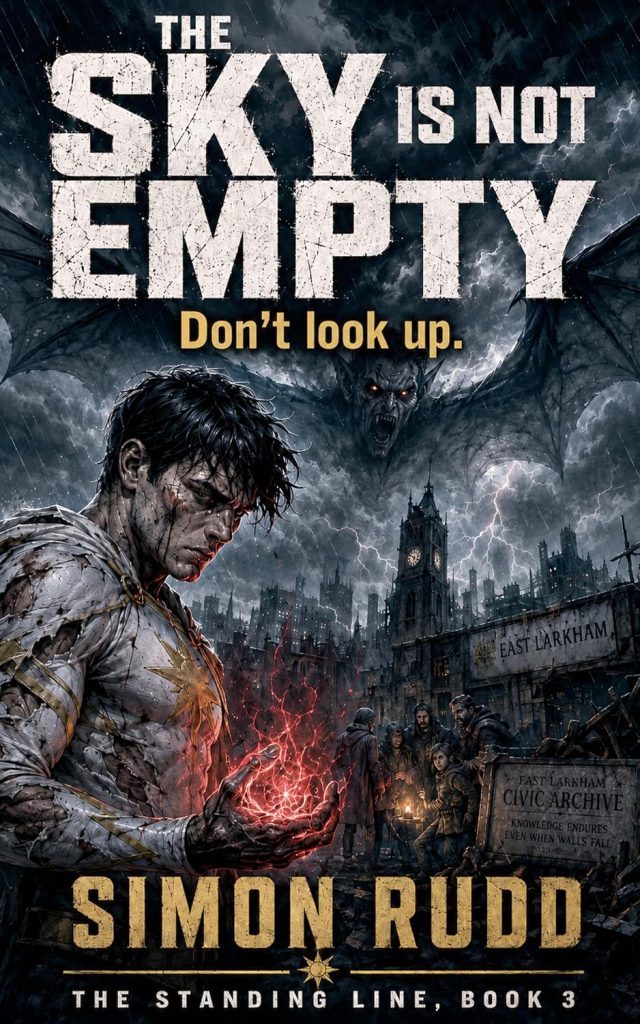
Once, when you looked up, it meant rescue was coming.
Ten years after the vampires took Britain, the survivors of East Larkham have no walls left to hide behind. Only road, ruin, and Tobin Anstey — the fallen daylight hero they used to call Dawn — leading them across open ground in a body that no longer fully belongs to him.
There are no doors to bar now. No tunnels to seal. Just one rule that keeps them breathing: no sky.
Because something is hunting from above. Something that, from a distance, through rain and smoke, can still look almost like an angel — almost like the help that used to come when people needed it most. Look up, and it has you.
Dawn cannot fly. He can only burn, and every use of his contaminated light feeds the thing trying to finish turning him. To get his people to safe ground, he must teach them a new way to stay alive beneath a sky that once meant salvation — before the city learns exactly what makes them move.
Don't look up.
The Sky Is Not Empty is the third book in The Standing Line — bleak, British, and defiantly human fallen-superhero survival horror. For readers of post-apocalyptic vampire fiction who like their monsters earned and their heroes ruined.
Read the first chapter
Chapter 1 — The Rule Above Them
The Civic Archive had doors, and that was why they had to leave it.
Doors made people believe in staying.
Dawn stood under the covered entrance with rain dripping from the broken concrete lip above him and watched sixty-four living people try to become a thing that could move. Not a crowd. Crowds panicked. Not a line. Lines were easy to follow. Not a shelter, because shelters ended with smoke, blood, copied voices at shutters and people learning too late that walls could become a mouth.
Sixty-four.
Jory had written the number three times before accepting it. Once for those who had left the school alive. Once for those who had reached the archive. Once for those who were leaving it now.
The third count had taken the longest because some of the rescued did not yet understand that leaving a place did not mean being safe from it. Mabli Sennett had stood by the map cabinet until Kit touched her elbow and said her name gently enough to make it a rope instead of a hook. Blue Sleeve had refused to step past the inner corridor until Merrit put a cup of water in his hands and told him he could either carry it or spill it, but he was not staying to be useful to ghosts. The last captive, the woman who had kept breathing as if breath was an argument, had been wrapped in two coats and tied onto a door panel with strips of archive curtain.
No one called it a stretcher. A stretcher sounded prepared. This was a door pretending it had another use.
Trewin came out last with the copied records pressed inside a flat waterproof case that had once held emergency flood plans. He had strapped the case across his chest with webbing taken from a first-aid cupboard. It made him look official from a distance, which in East Larkham was not a survival advantage.
Clem noticed at once.
“Take that off,” he said.
Trewin blinked through rain-speckled spectacles. “The case?”
“The look.”
“I can’t remove a look.”
“You can if you stop standing like you expect someone to ask for a form.”
Merrit tightened a knot around the door panel and did not look up. “He’s right.”
Trewin looked at Dawn.
Dawn said, “Carry it lower.”
“The records need to stay dry.”
“So do throats,” Clem said. “Doesn’t mean we hold them out for inspection.”
Trewin moved the case under his coat. It made an awkward square against his ribs. Better. Less visible. Still dangerous, but everything they carried now had learned to be dangerous.
Maps. Names. Water. The first truth. The first two. The warning.
The sky is not empty.
Rain ticked on the archive’s metal sign above the entrance. EAST LARKHAM CIVIC EMERGENCY RECORDS CENTRE. Two letters had fallen years ago. The missing spaces made the name look like something damaged trying to introduce itself politely.
Dawn listened. The city beyond the plaza held rainwater, distant shutter metal, a drain gargling somewhere below the kerb, old leaves moving in the gutter, sixty-four human heartbeats behind him and one heartbeat that kept half-stopping because its owner had learned captivity in a place where sound could be answered.
No close vampire stillness. No Young scrape in the immediate buildings. No voice at the shutter now. That did not make the plaza safe. It only meant danger had chosen patience.
Rhea stood just beyond the entrance shadow. Not fully visible. Not gone. Her outline came and failed in pieces: shoulder, cheek, left hand, rain catching on fabric that did not quite admit it was fabric. When the archive file had shown Seren Holt’s photograph, Rhea had looked up before anyone else. Since then she had kept her face angled too low, as if her neck had been told a secret and was trying not to repeat it.
Dawn moved beside her. “Can you walk?”
Her mouth appeared before the rest of her face did. “Yes.”
“That wasn’t the question I asked badly.”
A little of her right eye formed. Tired. Furious. Too hollow around the edges. “I can walk.”
“Rhea.”
“Don’t make me visible for comfort.”
The words were flat enough to cut.
Dawn accepted the wound and let it remain open. “I need to know if you can scout.”
“Not up.”
“I didn’t ask up.”
“No one asks up,” she said. “That’s how it gets in.”
Behind them, Kit’s voice moved through the group, low and firm.
“Children between adults. Wounded centre. Records never on the outside. Water with me. If you held a bottle before, you still don’t own it. If you found a tool, it belongs to the route. If you need to stop, you say before you fall.”
Clem muttered, “If you fall, I complain while lifting you.”
One of his children made a small sound that might have been a laugh if the world had been kinder. Good. Not happy, but good.
Kit had the water board under one arm, Ivo’s grey cuff still tied below the pencil string. The cuff had darkened in the rain. Every time Kit turned, it tapped against the board like a small dead hand asking to be counted properly.
Jory stood near them with the biscuit tin under his coat. He had copied the warning from the Highwake file on a scrap of archive card. Dawn had watched him write it.
THE SKY IS NOT EMPTY.
NO FLARES.
NO MIRRORS UP.
NO SKY.
Jory had underlined the last one once, then stopped himself before making it a charm. Now he watched the plaza without looking above the second storey of any building.
That was new discipline. Or new fear. They would need both.
“Depot route?” Dawn asked.
Jory took out the folded map strip. Not the full map. The full map stayed under Kit’s coat now because too much paper in one hand made one person too important. Jory had copied only what could be used in the next hour.
“North-east by service road,” he said. “Past the old magistrates’ side wall. Across the bus lane. Under the pedestrian cover if it’s still standing. Then council maintenance road. The depot’s here.”
He tapped the paper.
Dawn saw the mark. COUNCIL FLEET AND HIGHWAYS DEPOT. Vehicle bays. Maintenance pits. Fuel stores, maybe. Rain tanks, if the old infrastructure had not been stripped. Tools. Mirrors for buses and vans. Metal. Cover, if cover meant walls. Not enough overhead.
“Open crossings?” Dawn asked.
“Three bad ones. One worse.”
Clem leaned over the map without stepping too close. “There are always three bad ones and one worse. That’s not navigation. That’s weather.”
Jory did not look at him. “The worse one is civic square.”
“We don’t cross the square.”
“We cross part of it or we go through buildings.”
Clem’s mouth shut. Buildings were a worse kind of answer.
Dawn studied the map, then the road beyond the archive. The city waited in wet greys: stone, tarmac, dirty glass, drainwater. Low cloud pressed between office blocks. Smoke from the school and farther fires had thinned into a brown smear over East Larkham, not enough to hide the day, enough to make daylight feel borrowed.
He hated the open now. The school had taught them that walls could be bait. The archive had taught them that truth could attract mouths. The file had taught them that sky was not absence.
A pigeon moved on the courthouse roof across the plaza.
Clem saw Dawn see it. “What?”
“Bird.”
“Birds are allowed.”
“Some are.”
Clem squinted across the rain. “It’s sitting.”
“For now.”
“You want me to start distrusting pigeons, I can. I have room in my day.”
“Don’t look above the roofline too long.”
Clem’s face changed then. Irritation drained, leaving the useful thing beneath it. Fear with its sleeves rolled.
“Right,” he said. “Roofline and below.”
He turned before Dawn could tell him to and snapped his fingers at the nearest adults. “Eyes low. Roofline and below. You want to admire the clouds, survive long enough to bore someone with it later.”
Mabli whispered, “He makes terror sound rude.”
Kit heard and answered without turning. “That’s why it listens to him.”
Mabli gave a tiny smile. It did not last.
Dawn stepped into the rain. The plaza opened in front of him, wide and pale and wrong. Once, this civic centre would have been a place where people looked up without thinking. Up at flags, clock faces, council banners, a roofline with pigeons, a helicopter sound, a hero crossing the sky.
Highwake had once made people lift their faces.
The thought came with an old ache behind his ribs. Seren Holt laughing on a roof. Seren Holt above smoke. Seren Holt’s voice through comms, bright as flint.
Don’t make me catch you twice, Dawn. It’ll look needy.
He had looked up then. Everyone had.
Dawn forced his gaze to the broken paving slabs in front of him. “First group,” he said.
Jory raised two fingers.
Six moved first, then eight because the door panel needed four carriers and the person tied to it could not be made lighter by arithmetic. Kit adjusted the shape without speaking. Clem placed himself rear-right. Merrit stayed near the door panel, one hand on the patient’s wrist, the other already pointing at people whose limps were becoming lies. Rhea moved nowhere and was suddenly three yards ahead of everyone, a shimmer at the edge of rain.
Dawn did not ask how.
The group left the archive.
No one said goodbye to Hester. She had refused to come.
“I’ve been waiting in records for ten years,” she had said. “I’m not dying in traffic.”
Merrit had argued. Hester had won by being old, armed with a stick, and already more archive than woman.
Now the entrance behind them darkened as the first bend in the route took it away.
Jory looked back once. Dawn let him. Some people had to look back because names needed witnesses behind them as well as ahead.
The service road ran between the civic buildings and an old row of municipal offices. Rainwater had turned potholes into small brown mirrors. Every reflective surface made Dawn’s skin tighten. No mirrors up, Jory had written. No flares. No sky.
Puddles were sky if you stood over them wrongly.
“Step around water,” Dawn said.
Clem repeated it louder. “Around puddles. Not through. Don’t give anything your face for free.”
A boy from the school captives stumbled at that, as if the sentence had touched some remembered rule.
Kit saw. “Jack.”
The boy looked up at his name, then down quickly, correcting himself before anyone had to.
Eight or nine. Thin enough that his coat made him look stored inside it. One eye bruised yellow-brown. Hair shaved unevenly close to the scalp, probably for lice, probably with a blade too blunt for kindness. He had been one of Mabli’s small watchers in the kept place. He noticed gaps. He had noticed the archive’s loose vent before any adult did. He had noticed that the false Ivo voice outside had not known the right pause before Kit’s name.
Now he stared at the puddles as if they might open.
“Not because of water,” Kit said, quieter. “Because of what water shows.”
Jack nodded.
“What do we watch instead?” Kit asked.
He swallowed. “Edges.”
“Good.”
“And shadows.”
“Those too.”
“And other people’s feet.”
“Very good.”
Clem looked at Kit. “Starting a school now?”
Kit’s expression did not move. “No.”
Clem winced as if the word had struck him harder than accusation. “Sorry,” he said.
Kit nodded once. Not forgiveness, not refusal. Movement.
They crossed the first road.
Dawn went before them, hating every second of open tarmac. The road shone with rain. White lane markings had cracked into islands. A bus shelter stood to the left, its glass gone except for triangles clinging to the frame. Across the way, an old public health poster flapped from a noticeboard.
KEEP EAST LARKHAM MOVING.
Someone had scratched out MOVING and written QUIET.
Good advice. Late advice.
Rhea appeared beside the noticeboard in pieces. “No movement in the lower windows.”
“Upper?”
She did not answer.
Dawn turned his face enough to see her without inviting his own eyes higher. “Rhea.”
“I don’t check upper by looking.”
“How, then?”
“I wait for the room to know I’m below it.”
Clem, close enough to hear, whispered, “That’s horrible.”
“Yes,” Rhea said.
She faded again.
The second group crossed. The door panel tilted when one carrier slipped. Merrit swore and got under the side of it before it could drop. Dawn moved to help, but Kit was already there, shoulder under the panel, jaw tight.
“I’ve got it,” Kit said.
Dawn stopped. That was harder than moving. He had built his life, his hero life and the ruined life after it, out of reaching before others had to. The infection inside him liked that. It liked him central. It liked every frightened heartbeat turning around his light.
The road ahead would kill them if he kept being the only answer.
Kit took the weight. Merrit saw him stop and gave one sharp nod. Good. Painful, but good.
The carriers steadied. The woman on the panel kept breathing.
Across the road, the pigeon on the courthouse roof lifted its head.
Clem noticed.
Not Dawn.
Clem.
He froze with one boot in the gutter and one hand extended to help Fen across.
“What?” Dawn asked.
“The bird.”
Dawn did not look at the roof.
Clem did not either, not fully. His eyes fixed on the courthouse wall below the roofline. “It stopped moving.”
“Birds stop.”
“Not like that.”
The pigeon stayed still. Rain fell around it. Another pigeon on a lower ledge tucked its head under one wing, then snapped it out again and went rigid.
The road seemed to widen. Every person in the crossing felt the pause before they understood it. Shoulders tightened. Breath caught. A child’s hand squeezed an adult’s fingers hard enough to hurt. The door panel carriers tried to hurry and nearly tilted again.
“Slow,” Kit said. “Slow is alive.”
Clem still watched the wall.
“What are they listening to?” Jory whispered.
Dawn listened. Rain. Human hearts. The scrape of the door panel rope. Trewin breathing too fast under the records case.
No wingbeat. No glide, because glides did not have sound. That was the problem.
Silence meant she might be there.
The thought did not feel like thought. It felt like a rule arriving from the future.
“No one looks up,” Dawn said.
The order moved through the group faster than fear.
“No sky,” Kit said.
“No sky,” Jory repeated.
Merrit took it up, not loudly. “No sky.”
Clem turned on the nearest child before the child could obey instinct. “Look at my boots. Best view in East Larkham. Ugly, but educational.”
Fen stared at his boots and began crying silently.
“Good,” Clem said, voice rough. “You’re doing it right.”
The shadow crossed the road. It made no sound. It passed over the wet tarmac between Dawn and the door panel, long enough to be winged and gone too quickly to be understood. Not a cloud shadow. Too narrow. Too deliberate. It slipped across the puddles and the cracked white line and the dead leaves in the gutter.
Every body wanted to look up.
Dawn felt it like a physical attack. Chins pulled. Eyes twitched. Shoulders angled. The human body was made to search for the thing above it.
So was prey.
“Down,” Dawn said. Not loud. Hard.
The group lowered. Not to the ground. The ground had puddles, glass, exposure. They crouched under the line of the broken bus shelter and the municipal wall, faces turned towards boots, coats, hands, old chewing gum in pavement cracks, any ordinary ugly thing that could keep them from giving the sky their eyes.
Dawn stayed standing. Merrit hissed his name. He ignored her.
The bloodlight in his palms woke, painful and eager. It wanted upward. The old power remembered height. The bad power remembered mouths. His body strained towards the empty air above the road, wanting to flare, wanting to challenge, wanting to become visible enough that danger chose him.
That was old heroism. That was also bait.
He curled his fingers until the wounds split. Blood wet the bandages. The pain pulled him down into himself.
Not up. Never up.
Across the road, Rhea flickered into sight entirely. Only for half a second. Rain showed her: hair flat to her skull, eyes enormous, mouth tight with a terror Dawn had never seen on her face even in the school. She was not looking up. She was looking at the puddle by the kerb.
In the puddle, the courthouse roofline bent.
Not reflected properly. Bent, as if something had crossed above it and the water had remembered too late.
Then the puddle became ordinary rainwater again. The shadow did not return. No attack came. That made it worse.
A thing that attacked could be fought. A thing that passed over them without needing to prove itself became weather.
Dawn counted heartbeats until his own settled enough to speak. “Move.”
No one argued.
The door panel carriers rose first because the woman tied to it had started shaking. Merrit checked her straps with hands that did not tremble until after she had finished. Kit counted heads without saying numbers. Jory wrote nothing. Not yet.
Clem looked at the pigeons again, carefully, without lifting above the roofline. “They’re moving,” he said.
“Good,” Dawn said.
“Is it?”
“No.”
Clem gave a short nod. “Thought not.”
They moved.
The service road narrowed between buildings. That should have helped. Walls close on either side. Less sky. More shadow. More windows. More doors. East Larkham had become a place where every improvement brought its own teeth.
Dawn kept them away from recessed entrances. Rhea went ahead by absence. Jory chalked tiny route marks low on brick, not at eye level. Kit placed Jack near the middle and told him to watch the ground ahead for wrong reflections, not because he was responsible for adults, but because useful fear needed a job small enough to hold.
Trewin struggled beside Merrit for ten minutes before she snapped. “Stop touching the case.”
“I’m checking it’s secure.”
“You’re telling every predator with a brain that you’re carrying something worth tearing out of your coat.”
His hand dropped. “The records matter,” he said.
“So does your throat. Hide both.”
Mabli, walking behind them, said, “Records don’t matter if no one can carry what they mean.”
Trewin looked at her. She did not look back.
The school captives had brought a different silence with them. Stadium survivors knew route discipline, ration discipline, silence under threat. The kept people knew the shape of waiting under floors, the way voices could become tools, the way a body learned not to answer even when answer was the only thing left inside it. They flinched from open gaps. They did not trust daylight. They looked at passing doors with hatred rather than fear.
They had been rescued. They had not yet arrived anywhere. None of them had.
The first bad crossing came at the end of the municipal row.
Jory stopped before the corner and flattened himself against wet brick. “Bus lane.”
Dawn moved beside him. Beyond the corner lay an open strip where two roads met near a collapsed pedestrian cover. The old shelter roof had partly fallen, leaving metal ribs exposed like a cage with no skin. Past it, the council maintenance road angled away behind a row of shops and towards lower industrial buildings.
The depot lay somewhere beyond that. Tools. Water. Vehicles. Not safety. Useful was not safe, but useful could move.
Dawn measured the crossing. Too open for sixty-four people quickly. Too visible from upper windows. Too many puddles. Too much sky between the broken cover ribs.
“We go under the remaining roof,” Jory whispered.
“It’s exposed.”
“The road is worse.”
Clem leaned in. “Everything’s worse. Pick the worse that doesn’t have stairs.”
Dawn almost said something. Then the birds stopped again.
Not one bird. All of them.
Pigeons under the broken pedestrian cover. A crow on a traffic light. Something small nesting in the shop sign opposite. Stillness passed through them as if a hand had swept across the city and pressed every feather flat.
This time, no one needed telling. Faces went down. Boots. Hands. Pavement. The torn edge of a poster. The black line where rainwater ran along the kerb.
Dawn lowered his gaze with them. That was the hardest thing he had done since refusing Oren’s blood. To not look. To not know. To trust a group of frightened people to survive by denying the oldest shape of warning.
The silence above them thickened.
Rhea appeared next to the traffic light post, fully visible from throat to forehead and nowhere else. “Don’t cross,” she whispered.
Dawn lifted one hand low. Stop.
The group froze along the wall. Rain ticked through the broken pedestrian cover. A plastic bag moved in the gutter.
No wingbeat. No attack. No proof.
Then, across the open bus lane, every puddle darkened at once.
Not the sky.
Something between the sky and them.
Passing.
Slow.
Large enough that the broken cover ribs drew its shape in slices over the road: wing, gap, body, wing. Not clearly. Never enough. A suggestion written in shadow and immediately smeared by rain.
A child whimpered. Kit put one hand over the child’s eyes without covering the nose or mouth. Practical. Learned. Kind in a world with no room to look kind.
Dawn’s palms burned. The thing above them moved on.
Still no wingbeat.
Clem’s voice came out almost soundless. “It’s choosing not to.”
No one asked what. They all knew. Choosing not to attack. Choosing to be known. Choosing to let them carry the knowledge forward until fear did part of the hunting.
Dawn waited until one pigeon under the cover moved. Only then did he speak. “Cross in fours.”
Jory looked at him. “Sixes are faster.”
“Fours are lower.”
Kit nodded once. “Fours. No one stands tall under the ribs. Door panel waits until second crossing. Children with adults who can pull them down, not adults they love most.”
A woman opened her mouth at that. Kit turned on her. “You’ll reach for love. We need hands that reach for coats.”
The woman shut her mouth and gave her child to Clem.
Clem looked at the child, then at Kit. “I’m not comforting.”
“Good,” Kit said. “Comfort later.”
The crossings began. Four under the broken ribs. Four across. Four more.
Dawn stayed on the near side until half had crossed, then moved to the middle because his body insisted on being where danger could find him and because, this time, his body was not wrong. The old pedestrian cover gave partial overhead shelter. Metal ribs threw striped shadows over his face. Rain ran down his neck, under his collar, into old burns.
He did not look up through the gaps. Not once.
Rhea moved last before the door panel. She crossed without vanishing. That frightened him.
At the far side, she leaned against the shop wall and pressed both hands to her knees.
Dawn reached her. “You stayed visible.”
“I didn’t.”
“I saw you.”
“So did it.”
The words were almost too quiet. Dawn felt the answer settle cold in his chest. “It knows where absence should be.”
Rhea looked at the ground. “No. Not knows.”
“What, then?”
She lifted her face by the smallest amount, not towards the sky, towards the broken reflection in a puddle beside Dawn’s boot. “It feels the air complain.”
Before Dawn could answer, the door panel crossed. The carriers moved badly at first, too afraid of the gaps above them. Merrit walked backwards in front of them, eyes fixed on the patient’s face. Kit walked beside Jack, making the boy count rib shadows on the ground. Clem carried the borrowed child under one arm like a sack that mattered. Jory held the case under Trewin’s coat from the other side because Trewin’s hands had started shaking too hard.
They reached the far side. All of them.
The bus lane behind them remained empty. No blood. No scream. No proof except the fact that every living person now understood the sky as a surface.
Dawn looked towards the council maintenance road. It curved away under leaning walls and old signage. A highways symbol still showed on a rusted board: white lorry, black arrow, yellow warning triangle. Beyond it, low depot roofs sat in the rain, distant and ugly.
Good. Ugly could be useful. Beautiful things had become too dangerous.
Jory followed his gaze. “That’s the route.”
“How far?”
“Not far enough to relax.”
Clem arrived with the child still under his arm. “That should be every distance written on maps now.”
The child said, muffled against his coat, “Can I get down?”
“No,” Clem said. “I’ve become emotionally attached to being inconvenient.”
The child made a small noise that was not quite terror. Good again. Small good. Poor good. The only kind left.
They began along the maintenance road. Overhead cover came in scraps: a loading canopy, a line of trees grown too thin, a railway footbridge with missing panels, the side of a building leaning close enough to narrow the visible sky. Kit named the scraps as they passed.
“Canopy.”
“Tree cover.”
“Wall shadow.”
“Bridge.”
Not shelter. Terms. People needed terms before they could build rules.
Jack began whispering them after Kit.
Canopy. Tree cover. Wall shadow. Bridge.
Clem heard him. “Don’t make it a poem, lad.”
Jack looked frightened.
Clem sighed. “Make it a list. Lists are harder to haunt.”
“That isn’t true,” Mabli said.
“No,” Clem said. “But I liked it for a second.”
Dawn kept walking. His legs shook now. The vampire blood from the school had thinned inside him into cold traces. Rat blood would do almost nothing. Human blood was a line he would die before crossing. Protected human blood was not strength. It was surrender dressed as medicine.
He could hear every pulse near him: the woman on the door panel, Fen, Kit, Jory, Merrit, Rhea when she was visible enough for her body to admit sound, Trewin too fast, Clem angry and afraid and therefore useful.
Sixty-four heartbeats moving under a sky that had learned them.
The maintenance road bent. The depot roofs disappeared behind a row of dead council vans parked nose to tail along a fence. Their mirrors were still attached. Some hung cracked. Some were angled upward.
Dawn stopped. “Mirrors.”
Jory saw them. “No mirrors up.”
“Cover them.”
Kit was already moving. “Cloth. Sleeves. Sacking. Anything dull.”
People obeyed with the speed of those grateful for a task. Cloth went over mirrors. Sacking over glass. One cracked wing mirror reflected a slice of cloud before Clem struck it with the crowbar and knocked it downward.
“Not up,” he said to it.
No one laughed.
Then all the birds behind them took off at once.
Not from above. From behind.
The sudden wing-clatter shattered the road. Every head flinched.
Dawn shouted, “Down!”
This time the group dropped hard. The door panel hit the road with a crack. The woman tied to it gasped. Merrit swore. Kit pulled Jack flat against the side of a van. Clem folded over the borrowed child. Jory slammed one hand over the biscuit tin to stop it bursting open.
Dawn crouched too late.
Above the dead vans, beyond the covered mirrors, somewhere in the low cloud where no one looked, a sound moved across East Larkham.
One wingbeat. Only one. Deep, distant, heavy enough that rain seemed to pause on its way down.
No one looked up. No one breathed properly.
The sound faded. Nothing attacked.
That was the end of the first lesson.
Dawn stayed crouched with one bleeding hand pressed to wet tarmac and the other curled against the hunger in his chest. He stared at the ground until the ground stopped trying to become sky.
Beside the van, Jory opened the biscuit tin with hands that knew fear but did not let fear hold the pencil.
He wrote without asking.
One wingbeat.