A Fallen-Superhero Vampire Horror
The Standing Line Book 4
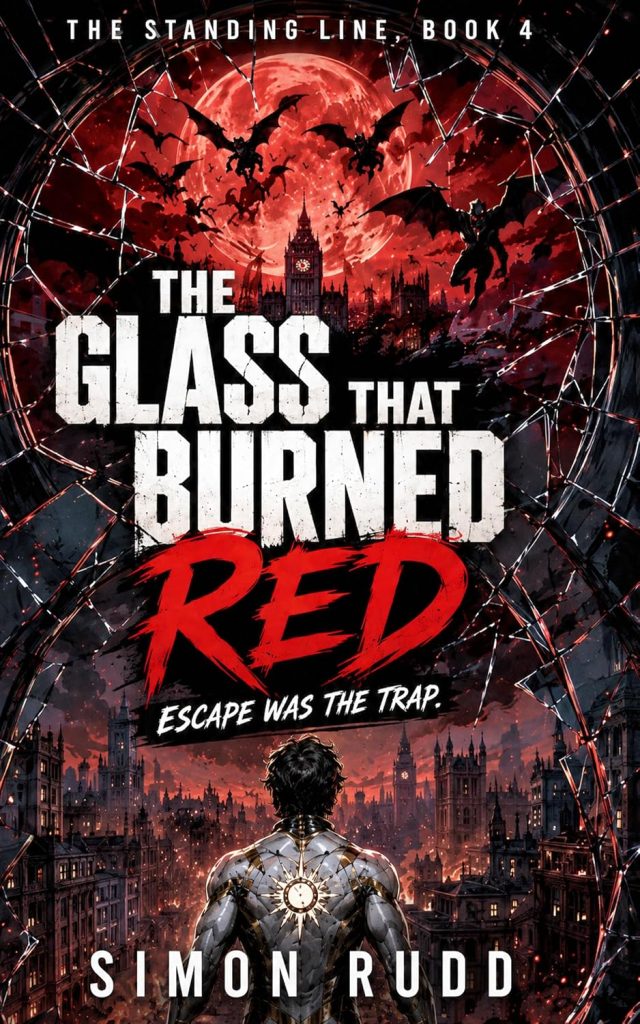
Ten years after the vampires took Britain, the dead don't haunt the cities. They hunt them.
Tobin Anstey was Dawn once — the light that pulled people out of the dark, the hero a whole city stood up to cheer. Now he's something the monsters have their own name for. Half-turned. Starving. Still standing between the frightened and the things that feed on them.
The stadium is ash. The depot is behind them. Dawn leads his survivors toward East Larkham Transport Interchange and its covered arcade — roofed routes, service tunnels, old maps, a way out of a city that wants them dead. On paper, it's the practical choice.
But the interchange is full of glass.
At first the reflections seem to help. A red angle in a bus window points to a safer door. A clean pane offers a shortcut nobody earned. Somewhere in the broken corridors of his own ruined power, a trapped rescuer is still trying to finish a rescue that ended a decade ago.
Then the warning appears, scrawled beneath the dead timetable boards:
NOT EVERY RED IS NOAH.
Some routes are true. Some are ash. Some are something far worse, wearing the shape of mercy — and the rules Dawn's people will live or die by are brutally simple. No easy angle. No single reflection. No following the dead.
Because the way out is no longer a place.
It's a hunger. And it knows the way home.
The Glass That Burned Red is the fourth book in The Standing Line — bleak, British, fallen-superhero vampire survival horror about a monstrous protector who refuses to feed, refuses to kneel, and refuses to look up. Perfect for readers who like their apocalypses rain-soaked, their heroes ruined, and their horror built on one unbearable question: what do you let yourself become to keep other people human?
Read the first chapter
Chapter 1 — Useful Things Leave Marks
The depot did not become home.
They got that much right.
No one named a sleeping place. No one chose a corner and made it theirs. No one tied cloth to a post and called it a family marker. No child was allowed to stack three useful things together and believe stacking had begun to mean safety.
Home had walls and habits. Home made people look for missing cups, favourite blankets, the nail where a coat belonged, the small kindness of leaving something where it could be found again.
The depot offered vehicle bays, water, grit bins, shutter chains, damaged buses, tool cages, old mirrors, covered inspection pits and enough dead civic usefulness to tempt exhausted people into staying.
So Morna made them strip it.
Not steal. Stealing sounded quick. This was slower and more honest: taking the useful pieces from a place before the place remembered it had once been obeyed.
“Cloth first,” she said.
Her voice carried badly because she did not raise it. People leaned in for her anyway.
Bay one had become a worksite of low hands and lower eyes. The main shutter stayed closed. The blue office stayed wedged open but unwatched, its black-painted glass covered in two layers of sack and one strip of old council curtain. No one crossed the bay without a reason. No one stood near bay three because victory had only made that door quieter, not kinder.
Morna sat on an overturned grit bucket with Merrit’s bandage wrapped around her hand and a tyre iron across her knees. She did not hold it. Everyone who knew Morna noticed. The tyre iron remained visible, close, available, but not offered to the world like an answer.
Tools had begun to look too much like permission.
“Cloth,” she said again. “Not the cleanest. The dullest.”
Clem held up a length of high-vis orange from a torn jacket. “This is dull if you’ve lost your mind.”
“Then put it down.”
“I was demonstrating the concept by failing at it.”
“You are always educational.”
“Thank you. I try to be a warning.”
Mabli smiled without letting it become sound.
Kit took the high-vis from Clem and threw it into the wrong pile.
“Bright,” they said.
Jory wrote the heading on a piece of flattened cardboard.
BRIGHT — NOT FOR COVER.
Beneath it, he had already written:
DULL CLOTH.
ROPE.
HOOKS.
MIRROR COVERS.
TROLLEY WHEELS.
SHUTTER PINS.
WATER CARRIERS.
USEFUL IS NOT SAFE.
He underlined the last line once, then stopped before making it a prayer.
Dawn watched him from beside the bus wash post, where Merrit had ordered him to sit and not bleed on anything needed for drinking. Ordered was too formal. Merrit had pointed at the post, pointed at the floor, and said, “There, or I start removing parts of you that are making poor decisions.”
He had sat.
The old Dawn had been good at standing where fear could see him. The current one was learning that a damaged man could help by staying out of the way while other people built the route.
His palms hurt.
The bloodlight had not settled.
Pain was better than hunger. Pain had edges. Hunger made suggestions.
Merrit crouched in front of him and unwrapped his right hand again. She had done it twice since Highwake had finally lowered her head and stopped being either wing or command. Each time, the wound looked less like a wound and more like a decision his body had not finished refusing.
Black at the edges. Red in the cracks. Pale light under the skin where the old power still knew how to burn.
“Don’t make that face,” Merrit said.
“I don’t know which face.”
“The one where you pretend you can’t smell your own hand trying to become a bad idea.”
Dawn looked away.
Merrit tightened the clean strip. Not gently. Gentleness wasted time if the patient was stupid enough to need pain.
Across the bay, Rhea sat on the floor with her back against the side of a council minibus. The bruises at her throat had darkened. Finger marks from Highwake’s grip lived there now, purple-black and intimate. She had wrapped a scarf high enough to hide them from the children, but not high enough to hide them from Dawn.
She had not vanished since the final crossing into bay one. Not completely. Her outline failed now and again at the edges, shoulder going thin, hair losing agreement with light, one hand becoming only rain shadow and old dust. Mostly she stayed visible, as if absence had become a room she no longer trusted herself inside.
Jack sat near her, sorting dull hooks from bright hooks. He did not look at her throat. Kindness, or training. In this group, most good things had become both.
“Why hooks?” he asked.
Rhea touched one with the tip of her finger. “For cloth.”
“We have hands.”
“Hands reach. Hooks can be set before reaching.”
Jack considered that. “Hooks don’t get curious.”
“No.”
“People do.”
“Yes.”
He placed the dull hook in the right pile.
Rhea’s mouth moved as if she nearly smiled.
Nearly was enough.
The depot roof ticked and whispered above them. Rain gathered in long runs along the corrugated panels and fell through old holes into buckets, trays, cut bottles and a cracked office bin with PAYROLL written on the side. Every container had been numbered. Every number had been checked by Kit. Every water measure had a mark beside it and a person assigned to carry it only until the next count.
No one owned water.
Kit had made that rule beneath the stadium. The city had given it teeth.
Now they moved through the bay with the water board tucked under one arm, Ivo’s grey cuff still tied beneath the pencil string. The cuff was darker than it had been before the depot, damp and grit-stained, worn by fingers that touched it only when they thought no one saw.
Dawn saw.
He wished, often, that he saw less.
Trewin sat near Jory with the copied records case between his knees. Not across his chest now. Clem had objected to that look enough times that even the doctor had learned. The case was wrapped in dull sacking and tied with rope so it looked less like a case and more like something awkward and uninteresting.
That was the hope, anyway.
Nothing in East Larkham remained uninteresting for long.
Trewin kept one hand on the knot and one hand in his coat where he had tucked the folded notes about Volunteer V, the origin pair, the damaged reports, the first myth with teeth. His spectacles were cracked at one corner. He cleaned them too often and made them worse each time.
“Stop touching the records,” Merrit called without looking up from Dawn’s hand.
Trewin’s hand froze.
“I wasn’t.”
“You were considering it with your fingers.”
Clem nodded. “She can diagnose intention now. Terrifying woman.”
“I could always diagnose intention,” Merrit said. “Most of yours has a rash.”
Mabli made the mistake of laughing properly.
Only for a breath.
The sound went up, hit the covered roof panels and came back thinner. Every head lowered. No one looked through the holes. The laughter died, not because laughter was wrong, but because the group had learned what upward instinct cost.
Kit turned the water board over and wrote on the reverse.
NO SKY HOLDS UNTIL REPLACED.
They stopped, looked at the words, and changed it.
NO SKY HOLDS.
Jory read it from the floor. “Good.”
“It isn’t a good rule.”
“No. But it’s a clean one.”
Clem looked at the words. “Can rules be clean?”
Morna answered before anyone else. “No. But they can be washable.”
Jory wrote that down too.
Clem watched the pencil move and sighed. “I need everyone to stop making me sound official.”
“You could stop speaking usefully,” Jory said.
“I’ve tried. It doesn’t last.”
The small sound that moved through the bay was not quite laughter this time. More like breath finding a crack.
Useful things leave marks.
Dawn did not know why the thought came then. Perhaps because the depot was full of them: the scraped floor where the bus had been dragged, the chalk routes Jory had drawn and half-erased, the covered mirrors with knots at their backs, the place where Highwake’s hand had pressed against wet concrete and stopped asking to be lifted, the minibus dent where Noah Kest had appeared for less than a second behind red glass, not dead, not safe, not free.
Useful things left marks.
So did traps.
So did heroes.
Merrit tied the bandage hard enough to bring him back.
“You’re thinking,” she said.
“That’s allowed.”
“Not with your hand lit.”
Dawn looked down.
Bloodlight had begun to seep between the cloth layers. Low. Red. Painful.
Merrit’s fingers closed around his wrist before anyone else saw enough to panic.
“One spark,” she said.
“It wasn’t even one.”
“It was rehearsing.”
Across the bay, Rhea’s head turned. Not towards the light. Towards the covered dent in the minibus.
Dawn followed her gaze despite himself.
The sack over the dent did not move. No red angle bled through. No ash gathered at the edges. No pale hand pressed from the other side. Only cloth, damp at the bottom, tied twice around the frame by hands that had refused to make hope easy.
Rhea looked away first.
Good.
Terrible.
Good.
Jory noticed and wrote nothing. Some things were counted better by not being put into the tin too soon.
Morna stood.
The bay understood the movement before she spoke. Knots were finished. Water lids tightened. Cloth folded. Rope coiled. Hooks wrapped in strips so they would not sing against metal while being carried. Two trolley bases had been stripped down to one working frame and one spare wheel. A plastic cleaning cart had become a low carrier for the weakest supplies because it had rubber wheels and no proud handle.
Proud handles caught on things.
Everything high was becoming suspect.
Morna surveyed the piles.
“Show me.”
Jory looked at Kit.
Kit nodded.
He read from the cardboard. “Dull cloth for mirrors, glass, puddle breaks if needed. Rope, six good lengths, four poor. Shutter hooks, twelve. Door wedges, eight useful, three noisy. Trolley frame, one. Spare wheel, one. Water, marked. Records, covered. Medical, with Merrit. Tools, with Morna unless assigned. Chalk, with me and Kit. Tin, with me.”
Clem raised a finger. “Crowbar, emotionally attached to me.”
“Crowbar,” Jory said, writing, “with Clem.”
“Emotionally attached.”
Jory looked at him.
Clem looked back.
Jory added, in smaller letters:
CLEM CLAIMS EMOTIONAL ISSUE WITH CROWBAR.
“Thank you.”
Morna’s mouth twitched. “Rejected bright items?”
Kit pointed to the wrong pile.
“High-vis. Clean plastic. Reflective office strips. Two intact mirrors. One chrome hubcap Clem liked.”
“I did not like it.”
“You said it had potential.”
“As a warning.”
“As a lure.”
“As a warning about lures.”
Kit looked at him.
Clem lifted both hands. “Fine. I liked the shiny death plate. I have grown.”
The hubcap stayed where it was, face-down under a sack, not trusted enough to break and not safe enough to carry.
Dawn stood too quickly.
The bay tilted.
Merrit caught his elbow, which annoyed them both.
“Sit back down.”
“No.”
“You say that as if it’s a complete medical argument.”
“We need to move.”
“We need you not to collapse in the first road.”
“I won’t.”
“You said that before the school.”
“I didn’t collapse in the first road.”
“You’re very proud of technical survival.”
Dawn did not answer because she was right, and because the taste in his mouth had changed.
Cold first. Then copper. Then the faint inward tug that came when reflective surfaces were nearby and waiting.
He turned towards the far side of the bay.
Beyond a line of covered bus mirrors and a half-open service hatch, Morna had laid out the old route boards taken from the depot office. Most had been useless: water-damaged, command-coded, too full of office arrows and vehicle procedures that had tried to become obedience.
One board remained.
Not a public map. Public maps wanted eyes. This was a maintenance board, ugly and functional, printed in black lines on yellowed laminate.
Fleet depot. Service road. Drain channels. Fuel yard. Staff access. Bus maintenance lane. East road.
Transport Interchange.
Jory had copied the last words onto his cardboard.
EAST LARKHAM TRANSPORT INTERCHANGE.
Not shelter.
Target.
Dawn walked towards it.
Merrit followed close enough to insult him if he fell.
The map showed the interchange as a knot of routes near the old city-centre bus lanes and rail access. Covered pedestrian ways. Taxi ranks. A shopping arcade attached like an afterthought or a parasite. Service corridors. Staff access. Maintenance stairs.
Covered movement.
That was the temptation.
No open civic ground. No long bus lane under the sky. No exposed yard where birds went still and everyone had to stare at boots while something winged passed overhead without proving itself.
Covered movement sounded like mercy.
Dawn mistrusted mercy when it arrived with a map.
“Too useful,” Clem said, arriving beside him.
Dawn glanced at him.
Clem shrugged. “I can learn patterns. I dislike it, but I can.”
Trewin wiped his spectacles again. “The interchange would have had emergency route boards. Service access to the rail underpass. Possibly staff stores. Public toilets with tanks. Vending units, if anything remains sealed. First-aid stations.”
“Maps,” Jory said.
“Many maps.”
“Glass,” Rhea said.
Everyone looked at her.
She had stood without sound. Her eyes stayed on the maintenance board, but Dawn knew she was seeing beyond it: ticket windows, timetable screens, bus windows, shopfronts, lift doors, polished floors, rainwater under roof glass, every surface that could show a route and every route that could learn hunger.
“Glass,” she said again.
Morna nodded once. “Then we dull what we can.”
“You can’t dull a building,” Rhea said.
Clem looked pained. “Please don’t say things like that where buildings can hear.”
Kit came up with the water board. “We don’t go because it’s safe. We go because it gets us farther than staying.”
“That should be carved above every bad decision we make,” Clem said.
“Low,” Jory said.
“What?”
“Carved low.”
Clem closed his eyes. “I hate this city.”
Outside, something scraped along the yard.
The group lowered.
Not dropped. Lowered.
Panic threw people down. Discipline made them smaller on purpose.
Dawn moved to the covered viewing slit beside the shutter. He did not look through the upper gap. He watched the lower seam, where rainwater ran across concrete and gathered grit. Shadows moved there better than bodies did. The yard beyond held dead vans, broken mirror stems, puddles made blind by cloth, and the black streak where Highwake’s last drag had crossed towards the gate.
No wingbeat. No command. No Seren Holt asking to be lifted.
Only ordinary vampire stillness somewhere beyond the fence.
Several.
Low to the ground.
Waiting because daylight was poor but not gone, and poor daylight could still hurt things that had forgotten sun but not pain.
“Old ones near the yard,” Dawn said.
Clem tightened his grip on the crowbar. “How many?”
“More than two.”
“I dislike the humility of that estimate.”
“They’re not close enough yet.”
“Comfort dies in your mouth, doesn’t it?”
Morna came to the shutter seam and crouched beside Dawn. “Can they block the main yard?”
“Yes.”
“Then we don’t leave through the main yard.”
Clem gave a tiny, despairing laugh. “We are in a depot. It is mostly yard.”
Morna pointed to the maintenance board. “Under first.”
Kit nodded. “Then out low.”
The phrase moved through those close enough to hear it. It had already saved them once. Repeated now, it became less memory and more route.
Under first.
Then out low.
Jory wrote it again.
Dawn looked at the board. The old wash channel under bay two connected to a service drain. The service drain ran beneath the fuel yard, past the inspection pits and under the outer gate. It did not go far. It did not need to. It only had to put them beyond the yard watchers and nearer the bus maintenance lane.
A hard route.
Wet. Narrow. Heavy with old oil and rainwater and whatever the depot had washed from vehicles before the fall.
Not clean.
Not generous.
Good.
“Door panel won’t fit,” Merrit said.
Everyone looked towards the woman they had carried from the archive, then through the depot, then into bay one. She lay on the lowest trolley frame now, strapped in coats and dull cloth. Still breathing. Still alive by argument.
“No,” Morna said. “Trolley frame might.”
“Channel lip?”
“Bad.”
“Width?”
“Worse.”
Clem nodded to himself. “Excellent. The route is disgusting, difficult and humiliating. That means it might not be lying.”
Rhea’s gaze flicked towards him.
For the first time since Highwake, she looked as if someone had said something useful she had not expected.
“No easy way,” she said.
Jory wrote it.
Then stopped.
He looked at Dawn.
“No easy angle,” Dawn said.
The words were not a rule yet. Not properly. They were only a shape the next place would sharpen. But everyone close enough to hear felt the weight of them.
No easy angle.
Morna repeated it once, testing the tool in her mouth. “No easy angle.”
Kit added it below No Sky.
Not replacing.
Adding.
Rules did not retire because a new horror arrived. They travelled until the world proved which ones still breathed.
They began preparing the drain route.
The depot made them pay for every useful thing it gave.
The wash-channel cover had to be lifted without letting the metal scream. Richard wedged cloth beneath one edge. Morna used the tyre iron carefully, not as a weapon but as a lever. Clem held the far side and complained under his breath with such steady rhythm that Jack began timing his pulls to the muttering.
“That’s not helping,” Clem said.
“It is,” Jack said.
“Then I retract nothing.”
The cover rose.
The smell came next.
Old oil. Stagnant rain. Grit. Rust. Dead leaves. Something animal that had gone in and not come out. The stink moved through the bay low and thick, and people were grateful for it because it was honest.
Merrit leaned over the channel and made a face. “If infection had a basement.”
Trewin, unwisely, said, “Most infections don’t—”
Merrit looked at him.
He stopped.
“Good,” she said.
The channel was wide enough for one crouched adult, two children if one was terrified and the other sensible, and the stripped trolley if carried on an angle. Its sides were slick. Its roof dropped lower after six yards. Water moved along the bottom in a thin black sheet, not deep enough to drown quickly, which meant it was deep enough to be hateful for a long time.
Dawn listened into it.
No heartbeat. No dead stillness. No false voice.
Only water, rat movement somewhere beyond the bend, and the echo of old wheels passing above a place no one had meant for escape.
Useful.
Not safe.
Kit organised the order.
Children who listened first. Children who panicked second but could be held. Wounded who could crawl. Wounded who needed dragging. Water carriers. Records. Jory. Trewin. Merrit. Morna. Clem at the rear until he objected and was ignored. Dawn where Dawn was least able to become the answer.
Not at the front.
“No,” Dawn said.
Kit did not look at him. “Yes.”
“I go first.”
“Rhea goes first.”
Rhea’s head lifted.
“No,” Dawn said again.
This time the whole bay heard the old command under it.
Not vampire command.
Worse in some ways.
Hero habit.
Kit turned.
The water board hung at their side. Ivo’s grey cuff touched the pencil string with a soft tap.
“You don’t own first,” they said.
The bay became still.
Dawn felt the words reach all the places hunger liked to sit. First through doors. First into smoke. First between teeth and throat. First so others could call him protector and not ask what the protection cost him.
The infection in him disliked Kit’s sentence.
Dawn trusted the sentence because of that.
Rhea stood beside the open channel. Bruises dark above her scarf. Face pale. Hands not quite agreeing with light.
“I’ll go first,” she said.
Dawn looked at her.
She did not look away.
“Not gone,” she said. “Visible enough for the people behind me. Absent enough if something waits too close.”
“That isn’t safe.”
“No.”
“Rhea.”
“Don’t make visible mean obedient.”
The words struck the bay differently from Kit’s. Smaller. Sharper. More personal.
Dawn stepped back.
One step only.
Enough.
Rhea climbed into the channel without vanishing.
Water took her boots. Oil shone around her ankles. She crouched, placed one hand against the slick wall, and looked back.
Not up.
Never up.
“Low route clear to the first bend,” she said.
Jory wrote it.
Then the first child went after her.
Jack.
He did not ask why. Perhaps he understood that someone had to teach the others how fear could fit through a small space without screaming. Perhaps Kit had told him with a look. Perhaps the kept place beneath the school had already taught him that small bodies learned ugly routes before adults admitted the route existed.
He crouched, swallowed hard, and entered the drain.
Clem watched him go.
“Lad,” he said.
Jack looked back.
“Make it a list.”
Jack nodded. “Water. Wall. Bend. Boots. Breathing.”
“Good.”
The boy disappeared after Rhea.
People moved.
Slowly at first. Then with the ugly competence that had become the group’s only miracle.
Water carriers crawled with bottles wrapped against their chests. Hooks were passed hand to hand. Rope went through the channel in coils, not loose, because loose rope liked ankles. The trolley frame took four adults and all of Morna’s patience to angle down. The woman on it groaned once when the frame dipped.
Merrit put her face close to the woman’s ear. “You complain later. That is medical advice.”
The woman breathed.
Agreement enough.
Jory went after the records, tin wrapped in cloth and tied under his coat so it would not knock against the wall. Trewin went in badly and improved when Mabli told him he was breathing like a man trying to fog glass.
“I’m not near glass,” he said.
“Practise.”
He practised.
Dawn remained in the bay with Morna, Clem, Merrit and the last six survivors.
Outside, the yard scrape came again.
Closer.
A vampire hand appeared beneath the shutter seam.
Long fingers. Grey. Nails split black. It slid under the gap as if the whole body were only a thought behind it. The fingers felt along the wet concrete and found the edge where Highwake had dragged herself earlier.
They paused there.
Touched the mark.
Not reverence.
Interest.
Dawn’s bloodlight woke hard.
Hunger answered first.
Then pain.
He closed his fist.
Merrit was beside him at once. “No.”
“It’s at the shutter.”
“We know.”
“It knows the mark.”
“Then it can admire it from outside.”
The fingers withdrew.
Clem swallowed. “That thing just learned something, didn’t it?”
“Yes,” Dawn said.
“Do we have time for me to hate that?”
“No.”
“Then I’ll carry it with me.”
Morna pointed to the channel. “Move.”
The last survivors went in. Morna followed, tyre iron wrapped in cloth across her back. Merrit climbed down next after threatening Dawn with three separate punishments if he used light before she was out of reach.
Clem waited at the edge.
“After you,” he said.
Dawn looked at him.
Clem’s face was pale. Frightened, angry, alive.
“I am not being noble,” Clem said. “I don’t want you behind me where I can imagine what your hands are doing.”
“Go.”
“That sounded heroic. Say it worse.”
“Get in the drain, Clem.”
“Better.”
He went.
Dawn stayed one heartbeat longer.
Bay one stood stripped behind him. No home. No comfort. Only covered glass, chalk marks, the wrong pile of bright things, the old route board and the covered dent in the minibus where Noah Kest had appeared and vanished.
The sack over the dent moved.
Not from wind.
Dawn froze.
A red thread shone through the weave.
Thin.
Angled.
For one second, the bay changed inside the cloth. Not enough to open. Not enough to show Noah’s face. Only a line of red from the dent to the wash-channel mouth.
Ash gathered along the bottom edge.
Four grey specks.
Holding.
Then the red went out.
The ash fell into the drain water and vanished.
Dawn did not reach for it.
That mattered.
He climbed down into the channel.
The depot did not call after him.
Almost worse.
The drain carried them under the yard in darkness that smelled of oil and rain. People moved by touch, by whispered lists, by the rope along the left wall and the faint scrape of Rhea’s boots somewhere ahead. Once, something moved above them, heavy and slow, crossing the fuel yard grating. Everyone stopped. Water ran around knees. A child breathed into a sleeve. Dawn listened until the weight passed.
No one looked up because there was no up worth trusting.
The channel opened beyond the depot fence through a rusted outflow half-hidden by weeds and broken concrete. Rhea emerged first into the lee of a low retaining wall. Jack came after her covered in black water to the waist and looking older by another year. One by one, the group pulled itself into the narrow service strip beyond the yard.
East Larkham waited ahead in wet greys.
The depot sat behind them, useful and not safe, giving nothing more.
Jory counted as people emerged.
Not aloud.
Lips moving. Pencil marks on damp card. Names touched as shapes, not spoken for the city.
Kit checked water.
Merrit checked the woman on the trolley frame.
Morna checked the route behind.
Clem checked his crowbar, then the sky without looking at it, which meant he watched the puddles and the wall and the way birds did not yet care.
Dawn listened.
Vampires behind. Vampires somewhere to the west.
No wingbeat. No command. No red.
Ahead, beyond the service strip and a line of dead buses, the city changed its shape.
Roofs joined over the road. Old pedestrian walkways crossed between buildings. Timetable boards hung at angles. Signs pointed towards buses, rail access, taxi ranks, public toilets, shopping arcade, information, exit. Glass caught the rain everywhere: bus windows, shelter panels, ticket-office fronts, roof panes, shopfronts beneath the covered arcade.
The East Larkham Transport Interchange stood under wet glass and old directions.
Covered.
Useful.
Waiting.
Jory came to Dawn’s side and looked only at the lower signs.
“That’s it,” he said.
Dawn felt the bloodlight in his palms answer the reflections before his mind did.
Not flare.
Listen.
Rhea stood very still beside the outflow, oil-dark water dripping from her coat. Her bruised throat moved once.
“No easy angle,” she said.
This time, Jory wrote it as a rule.