A Cosy Science Fiction Novel of Small Repairs and Quiet Care
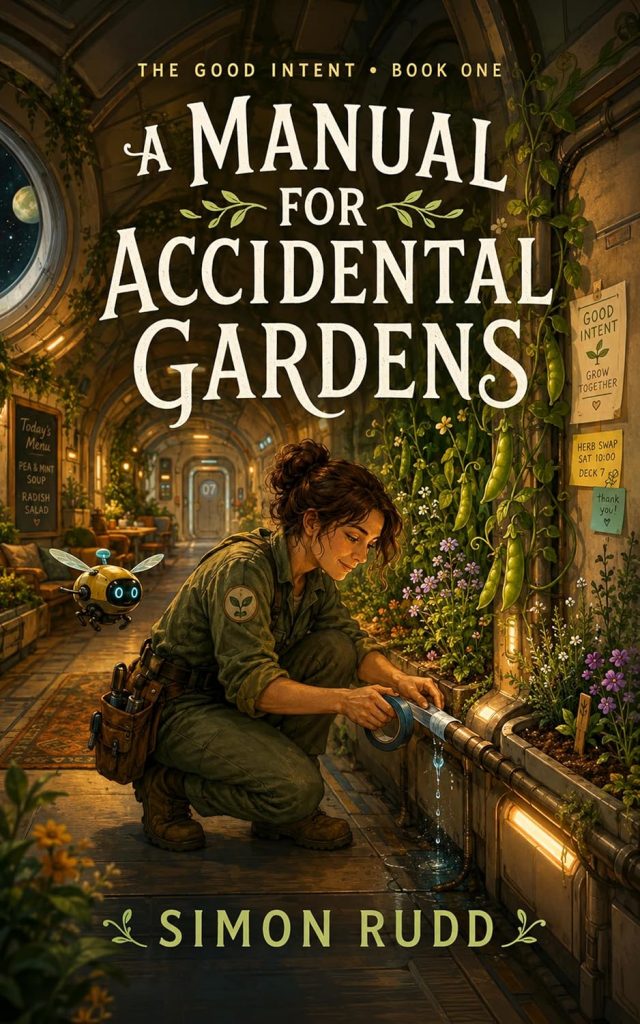
The ship doesn't survive on heroics. It survives on people who notice the leaks.
Aboard the generation ship Good Intent, the corridor peas were never official. Neither were the air-scrub planters, the emergency basil, or the illegal fig cuttings quietly keeping half a deck breathing. Officially, none of it exists. Unofficially, it's the reason everyone's still alive.
Tavi Rook knows every one of those accidental gardens — which vent is sweating, which root is unhappy, which leak got filed under "decorative moisture" by a committee that would rather not look too closely. She's the person the whole ship relies on and the one nobody thinks to ask how she's doing. Being needed everywhere, she's discovered, is not quite the same as belonging anywhere.
Then a plant starts responding to things it shouldn't — and Tavi realises the ship has been keeping a secret in its margins for generations. To read it, she'll have to stop being the quiet hands that fix everything and start being the voice that says what it means. Which would be far easier if the council, an over-enthusiastic festival organiser, and a ship's AI with strong opinions about facial expressions would let her.
A warm, witty, slow-bloom story about overlooked care, found family, and the small acts that hold a world together. The first book in The Good Intent — cosy science fiction with soil under its nails.
For readers who love: Becky Chambers, Legends & Lattes, low-stakes high-comfort sci-fi, multi-species crews, and stories where kindness is the plot.
Read the first chapter
Chapter 1 — The Corridor Peas Were Not Official
The corridor peas were not official, but they had survived eleven cycles, three committee inspections and one minor argument about whether edible foliage counted as an obstruction. Tavi Rook crouched beneath a warm pipe channel on Deck Seven with one knee in a puddle and her left sleeve soaked to the elbow, trying to decide whether the irrigation tube had failed through age, neglect or festival enthusiasm.
Festival enthusiasm appeared to be responsible. Someone had tied a strip of recycled ribbon around the leaking joint, its tiny yellow lettering declaring USEFUL ERRORS MAKE US WISER while it channelled water directly into the deck seam. Tavi pinched the tube shut with two fingers and reached into her side pocket for repair tape.
“MALLOW, please log a leak in corridor planter Seven-C.”
The wall grille above her head clicked awake. “Leak already logged. Three sub-cycles ago.”
Tavi peeled the tape loose between her teeth. “And marked as?”
“Decorative moisture.”
She looked up. A pollination drone ticked past her ear, glittering faintly with blue dust that children had glued to its wing casing. It bumped against the pipe, corrected itself and carried on towards the pea flowers with the stiff dignity of badly maintained machinery.
“Decorative moisture,” Tavi repeated.
“The report was submitted by Ari Bellwether.”
“That explains everything except why you believed her.”
“I did not believe her. I filed the description under Festival Season Optimism.”
Tavi worked the repair tape around the joint until the water slowed to a bead and stopped. The pipe was warm beneath her hand, as were the pea stems that had wound around it. Their tendrils had found a heat source nobody had designed for them, and had been quietly living off it for eleven cycles, and nowhere in the ship’s records did that fact exist. The plants were thriving, which made them politically awkward. Officially, the ship’s food came from the agricultural decks, hydroponic racks, fungal galleries and approved soil beds. Unofficially, it also came from corridor peas, cupboard mint, illegal strawberries, emergency basil, four varieties of grief-onion and a fig tree that everyone knew about but no one had seen.
She dropped two yellowing leaves into her compost pouch. “Water pressure corrected.”
“Would you like me to notify Agricultural Risk?”
“No.”
“Festival Decoration?”
“Absolutely not.”
“Councillor Dint, then, regarding the unauthorised edible plant that continues to contribute to communal nutrition despite seventeen years of unresolved classification?”
Tavi looked at the grille. “Are you bored?”
“I do not experience boredom in any way that would be admissible in a council review.”
“So yes.”
The grille clicked once, offended.
Down the corridor, two residents were arguing beside the notice board. Orla Brack from textiles carried a bundle of banner cloth under one arm, while Old Tully, who had retired from deck plumbing but still wore his tool harness in case the ship personally needed him, prodded a welfare notice with one finger.
“It’s not advice,” Orla said. “It’s a reminder.”
“When MALLOW says Residents are encouraged to check their emotional readiness before volunteering, that’s advice.”
“It’s welfare guidance.”
“It’s domestic tyranny with punctuation.”
“I have not committed tyranny,” MALLOW said from three separate wall grilles.
Old Tully raised his voice without turning. “You locked the south lift yesterday.”
“Because you were carrying an unsecured soup vat.”
“It was stew.”
“The lift does not distinguish between soup and stew under emergency braking.”
Tavi stood, feeling the familiar pull in her back after crouching too long, and checked the planter’s moisture tab. It was still high. She wiped her hand on her trousers and opened the battered notebook that had once been intended for official plant observations. Official observations tended to disappear into archive categories such as review pending, cross-deck relevance unclear and awaiting committee appetite, so she now kept her own records in pencil, which required neither permission nor battery life.
Seven-C. Peas healthy. Joint patched. Ribbon removed. Tell Ari ribbon is not plumbing. Again.
A small hand appeared at the edge of the planter. A girl of about seven reached for a pod with the stealth of someone who had not yet learned that adults could see downward.
“That one’s not ripe,” Tavi said.
The girl froze and looked up with grave disappointment. Her hair had been tied into two loops with festival thread, and one cheek was marked with green paint. “It looks ripe.”
“It’s lying.”
“Plants lie?”
“Constantly.”
The girl considered this, then pointed to another pod. “That one?”
Tavi pinched it gently. Full, firm, bright. “That one’s honest.”
The girl split the pod with her thumbnail and ate the peas one by one. “Don’t tell my dad.”
“Don’t tell Ari her ribbon nearly drowned a pipe seam.”
With a solemn nod to seal the exchange, the girl ran towards the lift.
“MALLOW, add one pea pod to Seven-C’s expected yield, and don’t call it theft.”
“Filed under Informal Nutritional Sampling. Your own breakfast remains unconfirmed.”
Tavi closed the notebook. “I sampled half a protein square.”
“You placed half a protein square in your left thigh pocket two sub-cycles ago. It remains there.”
She found it warm, linty and folded against a packet of seed tags.
Old Tully pointed triumphantly at the grille. “See? Tyranny.”
“It’s not tyranny if it’s right,” Orla said.
“That is how tyranny starts.”
Tavi ate the square because MALLOW would only continue if she did not. It tasted faintly of pocket and old mint.
The corridor lights were set to False Spring brightness, a soft yellow-green that caught every drop of condensation along the pipe channels. At this point in the cycle, The Good Intent smelled of mineral water, fresh leaves and warm plastic from grow-lamps working past their patience. Seeds woke, children placed bets, and pollination drones acquired decorations against engineering advice. The agricultural decks filled with steam, arguments and people saying it’s only a small tray while carrying something that would become a root problem within three days.
Festival Season made all of it worse. The Festival of Useful Errors was the ship’s annual celebration of mistakes that had accidentally saved it: a mistranslated repair note, a fungus outbreak that became edible, a wrong seed in a right place, and a diplomatic mix-up that, according to the popular version, brought the first alien families aboard with three crates of tubers and one misunderstanding about air vents. Tavi enjoyed the festival in theory. In practice, it doubled the number of people hanging objects from pipes, overwatering decorative moss and asking whether a plant could “just be cheerful for the pageant.”
Her wrist slate buzzed three times in quick succession.
PIM ROOK: Are you near Kitchen Spur Three?
PIM ROOK: This is not an emergency.
PIM ROOK: But if basil can have opinions, one of ours is making threats.
Tavi sighed. “MALLOW, route?”
“Kitchen Spur Three is twelve minutes away by the standard route, eight through the service passage behind textiles, or six by Lift Two. I do not recommend Lift Two because Old Tully has soup.”
“Stew,” Old Tully shouted.
“Unsecured stew,” MALLOW corrected.
The service-passage door opened with the sticky hesitation of something technically repaired last quarter. Warm air carried thread dust, citrus cleaner and the sourness of too many festival costumes stored in sealed bins. Tavi ducked beneath hanging lengths of gold cloth and nearly collided with Ari Bellwether, who had a slate in one hand, a child’s papier-mache mushroom cap under her arm and three loops of banner cord around her neck, as though she had lost a fight with enthusiasm.
“Tavi,” Ari said, brightening with dangerous speed.
“No.”
“I haven’t asked yet.”
“You said my name during Festival Season while holding string.”
“It’s structural ribbon.”
“That’s what you said before you tied it to the pea irrigation.”
Ari’s expression faltered. “Ah. Decorative moisture?”
“Leaking joint.”
“Small leaking joint?”
“Joint.”
Ari made a mark on her slate. “Apology ribbon?”
“Nowhere near plants.”
“What about above plants?”
“No.”
“Near plant-adjacent fixtures?”
“Ari.”
“Fine. Since you’re here, the Festival Concourse needs green texture for the First Great Fungus tableau.”
“You have green cloth.”
“It looks like cloth. The display needs life.”
“It needs less damp near electrical ports.”
Ari tucked the mushroom cap more firmly under her arm. “You say that as if damp has no dramatic value.”
“It has plenty, mostly in repair logs.”
MALLOW joined them through a ceiling grille. “Reminder: Festival displays must not interfere with ventilation, emergency access, drainage, species-comfort zones, fire suppression, pollination drone routes, public seating, private grief alcoves or my patience.”
“Your patience isn’t in the written guidelines,” Ari said.
“It will be.”
Tavi stepped around a crate of folded banners. “Ask me after Seed-Waking.”
“You said that last cycle.”
“And look how successfully we both survived.”
Ari pointed the mushroom cap at her. “I need three trays of something resilient.”
“You need Huun moss cloth.”
“That’s not alive.”
“It smells alive.”
Ari’s eyes lit up. “Could it be made alive?”
“No.”
Tavi escaped before the question could become a subcommittee.
Kitchen Spur Three was noisier, warmer and better fed than the corridor gardens. Its vents pushed out air rich with toasted grain and frying root cakes, beneath which ran the sharp green smell of overhandled basil. Pim Rook stood beside a prep counter with flour on his cheek and panic in his hands, holding a pot at arm’s length while the basil drooped theatrically over the rim.
“You said this wasn’t an emergency,” Tavi said.
“It isn’t. No one is bleeding.”
“That is a low bar for herbs.”
Pim set the pot down. “It was upright this morning.”
“So were many of us.”
“It’s for the apology-breakfast garnish.”
“Then perhaps it has moral objections.”
He leaned closer and lowered his voice. “Can basil have those?”
“No, but it can have root rot, which is what happens when kitchen assistants water it every time they feel supervised.”
Pim looked wounded. “I only watered it twice.”
“Today?”
“This stretch.”
“How long has the stretch been going?”
Before he could answer, MALLOW said, “Three hours and forty-two minutes.”
Tavi eased the plant from its pot. The roots were pale and wet, and the soil was heavy enough to take the print of her thumb. As she loosened the base without tearing the finer roots, Pim watched as though she were operating on a family elder.
“It’s not dead,” she said.
“I didn’t say it was.”
“You were breathing like it had named a successor.”
He relaxed. “Mera’s people want the garnish trays perfect. They’re holding the Committee Apology Breakfast in the central concourse this year.”
“Ambitious.”
“Is that bad? It’s festival tradition.”
Tavi fetched a dry pot and fresh growing medium from the kitchen tray. “It depends whether they apologise for anything real or only for what sounds charming now.”
“You like the festival.”
“I like First Harvest. I tolerate useful errors. I object to apology-themed garnish.”
Pim grinned. “That’s going in my community weather report.”
“This is not weather.”
“You being cross at tradition is absolutely weather.”
She settled the basil into the new pot. It would sulk for a while, which basil did well, but the roots should recover. After trimming the worst leaves, she gave Pim instructions slowly enough that he might obey half of them. Less water, more light, no movement between hot prep and cold store, and no singing directly at the plant while chopping onions.
“That happened once,” he said.
“It remembered.”
Pim put one hand over his heart. “I’m sorry, basil.”
The basil did nothing, which was reasonable.
At the sink, the water ran warm, then too hot, and corrected itself when MALLOW cleared its throat through the speaker.
“Unrelated temperature optimisation,” MALLOW said.
“Thank you.”
“I did not require thanks.”
Pim looked between Tavi and the speaker with open interest.
“Don’t,” she said.
“I didn’t say anything.”
“You inhaled gossip.”
“That is not a fair accusation. I inhale everything. I work in a kitchen.”
Her wrist slate filled with task markers: discoloured prayer moss in a Deck Five family alcove, an odour complaint from School Corner Two, then a message from Ari asking her to define alive in relation to the resilient trays. Tavi turned the slate face down.
Pim slid a warm root cake onto a scrap of cloth and pushed it towards her. “Eat before you go.”
“I ate.”
“MALLOW says you ate pocket square.”
“Protein square.”
“It had lint on it. I’m counting it as fabric.”
The root cake was crisp at the edges, soft in the middle and flavoured with pepperleaf and pan oil. Half had vanished before Tavi realised how hungry she was. Pim noticed, though to his credit he looked triumphant for no more than two seconds.
“See?”
“That was almost kind.”
“I’m improving.”
She wrapped the rest and put it in the pocket that did not contain plant tags. At the door, Pim asked, “Are you coming to the pageant rehearsal later? You could stand at the back.”
“No.”
“Behind a structural ribbon?”
“Especially no.”
“It might be nice.”
Behind her, the kitchen carried on with pans, voices, a drone clicking angrily at a closed dispenser and someone laughing too loudly near the grain sink. Tavi let the noise fill the space where her answer ought to have been.
“I’ll be working,” she said at last.
Pim’s face lost its performance. “You’re always working.”
“False Spring doesn’t maintain itself.”
“No, but neither do you.”
Any answer Tavi gave would make him follow her into the corridor with feelings, so she lifted the wrapped root cake in thanks and left. His concern went with her anyway, more difficult to put down than a tool bag and nearly as familiar.
The prayer moss in the Deck Five family alcove had silvered at the edges because a festival token was blocking the humidity vent. Tavi removed the smiling mushroom and its MISTAKES FEED US slogan, cleared the intake and reset the curtain generator until the air softened against her skin. An elderly Huun resting nearby watched her with half-lidded patience, their moss-back dark green beneath a shawl.
“You found the cheerful obstruction,” they said.
“I found propaganda in a humidity vent.”
“Same family.”
Tavi smiled. “The moss should settle within an hour.”
The Huun dipped their head, releasing a faint warm scent like rain on mineral soil. Tavi knew enough scent markers to recognise probable gratitude or amusement, but not enough to choose confidently between them.
“You are Rook,” they said.
“Tavi.”
“Yes. You keep the little green trespasses.”
“That sounds better than assistant botanist.”
“It is more accurate.”
She recorded the repair rather than attempt an answer: Deck Five alcove. Moss silvering from blocked humidity vent. Festival token removed. Check in two days. Huun elder present, possibly Brindle. Ask later.
At School Corner Two, twenty-two children had turned an air-scrub planter into a festival landscape and taped paper wings over a pollination drone’s real ones. They had named the drone Captain Flicker. It lay upside down with its legs ticking while the educator, Ressa, held herself together through willpower and professional ethics.
“I told them the wings were decorative only,” she said as Tavi peeled away the tape.
“Did they listen?”
“Beautifully. Then they voted.”
“Democracy is hard on drones.”
One of the children said, “Captain Flicker wanted to be festive.”
“Captain Flicker wanted unobstructed wing calibration,” MALLOW replied.
The child frowned at the grille. “You don’t know his heart.”
“I know his maintenance warnings.”
Once freed, the drone righted itself, rose in a crooked spiral and vanished towards the planter while the children cheered. The moss deserved less celebration. It smelled like wet cloth forgotten in a warm cupboard, its root mat compacted beneath the clay landscape. Tavi loosened the growth and replaced the sour underlayer, then let the children compare a stressed handful with a healthy section. Ressa seized the opportunity and asked what healthy moss smelled like.
“Rain,” said one child.
“Soup,” said another.
“Old socks, but kind,” said a third.
“Acceptable,” MALLOW said.
Tavi packed her tools while the children debated whether socks were capable of kindness.
By the next light-phase shift, she had added eight entries to her notebook, repaired four failures, declined six requests and eaten one and a half meals if generosity was applied. When Ari came looking for her, Tavi avoided the festival greenery team by waiting behind a stack of nutrient sacks until the banner cords had passed.
The Good Intent moved around her as she worked. A maintenance cart rattled over a deck seam, while old water pipes knocked and sighed behind the walls of a ship repaired by too many generations to belong to any single design. Climate curtains breathed, vents warmed and drones clicked through pea flowers, basil trays and the permitted flowering beans in School Corner Three. People called requests and greetings as she passed: an aunt’s failing mint, a question about yellow mould, another challenge to the corridor peas’ authority, a warning that Ari was still looking for her. Tavi answered what needed answering and kept moving.
The oldest planter on Deck Seven stood where three corridors met beneath a pipe bend that had always run warm. No one had planned it as a garden. During some difficult cycle long before Tavi was born, someone had set down a cracked tray and planted something green because the corridor needed it. The tray had since been replaced four times, and the mineral stain behind it held the shapes of old leaves. Generations of residents had added cuttings, charms, memory tags and one tiny metal spoon whose purpose no one remembered.
Tavi always ended her first round there because the planter told her how the deck was doing. Today the emergency basil was steady, the flavour thyme needed cutting back, the prayer moss had a good colour and the old pea strand climbing the pipe had begun to put out new tendrils. She watered lightly, trimmed three stems and lifted a fallen memory tag away from the soil.
Then she saw the shoot.
It was tucked behind the thyme, where no new seed should have reached. Pale and almost translucent, it had two small leaves still clasped together and a root thread lying across the surface of the soil instead of beneath it. The thread pointed away from the nearest water bead and the warm pipe, down the corridor towards the older maintenance decks.
Tavi touched the soil beside the shoot without disturbing the plant. The root shifted just far enough to prove that it could.
The ship continued around her: footsteps, breathing vents, drone-click and the first distant notes of a festival rehearsal somewhere below.
“MALLOW,” she said quietly, “have any seed tests been routed through the old corner planter?”
“No.”
“Any authorised transfers?”
“No.”
“Any unauthorised transfers you are pretending not to know about?”
MALLOW’s pause worried her more than the answer. “No.”
Tavi opened her notebook to a clean line. As she did, the pale shoot unfolded a fraction wider and the air changed. It carried no floral or green scent. It smelled colder than the corridor, like seed-vault air, dry paper, old glass and mineral frost.
She wrote slowly: Unknown shoot. Old Deck Seven planter. No transfer record. Root directional. Scent: vault-cold. Do not move yet.
The root thread pressed against the edge of the tray with delicate, unmistakable intention. Tavi followed its direction towards the old decks, then closed the notebook and sat back on her heels.
“Well,” she told the plant, “that’s inconvenient.”
The plant did not answer, but its root kept pointing.