A weird wild west novel
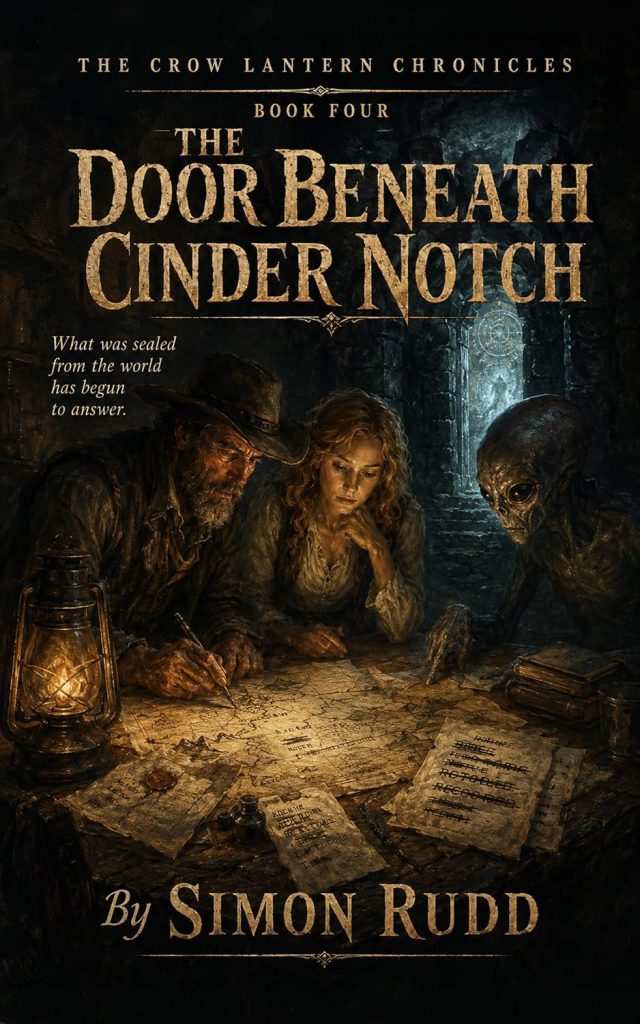
Four marks on the map now. Glassfall. Ashspur. Hollow Star. And a place where a road used to turn.
An army patrol rode into Cinder Notch and did not ride out. Two horses came back. One man came back, and he can describe a dead rider down to the patched thumb of his glove — but the roster has a clean gap where that rider's name should be, and every day the men who knew him find him harder to hold in mind.
Cinder Notch does not simply kill people. It takes them out, and then it takes out the taking.
Major Halden Pierce arrives in Kettle Cross with two wagons, an escort, and the habit of turning danger into proof. He is not a fool and he is not a brute, which makes him worse than anything Duskline ever sent: he wants an accurate record, he has the authority to compel one, and he intends to signal into the notch and see what answers.
What lies under Cinder Notch is not a road. Eli's people did not open it. They closed it — and the seal that holds it shut is made of absence, and it was already wounded before any human came near.
Clara Sayers has spent three years insisting that the truth must be written down. At Cinder Notch she meets the harder half of her own rule. Some accounts are not testimony but instruction. A route described is a route that can be walked twice. A name set down plain is a handle for something to take hold of.
So she keeps three pages instead of one: the full account, the safe account, and the sheet that must never be copied.
And on the last night, at Jonah's table, with the lamp low and the pencil still loose in her fingers, Clara's hand moves on its own — and writes the one word she has spent four days refusing to set down.
The Door Beneath Cinder Notch is the fourth volume of The Crow Lantern Chronicles. Its final page opens directly onto Book Five, The Hunter at Crow Lantern Creek.
The series begins with Book One: The Light Beyond the Ridge.
Read the first chapter
Chapter 1 - The Starless Mark
Clara Sayers had learned that truth could be sharpened until it cut the wrong hand.
That was why she sat at Jonah Latch’s table with three pages beside her instead of one, the lamp trimmed low, the shutters fastened, and her best ink thinned with a little water so it would not shine too darkly against the paper. A full account lay under her left hand, close-written and cramped in places where fear had outrun neatness. A safer account lay beneath her pen. Between them sat a third sheet, folded once, then folded again, then turned so the blank side showed upwards.
That third sheet was for what must not be copied.
The cabin smelled of lamp oil, leather, coffee grounds and the dry mineral dust that never quite left their clothes now. Even with the door barred and Jonah’s rifle standing in its accustomed corner, Clara could not persuade herself that the room was small enough to be safe. A few weeks ago, this table had been a place where she set down cups, bread, bandages and questions. Now it seemed to hold half the unsettled country: Glassfall, Ashspur, Hollow Star, and all the marks between them.
She dipped the pen and wrote carefully.
The Hollow Star Mine did not speak in the manner of a human witness. It held impressions, injuries, signals and repeated distress. It should not be described as a ghost, a miracle, a confession, or a machine built for ordinary use.
She paused, listening to the sentence in her head. Too plain in one direction, too cautious in another. She had learned to distrust sentences that could be read by fools with authority.
Across the table, Eli watched the moving point of the pen.
He sat on the bench Jonah had altered for him after Glassfall, with folded blankets behind his narrow back and a strip of Jonah’s old coat over his shoulders against the cold. Nothing about him had been made on this world, and the months since had not taught his body to want its weather. His skin had its faint river-stone sheen in lamplight, less blue than grey tonight, with the fine pale seams along his throat opening and closing more slowly than Clara liked. Hollow Star had taken something out of him. Not blood, not exactly strength, not any loss Dr Mara Wicks could have measured with fingers to a pulse. It had left him quieter in a way that seemed less like rest than distance.
His long hand lay near the edge of the table, fingers bent under, not touching the papers.
That, too, was new.
At first he had touched everything. Wood grain, tin cup, Clara’s sleeve, Jonah’s revolver until Jonah had said, very mildly, “No,” in a tone that would have discouraged weather. Eli had been hungry for the world then, afraid of it but hungry all the same. Now he watched paper as if paper were a loaded weapon.
Clara wrote another line.
Glassfall warned.
She looked towards Eli. His eyes — too dark at their centres, too bright at their rims — shifted from the page to her face.
“Glassfall,” she said softly.
Two words for a thing that had come down out of the sky in front of half the district, opened the ground at the old Glassfall workings, and left one survivor sitting at this table with a bench built to fit him. She had tried longer sentences. Every one of them had turned out to be useful to somebody she did not trust.
Eli lowered his gaze. One finger moved, touching the table twice. Not disagreement. Not quite assent. Acknowledgement, perhaps.
Clara continued beneath it.
Ashspur connected.
Jonah made a sound from near the hearth. He was sitting on a low stool with a strap of harness across his knee, working tallow into a cracked place with his thumb. He had been at that same piece of leather for long enough that Clara suspected the repair was half excuse and half guard duty.
“Connected sounds too friendly,” he said.
“It did connect.”
“So does a snare if you put your foot wrong.”
Clara let the pen hover. “Ashspur relayed movement, distance and route memory. ‘Connected’ is the least misleading word I have.”
Jonah grunted. “That’ll be a comfort when some rail man reads it and decides connected means useful.”
“No rail man is reading this.”
“Not if I’m breathing.”
It should have been comforting. It was meant to be. Instead, Clara heard the strain beneath it. Jonah had once treated the world beyond Crow Lantern Creek as something that could be kept back with distance, silence, a barred door and a straight shot if need pressed hard enough. He no longer believed that. Neither did she.
The Duskline Rail Company, which had spent the spring trying to survey, buy or condemn every acre the light had touched, had not needed to see Eli clearly to become dangerous. A rumour, a damaged survey, a changed report, a missing man, a foolish diagram carried in the wrong pocket — paper travelled where people were stopped.
Clara blotted the line and wrote beneath it.
Hollow Star listened.
The word sat there, black and simple.
Eli made a faint sound. Clara’s pen stopped.
It was not one of his clear words. Not Nakel, not Kesh, not Raesh. It was a breath broken over something too wide for his mouth.
“You want another word?” Clara asked.
Eli touched his own chest, then the paper, then the place in the air where, days earlier, the device had shown them the chamber under Hollow Star. His fingers trembled before they fell back.
“Witness?” Clara asked. “Tavren?”
His head angled. Almost. Not yes.
She looked down again and wrote in the margin, not in the clean account.
Hollow Star listened, but not as a person listens. It received. It held. It repeated when disturbed.
Jonah stopped rubbing the leather. “That going in?”
“Some of it.”
“Which part?”
“The part that warns without instructing.”
“That a thing a person can do?”
Clara gave him a look across the lamp. “I am trying to find out.”
The corner of Jonah’s mouth moved, but the expression did not become a smile. “Fair answer.”
Clara turned back to the page. The next word waited for her, and she found that she did not want to write it.
Maeth.
Gone. Cannot return. Must not be erased.
It had never held one clean meaning. None of Eli’s words did. They gathered use the way a coat gathered dust. Maeth had been grief, warning, absence, refusal and plea, depending on whose mouth shaped it and what had already been lost. Clara had written it before, but each time she did she felt the page become less harmless.
She dipped the pen again. The nib scratched too loudly.
Maeth.
Eli’s hand moved.
Not to stop her. Not quickly. His fingertips came to rest on the table beside the word, close enough that the wet ink reflected in the black curve of his nail.
“Maeth,” Clara said.
Eli looked at the word as though it were a grave he had agreed not to dig up and could not bear to leave unmarked.
“Not erased,” Clara said. “That is part of it, isn’t it?”
His eyes closed. His throat seams tightened.
Jonah set the strap down. “Clara.”
“I know.”
“You don’t sound like you do.”
She kept her voice level because anger, if she let it rise, would be easier than fear. “If a thing happened and we all agree not to write it, then Brome can call it judgement from his meeting-hall steps, Duskline can call it accident, and whatever office sends men after the next report can call it property. Silence is not safe just because it is quiet.”
Jonah’s chair creaked. “No. But a map ain’t safer because it’s honest.”
That landed too close to what she had been avoiding.
Clara looked at the folded blank sheet. The one that held nothing yet.
There had been a route in Hollow Star. Not a trail under the earth, exactly, and not a road any horse could take, but a sequence of signal and response, a way the chamber had woken when disturbed. Clara had recorded enough to know what had happened. She had not recorded enough for a stranger to repeat it. She had told herself that was prudence, not cowardice.
Tonight, the distinction felt thin.
She wrote:
Certain route and signal particulars are withheld because repeated disturbance produced measurable danger to persons present.
She nearly crossed out measurable. Mara would have objected to that word. Mara measured fever, pulse, breath, blood, tremor, pupil. She could not measure a mine listening to the sky. But she had measured the after-effects well enough: nosebleeds, lost time, men crying over names they could not explain, Eli shaking until his bones seemed too light for his body.
Clara left the word. The lamp flame dipped.
No wind came through the cabin. Jonah had stuffed the cracks that morning. Still, the flame leaned towards Eli and then away from him.
Eli lifted his head.
The device lay in the old flour tin near the far end of the table. Jonah had padded the tin with folded cloth and wrapped the device itself in two layers of oilskin, less from any belief the oilskin could contain it than because a thing wrapped twice made men less inclined to touch it. Clara had not seen it pulse since the third night after Hollow Star.
It pulsed now.
Once.
A low, colourless tremor moved through the oilskin. Not light exactly. More the memory of light being pressed through cloth.
Jonah was on his feet before Clara had set down the pen.
“Don’t touch it,” he said.
“I wasn’t going to.”
“You looked like you were considering being sensible after touching it.”
“I can consider two things at once.”
“Then consider the one where you sit still.”
Eli made a sharp sound. The device pulsed again.
This time the tin gave a tiny knock against the tabletop. Clara felt it through the heel of her hand. Ink trembled in the open pot, dark surface tightening, loosening, tightening again.
Eli reached for the tin.
Jonah caught his wrist, careful but firm. “No.”
For one breath Eli resisted him. Not with strength. There was little strength in him. But with such naked terror that Jonah’s face changed.
“What is it?” Clara asked.
Eli’s gaze fixed on the tin. He spoke a word Clara had learned to fear.
“Raesh.”
Danger approaching.
The cabin seemed to draw itself smaller around them.
Jonah released Eli’s wrist slowly. “Outside?”
Eli did not look at the door. He looked at the papers.
Clara gathered the clean account, then hesitated. If danger was paper, hiding the page would not make the page less dangerous. She slid the full account beneath her forearm instead and reached for a charcoal stub.
“Clara,” Jonah warned.
“I’m not touching the device.”
“That ain’t the only foolish thing available.”
The oilskin loosened by itself.
No hand moved. No knot untied. The top fold slipped back as though an invisible finger had found the seam. Beneath it, the device showed a skin of dull facets, star-metal without a star’s warmth. Its markings were usually faint unless Eli coaxed them, lines nested inside one another, too exact for engraving, too alive for ornament.
Tonight the old marks appeared one by one.
Glassfall first.
Clara knew it before she could have said how: a hard point and a falling curve, like a star dragged downwards by a hook buried under stone.
Then Ashspur.
A broken line doubling back upon itself, road becoming road becoming something less certain than distance.
Then Hollow Star.
A circle not quite closed, with fine radiating marks that trembled outward, listening and answering until Clara wanted to put her hands over her ears though the device made no sound.
Hollow Star’s mark brightened, then dimmed.
It did not vanish.
That troubled her more than brightness would have. It faded to a coal-red ghost and stayed, a wound under ash.
Eli whispered something too soft for meaning.
Clara leaned forward despite herself. “It remains.”
Jonah had moved to stand behind her chair. He did not touch her shoulder, but she could feel the shape of him there: watchful, braced, one hand free.
“Is it supposed to?” he asked.
“No.”
“You know that or you think that?”
“I know enough to dislike it.”
“Same family of answer.”
The device pulsed a third time.
A new mark opened beyond Hollow Star.
Opened was the wrong word. Clara knew it at once. Nothing opened. Something failed to be present.
On the device’s surface, among the small cold lights that suggested a star field only when the eye surrendered ordinary sense, a dark break appeared. Not black pigment. Not shadow. A notch of absence where fine points should have been. The marks around it seemed to avoid its edge. Even the lamp did not reflect there.
Clara had the sudden, childish conviction that if she looked up through the cabin roof she would find that same piece bitten out of the sky.
Eli recoiled so hard his shoulder struck the wall.
Jonah caught the table edge as the bench scraped. “Easy.”
Eli’s breath came fast. The seams at his throat opened and closed, opened and closed, each movement shallow.
Clara reached for the margin page, then stopped. Jonah saw the movement.
“No.”
“I need—”
“No, you don’t.”
“I need to know what it is.”
“You don’t need to draw it.”
Her fingers curled around the charcoal. “Jonah, every time we have waited to understand, somebody else has named the thing first.”
“And every time you’ve drawn what no one ought to have, something has woken up meaner than before.”
“That is not fair.”
“No,” Jonah said. “But it may be true.”
Eli made a sound between them.
Clara turned to him before answering Jonah. “Belesh?”
Below. Buried.
It would fit too easily. Glassfall had taught them to look beneath. Mines, shafts, buried remnants, things under the land that had no business being there. The mark could be another depth, another buried chamber.
Eli stared at her. Then, with effort, he lifted one hand and cut it sideways through the air.
No.
“Not Belesh,” Clara said, and wrote the rejection on the margin page.
Eli flinched when the charcoal marked paper.
Jonah noticed. So did Clara.
She eased her hand away from the page. “I am writing the word, not the mark.”
Eli’s hand pressed to his own chest. His fingers moved once, closing as though over something that must not escape.
“Velar?” Clara asked.
Path. Route. Way-between.
The Ashspur word. The road word. The word that had never meant only road, because nothing in Eli’s language was courteous enough to stay in one place.
Eli’s rejection came quicker this time. His hand struck the table, weak but clear.
“No,” Clara said. “Not Velar.”
The absence on the device seemed larger now, although Clara could not prove it had changed. That was part of the fear. A lantern could be measured; a flame could be trimmed; a wound could be bandaged. Absence invited the eye to do half the harm.
She swallowed.
“Maeth?”
Gone. Cannot return. Must not be erased.
Eli did not strike the table. He went still.
For a moment Clara thought she had found it, and dread moved through her with the cold certainty of a draught under a door.
Then Eli shook his head.
Slowly.
Grief, yes. Kin to loss, yes. But not loss.
“Not Maeth,” Clara said, and her voice sounded smaller than she intended.
Jonah exhaled through his nose. “Then what in God’s dry country is it?”
Eli looked at him.
That, more than the device, silenced the room. Eli understood more of Jonah’s speech than he could answer. Sometimes too much. He looked at Jonah now not as a creature lost among human words, but as one old survivor looking at another across a fact neither of them wished to own.
Then Eli placed both hands over the dark mark on the device.
The facets under his palms gave no light. The old marks dimmed. His shoulders shook with the effort of holding contact, and Clara felt Jonah shift beside her, ready to pull him back.
Eli spoke.
“Veyr.”
The word was low, almost without breath.
Clara did not move.
“Veyr,” Eli said again.
It was not shaped like Velar. Not quite. It began in the same place and then closed sooner, harder, as if the mouth refused to make a road of it. The final sound was less word than pressure.
Clara wrote it before she could stop herself.
Veyr.
Eli’s head snapped towards the page.
Jonah said, “Clara.”
“I wrote the word only.”
Eli reached across and placed two fingers over it. Not smearing. Covering.
Clara let him.
“Veyr,” she repeated. “Not buried. Not path. Not gone.”
Eli’s fingers pressed harder over the word.
“Door?” she asked.
It was a human guess, and she disliked it as soon as it left her mouth. But the thought had been waiting there: a notch, a break, something held in the shape of an opening.
Eli’s response was violent.
He struck the table with both hands, and the device gave a sound Clara felt in her teeth. The lamp flame flattened. The shutters rattled though no wind touched them. Jonah moved between Eli and the far wall as if Eli might fall through his own fear.
“Nakel,” Eli gasped. “Nakel. Nakel.”
Stop. Forbidden. Do not touch.
“Not door,” Clara said quickly. “I understand. Not door.”
Eli shook his head again, but this time it was not enough. He dragged the margin page towards him, found the charcoal with awkward fingers, and drew a line.
No, not a line.
A closure.
A stroke across an empty place. Then a second mark bracing it. Then his hand faltered. He pushed the charcoal away as though it had burned him.
Clara stared.
The mark was crude by his standards, human-charcoal rough, but it told her enough to be dangerous. Not a door. Not the thing opened.
The thing that held.
“Veyr,” she said, very softly. “A seal.”
Eli’s eyes closed.
Jonah looked from her to the device. “A what?”
“A held place. A boundary. Something shut.” Clara’s pulse had begun to beat hard in her wrists. “Not an invitation. Not a road. Not a grave. Something made to keep a passage from becoming possible.”
Jonah’s face had gone expressionless in the way that meant he understood the practical part before the rest. “And that dark piece?”
“I think it is where stars should be.”
“Should be according to what?”
Clara looked at the device. “According to everything around it.”
Outside, the wind moved along the cabin wall with a dry, fingernail sound.
Jonah turned his head towards it. He listened for longer than seemed necessary. Then he crossed to the door, lifted the bar without opening it, and set his eye to the crack between frame and shutter.
“What do you see?” Clara asked.
“Yard. Cold. Mule looking offended by creation. Stars enough to make a preacher unbearable.”
“Is any part missing?”
“From here? No.”
But he stayed at the door.
Clara looked back at the device. Eli’s hands had slipped from it. He sat bowed over, breath shallow, the strip of old coat sliding from one shoulder. Clara wanted to go to him, but she did not yet trust the mark enough to leave it unobserved.
She took a fresh sheet.
Jonah turned at once. “I told you not to draw it.”
“You told me not to draw the mark.”
“That is the kind of answer that makes people die in canyons.”
“I am not drawing the inner pattern.”
“There oughtn’t be an outer one either.”
“There has to be a record that it happened.”
Jonah came back to the table, slow and angry because he was afraid. “Does there?”
Clara met his eyes. “Yes.”
Eli made a thin sound.
She softened her voice without looking away from Jonah. “Yes. But not a usable one.”
That checked him.
The three of them held there: Jonah standing with one hand on the back of her chair; Eli folded in pain and terror; Clara with a blank sheet before her and charcoal in hand. The cabin had never seemed so lamplit and so exposed. The walls were thick enough to keep out weather. They were not thick enough to keep out consequence.
Clara turned the sheet sideways.
She did not draw the stars. She did not copy the inner absence. She did not set down the bracing marks Eli had begun and abandoned.
Instead, she drew a rough empty outline, no more than the shape of a break, and around it wrote words in plain human script.
Starless mark observed after Hollow Star resonance. Eli rejected Belesh, Velar and Maeth. Word given: Veyr. Not door. Not route. Not grave. Held shut.
She stopped before writing seal.
The word was useful. That made it dangerous.
After a moment, she added:
Further form withheld.
Jonah read it over her shoulder.
“Well?” she asked.
“I hate it less than I expected.”
“That is nearly praise, from you.”
“It ain’t praise. It’s a temporary stay of complaint.”
Eli’s fingers touched the edge of the page. He did not try to destroy it. He did not approve it either. He looked from the outline to Clara, then moved his hand over the blank centre. Holding. Hiding. Warning.
“Veyr,” he whispered.
Clara nodded. “Veyr.”
The device’s light thinned. Glassfall vanished first. Ashspur next. Hollow Star lingered longer, coal-red and stubborn, before sinking back into the facets. The starless mark remained after the others were gone.
Not bright.
Not dark.
Simply not absent enough to be harmless.
Jonah took the flour tin and, after a questioning glance at Clara, set it over the device without touching the metal. The tin gave one small knock against the table from underneath.
Jonah rested his palm flat on the lid.
“None of that,” he told it.
For one absurd second Clara almost laughed. The sound rose in her chest and failed there, because Eli was still trembling and because Jonah’s hand was steady only by force.
Outside, somewhere far off, a horse called once.
Jonah looked towards the door again.
Clara listened.
The sound did not come again.
“It’s Crowbait,” Jonah said after a moment. “Dreaming up insults.”
“You know which horse by one call?”
“I know which horse thinks the night was arranged against him.”
Clara put the Veyr page beneath the safer Hollow Star account, then thought better of it and moved it beneath the full account instead. The order mattered. It had begun to seem that everything written too cleanly became an invitation to the wrong reader.
She capped the ink.
Eli watched the gesture with aching concentration.
“No more tonight,” Jonah said.
“I have to finish while I remember.”
“You have to sleep while you still can.”
“The two are not always compatible.”
“They are if I take the pen.”
“You wouldn’t.”
“I’ve done worse to better people.”
Clara looked at him and, to her surprise, smiled.
It faded quickly, but not before Jonah saw it. His own expression gentled for the space of a breath. Then the cabin went back to being a cabin with too many secrets in it.
Clara gathered the pages into their oilcloth wrap. Full account. Safer account. Withheld sheet. Veyr outline. Each separate. Each labelled only enough that she would know which was which if fear woke her before dawn.
She had just tied the cord when the knock came.
Not from the device.
From the door.
Three hard strikes, then two softer ones. Jonah’s pattern, when he gave it to the sheriff. Mace’s, when he gave it back.
Jonah had the rifle in his hand before Clara stood.
Eli slipped from the bench with a soft scrape and drew himself into the shadow beside the hearth, where the hanging blanket broke the line of sight from the door. He moved badly, but he moved. Practice had made fear efficient.
Jonah lifted the bar. “Who?”
A man’s voice came thin through the wood. Not Mace. Younger. Breathless.
“Sheriff sent me. From Kettle Cross.”
Jonah opened the door only as far as the chain allowed. Cold came in, sharp with dust and horse sweat. Clara could see a sliver of a boy from the livery, Tom Arber’s nephew, hat shoved low and scarf up to his nose. His horse steamed behind him, head hanging.
“What’s Mace want at this hour?” Jonah asked.
The boy held out a folded paper.
“Said put it in your hand and no other. Said I wasn’t to read it.”
“Did you?”
“No, sir.”
Jonah took the paper. “You look like you rode fast.”
“Didn’t fancy riding slow after what come in.”
Clara stepped closer despite Jonah’s glance.
“What came in?” she asked.
The boy’s eyes found her through the gap. He swallowed. “Man named Ewan Sutter. Patrol rider, they say. Come out of Cinder Notch after dark half-dead on his horse.”
The cabin went so quiet Clara heard Eli’s breath catch in the shadow.
Jonah did not look back. “Alone?”
The boy hesitated.
“That’s what they’re arguing over,” he said. “He says no. Everybody else says yes.”
Clara’s hand tightened around the oilcloth bundle.
Jonah unfolded Mace’s note. His eyes moved once across the lines, then stopped. He read them again, slower.
“What is it?” Clara asked.
Jonah handed her the paper.
Mace’s writing was blunt and hard-pressed, as if he had meant the pencil to behave by force.
Sutter returned from Cinder Notch after dark. Claims Gideon Prowse rode with him. No such name on patrol list here. He carries a folded route map. Folded, it shows the north road. Opened, it shows a road through black rock no one in town admits to knowing. I need you in Kettle Cross at first light. Burn this if sense still applies.
Clara read the note twice.
On the second reading, she saw something that had not troubled her the first time.
The line about the map looked shorter than it should have.
Not crossed out. Not smudged.
Shorter.
As though a turn had gone missing between one word and the next.
Behind her, from the hearth shadow, Eli whispered one word.
“Veyr.”
And outside, over the roof of Jonah’s cabin, the stars held their places — except in Clara’s mind, where one dark notch had already begun to remain.