A Frontier Weird Western
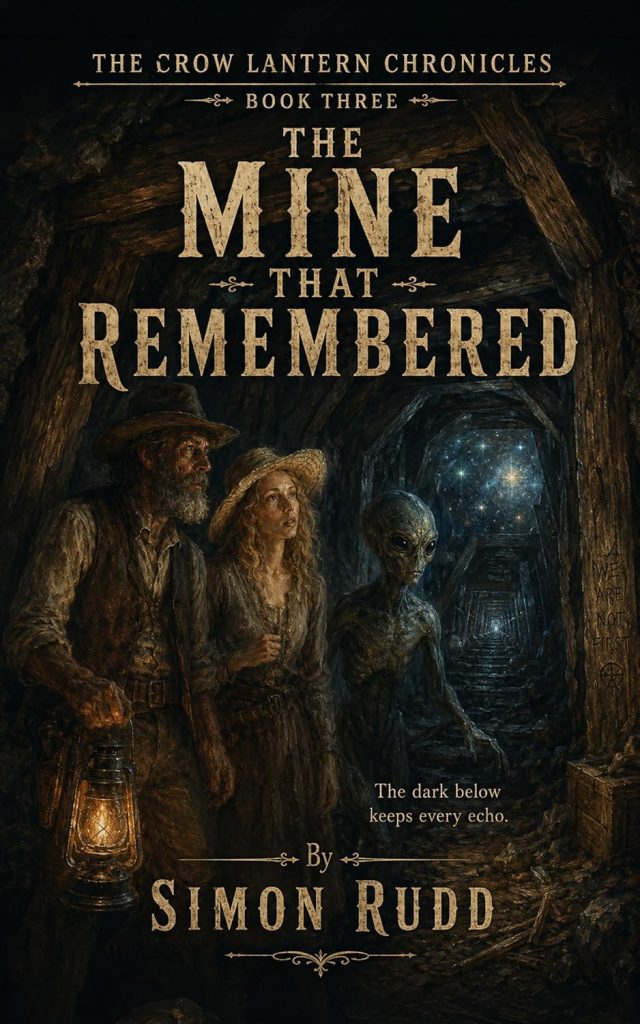
Some ground keeps what it hears. Hollow Star has been keeping it for twenty-five years.
Two weeks after Ashspur, the lights are gone and the talk has not stopped. Kettle Cross has a new name to be frightened of, and it is an old one — the mine north-east of town, boarded shut since the collapse, where men who go near the sealed shaft come back saying they heard their brothers.
Not remembered. Heard. The words, the breath, the name spoken back out of the dark in the right voice.
Clara Sayers goes looking for testimony: the widow, the sheriff's records, the one survivor still alive to be asked. Jonah Latch goes looking at wagon tracks, because the claim men left town before breakfast with rope, stakes, assay tools and confidence enough to bury three better men. Whatever lies under Hollow Star can be heard — which means it can be sold, and men are already deciding what to call it.
Eli has a word for it. Maeth. The dead. The gone. The thing that must not be used merely because it still answers.
But the mine does not hold only the dead of Hollow Star. Something older is down there with them, and every voice the ground has kept has begun to feed on every other. When a demonstration in the lower working goes wrong, the chamber beneath learns how to speak — and the first thing it learns is the name of the place.
Clara goes down with the record on her arm, because the dead are owed accuracy before they are owed silence.
The Mine That Remembered is the third volume of The Crow Lantern Chronicles — a slow-burning frontier western in which the strangeness is real, the century is wrong for it, and the only defence anyone has is a young woman with a pencil who refuses to record a thing she cannot swear to.
The series begins with Book One: The Light Beyond the Ridge.
Read the first chapter
Chapter 1 - The Hollow Star Mark
Eli had been listening to something since sundown, and it was not in the room.
Clara had watched him do it for three hours: head tilted a few degrees off true, one hand flat on the table, the stove-side shoulder going rigid whenever the wind dropped. Twice she had asked what he heard. Twice he had shaken his head — not no, but not yet, or not a word I have given you.
So she had done what she always did when the world would not answer plainly. She had opened the notebook.
She had written Velar beneath the Ashspur notes three times, and still the word looked less like a road than a warning.
The first attempt had been hurried, scratched down while Jonah was still shaking dust from his coat and Eli lay bent double by the stove. The third sat alone at the top of a clean page, because Clara had learned, after Glassfall and Ashspur both, that some words needed room around them.
Velar.
Path. Route. Way-between.
Not road, exactly. Not trail. Not passage the way men meant passage, with wagon wheels and hoof prints and a dry place to camp before night. Eli had tried to show her with two fingers in the ash beside the stove, drawing a line that was not a line, then closing his hand around it as if a thing could be held and hidden at once.
Jonah had watched from the doorway and said, “If it has no rails on it, no man has business calling it a road.”
Then, because Jonah Latch could look straight at a miracle and complain about its maintenance, he had gone outside to check the horses.
That had been two weeks ago. Time had not settled kindly since Ashspur. It came in scraps: chores by day, and nights where the cabin walls seemed thin enough for the stars to listen through.
Clara sat now at Jonah’s table with the lamp turned low, not from thrift alone but because a bright flame made Eli flinch. The wind had come down after dark, dry and thin, worrying the chinks in the cabin boards. It moved like a hand testing every seam.
The cabin looked as it always had if a person did not know how to read it. Stove. Table. Water pail. Jonah’s rifle on pegs above the door. A line of hooks. Saddlebags near the wall. A broom, a crate, a tin basin. Ordinary things in ordinary places.
But Clara knew better now.
The old map tucked behind the flour sack had a charcoal mark where Glassfall lay. The cracked cup by the window was not used because Eli had once taken water from it when he could take nothing else. The loose floorboard under Jonah’s bed hid two torn pages from Clara’s first notebook, the pages Mace had nearly seen, and the only two that had survived being asked for. The nail above the stove held a strip of canvas that had been wrapped round a piece of Ashspur rail when the metal had sung in the dark.
The cabin was still a cabin. It was also a ledger no one else could read.
Clara dipped her pen carefully. Ink was too dear to waste on blots, and too dangerous to waste on the wrong word. Pencil was safer for guessing. Ink was for what must not be rubbed away.
At the top of the clean ledger page she wrote:
Known words. Not names. Not guesses without witness.
Then, below it:
Eli — help / hear me / witness me. First mistaken for name.
She paused.
Across the table, Eli watched her hand.
He sat on the bench with one shoulder turned towards the stove and the other towards the room, as if warmth and escape both had claims on him. Ashspur had left him thinner, and the lamp found too many hollows. His skin held the stove glow oddly, not reflecting it like human skin but accepting and dimming it, as if light sank a little way before deciding whether to return.
The device lay near his left hand.
Clara still did not know what to call it. Jonah called it “that thing” when he was irritated and “put that away” more often than either. No bigger than his palm, it looked at rest like a cracked piece of dark metal with pale veins sealed inside. When it woke, those veins held light — not lamplight, not fire, something colder and older, with colours that made Clara’s eyes water if she stared too long.
Tonight it was dull.
That, Clara thought, was a mercy.
She wrote the second word.
Raesh — danger approaching.
Eli’s fingers moved once against the table.
Clara looked up. “Yes?”
His eyes were on the word, or on the place where the word sat. She had learned not to assume those were the same thing.
“Raesh,” she said softly.
His mouth shaped the sound back to her, thin and breath-worn. “Raesh.”
Jonah shifted by the stove.
He had been pretending not to listen, which was one of Jonah’s louder habits. He stood with a mug in one hand and his other thumb hooked at his belt, facing the stove though his attention filled the whole room.
“Don’t start practising trouble like hymn-singing,” he said.
Clara did not look at him. “I am preserving evidence.”
“You are teaching trouble to answer when called.”
“Trouble has not needed my help with that so far.”
Eli’s gaze moved from Clara to Jonah and back again. He understood tone better than words now.
Clara continued.
Nakel — stop / forbidden / do not touch.
That word had saved Jonah’s hand once, though Jonah objected to any retelling that made him sound saved.
Kesh — pain / injury / broken body.
She glanced at Eli before writing the next.
Belesh — below / buried / under-earth.
Eli drew back slightly.
The stove gave a small pop. Outside, one of the horses stamped in the lean-to.
Jonah put his mug down. “Enough for tonight.”
Clara held her pen still above the page. “I have not finished.”
“You finished when the room changed.”
“That is not a measure of—”
“It is in this house.”
She looked up then.
Jonah’s face was half in shadow. He looked older in low light, or perhaps just more honest. Ashspur had not softened him. It had worn him sharper — new lines around his mouth from holding words back, new silences where he used to grumble.
But back at the cabin, trust became something he rationed again.
“I need it clean,” Clara said. “If something happens to me—”
“Nothing is happening to you.”
“That is not a plan, Jonah. That is a wish with boots on.”
His jaw set. “A wish with boots can still walk farther than foolishness in slippers.”
Despite herself, Clara nearly smiled. She kept it down. Jonah mistook smiles for surrender if they came at the wrong time.
She wrote the next word.
Tavren — memory / witness / recorded truth.
The device pulsed.
It was not bright. That made it worse.
A strong flare had drama to it, enough light and pain and alarm to turn everyone practical. This was smaller. A faint glimmer under the cracked surface, like an ember seen through deep water. Eli’s hand flattened beside it but did not touch.
Jonah saw it. Of course he saw it. Jonah could miss a direct apology at two feet but not a horse twitching under moonlight at fifty yards.
“Clara,” he said.
“I did not do anything.”
“Didn’t say you did.”
Eli breathed once through his mouth, a sound too careful to be calm.
Clara’s pen hovered over the page. The wet ink shone black in the lamplight. Tavren. Memory. Witness. Recorded truth.
The device pulsed again.
This time a narrow light ran through one vein, then another, joining lines that had no place in normal geometry. Clara had seen it make pictures before, if pictures was the word for a thing that seemed to enter the eye and memory at once. Glassfall had come first: a pit, a warning, a buried brightness that pulled instead of called. Then Ashspur: lines and crossings, a way that was not meant to open and men’s rail iron laid over it like a child’s crude copy of a lock.
Now the device showed a dim mark in the air above the table.
Ashspur.
Clara knew it by the slant of the grade and the broken line Eli had taught her to follow. It hovered no larger than a silver dollar, though it seemed far away, as if the table had become the top of the sky and they were looking down through miles of dark.
The Ashspur mark flickered.
“Is it waking?” Clara whispered.
Eli shook his head too quickly, then stopped because the motion pained him. He raised two fingers, held them apart, and slowly lowered one.
“Sleeping?” Clara guessed.
No answer.
“Dying?”
Eli’s fingers tightened.
Jonah moved closer. “Don’t feed him words.”
“I am trying to understand.”
“Try slower.”
Clara swallowed what she wanted to say. She had learned that anger could make her careless, and carelessness was the one luxury none of them could afford.
The Ashspur light dimmed until it was not gone but buried in itself.
“Not dead,” Clara said, half to Eli, half to the page. “Muffled?”
Eli’s eyes shifted to her. There was approval there, or sorrow, or only recognition that she had stepped nearer to the right cliff edge.
Then the device gave a third pulse.
The room went silent.
Not quiet. Silent.
The wind stopped in the boards. The horse outside stopped stamping. The stove flame thinned until it made no sound. Even Jonah seemed to hold still in a way Clara had never seen from him, not listening for danger but trapped before it.
Above the table, beyond the fading Ashspur mark, another point of light opened.
At first Clara thought it was a star. A simple one, five-pointed in the childish way she might have drawn when she was small enough to think stars had corners.
Then the centre darkened.
The star became a ring of pale points around an empty middle. A hollow star.
Below it, lines formed.
Not rails. Not the cut of Ashspur. Not the old Glassfall slope.
A black opening, framed by timber. A low mouth set into stone. Boards across it. A warning sign tilted sideways. Something like a mine entrance, seen not from the road but from a memory that had been sealed below ground and left to listen.
Clara felt cold settle behind her ribs.
She did not know the place. Not fully. She had heard the name, of course. Everyone around Kettle Cross knew the names of dead workings the way they knew the names of bad wells, dangerous horses and men who should not be lent money. But knowing a name and seeing it wake above Jonah’s table were different measures of knowledge.
“Hollow Star,” Jonah said.
He said it before Clara could.
Too fast.
The words came out of him like something struck from stone.
Clara turned.
Jonah’s face had changed. The lamplight had not. The room had not. But something in him had closed so hard she almost heard it. His eyes were fixed on the mark above the device, not with confusion, not with the wary calculation he had shown at Glassfall, not with the exhausted dread he had carried through Ashspur.
Recognition.
Old recognition.
“You know it,” Clara said.
Jonah looked at her as if she had accused him in front of a court. “Everybody knows Hollow Star.”
“No,” she said. “Everybody knows of it.”
The hollow star brightened.
Eli made a sound.
It was low and strained, and it did not belong with the sounds Clara already knew. Not Raesh. Danger had sharpness in it, a forward edge. Not Kesh, though pain sat under it. Not Belesh, though the mine mouth in the light was all below and buried things. This sound was heavier. It fell rather than warned.
“M—” Clara began, then stopped.
Eli’s hand had risen halfway to his throat. His fingers trembled against the place where a human pulse would beat. His eyes were not on the device now. They were on the hollow middle of the star.
Grief, Clara thought.
Not fear alone. Grief.
The realisation unsettled her more than a warning would have. Fear could be acted against. Grief asked for something else, and she did not yet know what.
She reached for the pencil instead of the pen.
Jonah’s hand came down over the page.
Not hard. Not cruel. Just final.
“No.”
Clara stared at his hand. The knuckles were scarred. A half-moon of old dirt sat under one nail. There was a small burn on the side of his thumb from the stove latch he refused to replace because, according to him, a man who could not remember hot iron deserved an education.
His hand covered Tavren. It covered the space where the new word should go.
Slowly, Clara looked up.
“You do not get to close my book because a place frightens you.”
Jonah’s voice was flat. “We are not going to Hollow Star.”
“I did not say we were.”
“You were about to write it down. With you that is near enough saddling a horse.”
“That is unfair.”
“That is experience.”
The hollow star hung above them. It made no sound, and yet Clara felt watched by it. Not watched as a person watched. Held, perhaps. Registered. As if the cabin had become part of whatever record the device was trying and failing to show.
“Why?” Clara asked.
Jonah took his hand from the page but did not step back. “Because that mine is closed.”
“Glassfall was closed.”
“Glassfall should have stayed closed.”
“Ashspur was open and killing men by inches before anyone would name what was happening.”
“Ashspur is not Hollow Star.”
“No,” Clara said. “That is what I am trying to learn.”
Jonah’s expression went darker. “Some places don’t need learning. Some places need boards across the mouth and sense enough not to pry them loose.”
Eli whispered the sound again.
This time Clara heard more of it.
“Maeth.”
Or something close to that. The shape was soft at the beginning, then thinned and broke. It was not a word made for her mouth. She wrote nothing. Jonah’s warning still lay between her and the page even though his hand had moved.
“Eli,” she said gently.
He looked at her.
“Is it danger?”
No answer.
“Raesh?” she asked.
He flinched, but shook his head.
“Belesh?”
A pause. Then a small, reluctant motion of uncertainty. Below, yes, perhaps. Buried, yes. But not enough.
“Tavren?”
At that Eli closed his eyes.
Jonah turned away with a sound that might have been anger if it had not been so tired. “Don’t.”
Clara watched him. “You understood that.”
“I understood enough.”
“Then help me understand.”
“No.”
The word fell with the same weight as the mine name had. Too quick. Too old.
Clara sat back, the pencil caught between her fingers. It would have been easier if Jonah were simply wrong. Easier if he were treating her as a child again, easier if this were only the old argument with new stars hung over it. But his refusal did not feel like dismissal.
It felt like a door held shut from the other side.
The device’s light trembled.
The hollow star dimmed, and for one heartbeat the mine mouth beneath it seemed to deepen. Clara saw boards bowed inward. A strip of torn canvas. Dust not red like Ashspur but pale, almost silver. Then a blackness beyond the opening that did not sit still. A mouth that had learned patience.
She had thought, after Ashspur, that she understood the next shape of fear. Roads. Signals. Something outside Earth finding the way back.
But this was different.
This was not a road.
This was a place that had heard something.
Perhaps still did.
Eli’s hand moved.
The motion was slow, costly, and so deliberate that neither Clara nor Jonah stopped it. His fingers crossed the table to Clara’s notebook. They were too long by human measure, jointed with a delicacy that still made Jonah uneasy when he thought Clara did not notice. They hovered over the cover.
Jonah had closed the notebook without Clara realising it.
The brown leather lay shut beneath the lamp.
Eli touched it.
For a moment nothing happened.
Then, with two trembling fingers, he opened the notebook again.
The page lifted. The inked words returned to lamplight.
Eli drew one breath. It caught. He pressed his fingertips to the empty space below Tavren, where the new word should go, but he did not look at Clara.
He looked at Jonah.
Jonah stood very still.
The wind came back against the walls all at once, a dry whisper along the cabin boards. The stove flame stirred and found itself again. Outside, Crowbait stamped twice, then settled.
The hollow star faded from the air, leaving only the device on the table and a pale afterimage in Clara’s sight.
No one spoke.
Clara picked up the pencil.
Jonah did not stop her.
She did not write Hollow Star. Not yet. Not while Jonah watched the page as if it were a shaft opening beneath his boots.
Instead, beneath Tavren, she wrote:
Unknown word — Maeth?
Then, after a pause:
Not Raesh. Not simple danger. Eli afraid as if grieving. Jonah knows the place.
The pencil point broke on the final full stop.
Jonah looked at the snapped lead, then at Clara. His mouth moved once before any words came. When they did, they were quiet enough that the stove nearly took them.
“There are mines that close because men run out of silver,” he said. “And there are mines that close because men finally learn what they ought to have known before the first pick struck.”
Clara held his gaze.
“Which one was Hollow Star?”
Jonah picked up his mug from beside the stove. It had gone cold. He drank anyway, because Jonah would rather swallow bad coffee than answer a question that had found bone.
“Hollow Star,” he said, “had silver enough.”