A Frontier Weird Western
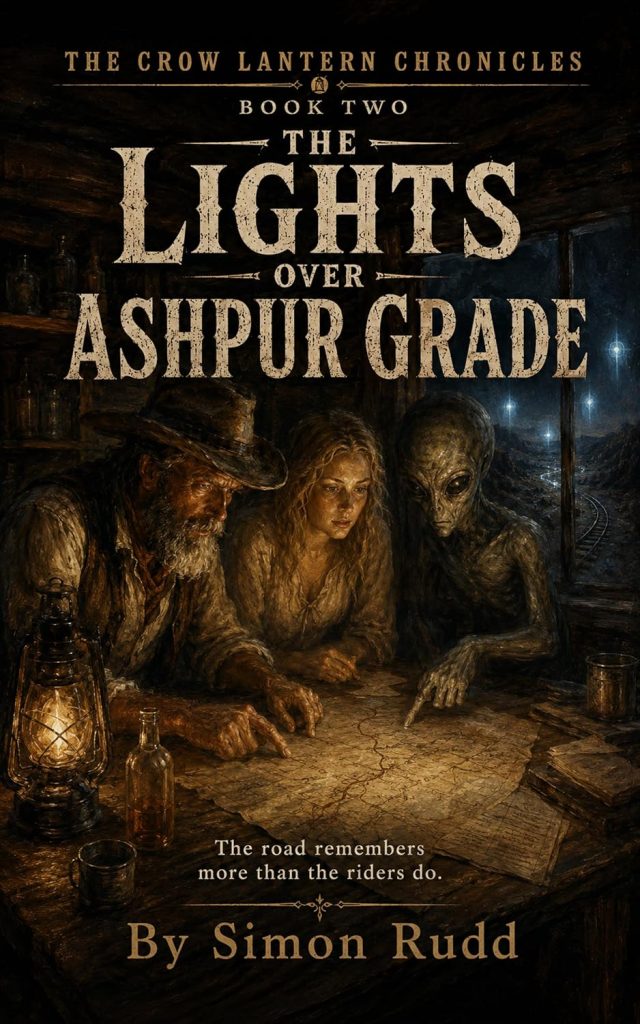
Six weeks ago, Clara Sayers watched her record of the impossible destroyed. She has been rewriting it from memory ever since.
The territory has settled on what happened at Glassfall. A gas seam. A rockfall. A girl with too much imagination and a hard old man who should have known better. Clara lets them believe it — belief is cheaper than proof, and proof is what she no longer has. Two torn pages. A cracked device that gives no light. And a survivor sleeping by the stove who cannot shape a single human word.
Then Duskline Rail begins cutting east.
At Ashspur Grade the work crews have started to talk. Lights run beneath the rail stacks at dusk, pale and cold, like lanterns dropped in shallow water. A telegraph operator hears the wire sing with no message on it. A man walks into the cut at dawn and comes back three days later saying he followed the wire, and the wire went under the ground, and there were stars down there.
Superintendent Walter Stannard has a schedule, a company behind him, and no patience for ghost stories. He will finish the grade. If fear stands in the way, he will move fear. If men stand in the way, he will move men.
Clara knows what the rails are waking. She holds the only vocabulary for it in the world — eleven words, badly understood, every one of them a guess she has to write down honestly or not at all.
And far out past Ashspur, where the roads run beneath the earth, something has learned there is warmth at the other end of the line.
It is not near.
Not yet.
The Lights Over Ashspur Grade is the second volume of The Crow Lantern Chronicles — a slow-burning frontier western in which the strangeness is real, the century is wrong for it, and the only defence anyone has is a young woman with a pencil who refuses to record a thing she cannot swear to.
Begin the series with Book One: The Light Beyond the Ridge.
Read the first chapter
Chapter 1 - The Map Clara Kept
The first copy of the words had been made in fear.
Clara Sayers had two pages of it left.
Two, out of a book she had filled between Glassfall and the spring pit — torn free on the afternoon the sheriff came, and spared by that accident from whatever had come for the rest.
She could still see the fear in them: the broken pressure of the pencil, the letters leaning hard where her hand had shaken, the places where dust had gritted under the point and left pale scratches instead of lines. One had a brown thumbprint near the margin that might have been dried mud, or blood, or something from Eli that no doctor in Kettle Cross could have named without first sitting down.
She did not clean that page.
She had tried once, with the corner of a rag barely damped from the basin, and stopped when the stain began to loosen. A record was not improved by making it prettier. It was improved by being true.
The rest she was writing out of her head.
Six weeks of it. Sitting at this table with a clean ledger and nothing to set beside it, putting down El-i and Raesh and Nakel in the order she remembered receiving them, in the wording she remembered choosing, with the doubts she remembered having.
Remembered.
She had begun to hate the word. A witness account was meant to be the thing that stood when memory failed. Hers had become memory and nothing else. Some words had been written by lamplight. Some by daylight in the lee of a rock with Jonah telling her to put the book away and keep her eyes on the trail — and she could see those afternoons perfectly, which proved nothing at all, because a woman who could see an afternoon that clearly could also furnish one.
Every morning she sat down to it and asked whether she was recording or composing.
Every morning she wrote anyway. The alternative was letting it go entirely, and she had already watched that happen once.
Now she sat at Jonah’s table with the two torn leaves weighted flat under the lamp on her left and the cleaner ledger on her right, copying what she could see and setting down what she could only carry.
El-i.
She paused after that one.
Outside, the wind moved along Crow Lantern Creek with a dry, restless sound, worrying at the cabin boards and feeling for gaps around the shutters. The stove gave a low pop. Jonah had banked the fire too grudgingly, as if warmth were one more luxury that might give away their position. The lamplight held steady over the table, yellow and close, touching the rifle hooks by the door, the water bucket, the hanging tack, the folded blankets now kept nearer the corner where Eli slept.
Or pretended to sleep.
Clara did not look at him yet.
She wrote beneath the first word: help / hear me / witness?
The question mark felt cowardly. It also felt honest.
When they had first found him in the rocks beyond Glassfall, hurt and strange and folded in on himself like a thing the sky had dropped and the earth had tried to keep, he had said that sound over and over. El-i. El-i. She had thought it was his name because a human mind reached for human shapes when the world broke open. Jonah had let the name stand because he preferred anything that could be spoken plainly, even if it was wrong.
Only later had Clara begun to understand that he had not been naming himself.
He had been asking.
She dipped the pen again and kept going.
Raesh — danger approaching / warning before sound. Horses knew it too.
Nakel — stop / do not touch / forbidden.
Kesh — pain / broken body / hurt-place.
Belesh — below / buried / under-earth.
Vesh — hide / silence / say nothing and be small.
She glanced towards Eli then.
He sat on the low pallet near the stove, his back against the wall, long hands folded over the blanket across his knees. Even after weeks in the cabin, Clara’s eyes still had to learn him each time: the too-still shape of him, the fine angles of his head, the dark reflective sheen of his eyes when lamplight caught them, the narrow rise and fall of his chest when the air was dusty. Dr Mara Wicks had said, in the tone she used when she did not want anyone to hear fear in her, that he was healing.
Clara believed Mara.
She also believed Eli was less well than he let them think.
His gaze was fixed on the ledger.
Not on Clara’s hand. Not on the pen. On the words themselves, as if the act of setting them down in human marks changed their weight.
“You needn’t stare so hard,” Clara said quietly. “I am spelling them as best I can.”
Eli’s mouth moved around no sound.
“You may complain after you teach me better letters.”
Across the room, Jonah Latch made a noise that was not quite a laugh. He stood at the small shelf by the door, checking cartridges he had already checked twice since supper. The motion was slow and ordinary and meant to look like habit. Clara knew better. Jonah had become a man made of habits since Glassfall. He checked the latch whenever the wind changed. He counted lamp oil under his breath. He stood outside before dawn and read the ground around the cabin for prints that were never there.
He had widened the meaning of his own, but he had not stopped trying to fence it in.
“Don’t teach him complaint,” Jonah said. “He’s picked up enough from you.”
Clara kept her eyes on the page. “Then he is learning useful language.”
“He can learn useful silence next.”
Eli’s head turned a fraction towards Jonah.
Jonah noticed. He always noticed. “That was not an instruction,” he said, and went back to the cartridges.
Clara wrote the next word with unusual care.
Tavren — memory / recorded truth / witness.
This one she did not fully understand. It had come at Glassfall when Eli’s little cracked device had shown images that were not images in any human sense: old light over Crow Lantern, lines beneath earth, shapes moving where the mine should have been solid rock. Tavren was the sound he had made then. Not fear. Not warning. Something closer to grief with a duty tied to it.
Two words were left, and she had kept them for last because she was a coward about each of them in a different way.
Ravun.
Her hand stopped over the page.
In the first book the entry had stood alone — the word, a question mark, and nothing else. She was sure of that much. The emptiness around it was the part she had never managed to stop seeing. The question mark had looked too small for the fear even then. Later they had filled it in between them — hunter, pursuer, the thing that follows — because Jonah wanted a word he could say plainly and Mara wanted one she could put in a report.
Clara wrote the meanings down. Then she wrote the question mark after them anyway.
Deciding was not knowing. She would not let a clean page pretend otherwise.
Then the last one.
Ren — yes? / enough? / understood? Not known. He said it in the mine, over a page he could not read. We went on.
She copied that entry exactly, including the part that was about her.
It would have been easy to leave out. A tidier ledger. A kinder one. Nobody living would have known the difference, and Eli could not read it to object. She let the pen hover long enough to be honest with herself about wanting to, and then she thought of the brown thumbprint she had not scrubbed, and wrote it all.
We went on. Two words, and none of Eli’s carried more.
There was one more.
She did not copy it.
Orraen.
She had written it on the loose sheets Jonah gave her afterwards, in handwriting gone loose past exhaustion, and it had been the last thing she set down before sleep took her for eleven hours. It sat on paper that had never been part of anything. That felt about right. She knew what she had wanted it to mean when she wrote it down, and that was the whole of the trouble. He had said it at the end, pointing at nothing she could see. Not at the false trail. Not at Ravun.
Home, she had thought.
Let it be home. Let there be a place he is from, and a road back to it, and somebody at the far end who has been waiting and has not given up.
That was not a translation. That was a prayer with a foreign word in it.
Clara left the line beside it empty and went on.
She rested the pen and flexed her fingers.
The table still carried the scars of those weeks. A dark burn mark near the centre where Eli’s device had pulsed too hot. A gouge in the edge from Jonah’s knife when he had cut bandage strips in a hurry. A little spill of lampblack in a crack where Clara had dropped the chimney trying to hide the light before Sheriff Mace reached the yard.
Before Eli, the table had been for coffee, mending, cartridges, meals, Jonah’s old maps, Clara’s letters never sent.
Now it was an archive.
The thought was too grand. She almost smiled at it, then found she could not. A table did not need to be grand to hold the truth. It only needed someone stubborn enough to keep writing.
From the corner, Eli gave a soft click in his throat.
Clara followed his gaze.
The device lay between two folded cloths near her elbow. Jonah disliked having it on the table, which was why Clara had put it there. Not out of disobedience exactly, though Jonah would have argued the point. The device was a witness too, and hiding a witness did not make its testimony safer.
It was smaller than a lantern globe, though heavier than it looked, made of a metal that did not choose one colour and keep to it. In daylight it looked dull and grey, almost dead. By lamplight, thin lines inside it stirred like a coal thinking about flame. One side remained cracked from the fall. Another bore a blackened seam from the night beneath Glassfall when Eli had spent too much of himself and too much of it keeping the buried thing quiet.
Clara had promised Jonah she would not ask Eli to use it.
She had not promised not to look.
“Only the map,” she said.
Jonah’s hand stilled on the last cartridge.
Clara did not turn. “I am not asking him to make it do anything. I am copying what we already saw.”
“That thing has a broad notion of what counts as already.”
“That thing,” Clara said, “helped keep all of us alive.”
Jonah closed the cartridge box with a click. “That thing nearly lit us up for whatever was listening.”
Eli lowered his head.
Clara saw it and regretted the argument at once, though not enough to surrender it. “It was not his fault alone.”
“I did not say it was.”
“You said it while looking at the device.”
“Because the device is the part I can put in a box.”
That made her look at him.
Jonah stood with one shoulder to the lamplight, his face cut in hard planes by shadow. He had shaved three days ago and missed a strip under his jaw. His hair needed cutting. Since Glassfall, he looked as if sleep had become something he remembered but no longer believed in.
“You cannot put the sky in a box,” Clara said.
“No,” Jonah answered. “But I can keep from opening the lid when I do not have to.”
The wind pressed against the cabin, then passed on.
Clara reached for the loose sheet tucked inside the ledger. It was the map she had made the morning after Eli showed them the other marks: not a true map, because the image had not been drawn for human directions, and not a star chart, because some of the points had corresponded too closely to ground she knew. Crow Lantern Creek sat near the lower left, marked by Clara’s own small lantern sign. Glassfall had been circled once, then again after she realised the first circle was too timid.
Beyond it, scattered across the page, were marks she had not yet named.
Some might have been other places.
Some might have been warnings.
Some might have been graves.
No, she thought, and crossed that word out in her mind before it could settle. She would not bring human burial thoughts to a thing she did not understand. That was how Brome worked: give the unknown a familiar terror, then tell people where to point it.
She laid the loose map beside the clean ledger.
Eli went very still.
It was not the stillness of rest. Clara had learned that now. His resting stillness had softness in it, a long body conserving warmth, eyes half-lowered, one hand curled near the wound that still troubled him in cold weather. This was different. This was all of him listening.
“What?” she asked.
Jonah took two steps towards the table. “Clara.”
“I only laid it down.”
Eli’s eyes fixed on a mark east of Kettle Cross.
It was one of the smaller ones. Clara had copied it because it had shone briefly in the memory image, low and sharp, before the device failed. At the time, she had thought it might be a star. Later, comparing it against Jonah’s old trail map, she had seen it sat too near the Ashspur country to ignore.
She touched the page below it, not the mark itself.
Eli’s hand came up.
“Nakel?” Clara asked.
His fingers hovered, then closed slowly into his palm.
Not Nakel, then. Not forbidden.
Worse, perhaps.
Jonah saw the difference too. “Put the paper away.”
“Not yet.”
“Now.”
Clara heard the old command in his voice, the one that had once been enough to halt her at the cabin door or turn her back from a bad trail. It had saved her more than once. It had also kept the world small enough to choke on.
She kept her hand flat beside the map. “He knows this place.”
“He knows a deal he has not told us.”
Eli made a faint sound. His face tightened as if Jonah’s words had touched a bruise.
“Then perhaps we should let him tell us,” Clara said.
Jonah gave her the look he used for weather, horses, loaded guns and foolishness approaching at speed. “How? You going to write him a polite invitation? Dear sir from the low stars, kindly explain which hole in the ground aims to kill us next?”
Despite herself, Clara felt the corner of her mouth move. “That is too many words. He would never trust my spelling.”
Jonah did not smile. That told her more than the silence.
She turned back to Eli. “This mark,” she said, tapping once below it. “Where?”
Eli’s gaze moved from the page to her face.
“Crow Lantern,” she said, pointing to her lantern sign. “Glassfall.” She moved her finger to the circled place. “Kettle Cross.” She touched the town mark.
Eli watched.
She returned to the eastern point. “This?”
For several seconds nothing happened.
Then Eli leaned forward and laid two fingers in the air above the mark without touching it. The device gave a weak pulse beside Clara’s elbow. Pale light ran through its cracked seam, not bright enough to cast shadows, only enough to make the ink on the page seem wet again.
Jonah swore under his breath and reached for the cloth.
“Don’t cover it.”
“I am not taking instruction from a table ornament that burns holes.”
“It is not burning.”
“It is thinking about it.”
The device pulsed again.
This time the line of light crossed Clara’s hand. It was cold, not warm, and so faint she might have mistaken it for a trick of the lamp if Eli had not flinched at the same moment.
A shape formed above the map: not a full image, not like the terrible memories under Glassfall, but a thread. One pale line extended from Crow Lantern eastwards. It did not draw itself straight. It bent, halted, shivered, then found the little mark near Ashspur and trembled there.
Eli whispered a sound Clara had not heard before.
Not Raesh. Not Belesh.
Softer than warning. Worse than curiosity.
“Again,” Clara said.
Eli shut his mouth.
“Clara,” Jonah said.
She held up one hand without looking at him. “Please. Just the sound.”
Eli’s throat moved. His fingers curled against his own chest, not in refusal but restraint.
The device went dark.
The cabin seemed to shrink around the absence of its light.
Jonah pulled the cloth over the device and kept his hand there. “Enough.”
Clara looked from him to Eli. “It was answering the map.”
“It was answering something we do not understand.”
“That is why we need—”
“No.”
“You did not hear what I was going to say.”
“I have heard it since the night that thing fell. We need to know. We need to ask. We need to go. We need to stand in the worst place available and invite every fool with a gun, a Bible or a company seal to come see what we found.” Jonah’s voice stayed low. That was how Clara knew she had frightened him. “No.”
The words struck harder because some of them were true.
Clara capped the ink before it could dry on the nib. “Crow Lantern Creek was not the only mark.”
“I know.”
“Then pretending the others are not there will not make them harmless.”
“No. But walking towards them may make us dead.”
“People may already be walking over one.”
Jonah’s jaw tightened. “People walk over all manner of trouble. A man can spend his life pulling strangers out of holes and end with nothing but more holes.”
“You do not believe that.”
“I have lived long enough to know it.”
“You did not leave Eli in one.”
At that, something in Jonah closed.
Clara wished she could take it back. Not because it was wrong, but because it was sharp in the wrong direction. Jonah had not left Eli in the rocks. Jonah had carried him, cursed him, hidden him, nearly died under Glassfall for him. Jonah’s fear was not selfishness. It would have been easier if it were.
Eli made a small sound.
Both of them turned.
He had drawn his knees up a little, one hand pressed near the mended wound in his side. His eyes were on Jonah, but not with accusation. Clara had seen that look on him when the horses started under thunder or when Mara approached with a needle. He was measuring danger and kindness in the same breath, still never certain which would reach him first.
Jonah saw it too. His hand left the covered device.
“Don’t look at me like that,” he said. “I am trying to keep you breathing.”
Eli blinked once, slow.
Clara lowered her voice. “He knows, Jonah.”
“That is what worries me.”
Before Clara could answer, a sound came from outside.
Not the wind this time.
A horse.
Jonah moved so quickly the chair scraped hard against the floor. He crossed to the door, took the rifle from its hooks, and signalled with two fingers for Clara to put the papers away. She gathered the two torn leaves, the ledger and the loose map, sliding them beneath the folded mending in the basket by her chair. Eli shifted towards the darker corner without being told.
Another sound: tack leather, a hoof against stone, then a man’s voice calling from beyond the yard.
“Latch?”
Jonah did not answer at once. He stood beside the door, not in front of it.
“Latch, it’s Bess Arkley’s boy. From the store.”
Clara let out a breath she had not noticed holding.
Jonah did not lower the rifle. “Bess Arkley has no boy.”
A pause outside.
“Her nephew, then. I ain’t aiming to inherit the woman.”
Clara knew that voice now: Tom Arkley, who was not on any of their ledgers because he was fourteen, mostly elbows, and terrified of his aunt.
Jonah opened the door only wide enough to show one eye and the rifle barrel. “What do you want?”
The boy outside sat hunched on a tired roan, hat clutched in both hands. The wind had reddened his ears. He looked past Jonah as if expecting the cabin to be full of ghosts, devils, rail men, or all three sitting down to coffee.
“Aunt Bess said you was to have this.”
He held out a folded scrap.
Jonah did not take it.
Clara came to the doorway. “From Mrs Arkley?”
The boy’s face loosened with relief at the sight of her. Clara almost laughed. There were men in Kettle Cross who thought her half wild after Glassfall, but apparently she remained less alarming than Jonah with a rifle.
“She said give it to Miss Sayers if Mr Latch acted ornery.”
“I’m never ornery before breakfast,” Jonah said.
“It’s supper time,” Clara said.
“I am getting ahead.”
The boy looked uncertain whether that was a joke and wisely made no decision.
Clara took the scrap. “Did she say what it was?”
“She said to tell you Duskline men are filling her store with talk and not enough buying. Said they’re working Ashspur Grade now under a man called Walter Stannard. Said there were lights last night over The Cut.” He swallowed. “Said they didn’t move natural.”
Jonah’s expression did not change, but Clara felt the attention in him sharpen.
The boy rushed on, glad to be emptying himself of the message. “One of the grade men came in for coffee and tobacco. Said the lights ran along the rail stakes like lanterns under water. Then another told him to shut his fool mouth if he wanted paying. Aunt Bess said that means there’s truth in it.”
“Your aunt often finds truth in unpaid accounts,” Jonah said.
“Yes, sir.”
“What else?”
The boy shifted in the saddle. “She said Sheriff Mace was asking after you.”
“That all?”
“No, sir.”
Jonah waited.
The boy’s voice lowered, though there was no one in the yard but them and the wind. “She said Reverend Brome told three women outside the church that the sign at Glassfall weren’t finished. Said the Lord don’t knock once.”
Jonah looked tired all at once. “Brome would call thunder a personal introduction.”
Clara unfolded the scrap.
Bess Arkley’s handwriting was strong, square and more practical than pretty.
Duskline at Ashspur. Stannard in charge. Lights over Cut. Men frightened. Mace watching west. Brome making meaning. Thought you’d rather know before the whole town made it worse.
Below that, added in a squeezed line:
One worker missing since dawn. Company says drunk or run off. Workers say otherwise.
Clara read it twice.
The cabin seemed to fall away behind her, leaving only the paper and the mark beneath the mending basket. East of Kettle Cross. Ashspur Grade. The line Eli’s device had drawn.
She looked at Jonah.
“No,” he said.
“I have not spoken.”
“You looked.”
The boy glanced between them with the expression of someone suddenly aware he had delivered a lit match into a powder shed.
Clara folded the note carefully. “Thank Mrs Arkley.”
The boy nodded, too quickly. “Yes, miss.”
“And tell her—”
“Tell her nothing,” Jonah said.
Clara looked at him.
Jonah kept his eyes on the yard. “Tell her we got the message.”
The boy accepted this as the safer version and turned his horse with visible gratitude. He was halfway across the yard when Jonah called after him.
“Ride straight back. Don’t cut by the creek.”
The boy twisted in the saddle. “Why?”
“Because I said straight.”
That answer, being pure Jonah, sent him on faster than any explanation.
Jonah watched until the hoofbeats faded. Then he shut the door and set the bar in place.
For a moment none of them moved.
A new name over Ashspur.
Pryor’s report had gone east in September. Clara had wondered all autumn whether writing it would end the man or save him, and here was the answer: Duskline had put someone else on the ground inside two months and not troubled to explain the change. Filed, then. The way a company files a thing it has already decided not to act on.
Silas Pryor had at least looked at Eli and been frightened in the ordinary way.
She doubted the next one would be.
Eli remained in the corner, half-shadowed, his eyes on Clara’s hand where the folded note rested. He had not understood the words. Clara was almost sure of that. But he understood arrival. Warning. The shape of news crossing a threshold.
Clara went back to the table and drew the hidden map from beneath the mending.
Jonah stayed by the door. “Put it away.”
She unfolded Bess Arkley’s note beside it.
“Clara.”
“One worker missing,” she said.
“Duskline loses men to drink, bad ground and worse judgement. That is not new.”
“Lights over The Cut.”
“Men see lights when they are tired.”
“Moving along the rail stakes like lanterns under water.”
“That is store talk.”
“Bess thought it was enough to send word.”
“Bess Arkley would send word if a hen laid an egg shaped like President Hayes.”
Despite everything, Clara nearly smiled. “Would you ignore that?”
“I would ask what she was charging to view it.”
Eli made the soft sound again.
Both of them heard it.
Not loud. Not pain. Not Raesh, though Clara felt danger near it. The word was shaped around a breath that did not belong comfortably in his body. It had a narrow middle and a falling end.
She took up the pen.
“Say it again,” she whispered.
Eli looked at the map.
Jonah crossed the room. “No.”
But Eli spoke before he reached them.
“Velar.”
The lamplight flickered.
Clara wrote it at once, not trusting memory alone. The letters looked too human, too simple, but they were what she had.
Velar.
“What does it mean?” Jonah asked.
Eli’s long hand lifted. He did not point to the sky. He did not point to the buried mark of Glassfall.
He traced, with two fingers held just above the paper, the pale line that the device had briefly made between Crow Lantern and Ashspur.
A path.
A road.
A way between.
Clara felt the hair rise along her arms.
Jonah saw her understanding and wanted no part of it. “No.”
This time the word did not sound like command.
It sounded like prayer with its back broken.
Clara dipped the pen once more. Beneath Velar, she wrote: path? route? way?
Eli watched the question marks form.
Then he reached out and placed his hand over the Ashspur mark.
Not to forbid it.
Not to claim it.
To cover it, as if a hand, a thin sheet of paper and three frightened souls in a cabin could keep a thing beneath the earth asleep.
Outside, the wind moved east.