A Gothic Ghost Story (The Unquiet)
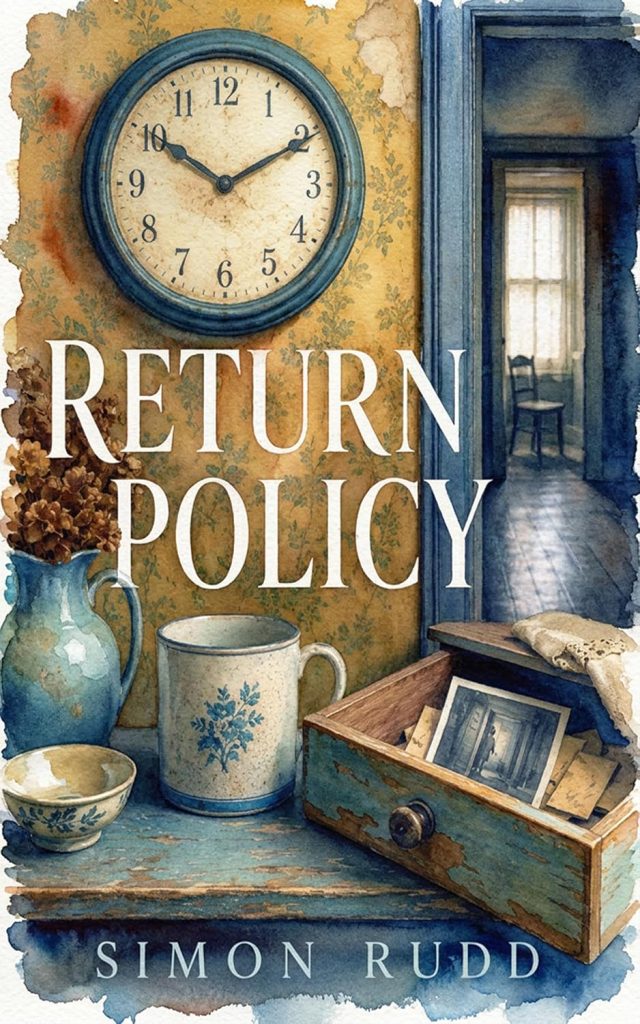
Colleen Maguire has built a good life. A husband who brings her tea without being asked. Two children — one sharp-tongued, one steady. A home where every cupboard handle points the same direction and every shelf is labelled. She sells vintage finds through her eBay shop, Second Lives, giving other people's discarded objects careful descriptions and tender provenances.
She's very good with other people's pasts.
Then a parcel arrives on her doorstep. No return address. Inside: a white mug with a blue stripe that she recognises but cannot place. It isn't in any of her systems. She didn't order it. She can't account for it.
The review appears on her shop page that night. Five stars. Written by someone who knows things about Colleen's childhood that Colleen herself cannot fully remember. And the review doesn't stop where her memory stops. It keeps going.
More parcels follow. A child's shoe that smells of smoke. A coat that fits a man she will not name. Each object is slightly wrong — the colour too bright, the weight too heavy, the temperature impossible. Each review describes another memory, pressing deeper into territory Colleen sealed off at seventeen and has spent twenty-six years building a life on top of.
The hallway grows longer. The stairs change number. Her son hums a tune she never taught him. Her daughter finds a name she never spoke.
Room by room, the house she made begins to merge with the house she fled.
Some things can't be resold. Some transactions don't close. And the past has its own return policy.
Return Policy is a literary horror novel about memory, domesticity, and the structures we build to contain what we cannot face — and what happens when those structures start sending the contents back.
Read the first chapter
Chapter 1: Front Hall
Item received. Good condition. No damage to packaging. The mug is exactly as I remember it, although I don't believe I ordered it and I can't find the transaction in my purchase history. A nice, simple design — white with a blue stripe — the kind of thing you'd reach for without thinking. The kind of thing you'd miss without knowing what you were missing. Would buy from this seller again, although I don't recall buying from them the first time.
Buyer: 31102026
# # #
The parcel was on the doorstep when Colleen opened the front door at seven forty-two, which she knew because she always knew, because the day had a schedule and the schedule began with the front door and the cold and the particular thin light of mid-October in the Midlands, the kind of light that hadn't committed to being morning yet.
She nearly stepped on it. A small box, brown, taped with clear packing tape that had started to peel at one corner. No courier branding. No return address. Her name and address printed — not handwritten, not label-printed, but printed directly onto the cardboard in a font she didn't recognise. COLLEEN MAGUIRE. The postcode was correct. The spacing was odd, the letters slightly too far apart, as though whoever had printed them was unfamiliar with the alphabet but had done their research.
The box was light. She shook it gently — the habit of a woman who dealt in objects — and something shifted inside with a ceramic sound, the dull clunk of a solid thing wrapped in paper. She carried it inside and set it on the hall table, next to the key hooks she'd installed herself, one for each of them: hers, David's, Niamh's (on which the key never hung, because Niamh's key was in Niamh's coat pocket or Niamh's schoolbag or the bottom of the washing machine, and Colleen had stopped mentioning this because she was choosing her battles, and this was not the battle she was going to choose, not this week). Callum didn't have a key yet. He was nine. There was a hook for him anyway, because eventually he would need one, and the system worked best when it anticipated.
She would deal with the parcel after the school run.
The school run was a seventeen-minute operation on a good day, twenty-three on a bad one, and the difference was almost always Niamh, who had developed, in the last six months, an ability to be simultaneously not ready and not rushing that Colleen found both infuriating and, in a way she wouldn't admit to anyone, impressive. Niamh was fourteen and moved through the house as though the house were a suggestion. Callum, by contrast, was ready when he was asked to be ready. He sat at the kitchen table with his bag packed and his shoes on, eating toast, watching his mother with the steady, uncomplicated attention of a child who hadn't yet learned that watching could be a form of worry.
"Niamh, we're leaving in four minutes."
"I know."
"You know, and yet your shoes are in the front room and your bag is upstairs and your lunch is on the counter."
"I'm a woman of many locations."
"You're a woman who's about to walk to school."
Niamh appeared at the top of the stairs in socks, holding one shoe. Her school jumper was inside out. She looked beautiful and completely disorganised, and Colleen felt the impossibility of keeping her safe by keeping her on time, which was the same impossibility, which was every impossibility, which was the whole point of the schedule.
"Callum, teeth?"
"Done."
"Show me."
He grinned. She inspected. Acceptable.
David came down the stairs behind Niamh, already dressed for his desk — which was the spare room, three days a week, where he managed projects for a company that made software for other companies that made software for hospitals, a recursion of usefulness that Colleen had stopped trying to explain at parties. He was carrying his coffee in the mug she didn't like, the one with the chipped rim that she'd asked him twice to throw away and that he kept using because it was his favourite, because it was the right weight in his hand, because David's relationship to objects was sentimental in a way that Colleen found both endearing and faintly alarming, as though he didn't understand that a mug with a chipped rim would eventually cut someone's lip.
"There's a parcel," she said.
"Expecting something?"
"No."
He glanced at the hall table. "Want me to open it?"
"After I'm back."
This was how they worked. Small negotiations, small deferences. He didn't push. She didn't explain. The marriage was good — she believed this with a conviction she examined periodically, the way you check the locks before bed, because the checking is part of what makes the house safe. David was kind. David was present. David noticed when she was tired and adjusted accordingly, bringing tea, lowering his voice, making dinner without being asked. He did not notice other things. The things he did not notice were not his fault. She had built the architecture of their life specifically so that those things would not be noticeable, and she had done an excellent job, and the fact that she had done an excellent job was not something she thought about, because thinking about it would require acknowledging that the job existed, and the job only worked if it was invisible, if the ordinary surface of their life was so seamless and warm and well-maintained that no one — not David, not the children, not the friends who came for dinner and said you've got such a lovely home, Colleen, it always feels so calm here — would think to ask what was underneath.
She drove the children to school. Niamh was silent in the passenger seat, scrolling her phone, focused, reading a language Colleen couldn't speak. Callum was in the back, singing something tuneless and content. The route was automatic — left, left, right, past the Tesco Express, past the church with the Norman doorway that she'd walked past four thousand times and never entered, past the row of terraced houses where someone had put a sofa on the pavement with a sign that said FREE and someone else had added NO THANKS — and she was home by eight nineteen.
The parcel was on the hall table where she'd left it. David was upstairs. The house was doing its thing — the heating had come on at six, and the pipes were still ticking in the walls, the particular metallic settling sound that she'd grown so accustomed to she only heard it when she listened, which she was doing now, standing in the front hall with the parcel in her hands, listening.
She opened it at the kitchen table. Scissors through the tape, flaps folded back. Inside, wrapped in a single sheet of tissue paper — not bubble wrap, not newspaper, tissue paper, which was wrong, because tissue paper was how she wrapped things, it was her method, her brand, the small professional touch that her buyers commented on in their feedback — was a mug.
White. Blue stripe. Ceramic, not porcelain. The kind of thing you'd find at a car boot sale for fifty pence and either leave on the table or take home and put in the cupboard and use every day without thinking about it. It was, objectively, nothing. It was a mug.
She held it. Turned it. The blue stripe was slightly uneven — hand-painted, maybe, or machine-painted in an era when machines were less precise. No maker's mark on the base. A faint tea stain inside, the kind that doesn't come out, that becomes part of the object. She ran her thumb over the rim. No chips. The glaze was intact.
She knew this mug.
What she couldn't do was place it, which was unusual, because Colleen's relationship to objects was precise and catalogued. She could identify the era of a piece of Denby pottery by the weight of it in her hand. She could date a picture frame by the type of backing, the colour of the cardboard, whether the glass was cut or pressed. She had sold over three thousand items through Second Lives, and she could, if pressed, describe most of them from memory — not because she had an extraordinary memory, but because she paid attention, because attending to objects was what she did, because the careful noticing of things was the skill that made the business work and the skill that made her life work, and the two skills were the same skill, and she had never thought about this, and she was not going to start now.
The mug was in her records nowhere. She checked the spreadsheet, the eBay sold-items archive, the handwritten log she kept for car boot sales. Nothing. She had not sold this mug. She had not listed this mug. She checked her purchase history. Nothing. She checked the parcel again. No return slip. No order number. No sender.
Filing a query with eBay was the sensible thing. Reporting an unsolicited package. The procedural thing, the thing that kept the system clean. Instead, she washed the mug — hot water, washing-up liquid, the good sponge — and put it in the kitchen cupboard, second shelf, behind the everyday mugs but in front of the ones they only used when people came round. A middle position. A holding position.
The cupboard closed, and she went to the shop.
# # #
The shop was the converted garage, accessible through the kitchen door or the side gate, and Colleen had made it hers the way she'd made the house hers — by organising it into a system that worked. Metal shelving units along three walls, labelled by category: ceramics, glassware, textiles, paper goods, miscellaneous. A packing station in the centre — a repurposed dining table with a cutting mat, tape dispensers, a stack of pre-folded boxes in four sizes. A label printer. A ring light for photographs. A clothes rail for hanging items. The fourth wall was the garage door, which didn't open anymore because she'd had it sealed and insulated, and in front of it she'd put a set of wooden cubbyholes that she used for outgoing orders, each slot labelled with a buyer name and a dispatch date.
She liked it in here. A space that existed entirely on her terms — no children, no compromise, no noise except the radio and the sound of tape being pulled from the dispenser. She could spend an hour photographing a single item: turning it in the light, finding its best angle, writing the description that would make someone want it. The descriptions were her favourite part. She was good at them. She wrote provenances — not fabrications, but imaginings, careful fictions that gave each object a context, a before-life, a story the buyer could take home along with the item. A 1940s brooch became a woman waiting at a train station. A 1960s serving bowl became a dinner party in a house with orange curtains. She gave the objects what they needed to be wanted again, and in doing so she performed an act that she did not recognise as an act of mercy, because recognising it would mean recognising what it was mercy for, and she wasn't going to do that, and she hadn't done it in thirty-two years, and the system worked.
Three orders packed. A set of Hornsea pottery photographed, picked up at a house clearance in Tamworth. A listing written for a wooden letter rack that she described as the kind of thing that waited for you in the hallway, holding the post with the quiet patience of an object that knows its purpose. She liked that sentence. She liked sentences that gave objects a kind of domestic stoicism, as though surviving were simply a matter of knowing where you belonged.
At eleven, she made tea. Went inside. Opened the cupboard.
The mug was in a different position.
It was still on the second shelf. Still behind the everyday mugs. But she had placed it with the handle pointing right — she always placed handles pointing right, because she was right-handed and it was more efficient to reach in and grasp, and this was not a thing she thought about, it was simply how she did it, the way you put your seatbelt on or lock a door, the body's own routine — and now the handle was pointing toward the back of the cupboard. Toward the wall.
As though it had been turned by someone who didn't know her system. Or by someone who knew it and had decided not to follow it.
She reached in and corrected it. Handle right. Closed the cupboard. Stood for a moment in the kitchen, her hand still on the cupboard door. The heating ticked. The house was quiet.
She let go of the door and finished her tea and did not open the cupboard again for the rest of the day, a small thing, an almost nothing, and she did not think about why she was doing it, because it was not a thing that required thinking about, because it was a mug, because it was a cupboard, because the handle had probably been like that when she put it in and she simply hadn't noticed, and she always noticed, but this time she hadn't, and that was fine.
That was fine.