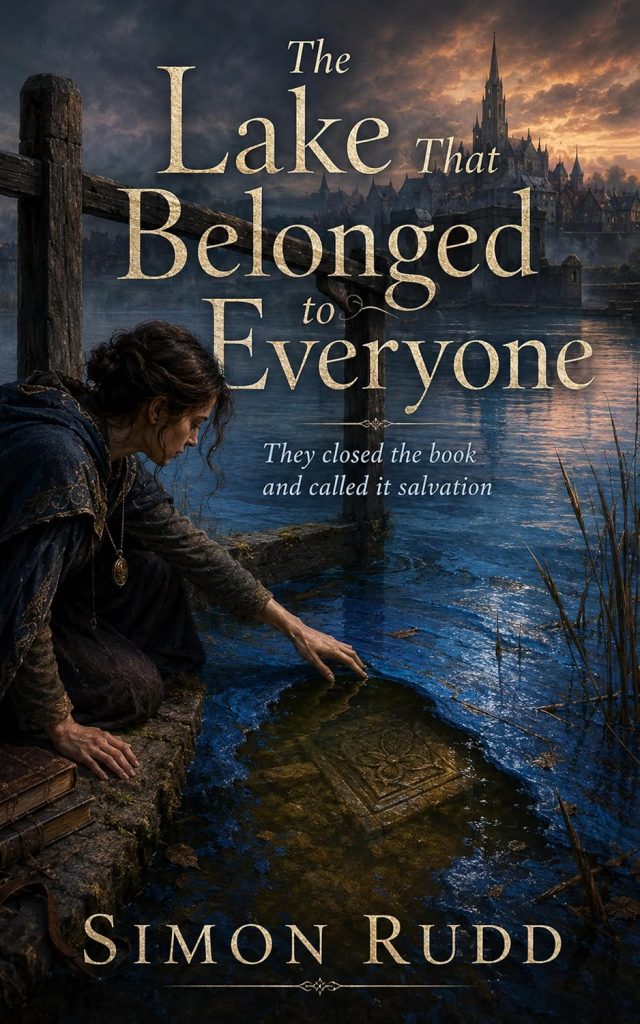
All her life Myrra Fernn has kept her record open. Across the front of her great ledger she long ago wrote the only instruction that ever mattered — this record remains open — and she has spent a lifetime leaving the lines unfinished at the foot of every page, leaving the pen where any hand at all could reach it.
So when word comes down the slow road of a far western town that has cured its lake — nailed the cure up where the road can see it, closed the matter, finished its book, and called the finishing salvation — something goes cold and exact in her. She takes her case down off the shelf of a settled life and walks west to Vellmere, to see a thing she has spent her whole life refusing: a record shut on purpose, and a town proud of it.
What she finds behind the bright board is a lake going grey under the proof of its own mending, a cure that is the perfect counterfeit of a gift — and one young keeper, Wren, who never stopped keeping the real book in secret. Because a finished record is a dead one. A lake answered from outside, however beautifully, is only a brighter kind of starving. And a water cannot be saved by one triumphant hand and hung up done; it has to be given back to the many hands it always belonged to.
The culminating standalone in an Orrowmere Story. The Lake That Belonged to Everyone is a profound, luminous fable about stewardship, false endings, and the things that only stay alive while we refuse to call them finished — for readers of Ursula K. Le Guin, Susanna Clarke, and The Overstory.
Read the first chapter
Chapter 1: The Lake Behind the Board
The western road did not end at Vellmere so much as lose its nerve there, narrowing through the last of the hill country until it was hardly more than a habit the grass had got into, and then giving up the whole valley at once — lake and town and the long gold light lying over both — as if it had been saving the view to excuse the walk.
Myrra Fernn came down it at the pace of a woman who had been on roads longer than this one had been a road, her case in one hand and the weight of her field-notebook riding in the coat against her ribs where it had ridden since she was younger than anyone now alive in the place she had left. She did not hurry. She had stopped hurrying a long time ago, somewhere east of everything, at a lake that had taught her there was no errand worth arriving at out of breath. She had not expected to be walking toward another one at this end of her life, and she was still, three towns into the going, a little affronted at the world for arranging it.
The road had been a fair road, as roads went, and then less fair, and then for the last good stretch only the western road, which is the name a road gets when there is nothing further on for it to be the road to. She had passed the marks of it going as she came: a milestone with the far face worn blank by weather and the near face by hands, a shrine-niche in a rock with the offering gone to a green crust, a place where two cart-ruts had argued about which of them was the road and one had won. She had read each of them the way she read everything, without meaning to, filing the small evidences of a country thinning out toward its last town. By the time the valley opened she had the shape of the going already; she had only to set it against the place itself and see where they disagreed.
She had not meant to come. That was the part she kept turning over, the way you turn a stone you have already decided to keep. The report had reached her by the slow road, hand to hand, the way the true things always came — a keeper two valleys over had heard it from a carter who had heard it from his sister, and by the time it got to Myrra it had been worn smooth by the telling, all the particulars rubbed off, only the shape of it left. A town away west that had cured its lake and nailed the cure up where the road could see. A town that had finished its book.
A finished book. She had read that phrase off the keeper's careful face and felt something go cold and exact in her, the way a draught finds the one gap in a shutter. She knew what a finished book was. She had spent a life making sure her own was never finished, leaving the lines open at the end of every page, leaving the pen where any hand at all could reach it, writing across the front of the whole great ledger the only instruction that had ever mattered: this record remains open. And here, the report said, was a town that had done the opposite on purpose, and called it being saved, and was proud.
So she had taken the case down off the shelf where it had been gathering the good honest dust of a settled life, and she had told Tovan she would not be long, which was a lie they had both been kind enough to let stand, and she had gone west. Tovan had not argued. Tovan had got out the case for her, in fact, and brushed the worst of the shelf-dust off it with the flat of his hand, and not said any of the several true things a person might have said to a woman past the easy age for roads, and that not-saying was the nearest thing to a blessing she owned. He knew, as well as she did, the one fact that ended the argument before it started: that a shut record was the single thing in the world she had never learned to leave alone.
The valley narrowed her thoughts as it narrowed the road. The hills came in close on either side, dark with a low scrub that smelled of resin and dust where the afternoon had been working at it, and between them the lake lay flat and bright and entirely wrong.
She saw the wrongness before she saw the Board, which she would think about afterwards, because the order of it told her something. A person who had come to admire would have seen the Board first — it was placed to be seen first, set square in the throat of the road on two stout posts, angled just so toward the traveller. But Myrra's eye had been reading water since before the famous hand that signed that Board was born, and her eye went past the gold to the lake behind it and stopped there, and her face did the small private thing it had learned to do over many seasons of standing in rooms where the truth would not be welcome, which was nothing at all.
The colour was on the water. That was the trouble, named in four words, though it would take the town the better part of a season and a great deal of grief to hear them. The colour was on the water the way paint is on a wall, the way gilt is on a frame, the way a good answer copied out by a hand that does not understand it sits on the page — present, even handsome, and stopping dead where it meets the thing beneath. There was a brightness across the whole broad surface, a sheen that caught the long light and threw it back blue, and it was the blue of something remembered rather than something happening, a blue with nothing under it, a blue that ended exactly at the skin of the water and did not go down.
A true lake did not do that. A true lake answered from its floor. The colour came up out of the deep of it, soaking the grain of the water from below like dye taking in cloth, blue going to violet where it gathered at the heart of the bowl, and the whole point of it, the entire and only point, was that it had a floor — that you could look at it and feel the down of it, the going-on of it, the depth that did not stop because the lake was not a surface but a held thing, full all the way through. Myrra had spent her life beside such water. She knew the look of it the way she knew her own hands. And she knew, standing at the head of the road with her case going heavy in her grip, that she was looking at the absence of it dressed up in its colours, and that the dressing had been done well, which was somehow the worst part.
She stood a while and let the lake be what it was.
Then she read the Board, because it would have been unprofessional not to.
It was a fine piece of work. She gave it that, in the dry back room of herself where she kept her judgements filed. The wood was good and seasoned, the posts were sunk deep and true, and the letters had been cut and gilded by someone who took pride in a clean edge. THE LAKE OF VELLMERE, it said, RAISED AND ANSWERED AND MADE WHOLE, and then a line she read twice, the way you read a thing that is going to matter — the labour of this water is finished, that the town may rest — and beneath that, smaller, the loop of a signature gilded in with the rest, a name she did not know yet and would come to know too well, set into the wood as though the wood were a thing that could be owned by signing it. The gilt had begun, very slightly, to lift at one lower corner, the way gilt does when it is laid on for the look of permanence and not the fact of it; a thread of bare grain showed through, no wider than a hair. She marked it and said nothing of it, even to herself, beyond the marking. It was the kind of small honest thing a board could not help telling about itself, and she had learned long ago to let such things lie where they fell until they were needed.
The labour of this water is finished. She turned the sentence over and found it heavier than the whole Board it was cut into. Somebody had stood here, she thought, and looked at a living lake, and decided that the kindest thing they could do for it was to tell it the work was over. The way you might, out of love, take a pen from the hand of someone you were tired of watching write, and cap it, and put it on a high shelf, and say there now, you've done enough, rest. And the someone would rest. That was the cruelty folded inside the kindness so neatly that even the folder could not see it. The someone would rest, and rest, and go on resting, until resting was all they remembered how to do, and then they would not be resting at all. They would be the other thing.
She became aware that she had been standing in the road for some while, and that she was no longer standing in it alone.
"You'll want the inn, then." The man had come up the road from the town without her marking it, which told her how far inside her own head she had gone. He was broad and weathered and pleased, with the particular ease of a person who lives somewhere he is certain is the finest place a person could live, and he was looking from her travel-stained coat to her case to her face with the open friendliness of a town that did not get many strangers and had decided, on no evidence, to like this one. "Come a long way, by the look. Most do now." He said it the way a man says a thing he has got to enjoy saying. "Come to see her, have you."
It was not a question, and Myrra understood that the her was the lake. "I've come a long way," she agreed, which was true, and let him have it as the answer he wanted.
"Aye, well." He turned and looked back at the water with her, and his face changed, going soft and proud all at once, and Myrra watched it change and felt the first proper ache of the thing she had walked all this way into. Because he loved it. That was going to be the whole difficulty of this place, she could see it already, laid out plain as a column of figures: they were not lying to her, and they were not fools, and the man beside her looked at his dying lake with the uncomplicated tenderness of a man looking at something that had been given back to him, and meant every ounce of it. "She was going," he said. "When I was a lad. Greying out at the edges, the fur on the old jetty-stones gone the colour of a bad tooth, and the elders saying it the way they'd always said it, that we'd to keep the book and keep the book, and us keeping it, and her going anyway." He shook his head at the memory. "And then the hand came over the pass and raised her up in an afternoon. One afternoon. I stood there. We all stood there. The whole of her come up blue like the first day of the world." He gestured at the Board without quite looking at it, the way you gesture at a thing you are proud of and have stopped seeing. "And good sense at last, to write it down and have done. No more grandfather's grandfather's scribble. The labour finished. Her, at rest, and us with her."
"At rest," Myrra said.
"At rest." He smiled at the word, untroubled, a man for whom rest was the happy end of a long worry and not, as it was for her, a thing she had spent long winters teaching a lake not to do. "You should've seen the keeping of that old book, before. My own gran with her sleeve in the ink half the days of the season, writing down whose ewe had whose lamb and who owed who for the mending of a wall, as if the water cared a straw for a wall." He laughed, fondly, at the foolishness of the dead. "Hours of it. Generations of it. And all that labour, and her going grey anyway, and then a hand comes and does in an afternoon what the book couldn't do in a hundred winters. Tells you something, that does."
"It does," Myrra said, and did not say what.
"You'll see for yourself. Go on down to the edge, if you like, before the light goes — folk like to, first thing, them as come. Stand and look at her. Then the inn. Coll's wife keeps a good table, and the Recorder'll be glad of you — Mabe's always glad of someone new to show the Board to."
He left her with a nod and went on up the road whistling, a man entirely at peace with the most frightening thing Myrra had seen in a long while, and she stood and watched him go and thought: that is the disease. Not the Board. The Board is only the symptom they nailed to a post. The disease is that good a man, that happy, walking away from a lake that is starving in front of him with the dye still wet on its face, and telling you with his whole kind heart that the labour was the trouble and the ending of it was the cure.
She went down to the edge, because he had told her to, and because she would have anyway.
The path down to the water was worn smooth and broad, more worn than the going down of a small town should make it, and she understood when she reached the shallows that the wear was new — that people came here now, came to stand and admire, where once they would have come to work and to write and gone away again about their lives. There was a little flat place at the bottom, a kind of viewing-stone, with the grass beaten back around it by the feet of people who had stood exactly where she was standing and felt exactly the thing the man had felt and gone home warm. Someone had even set a low rail of peeled poles along the lip of it, the way you do at a thing meant to be looked at rather than used, so that the looking should be comfortable and should not muddy the boots. She rested her hand on the rail, which was smooth with the resting of other hands, and she looked at the bright blue skin of the lake at close quarters, where the light could not flatter it, and it was worse close to, the way these things always were. The blue lay on the water in a film you felt you could have lifted at the corner like the scum off cooled milk. Beneath it the water was the no-colour of any water anywhere, pondwater, a brown-green nothing going down into dark, and the dark had no answer in it, no rising, no floor that gave back the looking. It was a lake wearing the memory of being alive.
She crouched, which her knees had opinions about, and reached down past the comfortable rail into the cold shallows to the nearest of the old works — a sunk stone, one of a line of them running out from the bank, the kind of stone a town lays down generations back to give the water something to answer against. The rail, she noticed, did not run out to these. The rail ran along the place for standing and stopped; the works lay beyond it, in the wet, where nobody went now, because the works were for working and the working was finished. Her fingers found the fur on the stone. She did not need to bring it up to the light; her thumb knew before her eye did, the way her thumb had known for forty winters. But she brought it up anyway, because she was a cataloguer and a cataloguer confirms, and she turned her wet hand in the gold light and looked at the scrape of scale caught under her nail.
Grey. Ochre-grey, the grey of old bone, of a thing that had been the deep living blue-violet of a true lake's fur once and had given it up so long ago it had forgotten the colour. Under a blue surface bright enough to draw travellers from three valleys, the fur on the sunk stones was the colour of starvation, and it had been that colour, by the dryness and the deadness of it, for a good while. Long enough that the brightness on top was not a fading cure but a thing that had never reached the bottom at all. She tried it on a second stone, further out, the cold climbing past her wrist, and the second told her the same as the first, and a third the same as the second; the lake did not contradict itself. The hand had raised the colour in an afternoon, the man had said. Of course it had. You could raise a colour on a surface in an afternoon. You could not raise a floor in an afternoon. A floor took a town and a book and the patient telling-down of the true small state of things, season on season on season, and you could not buy it, and you could not sign it, and you certainly could not finish it.
Myrra wiped her hand on her coat and stayed crouched at the water with her knees complaining and her face doing its careful nothing, and she let herself feel, for one held moment, the full size of what she had walked into. A whole town, kind and proud and wrong, standing on the bank of a lake that was dying behind a board that said it was saved, and loving the board, and loving her for coming to love it too. She did not take out the field-notebook. There was nothing yet to write that the water had not already written plainer, and besides, she had not come to file this one and leave it; she had felt that much settle in her even as the man walked away whistling. This was not a finding. A finding you could close the cover on. This was the precise shape of the only thing her whole life had ever stood against, and it had been waiting for her at the end of the western road, and there was going to be no closing the cover on it at all.
She had come a very long way. She had told herself, the whole long way, walking west into the failing light with her case getting heavier at every town, that she had likely misheard it — that the report had come too far hand to hand, that no town would truly nail its own book shut and call it a cure, that she would arrive and find some ordinary trouble she could read and file and leave to the people whose trouble it was, and go home to Tovan before the turn of the season with her curiosity quieted and her conscience clear.
She had not misheard it. The first look had told her that, before ever she reached the edge. The water had told her, plainly, in the one language she had given her whole life to learning: the blue on the surface, the grey on the stone, the dark with no floor in it going down and down to nothing. She knelt at the cold lip of the last lake on the western road, the proudest lake she had ever stood beside and the most thoroughly fooled, and she heard it exactly as it was, and there was no comfort anywhere in being right.
Behind her, up the worn path, the gold light caught the gilt of the Board and threw it back, bright and finished and proud, and beneath it the lake said nothing at all, because nobody had told it anything true in a long time, and a lake will only ever answer what it is told.g time after, that she had told the lake the truest thing she owned and the lake, for half of one breath, had answered.