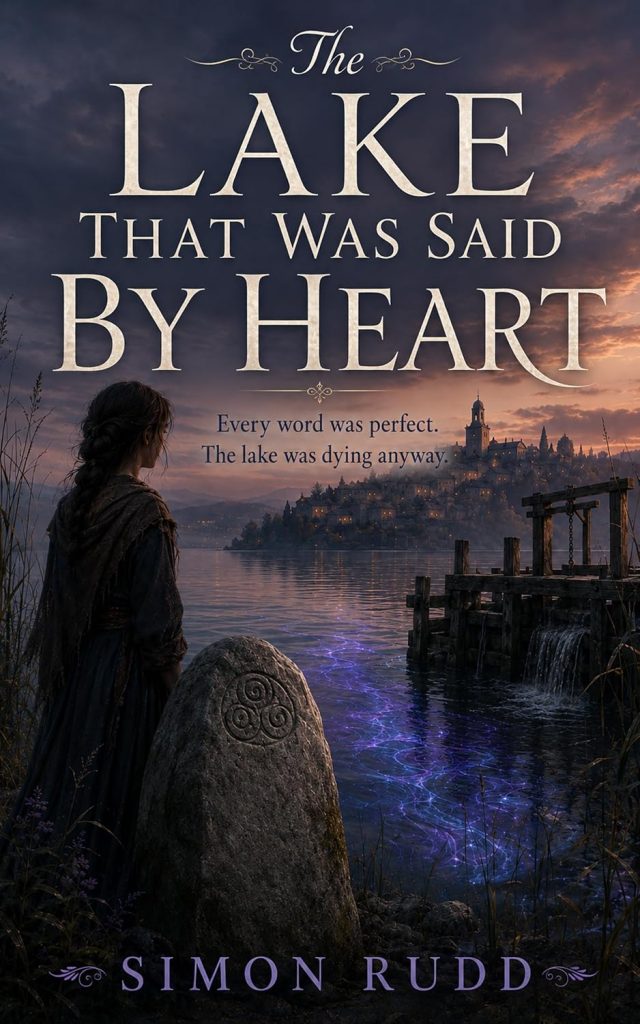
At Senn the water goes grey before the light does — and every evening at low light the whole town gathers on the bank to say the Saying, the old liturgy that has been spoken over the lake for a hundred keepings, word for word, by heart.
Esk has never dropped a word of it. Not as a child learning it by the fire, not through the fever-season, not the evening her own parent was carried down to the water. The words come up out of her like breath. And she is the only one who has noticed that the colour beneath the surface is failing — that the deep blue is greying year by year while the town recites on, flawless and content, certain that a Saying said perfectly must be a Saying that works.
But a lake does not read the words. It reads the heart beneath them. And a recitation said by rote — said by heart in the emptiest sense — is only a beautiful, hollow sound laid over a starving deep.
When a stranger named Bryda comes over the pass carrying a roll of full brushes, Esk is forced toward the hardest distinction of her life: the difference between saying every word right and meaning a single one. To save Senn she will have to break the perfect thing, and learn to say the lake not by heart, but with it.
A standalone in the Orrowmere Story, The Lake That Was Said By Heart is a haunting parable about authenticity and rote devotion, ritual and meaning — for readers of Le Guin's Earthsea, McKillip, and Robert Holdstock.
Read the first chapter
Chapter 1: The Low-Light Saying
The water at Senn went grey before the light did. That was the first thing anyone learned about the lake, before they learned the words, before they could even be trusted to stand at the edge without a hand on their collar — that the lake did not wait for the dusk to come down to it but went out to meet the dusk halfway, the colour leaving the surface from the middle outward while the sky overhead was still holding its gold, so that by the time the town had gathered on the bank the water lay flat and pewter-pale and waiting, like a held breath, like a face turned up to be told something.
It was a good lake to have been born beside. Esk thought so even on the evenings when she felt least entitled to think anything about it at all. The bank shelved gently down through the cropped turf to the saying-stone, a long low slab of the grey local rock that had been set there before the count began and worn since then to a sheen, and at the lake's narrow north end the works stood out into the shallows on their old black timbers — the sluice, the weir-gate, the sunk stones laid down by hands a dozen keepings dead to hold the channel true. The town came down the bank the way the town did everything to do with the water, without hurry and without slouch, the older ones first because their knees wanted the time and the younger ones held back behind them because that was the order of it, and they ranged themselves along the stone the way they always had, and waited for Hesta.
Hesta took her place at the centre of the slab where the worn dip in the rock was deepest, where a thousand thumbs across a hundred keepings had rested while their owners said the words, and she set her own thumb into the dip without looking down for it, the way you find the latch of your own door in the dark. Esk stood at her grandmother's right hand. That was her place and had been since she was small enough to need lifting onto the stone, and she had stood in it so long now that the rock under her feet had a shallow scoop in it too, a fainter one, hers.
"Low light," said Hesta, which was how it always began — not a word of the Saying yet, only the naming of the hour, an old courtesy to the lake that it should know the town had come on time and not been kept waiting. The murmur of the bank went down to nothing. Somewhere out past the works a fish turned and the rings of it spread and were swallowed by the grey, and that was the last small sound before the words.
Then Hesta said the Saying, and the town said it with her, and Esk said it too.
Behind them, where the children stood, Wick was saying it as well, or saying at it. Esk could hear the small voice going a half-beat behind the rest of the bank and then, on the verses she loved, a half-beat ahead — hurrying the easy parts, stalling on the hard ones, putting the third verse where the second belonged because the third had the heron in it and Wick could not bear to be made to wait for the heron. No one minded, yet. A child was let to stumble through the words however she could until the words came right of themselves; the minding came after, when the child was old enough to be reckoned a keeper and not merely a warm small body on the stone learning the shape of the evening. Down the line old Marn, who had stood at the water longer than anyone now living but Hesta and whose voice had thinned years since to a dry seam of breath, said it the way he had always said it, every word in its place, his lips barely going — and his grandson at his elbow got perhaps two words in three and was perfectly content, and the lake was said to by the whole spread of them at once, the word-perfect and the half-right and the barely-able, and to all of them it gave back the same shy grey-blue and no more.
She had never once dropped a word of it. Not as a child learning it in pieces by the fire, not in the bad season when the fever went through Senn and half the bank stood empty and the few of them who were well said it for all the rest, not on the evening — she had been fourteen — when her parent had been carried down to the water for the last time and laid where the dead were laid and said into the Saying by name, the way the dead were always said, present and unchanged. She had said it through all of that, perfect, every word in its place. The words were under her tongue before she thought of them. They came up out of her the way breath came up, without her asking, so that her mouth had already shaped the opening of a verse while the back of her mind was still somewhere else entirely, watching the grey water, counting the timbers of the works out of an old habit, noticing without wanting to that the fur on the nearest sunk stone had gone the colour of a dead leaf.
That was the trouble, and it was hers alone, and she had been told what it was.
The fur — the soft scale that grew on the works and the sunk stones and the underside of the saying-stone where the water lipped it, that bloomed in the good keepings to a deep wet blue running down into violet at the thick of it, so that a child could lie on her belly on the slab and put a thumb to it and feel the colour go down and down under the skin of the water and not stop — the fur had been greying for three keepings now. Greying slowly, the way a person greys, so slowly that you could stand on the bank at the low light and say the Saying flawless and go home and tell yourself you had imagined it, that the fur was as it had always been, that the colour had come up the same as ever. The town did tell itself that, mostly. The town said the words and watched the colour rise and went home content, and the colour did rise — it rose now, even as Esk noted the dead-leaf stone, the blue lifting from under at the centre where the depth was, soaking up into the grain of the surface the way it should.
But it rose shy. It always rose shy now. It rose the way a fire rises when the wood is damp, the way a voice rises when the throat has been crying — there, real, you could not say it was not there, and thin, and short of itself, and gone too soon back down into the grey. And the Saying that had called it up had been perfect. Esk knew it had been perfect. She had heard every word of it land in its place around her, fifty voices and Hesta's over them all, not a syllable out of true, the same words the same way they had been said since before the count began — and the colour that answered a perfect saying should not, by anything Esk had ever been taught, have been a colour you had to lean down and squint to be sure of.
There was a gap in it. That was the only word she had ever found for the thing, and it was not a word she was allowed to say aloud. There was a gap between the word that went out and the colour that came back, a hollow place where something should have been carried across and was not, and the gap had a shape, and the shape was the shape of the difference between the two things — between the saying of a thing and the meaning of it — and Esk could feel that shape the way you feel a missing tooth with your tongue, all the time, helplessly, going back to it.
She had told Hesta about it once. She had been perhaps nine. She had said, in the words a nine-year-old has, that the lake did not seem to hear them, that the colour came up small as if it were being polite, and her grandmother had crouched down to her on the bank with the lake going grey behind her and taken both of Esk's hands and told her, gently, absolutely, that this was the oldest wrong feeling a keeper could have. That it was a wanting. That a keeper who needed the water to answer her big and bright, who stood at the stone hungry for a show, had got the whole thing backwards — had made the saying about herself and her own wanting to be answered, when the saying was never about the keeper at all. You say it because it is true and because it is owed, Hesta had said. You say it whole and you say it right and you do not stand there waiting to be paid. The day you find you are saying it for the colour is the day you have stopped saying it for the lake.
And Esk, nine years old, had understood that she had been told her own heart was a kind of greed, and had believed it, because her grandmother was the most faithful person she had ever known and her grandmother's hands were warm and certain around her own, and because there was no one else, anywhere, who seemed to feel the gap at all. She had folded the feeling up small and put it away. She had got very good at putting it away. By now she could feel the whole grieved length of it open in her chest at the low light, the colour rising shy and the words landing perfect and the dead stone greying under it all, and let none of it reach her face — could stand at her grandmother's right hand word-perfect and ache like a struck thumb and call the ache her own fault, the way she had been taught, the way you call a thing grace when you have run out of any other name to give it.
The Saying came to its close. Hesta said the last of it and the town let the last of it go, and there was the small settling sound of fifty people remembering their own weight again, a cough, a child shifting, the bank easing. The colour held a moment longer at the centre and then sank, the way it did, the blue going thin and then going under and then only the grey again, the lake gone back to its evening face. No one but Esk seemed to mind how soon.
Down the stone a little, Pell had already turned to the door-post — not the keeper-house door, but the old say-post sunk by the head of the saying-stone, a squared baulk of the same black timber as the works, its weathered face cut from the ground up with the count. Pell kept the count. Pell's people had kept the count before Pell, and the count was the proudest thing Senn owned: a tally of every Saying said whole and on time at the low light and the turn of the season, cut a stroke at a time up the post, with the long marks for the great keepings and the cross-strokes for the turns, climbing the timber past the reach of a tall man and on up where it could only be read by ladder, every stroke of it a saying that had not been missed.
"And another," Pell said, and set the new cut, and a few near enough to hear made the small pleased sound the town always made — the warm, certain sound of a thing done right again, the way it had been done right every low light anyone present could remember and every low light their dead could have remembered before them. Never missed. It was the first thing they told you about Senn, on the rare occasions a stranger came over the pass to be told anything: that this was the town that had never once missed a Saying. They said it the way other towns said they had the sweetest water or the oldest bridge. It was their water and their bridge and their whole pride at once, the unbroken count, and Esk loved it the way she loved all of it, helplessly, and felt the gap open under the love, and said nothing.
The bank began to thin. People went up the turf in twos and threes toward the lights coming on in the town, calling the soft after-saying things to one another, who would do what at the high water, whose roof wanted seeing to before the turn. Wick came and leaned against Esk's side the way a tired small animal leans, all elbows and damp hair, and Esk put a hand on the back of her sister's neck without thinking about it.
"I said it nearly all," Wick said, with enormous satisfaction.
"You said most of it grandly," Esk agreed. "You said the third verse in front of the second."
"The third's better."
"It is a good verse." She could feel Hesta a little way off, gathering the last of the older ones, not near enough to hear, and so she let herself add, very low, the dry true thing she would not have said within her grandmother's reach: "Don't tell the post."
Wick snorted — a wet, delighted, scandalised sound — and was hushed by it herself, clapping a hand over her own mouth, eyes huge with the joke of it, and for a moment Esk felt the gap close over entirely, felt herself wholly and warmly in one place with one person and nothing missing at all, the way she only ever did with the child. Then Hesta's voice came down the bank — "Wick. Esk. The dark's coming" — and the moment folded itself away with all the rest.
"Go on up," Esk said. "I'll bank the stone."
It was an old word for an old small task, banking the stone — only sweeping the loose turf and grit back from the slab so the dew would not work under it in the night, a thing that did not strictly need doing every low light and that Esk had taken to doing every low light because it bought her the last of the dusk alone. Hesta gave her a look that knew exactly how much sweeping the stone wanted and let her have it anyway, and took Wick's hand, and went up the bank into the gathering dark, and the calling voices went up after them, and then there was only the lake and the works and the grey going to black, and Esk.
She crouched at the head of the stone and swept the grit back with the side of her hand, slow, listening to the water lip the timber. The pebble was in her pocket. It was always in her pocket; she had carried it so long she only noticed it the way you notice your own pulse, when something makes you. She put her hand in and found it now, smooth and dark and small and faintly warm from her body, the pebble her parent had given her at the very end, pressed into her child's palm with a strength a dying hand should not have had, with the one instruction that had ever in her life run crossways to everything Hesta taught.
Keep one word you truly mean.
That was all. Not say it — keep it. Her parent had not lived to tell her what it was for, and Esk had been too young, that last evening, to think of asking; she had only closed her fist around the stone because a fist was what the hand had asked of her, and held it through the saying-in afterward when her parent was said into the words present and unchanged, where her parent had stayed ever since, present and unchanged, every low light, said the same way she had learned to say everything the same way. She had spent every keeping since turning the pebble over, the stone and the words both, never daring either. You did not say what you meant at the water. You said what was set. The set words were the wall that held the dead in their places, the whole town's dead and her own among them, said present and unchanged at every low light so that they should never be more gone than they had been the evening before — and to stand at the stone and say instead some true thing of your own, some word that was only yours and that no keeping had ever set, was the one wrongness Esk had never seen anyone commit and could not imagine surviving the committing of.
She held the pebble and did not say its word. She had never once said its word. But the dark was down now and the bank was empty and the lake lay there in front of her with its tired grey face turned up, waiting, the way it always seemed to be waiting, and the gap was open in her chest, and she was so very tired of calling it grace.
So she said one true thing. Not the pebble's word — she kept that, she had always kept that. Just a small true thing of her own, the truest small thing she had, said under her breath to the water in the dark where no post could hear it and no grandmother and no town: that the colour was going. That she could see it going. That she loved the lake and she could see it going and saying it right was not bringing it back, and she did not know what would, and she was sorry.
It was four or five sentences and not one of them was set, and her voice shook on them in a way her voice never shook on the Saying, because the Saying came up out of her like breath and this came up out of her like blood.
And the fur on the nearest sunk stone — she would swear it, after, in the part of herself that kept no count and told no one — the fur on the nearest stone, dead-leaf grey a moment before, went for the space of a single breath the faintest blue at its deepest fold, down under the black water where the colour should come from, a blue so small and so quickly gone that a sensible person would have called it a trick of the last light, except that there was no last light, the light was gone, and the blue had come up from under all the same.
Esk knelt very still on the cold stone with her hand around the pebble and her heart going hard and did not breathe.
Then it was grey again, and the dark was full, and the water lay flat and gave nothing back, and from the town behind her came the small far sound of doors and the smell of the first fires, and after a while — her knees telling her how long — she got up off the stone and brushed the grit from her skirts and went up the bank toward the keeper house, where the window was lit and the door stood open and Hesta would have the kettle on, and she did not say to anyone, that night or for a long time after, that she had told the lake the truest thing she owned and the lake, for half of one breath, had answered.