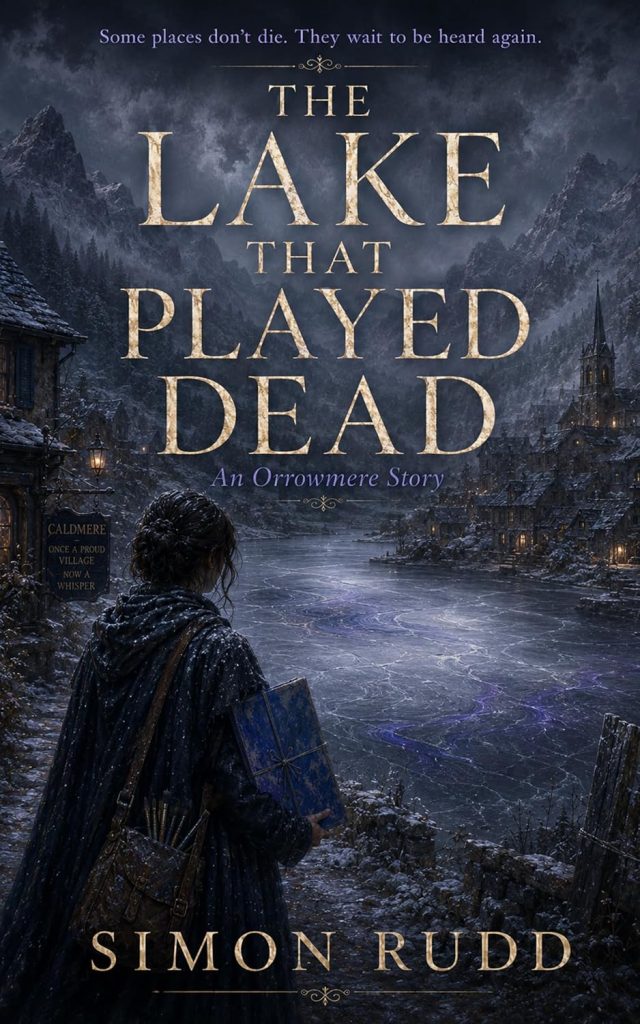
In the high lake-country, the water answers. Set a painted board at the waterline, speak something true, and the lake gives back its colour — and a deep blue gone over toward violet is the oldest yes there is.
Bryda Sael learned this as a child in Caldmere, the valley she was born in. She also learned to leave it. When the lake went grey and silent, the whole town agreed it had died — gone is gone — and a frightened girl believed them, climbed the pass, and built a good life out of never looking back.
Now Bryda is going home: a painter the lakes themselves answer, certain she can wake what Caldmere buried thirty years ago. She means to be the cure.
She is wrong about nearly all of it.
The lake never died. It was starved — answered less and less, then quietly written off, grieved as gone while it lay alive beneath the ice with no mouth to say so. And a lake does not come back for the most gifted hand in the country. It comes back only for a hand its own people own — which makes Caldmere's one hope not the admired outsider, but young Coro Renn, whom the valley has spent eighteen years calling mad: a painter who sees too truly to be comfortable, and who wants only to be left alone.
The Lake That Played Dead is a warm, slow-burning fantasy about grief and belonging, the quiet harm of being told you're fine, and the difference between fixing a place and letting it heal on its own terms. The third Orrowmere story — and a tender, self-contained homecoming you can read on its own.
For readers who love T. Kingfisher, Travis Baldree's Legends & Lattes, and Heather Fawcett's Emily Wilde: low stakes, deep heart, found family, gentle magic, and a town learning — board by board — to listen to its own water.
Read the first chapter
Chapter 1: The Long Pass
The last stretch of the climb was the part nobody warned you about. The pass itself was honest work — a long grind up through the thinning trees, the air going thin and then thinner, the kind of effort a body could lean into and at least feel righteous about. It was the level run afterward that did the real damage, the place where the road flattened and pretended to be kind, because by then a person had stopped bracing for it.
Hobb’s cart took the flat at the same pace it had taken everything else, which was the pace of a carter who had decided long ago that arriving and not arriving came to roughly the same thing in the end, and that the horse agreed with him.
“There it is,” he said, and tipped his chin at the country opening below them. “Or there it isn’t. Depends how you feel about it, I suppose.”
Bryda looked where he pointed, and the old thing happened in her shoulders before she had decided to feel anything. The weight came back into them. The bracing — chin down, eyes ready to drop, the body holding itself a half-step from a door it expected to close — settled over her like a coat she had left on a hook two seasons ago and was now, without asking, wearing again. She had spent the better part of those two seasons learning to stand the other way. It had taken Orrowmere most of a year to teach her shoulders that no door was going to slam. It took the sight of Caldmere from the pass about the length of one breath to unteach them.
The valley held its lake the way a cupped hand holds water it has stopped meaning to drink. Grey houses, grey smoke going up thin and straight in the still cold, grey slope down to the grey shape of the mere — and the mere itself the greyest thing of all, flat and frozen and giving back the white sky as a dull pewter nothing. There was no colour in it. That was the part that reached in under her ribs and took hold. Not that the colour was wrong, or faded, or sad. That there was none. Orrowmere’s water, even on its worst mornings, even when it was dim and tired and barely answering, had always at least remembered colour the way a banked fire remembers fire. Caldmere did not look banked. It looked like a hearth that had been swept.
“Well,” Ilsa said, beside her on the bench, and then did not say anything else.
Bryda did not look at her. There was a particular cruelty in watching a person see a thing like that, and she had decided somewhere on the long road up that she was not going to be cruel today, whatever else she managed. She kept her eyes on the lake and listened to Ilsa not finishing her sentence, and to the small dry sound of Ilsa’s hands moving on the case in her lap — the ledger-case, the flat leather thing she had carried over the passes the way some people carry an old wound, holding it carefully so it would not knock against anything and start hurting again.
The horse stamped, blew out a long plume of breath that hung in the air and refused to go anywhere, and waited to be told the day was over.
“I’ll take you down to the edge of the houses,” Hobb said. “Not into them. No offence to the place, but a cart that goes in tends to get talked at, and I’ve a long way back before the light’s gone, and I’d as soon do my being-talked-at on the return, when I’ve nothing to lose by it.” He clicked his tongue and the cart eased forward over the lip of the pass and began the long careful descent, the brake groaning, the wheels finding the ruts that the cold had set hard as stone.
“You’ll come back, then,” Bryda said. It was not quite a question. She heard it come out shaped like one anyway — the old trailing lift at the end, the opinion folded up small enough to be taken back if anyone objected to it — and she was annoyed with herself for it, and tucked the annoyance away to look at later.
“I’ll come back.” Hobb said it the way he said most things, as though it were faintly ridiculous of her to need telling. “I’ve a route, haven’t I. Caldmere’s on it, just barely, the way a toe is on a foot. I come through when there’s reason and sometimes when there isn’t, and I carry what wants carrying. Letters, mostly, these days. Not much else wants to come up this road.” He glanced sideways at her, and the glance took in the pack between her boots, the long roll strapped to the top of it, the careful way she had her arm across the whole arrangement. “You’ve brought things up it, though.”
“I’ve brought things up it.”
“Painter’s things.”
“Among others.”
Hobb let that sit. He was good at letting things sit; it was most of what made him bearable on a long road. The cart picked its way down, and the houses came up to meet them, and Bryda had time to count, the way she had not wanted to count and could not help counting, how many of the chimneys had smoke and how many did not. More than half did not. She remembered the town fuller than this. She had been a child here and the memory of a child made everything larger, so she allowed for that, took it off the total like a careful clerk — and the number that was left was still too small. Whole runs of houses stood with their shutters drawn and their gutters clean of any smoke-stain, the snow on their thresholds unbroken. People had not died here, mostly. People had simply gone, a few at a time, toward lakes that still did the thing a lake was for, until what remained was this: a town the size of a held breath, gathered down at the living end of itself, keeping warm.
One of the dark houses, the third in a shuttered row, had been the Maddrens’ — she dredged the name up from somewhere far down and was surprised to find it still there at all. There had been a girl in it her own age, and a dog with one bad eye, and a woman who sold honey-cakes off a board by the door on the mornings the town stood at the ice, back when the town had such mornings. Bryda had not thought of any of them in years. She did not know where they had gone, only that they had, the way you know a tooth is gone by the shape of the gap your tongue keeps finding. The town was full of such gaps. She could read them as she came down, house by house, a tally kept in drawn shutters and unbroken snow — and reading them was the first thing she had done since the top of the pass that felt like the work she had come up here to do, which frightened her, because the work she had come to do was meant to be the opposite of a tally of what was missing.
She had been one of the ones who went. She kept that thought where she could see it. It was important, she had decided, not to let it get behind her where it could do as it liked.
“You’ll want Eda’s,” Hobb said, as the first real houses closed around the road and the cart slowed to a walk. “Carrow. The hearth-kitchen, down by the old quay. Anyone you stop will send you there and feed you on the way, and Eda’ll feed you again when you arrive, and you’ll be warmer and better fed and no closer to anything you came for than you were on the pass. That’s Caldmere for you.” He said it without unkindness. He said most cruel-sounding things without unkindness, which was a trick Bryda had never learned and rather wished she had.
“You know it well.”
“I know everywhere a bit. It’s the curse of the road. You learn the shape of a place without ever having to live inside the shape.” He drew the horse up at a widening where three lanes met, near a low building with light in its windows and the smell of something long-simmered reaching out into the cold, and he set the brake, and he sat for a moment looking at the town the way a man looks at a thing he is fond of and does not expect to change. “Down you get, then. Both of you. I’d help with the pack but you’ve made it very clear with your arm there that the pack is not to be helped with, so I’ll keep my hands to myself and my dignity intact.”
Bryda climbed down. The cold came up through her boots from the packed snow the instant she stood on it, a different cold from Orrowmere’s wet seep, a dry hard cold that meant business and did not bother with damp. She breathed it and it scoured the inside of her nose. Above the lanes the light was doing the flat white thing that frost-country light did, where the sun was somewhere behind everything and committed to none of it.
She reached back up for the pack and brought it down against her chest, both arms around it now that there was no bench to brace it on, and felt through the canvas the hard flat shape inside — the board, wrapped twice in oilcloth and once in an old shirt, carried over the passes the way Ilsa carried her case, which was to say carefully, so it would not knock against anything. Except that Ilsa’s case held a wound and Bryda’s pack held the cure, or what she badly wanted to be the cure, and the difference between those two things was most of why she had come. A board from Orrowmere’s water. From the lake that had been dying and had not died. Proof, she had told herself the whole way up, that a starved thing was not a dead thing, and that what was starved could be fed.
The wrapping was the part she had not let herself examine yet — that she had bound the proof in oilcloth and shirt and stowed it in the dark of the pack, instead of carrying it open in her two hands where the first soul they met might have seen it and been given something to hope on. There would be a time to look at that squarely. It was not on the pass and it was not in this lane, and she suspected, with the small cold accuracy that was the best part of her, that it would go on not being the time for a good deal longer than was good for her.
Ilsa came down more slowly, the case held against her with one arm and the other hand finding the cart-rail, then the wheel, then nothing, and she stood on her home ground for the first time in years and looked at it with the over-careful composure of a person who had rehearsed this arrival many times and was discovering that none of the rehearsals had got the cold right.
“It’s smaller,” she said.
“It’s smaller,” Bryda agreed.
“I keep thinking I made it bigger in my head. Out of guilt. To have more to be guilty about.” Ilsa’s voice did the thing it had started doing somewhere around the top of the pass, the small professional flatness cracking just enough to let the rest of her show through. “And then I get here and it’s the opposite. It’s smaller than I let myself remember. I made it smaller so I’d have less to come back to.”
“That’s not a thing you decided,” Bryda said. “Towns get small on their own. It’s the one thing they’re good at.”
Hobb, who had been pretending with great courtesy not to listen, released the brake. “I’ll be through again before too long,” he said. “I’ll bring up whatever’s come for you from over the way. There’ll be something. There’s always something for the ones who’ve just gone somewhere — people can’t bear to let you arrive in peace, they have to send a letter after you to make sure you got there.” He lifted two fingers off the rein in something that was not quite a wave and not quite a blessing and was, Bryda understood, both. “Mind yourselves on Eda’s soup. It’s the kindest thing in this valley and it’ll talk you out of more than you’d believe.”
He turned the cart in the wide place, which took some doing, the horse unenthusiastic and the snow uncooperative, and then he was pointed back the way they had come, and the cart climbed away up the lane and did not look like a thing that would stop if you called after it. Bryda watched him go to the bend and around it. The sound of the wheels stayed a moment after the cart was gone, the way sound did in cold, and then that went too, and the valley closed back over the gap he left and was quiet.
It was quiet. That was the next thing, after the colour, that reached in and took hold — not silence exactly, because there was woodsmoke-crackle somewhere and a shutter knocking and, from the lit building at her back, the low burr of voices and a spoon going round a pot. The town made its small sounds. But under the small sounds there was a hush that Orrowmere did not have, a held quality to the air, as though the whole valley were a room in which something had been said that everyone had agreed to stop talking about, and the not-talking had gone on so long it had stopped feeling like not-talking and started feeling like weather.
Bryda stood in it with her pack against her chest and the cold coming up through her boots, and looked down the last of the slope to where the lane gave out at the frozen edge of the water. From here she could see the mere properly, the near reach of it, the ice gone over it grey-white and faintly ridged where the wind had worked it. Frost had grown along the margin in the night, feathering up off the ice in the fine crystalline plumes she had not seen since she was small — ice-feathers, her grandmother’s word for them, though her grandmother had said them differently, had said them the way you’d name a thing you were glad to see. The feathers stood in the still air, intricate and patient and entirely, perfectly white. Not a thread of colour in them. She remembered — or thought she remembered, in the unreliable enormous way of a child’s memory — that they had not always been white. That there had been mornings, very early, when the feathers had carried a thin blue down their spines like a vein, and that this had meant something, and that the something had been good.
Once, at first light, her grandmother had taken her down to the ice to see it — that was the memory, or the shape one had left where it used to be. Cold enough that the air had teeth. The whole near shore lined with people, more than lived in the valley now, all of them quiet and breathing smoke, all of them looking at the feathered margin where the blue had come up in the night. Someone had set a small painted board at the water’s edge, propped against a stone, and the colour in the ice had answered it — had reached toward it along the spines of the frost the way warmth runs along a wire — and a sound had gone through the gathered people that was not a word and was not a sigh, the sound of a great many of them being told one true thing at the same moment and finding, to their surprise, that they could stand it. She had been too small to know what was being answered, or why a whole town would come out into the dark and the cold before the light to watch frost turn a colour. She had understood only that the grown people around her, who were frightening in the ordinary way grown people were, had all gone soft in the face at once; that her grandmother’s hand had tightened on her shoulder; and that this, for reasons nobody bothered to explain to a child, had been counted one of the good mornings.
She filed the memory where she kept the other careful things and did not take it back out. There would be a time for it. There would, she was beginning to suspect, be a great many times for a great many things, all of them arriving in their own order and none of them today.
“Come on,” she said to Ilsa, more gently than she had said anything yet. “Before the soup hears us standing out here and comes to fetch us itself.”
Ilsa made a sound that was nearly a laugh, the first one, small and surprised out of her by the cold. They turned together toward the light in the windows and the smell of the long-simmered thing, two daughters of a quiet place come home over the high road, one carrying a wound and one carrying the cure, both of them carrying the thing carefully so it would not knock against anything yet. The door, when Bryda put her hand to it, was warm. That was the last thing she noticed before it opened — that after all the grey and all the white and all the held cold breath of the valley, the door of the place was warm under her hand, and had been waiting to be.