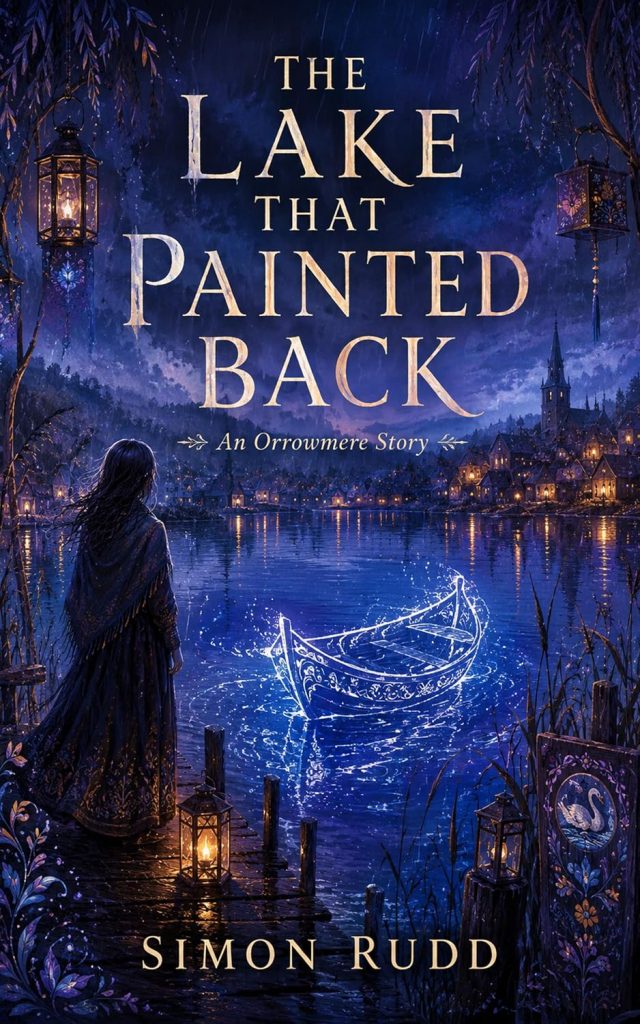
The lake has started painting again. The village would much rather it stopped.
Myrra Fernn analyses pigment for a living. She arrives in the rain-soaked village of Orrowmere with her cases packed, her tools labelled, and every intention of solving the problem and leaving — because Myrra always leaves. It's safer than discovering whether anywhere has saved a place for her.
The commission seems simple enough: the lake is producing colour it has no business producing. Impossible blues. Violets that won't dry. A pigment that behaves less like chemistry and more like an opinion. But the lake doesn't only make colour. It shows things. A puddle in the bakery. A bowl on a windowsill. Each one offering up a reflection of something the village has spent years trying not to look at.
Orrowmere once had a tradition called the Answering — a way of putting grief, thanks, apology and anger somewhere shared, where hands could carry it together. Then, one year, it stopped. Nobody quite decided to end it. They simply found that silence was easier to repeat than repair.
Now the water is asking again. And the deeper Myrra investigates, the more she suspects the lake isn't only painting the village's buried truth. It's started painting her.
A warm, witty, quietly moving novel about belonging, the things small communities agree not to say, and the difference between privacy and avoidance — for readers who loved Legends & Lattes, A Psalm for the Wild-Built, and the cosy magic of T. Kingfisher and Heather Fawcett.
Some answers can't be written alone. Some have to be made.
Read the first chapter
Chapter 1 — The Lake in the Wrong Colour
Rainmoot began by getting into Myrra Fernn’s boots.
It found the seam at the left heel first, then worked its way through the waxed leather with the patience of a magistrate and the manners of a cat. By the time the cart reached the last ridge above Orrowmere, her sock had accepted defeat. Her field satchel, better made, remained dry beneath three layers of oiled cloth. Myrra approved of objects that understood their purpose.
Below the ridge, the village curved around the lake in a wet half-moon of slate roofs, pale chimney smoke, painted shutters, and lanes darkened nearly black by rain. The water beyond it should have been grey. The sky was grey, the reeds were grey-green, and the hills behind the far shore sat under cloud with the patient misery of damp sheep. A sensible lake, under those conditions, would have reflected pewter, chalk, lead, or at most a subdued green.
Orrowmere reflected blue-violet.
Not the blue of distance or the violet of bruised evening. This was fresh pigment colour, alive under the rain: lavender petals ground into lapis, stirred across the whole surface by a careful hand. It held steady even when the wind moved across it. The ripples broke the colour but did not scatter it.
Myrra took out her notebook.
The cart driver, a narrow man called Hobb who had introduced himself three valleys back and said almost nothing since, glanced over his shoulder. “Best not to do that on the ridge.”
“Write?” Myrra asked.
“Judge.”
“I’m not judging it. I’m recording it.”
“Same face, usually.”
Myrra considered this, made a note of it, and kept her face arranged in professional neutrality. Professional neutrality was not the same as judgement. It was simply judgement with better posture.
The road into Orrowmere descended through wet orchard rows and low stone walls furred with moss. Rain tapped against the cart hood and slid down in steady strings. Every hollow held water. Every puddle reflected some portion of the lake’s impossible colour, though no puddle was large enough to see the lake directly. That was worth noting as well.
She wrote: Rainmoot reflective contamination may extend through standing water unconnected to main body.
Then, because accuracy mattered, she crossed out contamination and wrote: sympathetic reflection.
Hobb clicked his tongue at the mule. “Catalogue folk usually come later.”
“Later than what?”
“Than the rain deciding what sort of rain it is.”
The mule, whose opinion of rain was plain and unfavourable, shook its ears.
“I was told pigment blooms appear early in Rainmoot,” Myrra said. “If I wait for settled conditions, I risk missing first behaviour.”
“Nothing in Orrowmere settles till it’s had a good sulk.”
“Is that an observation or a warning?”
“Mostly village pride.”
The road became a lane, and the lane became a narrow wet street where houses leaned close enough for their eaves to drip into one another’s business. Shutters had been painted in different blues: milk-blue, storm-blue, faded kingfisher, old indigo rubbed thin at the edges. Several held traces of older layers beneath newer paint, visible where weather had lifted the surface. Myrra’s fingers itched for a scraper.
A woman in a reed cape carried a covered basket across the lane and nodded to Hobb. Two children launched paper boats into a gutter stream, cheered when one turned in a circle, then stopped cheering when it turned in a second circle against the slope of the water. One child looked at the gutter, then at the sky, then at Myrra with the grave suspicion reserved for outsiders and weather changes.
“New person,” the child announced.
“Temporary person,” Myrra said before she could stop herself.
The child narrowed their eyes. “That’s what new people say when they’ve brought too many bags.”
Hobb made a sound that might have been a cough if he had been kinder.
Myrra looked down at the cart bed. There were three travelling cases, one chest of tools, one flat portfolio wrapped in waterproofed canvas, two satchels, a folded measuring rod, and a small crate labelled SAMPLE TINS — DO NOT STORE NEAR HEAT, FERMENT, OR LIVESTOCK.
“For a professional visit,” she said, “this is moderate.”
“For a funeral, perhaps,” said the child. Their paper boat escaped the gutter, struck Hobb’s wheel, and folded itself into something less ambitious.
The woman with the basket turned back. “Pip Thornish, leave the cataloguer alone until she’s had bread.”
Pip Thornish considered this rule, apparently found it part of an unjust but familiar legal system, and retrieved the ruined boat.
“Bread first,” Hobb said, giving the words the weight of an official arrival procedure.
“I need to report to my lodging first.”
“You can. Bread’s on the way.”
That sounded unlikely, unless Orrowmere had arranged itself around bakery access, which would be sensible but rare. Myrra closed her notebook before the rain could soften the page and tried to observe without staring. There was an art to arrival. Too much interest made people perform. Too little interest made them think you were disappointed. Myrra had spent years learning the correct angle of attention: enough to catch details, not enough to be caught by them.
Orrowmere made that difficult.
A line of painted posts ran beside the lane, each one capped with a small carved shape: fish, oar, loaf, brush, lantern, reed bundle. Several were older than the railings attached to them. At least three had been repainted recently, though the work had been done around small iron hooks rather than over them. The hooks were empty. They had the look of things everybody had stopped mentioning too carefully.
At the next corner, a square opened between the lanes. Market stalls stood half-covered against the rain, their canvas roofs sagging with water. Reed baskets hung under one awning. A fishmonger wiped down his board. A girl in a bright scarf repainted a swinging sign despite the weather, muttering at the rain every time it tried to improve her work. Gutters crossed the square in shallow channels, all running toward the lake, all carrying threads of the same impossible colour.
The colour should have weakened in motion. It did not.
Myrra reached for her notebook again.
“Still not judging?” Hobb asked.
“Now I’m measuring my restraint.”
“Poorly?”
“With difficulty.”
The mule stopped without instruction outside a low building whose windows glowed gold and whose door released heat, yeast, salt, and something floral into the rain. The smell struck Myrra with such force that her stomach, which had been behaving like a disciplined field assistant, made an immediate appeal to management.
A painted sign over the door showed a round loaf with a wave curling through it. The words beneath read CRUMB’S LAKEFRONT BAKERY in blue letters repaired so often that the paint had a layered thickness like enamel. One letter had been touched up with a pigment that leaned violet. The same colour as the lake, but warmer.
The bakery door opened before anyone knocked. A broad-shouldered man looked out, flour on one cheekbone and forearms bare despite the damp. He had the expression of someone who had expected the weather to deliver exactly this inconvenience.
“Hobb,” he said. “You’ve brought me a wet scholar.”
“Cataloguer,” Myrra said.
The baker looked at her cases, her satchel, her wrapped portfolio, and the careful way she had covered her sample crate. “Worse. Cataloguers use spoons to disagree with soup.”
“I have never disagreed with soup in a professional capacity.”
“Give it time.” He stepped farther out, untroubled by the rain. “Tovan Crumb. Bread first, lodging second, lake after that. Anyone told you?”
“Several people have attempted to.”
“Good. Saves time.”
He reached into the bakery and came back with a cloth-wrapped roll. Steam escaped the fold. “For your hands. Not your notebook.”
“I can pay.”
“Later, when your fingers work.”
The roll was warm enough to make refusal foolish and acceptance complicated. Myrra accepted it. The cloth was thick and clean, patched at one corner with blue thread. She held it in both hands and felt rainwater cooling on her cuffs while the bread warmed her palms.
Tovan looked past her toward the lake. “That colour holding?”
“Yes.”
“Thought so. Starter was smug this morning.”
Myrra paused with the roll unopened. “Your bread starter responds to the lake’s colour?”
“Not responds. Comments.”
“That distinction seems important.”
“It is if you’re bread.”
The bakery behind him clattered with trays, voices, and the soft thump of dough being handled by someone confident enough not to hurry it. A few villagers sat at narrow tables by the window, all of them turning just enough to examine Myrra without admitting to curiosity. Their attention moved over her boots, cases, satchel, stained fingers, and notebook. She had been inspected by archive committees with less thoroughness.
One elderly man raised his cup in greeting. “If you’ve come to tell us the lake is odd, we’ve noticed.”
“I’ve come to catalogue pigment behaviour.”
“That too.”
Tovan took the mule’s bridle and glanced at Hobb. “Marlo’s got her room?”
“Lantern side. Window to the water.”
“Cruel.”
“Educational,” Hobb said.
Myrra was about to ask why a view of the research subject was cruel when rainwater dripped from the bakery sign into a puddle near the threshold. The puddle trembled.
It was not large: a shallow oval held between two uneven stones, clouded with grit, crossed by a thread of flour washed from the bakery step. For a moment it reflected the sign above it, the loaf, the wave, the worn blue letters. Then the image thinned, flattened, and became something else.
Painted boards hung in a hall Myrra had not seen.
They were arranged along a wall on small hooks, each board bright with wet colour: a boat under lanterns, hands holding a bowl, reeds bending toward a painted moon, a row of cottages with blue smoke rising from every chimney. The image was not a memory of the street. It had depth, lamplight, and the gloss of fresh paint. It smelled faintly of rain on old wood, though Myrra knew perfectly well puddles did not smell of old wood unless old wood was nearby.
The wind moved. The bakery sign swung. The puddle image remained.
Myrra crouched so quickly the warm roll nearly fell from the cloth.
Behind her, one of the villagers said, “Ah.”
It was the sound of someone discovering an aunt had arrived early and taken the good chair — not fear, not quite surprise.
Tovan sighed. “That’ll be the hall, then.”
Myrra looked up. “What hall?”
“The one no one uses for that.”
“For what?”
“Boards.”
The image in the puddle shivered. A line of colour ran down one painted board, violet over gold. The hand that had painted it was not visible, but the brushstroke had pressure in it. Someone had leaned into the colour, then lifted at the end with care.
Myrra leaned closer. The professional part of her mind moved first, grateful for work. Reflective surface behaving as active visual field. Apparent interior image unrelated to immediate surroundings. Potential recorded memory? Future projection? Festival material? Pigment stability unknown. Then another part, less organised and therefore less welcome, noticed that each board had a hook above it and that the hooks along Orrowmere’s lane were empty.
“Does this happen often?” she asked.
Three villagers found urgent reasons to drink from cups.
Tovan rubbed flour from his cheek and succeeded only in moving it. “Depends what you mean by often.”
“More than once.”
“Yes.”
“More than once in a season.”
“Also yes.”
“More than once in a morning?”
“Rainmoot has moods.”
The puddle cleared. The boards vanished, replaced by the bakery sign, Myrra’s crouched shape, and the blue-violet sky that was not blue-violet at all when she looked up.
Pip Thornish appeared beside her, having materialised with the silent skill of children near adult avoidance. “That was a proper one.”
“A proper what?” Myrra asked.
Pip looked at Tovan.
Tovan looked at the lake.
The old man with the cup became very interested in the last inch of tea.
“A proper reflection,” Pip said, with the air of someone simplifying the world for a difficult student. “Not just weather being dramatic.”
Myrra stood slowly. Her knees objected to the crouch; her wet left sock objected to everything. She had catalogued mineral blooms in old quarry chapels, fungal pigments that changed colour when lied near, and a shrine wall that shed green dust whenever anyone praised it insincerely. She was not easily impressed by unusual material behaviour. Impression was for tourists. Documentation was for professionals.
Still, the puddle had shown brushwork.
Not colour, not blur — a hand that had leaned in and lifted at the end.
She opened her notebook to a fresh page. “I’ll need the location of the hall.”
“No rush,” Tovan said too quickly.
Myrra looked at him.
He met the look with the calm of a man who had overproved dough, underproved excuses, and had learned which failures could be fed to ducks. “You’re wet. Your luggage is wet. Your mule is personally offended. The lake will still be peculiar after breakfast.”
“I was not informed that breakfast formed part of the commission.”
“It doesn’t. That’s why it’s reliable.”
The roll in her hand had cooled just enough to open. Inside, the crumb was pale with veins of blue-lavender running through it, not dyed but grown that way, each line following the air pockets, the bread risen around weather. The smell was warm crust, faint salt, and a soft floral note that made the rain seem briefly deliberate.
Myrra should have taken a small piece, assessed texture, noted colour distribution, asked about ingredients, and requested permission to retain a sample.
She took a bite.
The bread was savoury first, then warm with a sweetness that did not quite belong to sugar. Lavender, yes, but not the dried kind tied in wardrobe bundles. This tasted like lavender after rain, the green bitterness still in the stem. The lavender lines had a mineral coolness that faded as she chewed. Not unpleasant. More like the memory of touching stone under shallow water.
Tovan watched her expression with professional interest. “Starter was right.”
“About what?”
“That you’d make the face.”
“I did not make a face.”
“You made a cataloguer face. Very severe. Means it’s good or fatal.”
“It’s not fatal.”
“Good, then.”
Hobb began unloading her cases with the resigned care of someone who knew sample tins mattered but could not imagine why. Myrra moved to help, but Tovan took the heaviest case before she reached it. A second villager lifted the tool chest. Someone she had not met tucked the wrapped portfolio under the bakery awning, away from the rain. It happened with alarming efficiency.
“I can manage those,” Myrra said.
“Likely,” Tovan replied, carrying the case with the private offence due to its weight. “Managing isn’t the issue.”
“What is?”
“Arriving properly.”
There it was again: the sense that Orrowmere had procedures no one intended to write down. Myrra disliked unwritten procedures. They left too much room for people to call confusion rudeness.
She tucked the remaining bread back into its cloth and glanced toward the lake. From the bakery threshold, the water was visible between two houses and a sloping lane. The colour still held. Rain stippled the surface, but the lake did not give itself away.
A gust moved across the village, shaking water from awnings and bringing with it the smell of reeds, chimney smoke, wet stone, and something metallic from the shore. The lake darkened at its centre. For a breath, the colour drew inward, tightening under the touch of an unseen brush beneath the surface.
Then a shape appeared.
Not fully. Not yet. A line of gold, then brown, then a dark curve like the side of a small boat. It formed in the water beyond the nearest jetty, too far to be a reflection of anything tied there. No boat floated at that spot. The line held, faded, returned, and dissolved back into the lake’s colour before Myrra could be certain of its scale.
The old man inside the bakery set his cup down without a sound.
Tovan’s expression did not change much, but his hand tightened on the case handle.
Myrra looked from the lake to him. “Was that also weather being dramatic?”
“No,” Tovan said.
The honesty surprised her more than evasion would have.
Pip, standing ankle-deep in a gutter and apparently immune to adult attempts at boundaries, whispered, “Boat weather.”
“That,” Tovan said, “is not a recognised category.”
“Should be.”
Myrra wrote the phrase down. Boat weather. Then she underlined it once, because local inaccuracies often contained better information than formal terms.
The lake returned to its wrong colour and pretended, with considerable skill, that it had never done anything else.
By the time they reached The Tilted Lantern, Myrra’s luggage had acquired more carriers than she had names. The inn stood where a side lane lifted slightly from the water, its windows golden, its roof dark with rain, a small lantern charm swinging over the door. A round-faced man in a clean apron met them beneath the awning and took in the procession with one raised eyebrow.
“Cataloguer?” he asked.
“Myrra Fernn,” she said. “I believe you have a room for me.”
“I do. Marlo Fenwick.” He glanced at the cases. “And possibly a room for your equipment, if it promises not to ferment.”
“The crate labelled fermentation risk is sealed.”
“That was not as comforting as you hoped.”
Tovan set down the largest case. “She’s seen the lake do a colour and a puddle do the hall.”
Marlo looked at Myrra with sympathy of a kind she did not enjoy. “Before bread?”
“During bread,” Myrra said.
“Could be worse.”
“How?”
“It could have waited until you’d unpacked.”
This, Myrra suspected, was not an answer. Orrowmere appeared to have a surplus of statements shaped like answers and an economy of actual explanation.
Marlo led her upstairs while others deposited her luggage in a room overlooking the lake. The room was narrow but clean, with a sloped ceiling, a plain bed, a washstand, a small iron stove, and a worktable placed directly under the window. Someone had already set a ceramic bowl on the sill to catch a drip from the frame. The bowl was half-filled with rainwater.
Myrra noticed the bowl before the view.
The surface of the water in it shone with the lake’s colour.
“Does every room come with active reflective surfaces?” she asked.
Marlo looked at the bowl. “Only the better ones.”
“I’ll need another table.”
“For the bowl?”
“For the work the bowl is preventing.”
He smiled, not broadly. “I’ll see what can be found.”
After he left, the room settled around her with the soft sounds of rain and unfamiliar timber. Downstairs, voices rose and fell. A door opened. Someone laughed. A kettle lid rattled. The village continued around her, her arrival folded into its wet afternoon and worked around like any other weather.
Myrra removed her wet coat and hung it on the back of the chair, not the hook by the door. Hooks suggested intention. Chair backs were temporary.
Her cases waited in a neat line at the foot of the bed. She opened the tool chest first to check for damp. Scrapers, brushes, cloth packets, chalk papers, sample knives, sealing wax, and labelled tins sat in their compartments exactly as packed. Good. The field notebooks were dry. Better. The portfolio had no visible water damage. Best.
The bowl on the sill clicked softly.
Water should not click unless freezing, boiling, or holding something that struck its side. The room was cool but not cold. Nothing floated in the bowl.
Myrra approached with her notebook already open.
The rainwater had cleared to a pale reflection of the ceiling beam. Then the beam lengthened, darkened, and became a roof truss in a larger room. Hooks appeared along a wall. Boards hung from them: the same painted boards from the bakery puddle, though now she could see more. Some were old and cracked. Some were freshly bright. One showed a line of people standing by a lake, each holding a bowl. Another showed a small boat under lanterns.
At the bottom of the reflected scene, where the bowl curved the image, a hand moved with a brush.
Myrra stopped writing.
The hand was quick, brown-skinned, stained at the fingertips. It painted a stroke of lavender-and-lapis along the edge of a board, then lifted away. The brush left behind not a word, not a symbol, but a colour so exact Myrra could feel its coolness under her own thumb.
The image vanished.
Rainwater trembled in an ordinary bowl on an ordinary sill. Below the window, Orrowmere’s lanes gleamed. Beyond them, the lake held its wrong colour like an opinion it had no intention of softening.
Myrra stood there with her notebook open, her wet sock cold, her bread cloth still warm in one hand, and understood several things.
The commission would not be simple.
The lake was not merely producing pigment.
The village knew more than it had said.
And whatever Orrowmere’s old Answering had been, it had begun without waiting for permission.
She dipped the clean end of a sample strip into the bowl. The paper drank rainwater, took the colour briefly, and dried to plain white before she could label it.
Myrra looked at the blank strip.
“Rude,” she said.