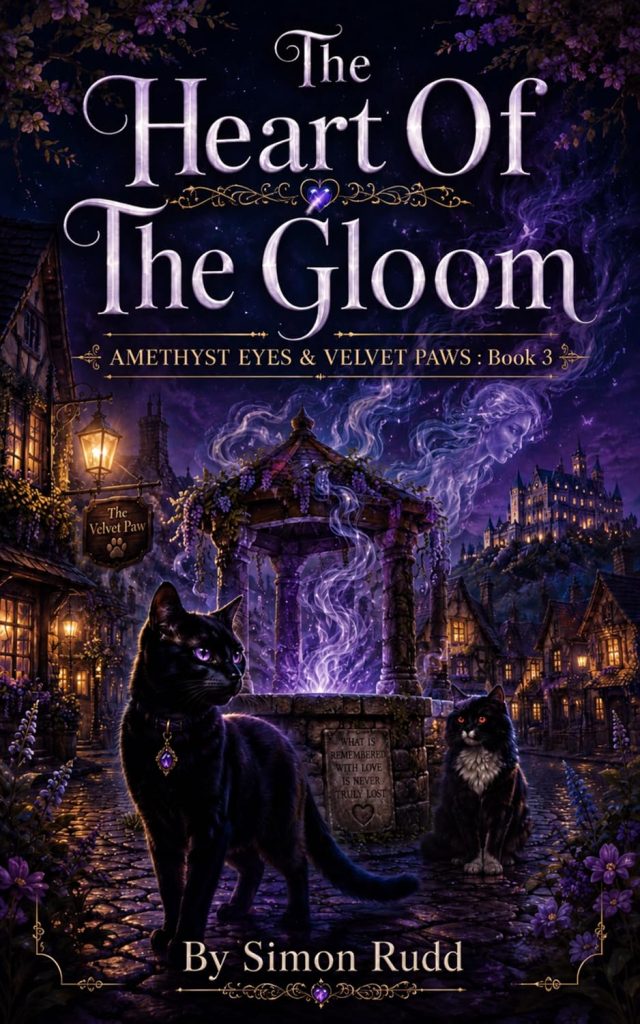
Ten months ago, at a ruined altar, Count Alaric Dracula made a promise to his own loneliness.
Not like this. Not yet. Wait — and I will come back for you properly.
He has not come back.
Cobblestones is at peace. Two vampires walk its rooftops now, weakened but content. The village knows the worst of what Alaric is and loves him anyway. And every night, at the sealed well in the square, a single thread of purple-grey mist rises and turns — patiently, hopefully — toward the lit window on the hill where its maker sits, finding reasons not to keep his word.
Then a scholar arrives with a family name Alaric has spent centuries dreading, carrying a journal, a theory, and one unbearable fact: the Gloom cannot be sealed again. It must be answered. Its maker must go down into the dark, lower every defence he has, and let four hundred years of sorrow be witnessed entire — and if any part of him still believes he was meant to be alone, it will take him.
There is no record of anyone surviving it.
There is, however, a record of someone fleeing it. Buried in torn parish registers, a hundred and fifty years gone, the village hid the story of another lonely creature who made a darkness of his own — and walked away rather than face it, leaving it orphaned in the ground beneath their feet.
He is the man Alaric will become if his courage fails.
The village will build a circle. A widow who has been held by the dark will stand closest to the rim. And a four-hundred-year-old monster will have to discover whether the bravest thing he has ever done is not to fight, or to flee, or to protect —
— but to walk down into his own loneliness, and take it by the hand, and bring it home.
The Heart of the Gloom is the final book of the cosy gothic fantasy trilogy Amethyst Eyes & Velvet Paws: a story about promises, courage, and the extraordinary power of simply being seen. Bring tea. Bring tissues.
Read the first chapter
Chapter One — Purple Shadows
The first thing Count Alaric Dracula noticed on that particular Tuesday evening was the absence.
Not the absence of the Gloom; that corruption still manifested in wisps and tendrils throughout Cobblestones, persistent as mildew in a damp cellar. Rather, it was the absence of urgency — the absence of that metallic taste of danger that used to accompany every sunset, the absence of the weight that had pressed against his shoulders for fifteen years.
He wasn’t alone anymore.
Beside him on the library’s peaked roof, Vladislav stretched with practised grace, his form shifted to the shape they both favoured for patrol now: a sleek dark cat with a white blaze at the throat and ember-red eyes that could track movement in absolute darkness. Ten months he’d been wearing it, ever since a certain mill roof, and he wore it easily these days, though he still swore in three languages whenever the transformation caught on something. His tail swished with satisfaction as he surveyed the village spread below them like a quilted blanket of warm lights and rising chimney smoke.
“Quiet tonight,” Vladislav observed, his mental voice carrying the slight accent three and a half centuries hadn’t quite smoothed away.
“Too quiet,” Alaric replied automatically, then mentally kicked himself. He sounded like a character in one of Mina’s penny dreadfuls. “No. That’s not right. It’s appropriately quiet. The correct amount of quiet for a Tuesday in autumn when the salt lines are fresh and the horseshoes properly hung.”
Vladislav’s whiskers twitched. “You’re allowed to enjoy peace, you know. We earned it.”
Had they, though? That was the trouble, and it had been the trouble for ten months. They had not won peace. They had borrowed it — Alaric had said as much to the whole village, on the green, in the plainest words he owned: that the thing under the well had not been defeated but reprieved, that it was his own loneliness grown vast, and that one day it would have to be answered rather than fought. He had told them there was a debt outstanding. He had told them he meant to pay it.
And then he had spent ten months not paying it.
He could still feel the price of the last containment — not pain, exactly, but a steady awareness of limits that hadn’t existed before. He tired more easily. The supernatural reservoir that had seemed bottomless for four centuries now had a discernible floor, and he and Vladislav both stood a little closer to it than they used to. A fair trade, he’d told himself at the time, for the village’s safety. What he had not reckoned on was that safety bought with a promise is not the same as safety, and that a promise unkept does not sit quietly. It waits. And it had been waiting, in the dark under the square, with a patience that ought to have comforted him and instead unsettled him more with every passing month, because he knew exactly what he was: he was a creature that made promises to the lonely and then found reasons not to return. He had done it for four hundred years. He had sworn, at the ruins, that he would not do it to the thing in the well.
Ten months was not yet a broken promise. But it was, he was uneasily aware, precisely how a broken promise begins — not with a decision, but with a series of nights on which one does not quite get around to keeping it.
“You’ve gone quiet,” Vladislav observed. “The loud kind.”
“Just noting the distribution of the wisps.”
“Mm.” The non-committal sound suggested Vladislav had picked up rather more than Alaric’s carefully edited surface thoughts. He had been at the ruins too. He knew about the promise; he had bled into the same seal; and lately he had taken to steering their patrols away from the square with a tact that was, in its way, more pointed than any question. “You haven’t been down to the well in weeks,” he added, mildly, to the night rather than to Alaric. “Edith asks after you. So does Margot. I keep telling them you’re busy.”
“I am busy.”
“You are avoiding,” Vladislav said, without heat. “I recognise it. I invented several of the techniques you’re using.” And he let it drop, because that was their arrangement — they named each other’s cowardice once, plainly, and then left the naming to do its slow work, which was the only thing that had ever worked on either of them.
• • •
“Southwest corner,” Alaric said, mostly to change the subject. “Mrs. Weston’s chickens have been agitated. Let’s check the coop.”
They moved across the rooftops with the synchronised silence of long practice, Vladislav taking the higher angles, Alaric sweeping the lower approaches. The autumn air carried the scent of Mrs. Chen’s perpetually blooming garden — chrysanthemums tonight, spicy-sweet — mixing with wood smoke and the faint mineral tang that always preceded the Gloom.
Then he saw it.
A wisp of mist, no larger than a silk handkerchief, drifting past the weathervane atop the Weston barn. Not unusual in itself. But this wisp wasn’t moving with the wind. It was hovering. And it was, unmistakably, turned toward him.
“Northeast. The barn,” Alaric murmured.
“I see it. Disperse it?”
“Wait.” He studied it. It wasn’t approaching the chickens, or the barn, or anything. It sat at the property’s highest point — an unobstructed vantage over the whole southwestern quarter of the village — and it watched. Not with malice. With something worse, something that made the old guilt turn over in him: with the patient, hopeful attention of a thing that has been told someone is coming and has decided to keep a lookout.
He extended a shadow-claw — a test. The wisp should flee or dissolve. Instead it rotated slightly, as if acknowledging him, and resumed its slow circuit. It circled the weathervane exactly seven times, and then, without drama, dissolved into the night.
“That,” Vladislav announced, “was deeply weird.”
“It was waiting to see if it was me,” Alaric said quietly, before he could stop himself.
Vladislav looked at him. “You know that how?”
“Because I know what it’s waiting for.” He didn’t elaborate. He didn’t need to.
They continued the patrol, and now that he was looking — really looking — he saw them everywhere. A wisp at the old mill, hovering at the window where he’d sat through his first friendless winters. Another at the abandoned gardener’s cottage on the estate’s eastern boundary, where he’d retreated when solitude grew too heavy to be around anyone. A third at the ancient oak at the village’s edge, where he’d spent a hundred nights watching the warm windows from outside, not quite brave enough to cross from observer to participant.
Places of isolation. Places of loneliness. His loneliness — marked, one by one, as if the thing in the well had sent its wisps out not to threaten anyone but to stand vigil at each of the spots where it had been born, the way mourners stand at a graveside. Or the way a creature waits at every door it thinks its person might come home through, not knowing which one.
Once he’d have called the pattern projection and been ashamed of himself for seeing it. He knew better now. He had stood on the green and named the thing aloud; he was past the dignity of pretending not to understand his own sorrow when it drifted past a window it remembered.
“They’re at the well too, aren’t they,” he said. “Thickest there. You’ve been walking us around it.”
Vladislav didn’t deny it. “Thickest there,” he agreed. “It’s not angry, Alaric. That’s the part I can’t get used to. I have been menaced by a great many things in my life and I know the feeling, and this isn’t it. This is—” he hunted for it “—expectant. It’s the feeling of a house where someone is about to come home. And the someone is you. And you keep not coming home.”
• • •
They passed the forest’s northern boundary — Ambrose Ashworth’s territory, the ancient woodland that pressed against Cobblestones like a living wall — and Alaric caught something he hadn’t noticed before. The treeline was darker than usual. Not the darkness of night, which he navigated with ease, but a thickness, as though the forest had drawn its edges tight around something it was protecting. Or containing.
A scent reached him on the wind: faint, musky, layered under leaf-rot and rain-damp bark. Animal, but no animal he recognised from fifteen years of patrolling this boundary. Something wilder. Older. Then it was gone.
“Did you catch that?” he asked.
“Catch what?”
Alaric stared at the treeline a long moment, watching the shadows between the trunks for a movement that didn’t come. “Nothing,” he said. “Probably nothing.” But he filed it, because probably nothing had a poor record in Cobblestones, and because a village that already had one reckoning coming did not need a second one arriving unannounced from the woods.
• • •
They returned to the library at eleven. Mina always left herbal tea on the outdoor table — not to vampiric taste, but the gesture mattered more than the flavour. Vladislav transformed back to human form, frowned into his cup, and said what they’d both been circling.
“More wisps than usual. And all with that same quality. Waiting, not warring.” He set the tea down. “It’s the promise, isn’t it. You feel it too. It’s not that the Gloom is stirring toward another attack. It’s that the thing you gave your word to has begun, very gently, to ask when.” He met Alaric’s eyes. “I’m not going to push you toward that well. God knows I understand better than anyone why you’d sooner walk into the sun. But I’ll tell you what I’ve learned, since I’m the resident expert in leaving lonely things waiting: it does not get easier the longer you make it wait. It only gets later. And then, one day, it gets too late, and the thing stops waiting and starts hurting, and you tell yourself it turned on you, when the truth is you taught it to.”
“I know,” Alaric said. “Believe me. I have the four hundred years of case studies.”
Vladislav’s mouth did the rusty half-smile. “Then you’ll forgive me for being the one, this time, standing behind the hedge watching you do the frightening thing. Turnabout.” He rose, rested a hand briefly on Alaric’s shoulder, and departed with a wave toward his cottage on the village’s northern edge.
Alaric remained on the porch. The wisps continued their slow manifestations, appearing and dissolving without pattern — no. Not without pattern. He simply hadn’t let himself read it until tonight.
A soft chirp announced Tabitha, materialising on the porch railing with supernatural stealth, her mismatched eyes green-and-amber in the lamplight. Then she did something strange: she turned toward the forest’s northern boundary, the same treeline Alaric had paused at, and her ears flattened — not the playful crouch of a cat tracking prey, but wariness. Her pupils blew wide and black. For three heartbeats she was perfectly, unnaturally still. Then she blinked, her eyes returned to normal, and she headbutted his hand with her customary demand for attention.
“You felt it too,” he murmured. “The wood. Something in it.” She said nothing, being a cat. “One reckoning at a time. I have a prior engagement with a well.”
He carried her inside, secured the locks, checked the window wards. The library wrapped around him — familiar, warm, home. His reading chair by the fire. A first edition bookmarked at an excellent villanelle. Fresh reserve in the coldbox with a note from Renfield reminding him to actually drink it this time.
He settled into the chair, Tabitha claiming his lap with the presumption of the truly entitled, and opened his book, and did not read a word of it. Through the window, wisps drifted past the garden. Patient. Expectant. Turned, whenever they passed, very slightly toward the house on the hill where their creator sat pretending to read poetry rather than keep his word.
The Gloom had been quiet since the ritual. Contained. Reprieved, he had insisted the village call it, refusing the comfortable lie of defeated — and how he wished now he’d been wrong, wished it had been a monster he could go on fighting forever instead of a debt he would one day have to sit down and pay.
But he hadn’t been wrong. He knew exactly what waited under the square, and exactly what it wanted, and exactly what he’d promised. The only thing he didn’t yet know was whether he had the courage to go down into the dark and give it.
Ten months, and counting, said the small patient wisp at the window, and dissolved.
It was going to be a long night. He suspected it was going to be a long autumn. And at the end of it, he already knew, there was a well, and a promise, and the longest walk down he would ever have to take.