A Superhero vs Vampires Survival Horror Novel
The Standing Line Book 6
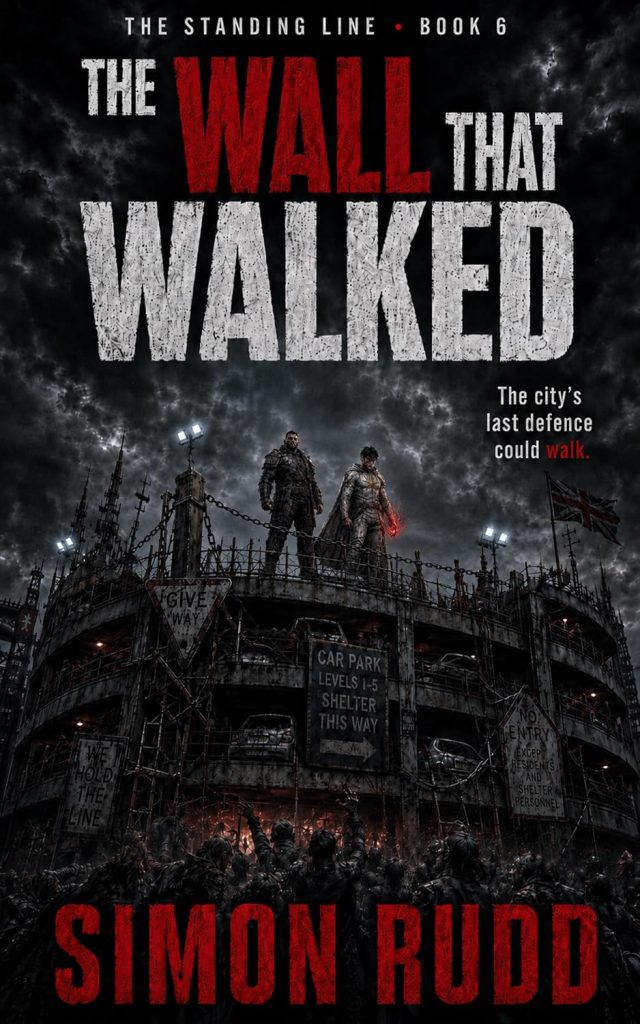
The hospital didn't kill him. Crownmarket might finish the job.
Dawn is dying by degrees. The drug that stopped the worst of it left his bloodlight faltering — every fifth pulse arriving late — and the thing living under his skin has started to enjoy being counted. Cinder has lost his voice. The wounded can't travel far. And the only refuge left standing is a fortified car park called Crownmarket, held together by a man they call the Wall.
Bracework can hold a collapsing roof on his shoulders. He can hold a gate, a line, a whole community of survivors who've learned to trust his body over any promise. Dawn needs him for the road ahead — for the greater horror gathering beyond the ruins. But you cannot ask a wall to walk. Not while something outside has begun to learn: copying the routes, mimicking a child's scream, teaching the doors to open from within.
This siege doesn't come with teeth. It comes with patience.
And when the western wall swings open on its own, Crownmarket discovers the truth every survivor pays for eventually — a wall that never moves can only ever fall.
The Wall That Walked is Book Six of False Dawn: a slow-burning, literary vampire apocalypse where the dead are organised, the living survive by counting bodies and not voices, and every safe place stays safe only until it learns your name.
For readers who like their post-apocalyptic horror character-driven, atmospheric, and genuinely frightening.
Read the first chapter
Chapter 1 — The Name That Could Hold
Saint Odran’s remained behind them without becoming farther away.
That was the trouble with hospitals.
They kept travelling inside the people who left them.
Dawn sat beneath the broken concrete lip of an old ground-floor balcony and watched rain work HLS-3 out through his skin.
Not the drug itself. Merrit had corrected him twice on that point and looked prepared to do it a third time with violence. What gathered along his arms was sweat, bloodlight and whatever his altered body had decided to reject now that the immediate dying had been postponed.
Postponed.
No one used the word saved.
The skin across his forearms shone faintly red beneath the rainwater. Not bright enough to light the service court. Not clean enough to be mistaken for his old power. Thin lines pulsed under the flesh, following veins that had become too visible since the injection.
Every fifth pulse came late.
Dawn had counted.
Then stopped counting because the infection inside him had begun to enjoy the attention.
“Hands open,” Merrit said.
She crouched in front of him with the hospital case wedged between her boots. Its clasp had broken somewhere between pathology and the staff car park. Morna had replaced it with wire twisted through two drilled holes, which meant the case now looked less medical and more like something taken from a building moments before the building collapsed.
That was accurate enough.
Dawn opened his hands.
The wounds in his palms had closed.
That should have been good.
Instead, the scars had become smooth in places and ridged in others, pale old light trapped beneath fresh red lines. The right palm looked almost intact until it moved. Then the skin tightened around a shape beneath it, as if something on the other side were pressing back.
Merrit touched two fingers to his wrist.
His bloodlight recoiled from her.
Not much.
Enough.
She felt it too.
Her face gave nothing away, which was how Dawn knew the answer had been bad.
“How late?” he asked.
“I’m counting.”
“How late?”
“You are not a clock.”
“No.”
“Clocks are more cooperative.”
Rain struck the balcony above them, found cracks in the concrete and fell in separate streams around the court. One landed near Cinder.
He sat against the remains of a brick planter with his knees drawn up and his ash-black coat spread around him like something burned had tried to become shelter. The rain did not wash him clean. It darkened the ash, cut narrow trails through it, exposed skin grey from recurrence and then gave up.
His throat had no visible wound.
That was the worst part.
The skin was intact. His mouth moved when he breathed. He could cough, though the cough produced only ash and a dry internal scrape. He could shape words with his lips.
No sound followed.
Jory had written the fact three times because the first wording had seemed too temporary.
CINDER — PRESENT.
CINDER — RECURRENT.
CINDER — VOICE ABSENT.
Then, beneath those:
COUNTED.
Cinder watched Merrit examine Dawn’s hands.
When Dawn looked at him, Cinder raised two fingers, tapped his own wrist and pointed towards Merrit.
She is still counting.
Dawn nodded.
Cinder pointed towards Dawn’s face.
Stop asking.
Dawn looked away.
Losing his voice had not made Cinder less irritating. It had made everyone else responsible for deciding how much irritation a gesture contained.
Clem had already declared that unfair.
The survivors had taken shelter inside the lowest service court of a council block across from the broken hospital wall. Shelter was generous. The building had lost most of its windows, one stairwell and part of the eastern corner. The service court offered three concrete sides, a covered loading recess, two exit routes and enough old brick planters to divide the wounded from the rain.
Kit had inspected it before anyone sat.
Morna had inspected what Kit missed.
Rhea had vanished through the loading recess, returned visible for count and written NO LOW STILLNESS on Jory’s card.
Clem had inspected nothing formally, then found a vampire hand beneath an overturned wheelie bin.
The hand had not been attached to anything.
He had complained that this still counted as useful work.
Now he stood near the broken vehicle entrance with the crowbar across both forearms, watching the service lane beyond. Morna kept the opposite route. Kit moved among the survivors with the water board tucked under one arm, checking bottles, wounds and names in an order no one else entirely understood.
The wider group had become quieter since Saint Odran’s.
Not calmer.
Quieter.
There was a difference.
People who had seen Null Patient move through fire did not spend breath proving they were frightened.
Trewin sat inside the loading recess with the hospital papers spread across flattened cardboard. He had used stones on the corners, then changed to pieces of brick because the stones were wet and made the paper bleed. Beside him lay the copied records case, the Saint Odran’s route notes, three damaged storage lists and the pages Jory had carried out beneath his coat.
Every sheet had been counted.
Every name had been read.
No name had vanished.
That mattered.
Ordinary paper could still contain extraordinary failures without becoming magical about them.
Jory sat opposite Trewin with the biscuit tin between his boots. The tin had gained a dent during the pathology escape. Its lid no longer closed cleanly. He had tied it shut with a strip cut from an old hospital pillowcase and written on the cloth:
OPEN WITH WITNESS.
No one had questioned the rule.
The hospital had made witnesses expensive.
Rhea leaned against the loading-bay wall near them, fully visible except for her left hand. The hand faded at the wrist whenever conversation moved towards Null Patient. Rain passed through the place where her fingers should have been and struck the wall behind her.
She noticed Dawn noticing.
The hand returned.
Not for his comfort.
For count.
Kit reached Cinder and held out a bottle.
He shook his head.
“You coughed ash twice,” they said.
Cinder lifted three fingers.
“Three times, then.”
He pointed at his throat.
“I know it hurts.”
Another gesture.
Kit frowned. “You can’t swallow?”
Cinder tilted his hand.
Not easily.
Kit crouched, loosened the bottle cap and poured a small amount onto a strip of clean cloth. Cinder pressed it to his lips.
No one called the act kindness.
Kindness did not need witnesses when it was done properly.
Merrit released Dawn’s wrist.
“Well?” he asked.
“Your pulse is wrong.”
“It was wrong before.”
“It has become ambitious.”
“That isn’t a measure.”
“It is today.”
Clem looked over from the entrance. “I support medical language becoming openly hostile.”
“You support anything that saves you learning a longer word,” Merrit said.
“Correct.”
Dawn flexed his right hand. The sealed scar pulled tight and released.
“Is the HLS-3 failing?”
Merrit’s gaze dropped to his palm.
“I don’t know.”
The service court heard her.
Not all of it. Not every survivor had been listening. But uncertainty travelled differently when it came from Merrit. She did not hand it out carelessly. She used it when a lie would be more dangerous than fear.
Dawn lowered his voice. “Is it hurting me?”
“I don’t know.”
“Did it change the bloodlight?”
“I don’t know.”
“Could it make me—”
Merrit caught his wrist again.
Not to examine him.
To stop the question.
“You do not get to finish that sentence without evidence.”
“I was asking.”
“You were volunteering to become the worst possibility before anyone requested it.”
“That isn’t what I—”
“It is exactly what you do.”
Dawn looked towards the broken hospital wall.
Saint Odran’s rose beyond it in pale, wet sections: service block, pathology corner, upper windows, pipework, roof equipment and one dark wound where fire had reached outside. From here the hospital looked empty.
They knew better.
Null Patient had escaped injured — burned, destabilised by HLS-3, but not defeated. Somewhere beyond the hospital, she was moving towards V_.
Towards Volunteer V. The V case. Patient 0.
The original hero whose failing blood had become hunger.
They had found an origin and turned it into another direction.
Dawn had spent ten years learning that directions were often only traps with better handwriting.
Jory looked up from the papers. “We can’t go after him.”
No one had asked the question aloud.
That did not mean the group had not been forming around it.
Trewin removed his cracked spectacles and wiped them with the driest corner of his sleeve. “We do not know where he is.”
“We know Dream-Receiver is with him,” Rhea said.
Her voice was low enough that the rain nearly took it.
“We know Null Patient is trying to return to him,” Jory replied. “Or we think she is.”
“She is.”
Dawn looked at Rhea.
Her missing hand flickered.
“What did you feel?” he asked.
“Not feel.”
“What, then?”
Rhea stared towards Saint Odran’s.
“She stopped searching.”
The words tightened the court.
Trewin put his spectacles back on. “At what point?”
“After the fire.”
“When she escaped?”
“Before.”
Merrit turned from Dawn. “You’re saying she knew which way to go.”
Rhea nodded.
Clem shifted his grip on the crowbar. “That is a very unpleasant improvement.”
“She was lost before?” Jory asked.
“Not lost.” Rhea pressed her visible hand against the wall. “Separated. There’s a difference.”
Dawn understood more than he wanted to.
Separation had direction inside it.
Lost could wander.
Separated pulled.
Kit came closer, leaving Morna and Clem to the entrances. “Even knowing which way she went doesn’t give us a route.”
“No,” Jory said.
“Or numbers.”
“No.”
“Or shelter between here and there.”
“No.”
“Or a plan for what happens when we find two things we barely survived one at a time.”
Jory’s pencil rested across his fingers.
“No.”
Kit waited.
Jory looked down at the papers.
“We can’t go after them.”
This time the sentence stayed.
Dawn felt the old response rise inside him before thought.
Then we prepare.
Then we follow.
Then I go first.
HLS-3 moved beneath his scars in a slow, cold pulse.
The answer inside his body was not courage.
It was appetite wearing the old shape.
He opened his hands until the pull eased.
Trewin sorted through the damaged records. “Direct pursuit would be speculation. V_ may not be anywhere near East Larkham. The references do not establish a current location. Dream-Receiver’s warning only gave us proximity through blood, not geography.”
Rhea’s eyes moved towards him.
Trewin corrected himself quickly.
“Not only. I don’t mean only as if the cost were small.”
“No,” she said. “You mean it didn’t give you a map.”
“Yes.”
“That’s true.”
The permission did not make him look better.
Jory took a folded page from beneath the hospital route notes. “We have maps.”
Clem groaned softly. “Maps have been trying to murder us for six books.”
No one understood the number except Clem.
He frowned.
“Six disasters,” he said. “I was counting disasters.”
Jory unfolded the page.
It was not a Saint Odran’s document. The paper was older, thickened by damp and reinforced along one tear with yellowing tape. A municipal emergency-planning grid covered most of it. East Larkham districts had been divided by roads, power routes, hospitals, transport sites and old emergency assembly areas.
Several names had been added by hand.
STADIUM.
SCHOOL.
CIVIC ARCHIVE.
FLEET DEPOT.
INTERCHANGE.
SAINT ODRAN’S.
Places they had crossed.
Places that had tried to keep them.
Trewin adjusted the page so the loading recess gave it more light.
“That was in the archive case.”
“I know,” Jory said.
“You said it was too broad to carry.”
“It was.”
“Then why—”
“I copied the section we needed.”
Jory placed another sheet beside it.
This one was smaller. Hand-drawn. Several district names ran along its edge. Old Standing Line response zones had been marked with symbols rather than hero names, perhaps to keep emergency dispatches short.
A rising line for Dawn, a vertical block for Holdfast, wings for Highwake, a narrow dark mark for Hushmark, red angles for Redglass, a circle scored through with heat lines for Cinder.
Others Dawn knew before he let himself think them.
Stone Choir.
Glimmerwright.
Waymark.
Bracework.
His finger stopped over the last symbol.
A square with two heavy lines pressed against its sides.
Holding pressure.
Holding walls.
Holding whatever had already begun to fail.
The old dispatchers had simplified them all into useful shapes.
Dawn wondered whether that had been the beginning of losing them.
“Where did you find this?” he asked.
“Archive records,” Jory said. “Trewin copied the names. I copied the zones.”
Trewin looked mildly offended. “I copied more than names.”
“You copied paragraphs.”
“They contained context.”
“They contained four versions of the word operational.”
Clem nodded. “Jory wins.”
Trewin pushed his spectacles higher. “The page is a pre-fall emergency deployment map. Standing Line members were assigned overlapping home-response zones so they could reach major incidents quickly without all travelling from a central base.”
Dawn looked at the Bracework mark.
Crownmarket.
The old retail and civic district west of the inner ring road. Multi-storey car parks. Shopping centre. Offices. Hardware warehouses farther out. Service ramps. Concrete built in layers over older concrete because the city had repeatedly decided demolition was less convenient than weight.
“Bracework lived there?” Jory asked.
Dawn did not answer immediately.
Memory offered pieces.
A large man sitting on the floor of the Standing Line briefing room because the reinforced chair had broken during his first week.
A paperback held carefully in hands that could crush doorframes.
Bracework correcting Glimmerwright’s quotation from a novel and refusing to admit he had read it twice.
Concrete dust caught in the pale ridges along his arms.
A quiet voice saying, The building doesn’t want to fall. It’s only run out of ways to stand.
Dawn pressed one finger against the Crownmarket mark.
“It was his home zone.”
“Home?” Clem asked. “As in house?”
“Area.”
“Good. I was imagining the floorboards.”
“He had a flat before the Line arranged somewhere reinforced.”
Trewin searched through the papers. “The later response notes place him repeatedly around Crownmarket after communications began failing.”
“During the fall,” Jory said.
Dawn nodded.
Bracework had held a shopping-centre evacuation route while the ceiling came down around him.
Held a pedestrian bridge after a vehicle explosion cut one side loose.
Held a hospital annex wall while thirty people were moved through the other side.
Held.
Always held.
The newspapers had loved the word.
BRACEWORK HOLDS AGAIN.
THE WALL EAST LARKHAM CAN TRUST.
A photograph of him under cracked concrete, smiling because a child beside him was smiling first.
Dawn remembered the final week less clearly.
Everyone moving.
No one arriving where they had been sent.
The city broken into separate emergencies until a team became a list of people failing alone.
“When did you last see him?” Kit asked.
Dawn searched honestly.
“Before the stadium.”
“How long before?”
“Days.”
“That isn’t close.”
“No.”
“Did he reach the final defence?”
“I don’t know.”
The admission hurt in a place HLS-3 could not reach.
He had known who stood beside him at the stadium.
He had not known who was still standing elsewhere.
Jory studied the dispatch marks. “The last confirmed record puts him in Crownmarket.”
Trewin pulled out a typed sheet. “Not confirmed. Logged.”
“Difference?”
“A confirmed record requires a return communication or second source.”
Clem stared at him. “Ten years after the world ended, you’re defending paperwork’s feelings.”
“I am defending accuracy.”
“He was sent there,” Jory said.
“Yes.”
“And no later deployment moves him elsewhere.”
“Yes.”
“Then Crownmarket is the last place the records put him.”
Trewin considered this, then nodded. “That is accurate.”
Merrit left Dawn and crouched beside the map.
“What was the incident?”
Trewin read from the damaged line.
“Crownmarket central evacuation. Structural collapse across the west retail deck. Vehicle fires in lower parking levels. Civilian concentration unknown. Bracework requested for load support and route protection.”
The next section had been torn away.
Jory touched the missing edge.
“No completion mark.”
“No,” Trewin said.
“No casualty mark.”
“No.”
“No reassignment.”
“No.”
Clem looked from the page to Dawn. “So he went into a collapsing shopping district ten years ago and no one knows if he came out.”
“Yes.”
“And that is our good news.”
“No,” Jory said. “The good news is that no one recorded him dying.”
Clem gave him a tired look. “You’ve become very skilled at finding the narrowest possible good news.”
“It fits in the tin.”
Cinder had risen without anyone noticing.
Not fully. One shoulder stayed against the planter. His legs trembled beneath him, and ash slid from his coat in wet clumps. But he stood.
Merrit turned.
“Sit down.”
Cinder ignored her.
He crossed the service court slowly, each step placed with care, until he reached the map. Jory moved the hospital papers aside before ash could fall on them.
Cinder looked at the Bracework symbol.
Then he pressed his palm flat over Crownmarket.
No one spoke.
His hand remained there.
Holding the page.
Dawn watched his face.
“You think he survived.”
Cinder’s jaw tightened.
He lifted one hand from the map, made a fist and struck it once against his chest.
Then he pointed west.
Clem frowned. “You saw him?”
Cinder shook his head.
“After the fall?”
Another shake.
“Before?”
Cinder nodded.
Dawn understood.
“You remember what he could survive.”
Cinder’s mouth moved.
No sound.
He tapped the Bracework symbol twice.
Then Dawn’s chest.
Then the map again.
Merrit’s face hardened. “No.”
Everyone looked at her.
She pointed towards Dawn without touching him. “Do not make him the reason.”
Cinder held her gaze.
“He needs help,” Jory said.
“He needs rest.”
“He needs both.”
“He needs not to be turned into a mission object because we are frightened by what HLS-3 did.”
Dawn heard the argument begin to gather around him.
Old habit.
His body as problem.
His body as route.
His body as reason to spend everyone else’s.
“No,” he said.
The word came out stronger than expected.
Bloodlight pulsed once beneath the sealed scars. Several people saw. No one moved away, which was worse in some ways. Trust could become carelessness if it was rewarded too often.
Dawn placed his hand beside Cinder’s on the map.
“We do not find Bracework to hold me together.”
Merrit’s eyes stayed on him.
“Then why?” Kit asked.
Dawn looked towards Saint Odran’s again.
Null Patient had taken fire and HLS-3 and Cinder’s burning grip.
She had escaped.
V_ had created a hunger capable of spreading through choice. He had survived long enough to become myth, classification and damaged records. He had Dream-Receiver. He had called warnings out of her blood.
Going after them with the group as it stood would not be brave.
It would be a delivery.
“We hurt Null Patient because Cinder held her,” Dawn said.
Cinder’s hand tightened on the map.
“Merrit weakened her,” Dawn continued. “Morna, Kit and the others burned her. Jory kept the count. Rhea found what the records missed. None of it worked alone.”
“No,” Jory said.
“If we find V_, we don’t know what he can do. We don’t know what Null Patient becomes when she reaches him. We don’t know whether HLS-3 will work twice, or whether using it once taught her body how to survive it.”
Merrit said nothing.
That silence confirmed the fear had already occurred to her.
“We need someone who can stop movement,” Dawn said. “Someone who can hold pressure while the rest of us work.”
Clem looked down at the square symbol.
“You need a wall.”
“No.”
The answer came quickly enough to surprise them both.
Dawn remembered Bracework beneath Collier House rubble, arguing with a firefighter about books while a floor settled across his shoulders. He remembered civilians touching the pale reinforcements along his arms for luck. He remembered Bracework hating that and allowing it because they were frightened.
“He was never a wall,” Dawn said. “Walls stay where they’re built.”
Jory turned the pencil between his fingers.
“What was he, then?”
Dawn looked at the old Crownmarket zone.
“A wall that could choose where to stand.”
The rain deepened around the service court.
For several breaths, Saint Odran’s disappeared behind it.
Not gone.
Obscured.
The distinction mattered.
Merrit studied the map, then Dawn’s hands, then Cinder’s ruined throat.
“Finding him does not mean taking him.”
“No,” Dawn said.
Kit looked up. “Why wouldn’t he come?”
“Because if he survived, he survived somewhere.”
Jory understood first.
“With people.”
Dawn nodded.
Bracework did not retreat alone. Not if anyone had reached him. Not if there had been a structure left to hold or a person inside it.
Clem looked towards the rain beyond the vehicle entrance. “Then we may be going to ask a man to leave the reason he’s still alive.”
“Yes.”
“Good. I was worried the day might become simple.”
Trewin traced the route west from Saint Odran’s. “Crownmarket is beyond the inner ring road. Direct route is impossible from here. The hospital service road intersects an old delivery corridor, but several sections were blocked before the fall.”
“Maps?” Jory asked.
“Partial.”
“Covered routes?”
“Some.”
“Open ground?”
“Considerable.”
Clem sighed. “There are the comforting details.”
Morna came in from the eastern exit.
She had heard enough to understand the decision before anyone stated it.
“Crownmarket?” she asked.
Dawn nodded.
“Reason?”
“Bracework.”
“Alive?”
“We don’t know.”
“Useful?”
“Yes.”
“Safe?”
“No.”
Morna looked at the survivors beneath the balcony, at the hospital case, the paper, Cinder standing by anger alone and Dawn sitting because Merrit had not yet permitted anything else.
“Then it sounds like one of our places.”
Kit turned the water board over.
The reverse still held Saint Odran’s route marks, dose checks and the final exit count. They found a clear strip near the bottom and wrote:
CROW NMARKET.
They stared at the gap, rubbed the word away and wrote it again.
CROWNMARKET.
Below it:
FIND BRACEWORK.
Cinder touched his throat.
Then he pointed towards the words.
Jory watched the gesture and added one more line to his card.
NOT TO SPEAK FOR US.
Dawn looked at him.
Jory shrugged. “He’ll need to know.”
Cinder’s expression changed.
Not gratitude.
Something smaller and more useful.
Recognition.
Rhea left the wall and came to the map. Her hand remained visible this time. She placed one finger on Saint Odran’s, moved it west along the damaged road grid and stopped at Crownmarket.
“Null Patient went another way,” she said.
“How do you know?” Trewin asked.
“The absence pulled north.”
Dawn felt every person near the map become still.
“Towards V_?” he asked.
“Towards something.”
Not proof.
Not route.
Enough to make Crownmarket a choice rather than pursuit.
Kit lifted the water board.
“Then we move before the hospital sends anything after us.”
Merrit pointed at Dawn. “He rests until the route is ready.”
“I can help.”
“You can remain alive while other people help. It’s a difficult new skill.”
Clem returned to the entrance. “I’ll prepare a lesson plan.”
Morna went with him. “You’re watching the lane.”
“That was lesson one.”
Trewin began sorting route pages.
Jory opened the biscuit tin and placed the Crownmarket copy inside.
Kit checked water.
Rhea vanished into the loading recess, then reappeared beyond it to test the western service route.
Cinder lowered himself beside the map and kept one ash-dark hand resting over the Bracework symbol.
The group did not become hopeful.
Hope would have been too large for the court and too bright for the rain.
They became directed.
That was enough.
Dawn sat beneath the broken balcony while HLS-3 moved wrongly through his blood and Saint Odran’s faded behind weather. Somewhere west, Crownmarket waited beneath ten years of ruin.
Bracework might be dead.
He might be turned.
He might be trapped beneath the place he had tried to hold.
Or he might have done what walls could not.
He might have moved.