A Superhero Horror Novel
The Standing Line Book 1
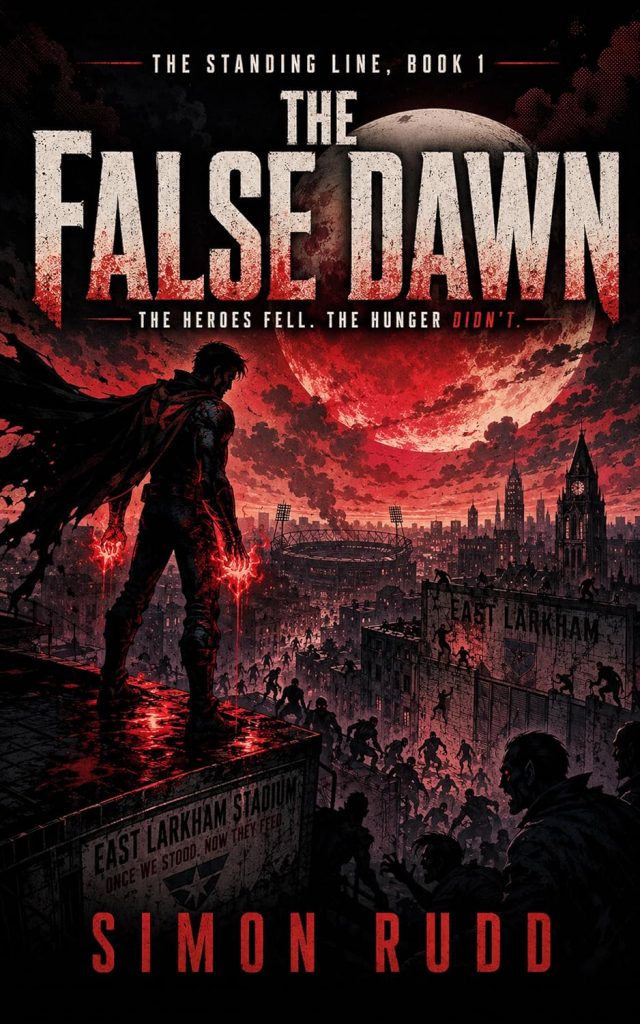
He used to save this city in daylight. Now he saves it from the creatures in the dark.
Ten years ago, East Larkham had heroes. The Standing Line held the city through fire, flood and worse — until the night the vampires came and the heroes fell with everyone else.
Tobin Anstey was Dawn: golden, beloved, a man who could pull light out of his own blood. The bite should have turned him. His light stopped it halfway. Now he is gaunt, half-turned and starving, hiding the red glow under his skin and surviving on rat blood in the buried shelter beneath the stadium where his own mural still smiles down at the people he failed.
The survivors he protects don't know what he carries. The vampires hunting them never forget a route, a name, or a smell. And out in the ruined city, something worse than hunger is moving — a voice that doesn't break doors down, because it can make people open them. The survivors call it the Kneeler. The vampires call it something else.
Our Lord.
When a tracker follows a daylight route home, the shelter's ten quiet years come to an end. Dawn must decide what his light is still for — and how much of his humanity he can spend before there's nothing left to defend.
He is not trying to win the war. He is trying to get living people through one more night without becoming the reason they fear the dark.
A bleak, intimate fallen-superhero horror novel for readers who like their capes buried, their vampires monstrous, and their hope expensive. Book One of The Standing Line.
Read the first chapter
Chapter 1 — Dawn in the Light
Dawn was halfway up the bank wall when the first child started cheering.
He heard her through the sirens, through the alarm, through the crackle of police radios and the hard thump of his own boots catching on the stonework. A little voice from somewhere below, bright with disbelief.
“It’s Dawn!”
After that, the crowd became sound.
He did not look down. Looking down made people wave. Looking down made camera lenses lift, made reporters shout his name, made children step too far past barriers because they believed his attention made the world safer. Dawn had learned, early on, that saving people sometimes meant not acknowledging that they loved you.
He climbed.
The bank stood on the corner of Charterhouse Street and Edrick Row, its pale frontage glittering in the late afternoon sun. East Larkham had given the building a nickname long before Dawn had been born: the Wedding Cake. Three floors of white stone, carved columns, balcony rails, brass letters over the main doors. It had survived two wars, three refurbishments, one attempted arson, and a hundred thousand ordinary Thursdays.
Today, four men had taken it hostage.
Dawn reached the second-floor ledge, pushed off, and caught the broken frame of a high window. Glass rasped against his glove. Below him, the crowd gasped as one creature.
“Stay back,” he called, without turning. “Everyone behind the blue line.”
The police had painted the temporary line across the pavement in chalk because someone had already knocked over the tape. It had become a joke at first. A city protected by chalk. A city waiting politely behind a line because Dawn had asked it to. Holdfast had arrived after that and spoken.
Now they stayed there.
Dawn swung himself up, body folding neatly through the empty window. The old suit moved with him like water. Gold-white panels along his ribs caught the sun and threw it back in clean shards. It had been designed to be seen; that was part of the job. People in smoke needed something visible to follow. People under rubble needed to know help had entered the dark.
He landed in a corridor full of dust, plaster and the smell of fear.
Two hostages crouched by a photocopier. One was a man in a grey bank shirt with blood running from his hairline. The other was a woman in a coat too warm for the weather, both hands clamped over her mouth to keep herself quiet. Dawn raised one finger to his lips.
The woman nodded. Tears stood in her eyes but did not fall.
From below came a shout.
“Keep them down!”
A second voice answered, high and shaking. “I said keep them down!”
Young, Dawn thought. Not professionals. Not calm. That made things worse.
He crossed the corridor quickly, light gathering under his palms. Not heat yet. Not enough to burn. A soft white glow, the kind he used for lifts and smoke and frightened rooms. It slipped along the walls and under the closed office doors, a quiet artificial dawn.
Three heartbeats behind the nearest door. Too fast. Five downstairs in the main hall. One erratic. Four armed men. Maybe twelve hostages. One of the gunmen crying.
Dawn’s mouth tightened.
He touched the comm bead at his ear. “Inside. Second floor. Two safe. Four hostiles. One unstable.”
A warm voice answered at once. “We hear you.”
Holdfast. Always steady. Always as if he had both feet planted somewhere no disaster could move him.
“Crowd?” Dawn asked.
“Behind the line.”
“Press?”
“Being annoying behind the line.”
Despite himself, Dawn smiled.
He reached the stairwell door and looked through the wired glass. A young man with a shotgun stood on the half-landing below, back pressed to the wall, face wet with sweat. He could not have been more than twenty. The gun shook in his hands. His mask had ridden up above his mouth, making him look less like a robber than a boy dressed badly for a school play.
Dawn opened the door. The boy saw the light first. His eyes widened.
“Don’t—”
Dawn moved before the weapon came level.
One foot on the rail. One hand against the wall. He turned his body sideways in mid-air, clean and fast, letting the shotgun blast chew plaster from the ceiling where his head had been. He dropped behind the boy and put one glowing palm on the hot barrel.
The metal flared white.
The boy screamed and let go.
Dawn caught the gun before it hit the stairs. He flicked the chamber open with his thumb, emptied the cartridges into his palm, and let them fall.
“Sit down,” he said.
The boy sat.
Dawn did not hit him. There was no need. Not yet.
Below, someone shouted, “Ryan?” The boy on the stairs began to sob. Dawn looked down through the stairwell. Three left.
The main banking hall was all marble counters, chrome barrier posts, broken brochure stands and people on the floor. Sunlight came through the high windows in grand yellow panels. It made everything too clear: a woman’s shoe lying on its side, a trail of coins across the floor, a security guard breathing carefully through a wound in his shoulder.
Three masked men stood among them: one by the doors, one by the counters, one in the centre with a pistol pressed against an elderly man’s neck. Dawn’s light wanted to rise. He held it low.
The old man’s lips moved. No sound came.
Dawn knew that kind of prayer. East Larkham had many of them. Traffic prayers. Hospital prayers. Don’t-let-this-be-the-day prayers. The kind that did not ask for miracles, only delay.
The man with the pistol dragged the hostage upright.
“Back off!” he screamed. “Back off or I’ll—”
Holdfast spoke from outside. Not loudly. He never needed loudness.
His voice travelled through the broken bank doors, through police speakers, through the noise of the crowd and the whole frightened shape of the street. It did not command so much as make command unnecessary.
“Everyone breathe.”
The words settled over the hall.
Dawn saw it happen as he had seen it a hundred times before. Shoulders lowered. Hands unclenched. Panic loosened its teeth. A bank clerk who had been shaking so hard her shoes tapped against the marble suddenly stilled. The wounded guard pressed harder on his own shoulder. The old hostage breathed in. Even the robber’s grip faltered for half a second.
That was all Dawn needed.
He crossed the hall in light. Not running. Not exactly flying. A bright, impossible line from stairwell to centre floor. His boots touched the marble once, twice, and then he was there, one hand over the pistol, one elbow turning the robber’s arm away from the old man’s throat.
The gun fired.
The shot went into the ceiling.
Dawn’s palm flashed. The pistol’s slide warped under heat. He took it, twisted, and guided the robber down hard enough to empty his lungs but not crack his skull.
The second man fired from the counter. Dawn threw the ruined pistol without looking. It hit the man’s wrist. The second shot went wild, punching through the brass letters above the cashier desk. Dawn caught a handful of sunlight from the window and dragged it across the floor. It rose in a bright wall between the hostages and the gunman, thin as silk and strong enough to turn bullets aside.
The crowd outside roared.
Dawn hated that part. Not because he hated them, but because there were still guns. Applause made people forget danger was not finished just because hope had entered the room.
The third man bolted towards the side exit.
Dawn went after him.
He vaulted the counter, slid across polished stone, and caught the man at the door before he could reach the alley. The robber swung a knife. Dawn let it score the gold-white fabric along his forearm. Then he took the man by the jacket and turned him gently, almost kindly, into the wall.
The knife fell.
Real silence followed: the stunned kind that came after people realised they had survived the thing they had already imagined dying inside.
Dawn stood in the centre of the banking hall with light still moving over his hands.
“Is anyone badly hurt?” he asked.
For a second no one answered. A breath later, everyone did.
He sorted the sounds. He always could. Panic became information if you listened properly.
Shoulder wound. Head wound. Asthma attack. Broken wrist. Pregnant woman behind the counter. Child in the back office. One of the robbers having a seizure, possibly shock, possibly something taken before the attempt. Police entering. Paramedics two minutes away.
“Stay where you are,” Dawn said. “Help is coming.”
The old man whose throat had been under the pistol caught Dawn’s hand.
“You saved my life.”
Dawn looked at the blood on the man’s collar. Not much. A shallow line where the barrel had pressed too hard. He smiled because people needed that from him too.
“Holdfast saved your breathing,” he said. “I was just faster.”
Outside, the crowd had become thunder.
Dawn stepped out through the broken doors into gold light.
Charterhouse Street blazed with late sun, camera flashes, raised phones, police uniforms and faces. So many faces. East Larkham packed behind the blue line, frightened and thrilled and hungry for proof that the world could still be interrupted by goodness.
Holdfast stood near the police cordon.
He was taller than most men, broad without seeming heavy, dark hair silvering at the temples, one palm lifted as if quieting an invisible storm. His suit was plain compared to Dawn’s, deep blue and steel grey, built less for spectacle than steadiness. Children called him The Standing Man. Newspapers called him the spine of East Larkham. Other heroes called him when things got too loud.
Dawn crossed the pavement towards him. The cheers rose again.
“Show-off,” Holdfast said.
“You used citywide speakers to tell people to breathe.”
“They were forgetting.”
“You always say that.”
“They always are.”
Dawn glanced back at the bank. Paramedics moved in. Police brought the robbers out one by one. The boy from the stairs looked smaller in daylight.
“Four hostiles alive,” Dawn said. “Twelve hostages alive. Guard needs surgery but should hold.”
Holdfast nodded. “Good work.”
The praise should not have mattered. It always did.
A child ducked under the tape. Six, maybe seven. Dark hair. Yellow cardigan. Her mother grabbed too late, fingers missing the fabric by inches.
Dawn saw the movement before anyone else. He crossed the gap in one bright step and crouched before the child reached the active road.
“Hello,” he said.
She stopped dead, eyes enormous.
“You’re not supposed to cross the line.”
“I know,” she whispered.
“Then we are both going to pretend this didn’t happen, because your mum looks like she might explode.”
The child held something out.
A drawing, folded twice. Wax crayon on cheap paper. Dawn in yellow. Holdfast in blue. Highwake floating above them with a person under each arm. Glimmerwright surrounded by stars that were probably meant to be hard-light points. Stone Choir with hands bigger than her head. Hushmark represented by a blank space and the words she is there.
Across the top, in uneven letters, someone had written:
THE STANDING LINE.
Dawn took it carefully.
“This is good,” he said.
“My brother says you’re not the strongest.”
“He’s right.”
“He says Holdfast is.”
“Depends what needs lifting.”
“What do you lift?”
Dawn looked at the bank. At the hostages coming out under blankets. At the robber boy being guided into the back of an ambulance instead of a police van.
“People,” he said.
The child considered this. Then she hugged him.
The crowd made a sound at that. Softer than cheering. More dangerous.
Dawn froze for half a second before putting one hand lightly against the child’s back. He could feel her heartbeat. Fast. Alive. Trusting.
Responsibility, then. Nothing more.
Holdfast watched him over the child’s shoulder. There was something in his face Dawn could not read. Pride, perhaps. Sadness. The look of a man measuring a future only he could see.
Holdfast spoke again, not through speakers now, but close enough that only Dawn and the child heard.
“No one gets left behind while one of us can still stand.”
The child repeated it, solemn as a vow. Dawn smiled into the sunlight. For a while, people believed that was enough.
***
Ten years later, no one cheered when he burned things that still had faces.
The first vampire came at him from the ticket office roof.
It had once been a steward. Dawn saw the orange sleeve before the thing dropped, saw the blackened badge still pinned above a chest that had caved and healed badly. Its mouth opened too wide as it fell. Teeth clicked together before it reached him, eager as cutlery.
Dawn stepped sideways. Not as fast as he used to. Fast enough.
The vampire struck the concrete where he had been and came up crawling, limbs wrong, head snapping towards the sound of his breath. It wore a man’s old shape the way a drowned thing wore river weed. The steward’s cap was still clipped to its belt.
Dawn’s palms split.
Bloodlight came through.
It did not shine cleanly. It crawled under his skin first, red threads waking in the backs of his hands, up his wrists, into the old scars. Pain opened with it. Always pain. As if the light had to tear permission from him before it could leave.
The vampire hissed.
Behind it, two more climbed over the broken turnstiles. A woman in a supermarket fleece. A boy in a school blazer gone green-black with damp. Old clothes. Old lives. No life in them now except hunger and route memory and the twitching cleverness of things that learned by feeding.
Dawn counted. Three visible. One above. Something in the shade by Gate C, not moving.
The stadium loomed behind him, a black bowl against the night sky. Once, floodlights had made it visible from half the city. Once, people had followed their glow down ring roads and across bridges, laughing, chanting, carrying scarves and paper cups and children on shoulders.
Now the floodlights were dead. The stadium survived by being mistaken for a ruin.
Dawn could smell the shelter beneath it. Not directly. Never directly. Layers of concrete, damp, oil, rust, old paint and mould stood between him and the people below. But under all that, if he let the hunger listen, there were heartbeats.
Fifty-three.
No. Fifty-two.
Merrit’s pulse was uneven again. Too much tea made from old leaves. Not enough sleep. Jory near the south service tunnel, awake when he should not be. Clem’s youngest coughing. Ivo and Kit close together.
Dawn shut the counting down.
The vampire in the school blazer lunged first.
Dawn caught it by the throat and drove bloodlight into its jaw.
The red flare went through bone and old flesh. The thing did not scream like a person. It made a breathless clicking sound, as if trying to remember language and finding only teeth. Smoke poured from its mouth. Its hands clawed at Dawn’s forearm, nails scraping through the patched sleeve and into skin.
The smell hit him: burned blood, dead blood, and under it the sharper memory of living blood. Dawn’s teeth ached.
He threw the vampire backwards before the hunger could turn the smell into thought. It hit the turnstile and broke around it, still moving until the red light inside its skull finished burning.
The steward came low.
Dawn pivoted, but his right knee faltered. Too little blood. Too much daylight earlier. Too long since anything warm.
The steward’s shoulder slammed into him and drove him back against the shutter of the old ticket office. Metal boomed. Somewhere inside the stadium, far below, someone would have heard.
Too loud.
He gripped the vampire’s head with both hands. For one second, its face was inches from his. There was a name badge on the ruined chest.
MALCOLM.
The vampire’s lips moved.
“Mal…”
Dawn’s blood went cold.
The thing smiled with every tooth it had left.
“...come.”
It had heard the name somewhere. Read it. Smelled it on old plastic. Learned the shape of it because names opened doors.
Dawn burned its face away.
Bloodlight flooded from his palms and took the vampire through the skull. Red filled its eye sockets. Its fingers drummed once, twice, three times against Dawn’s ribs, and then it collapsed at his feet.
“Names later,” Dawn whispered.
The woman in the supermarket fleece had stopped moving.
That was worse.
Normal vampires wanted the body. They came at heat, breath, blood. Hunger made them direct.
This one stood half in the shadow of Gate C and watched him. Its head tilted. Not afraid. Not attacking. Learning.
Dawn looked past it, into the black slit between the stadium wall and the collapsed burger kiosk. Something crouched there. Long-fingered. Still. Pressed close to the concrete as if listening through it.
A Blood Seeker.
The red light under Dawn’s skin pulsed hard enough to make his vision flicker.
The thing in the shade touched the wall with one hand. Not the gate. The wall.
Dawn moved.
The supermarket vampire sprang at the same time, not to kill him, he realised, but to slow him. He struck it aside with his shoulder, felt his own skin tear where its nails caught his neck, and sent a blade of bloodlight across the shadow by the kiosk.
The Blood Seeker was gone before the light hit.
Concrete spat red sparks.
The woman-thing crashed into him again. Its mouth snapped at his wrist. Dawn let it bite the reinforced leather strap instead of skin, then hooked two fingers into its collar and dragged it into the open.
The moon gave almost no light. His gave too much.
Red washed across the ticket concourse, painting old signs, broken barriers, torn posters, the shuttered programme booth. The vampire thrashed in his grip. Its fleece still had a supermarket logo over the heart. East Larkham Local. Open Seven Days.
Nothing was open now.
Dawn drove it to the ground and burned through its chest until the thing stopped moving. Afterwards, there was only the old city and his breathing. His palms smoked.
The cuts healed wrongly, closing too quickly at the edges and not enough in the centre. Red veins withdrew from his wrists, leaving tremors behind. The bite scar under his left collarbone heated, as if something inside him had leaned closer to a fire.
Dawn stood still and listened. No movement by Gate C. No clicking teeth. No claws on concrete. No breath except his.
Below: fifty-three heartbeats.
He had miscounted. Or one had hidden under another. Or the hunger had lied.
He wiped his hands on his coat and looked at the wall where the Blood Seeker had touched it. The old concrete held a dark smear, not blood. Something else. Damp, perhaps. Dirt from the thing’s fingers. A mark the width of a hand.
It had not tried to reach him. It had reached for the stadium.
Dawn went to the smear and crouched. A memory came, unwanted: a child in a yellow cardigan, arms around his neck, trusting him because he had been bright. He pressed his thumb against the mark.
Cold.
He lifted it to his nose.
Dust. Rot. Old rain. And beneath that, faintly, soap.
Human soap.
The kind they made below from rendered fat and ash and whatever scent could be scavenged from old hotel stores. The kind used sparingly on cloths, hands, wounds, children. The kind that should never have touched the outside wall.
Dawn closed his eyes.
Not breach. Not yet. A route, then. Someone had come home carrying enough of the shelter’s smell for a Blood Seeker to notice.
He should wake Jory. Check the boards. Close south access. Move the water run forward. Stop all daylight routes for forty-eight hours. Count every bar. Test every lock. Ask Merrit which children could walk if he ordered evacuation. Ask Clem nothing because Clem would hear fear inside the question and give it to everyone else.
His body gave him a different answer.
Blood.
Not rat. Not cold. Not dead thing gone sour in a jar.
Living blood.
Fifty-three heartbeats beneath concrete. Warm. Afraid. His.
No. Not his. Protected. The word hurt more than the light.
Dawn pushed himself upright and staggered towards the service entrance hidden beneath the collapsed east stair. His left leg dragged for the first three steps, then remembered. He passed the turnstiles, the old steward’s booth, the faded mural arrow pointing towards FAMILY STAND, BLOCKS E-F. Rainwater dripped somewhere steadily, counting down a thing no clock dared name.
At the base of the stairs, a small shape lay in the trap box.
Rat.
Thin. Grey. Still twitching.
Dawn had set four traps before dusk. This was the only one that had worked.
He stared at it. His stomach cramped. His mouth filled. Not with saliva. With light. Red seeped between his teeth and vanished when he swallowed.
He picked up the rat by the tail and carried it inside.
The service tunnel beyond the false panel smelled of rust, wet concrete and old football programmes turned to pulp. He closed the outer cover behind him. Three bolts. One chain. Lift, slide, press, listen. Then the second panel. Then the narrow squeeze between stacked catering crates. Then the drop into the old beer-cellar corridor where no one was allowed to speak above a whisper.
Halfway down, a lamp flickered.
Jory Hale stood beside it with a metal spike in one hand. Nineteen now, perhaps twenty. Too thin. Hair cut short with shelter scissors. A notebook tied to his belt. Ink on his fingers. Eyes that had watched childhood burn and had not forgiven anyone for surviving it badly.
“You’re late,” Jory said.
Dawn looked at the spike.
“You were meant to be asleep.”
“You were meant to tap twice at outer three.”
“I had company.”
Jory’s gaze moved to Dawn’s hands, his neck, the dark shape hanging from his fingers.
“Company outside or company under your skin?”
Dawn walked past him.
“Doors first.”
“That means bad.”
“It means doors first.”
Jory followed at once, because he knew when to argue and when to count locks.
At the inner service door, Dawn checked each brace. Jory checked the chalk line along the floor, then the hanging thread, then the little tray of dust placed beneath the hinge. Hushmark tests, though no one said that aloud after dark. If an invisible hero could vanish from the world, worse things could learn the trick.
Nothing disturbed. No draught. No scrape. No mark.
Inside, the shelter slept uneasily.
Blankets in the old catering corridor. Hammocks in the kit rooms. Medical bay behind the first-aid shutters. Water records pinned near the staff toilets. The route board covered with cloth. Children curled against adults who had trained themselves not to flinch when pipes knocked. Every lamp hooded. Every cough swallowed quickly. Every dream kept small.
A few people woke as Dawn passed. They always did. Not fully. Not enough to speak. Just enough to see what had come back wearing their protector’s shape.
A woman pulled her child closer. An old man touched two fingers to his forehead. Not a salute. Not quite a prayer.
Dawn hated both.
Merrit Shaw waited in the old treatment room with her sleeves rolled up and her grey hair tied back so tightly it lifted the skin at her temples. She looked at the rat, then at his face.
“That won’t be enough,” she said.
“It’s what there is.”
“You’ve split your palms again.”
“They’ll close.”
“That isn’t healing. That’s your body lying badly.”
Jory hovered in the doorway. “Something followed a smell to the wall.”
Dawn gave him a look.
Jory did not retreat. “You said doors first. Doors are checked. Now names.”
“Not names.”
“Then what?”
Dawn set the rat down in the metal bowl Merrit used for him and flexed his ruined fingers. “Soap.”
Merrit’s expression changed: no gasp, no fear performed for the room, just a small tightening around the eyes, which was worse.
“Outside wall?” she asked.
“Gate C.”
Jory’s hand went automatically to the notebook at his belt.
Dawn saw the movement and caught his wrist before he could draw it free.
“No.”
“If it touched our wall, it becomes record.”
“It becomes route discipline.”
“It becomes record first.”
Dawn felt Jory’s pulse under his fingers. Fast. Living. Trusting him less than the child had, which was good. Trust had killed a great many people in East Larkham.
He let go.
“Write soap mark. Gate C. Blood Seeker suspected. No names attached.”
Jory held his gaze for one stubborn second, then opened the notebook.
Merrit picked up the rat with forceps. “You need privacy?”
“No.”
“You need more than that.”
“No.”
“There are volunteers.”
The room changed. Jory’s pencil stopped. Somewhere in the corridor, a sleeper turned over. Dawn heard a child’s breath catch in a dream.
Merrit did not look away.
“She means me,” Jory said.
“I mean there are adults who have offered,” Merrit replied.
Dawn looked at the metal bowl. The rat’s blood was dark and already cooling. His teeth ached so hard his jaw trembled.
Human blood would clear his vision. Human blood would close his hands properly, steady the tremor, sharpen the light, make the Blood Seeker easier to hunt. A little, given willingly, from someone who believed survival could be measured in veins and need.
The imprint inside him rose towards the thought like a dog hearing its name.
Protected, Dawn reminded himself. Not supply. Not ration. Not resource. Protected.
“Human blood is not an option,” he said.
Merrit’s mouth pressed flat. “One night you’ll say that and fall over before you finish the sentence.”
“Then drag me away from the doors.”
“And if we need you at the doors?”
Dawn reached for the bowl.
“Then hope the rat was brave.”
Jory made a small sound that might have been a laugh if there had been a world left for laughter to live in.
Dawn lifted the rat to his mouth.
He hated that they watched. He hated more that some part of him wanted them to. Not the rat. Not the humiliation. The proof. See what I choose. See what I refuse. See the line still holding.
The blood hit his tongue cold.
His body accepted it with disgust. His hunger did not.
Rat blood was thin, sour, functional. It carried no memory bright enough to tempt him, no human heat, no terror, no trust. It slid down into the wrongness inside him and gave it just enough to chew on that it did not chew through him.
He drained what there was.
Not enough. Never enough.
Merrit turned away first. Kindness, perhaps. Or anger. Jory kept watching.
Dawn wiped his mouth with the back of his hand. Red veins flickered once under his skin, then faded.
From far above, beyond concrete and steel and old seating tiers, something scraped along the outer wall.
Everyone in the room froze.
Dawn listened.
One scrape.
Then nothing.
A loose sign, maybe. Rain-twisted metal. A dead thing settling. Or a long finger dragging softly across Gate C, remembering soap.
Dawn set the empty rat down in the bowl. His hands still shook.
“It was enough,” he told them.
Neither Merrit nor Jory answered.
Dawn looked towards the tunnel, towards the sleeping shelter, towards the doors between the living and the dark.
“It has to be.”