A Gaslamp Fantasy Comedy (The Wrong Chosen One Trilogy, Book Three)
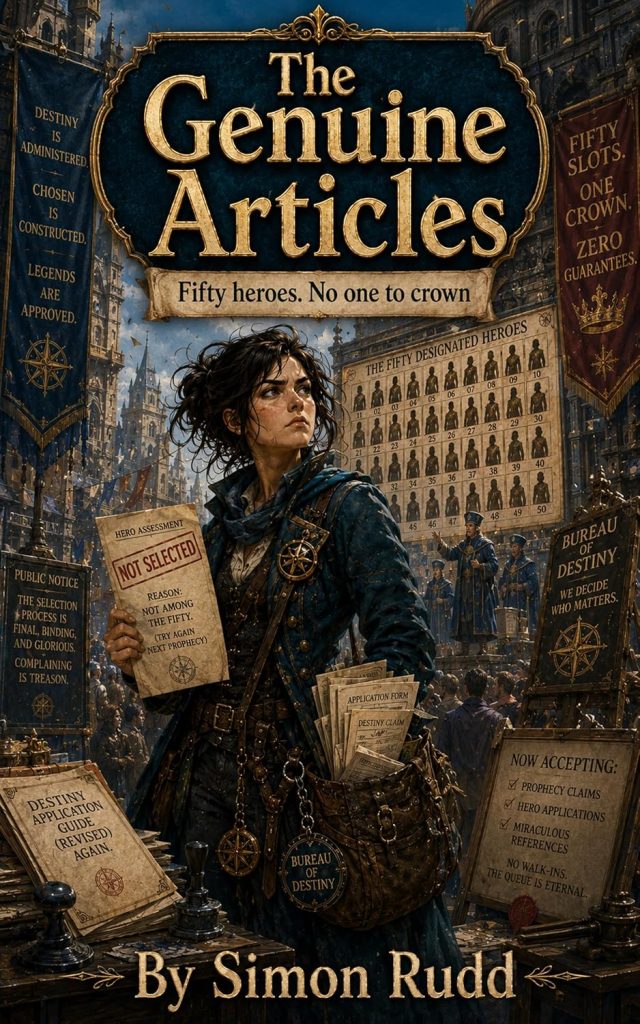
Andra beat the prophecy machine once by accident, and once on purpose. Both times, the Guild of Auspices learned.
So this time it isn't building a Chosen One. It's building fifty.
The Restoration: a whole cohort of certified, genuine, foretold heroes, consecrated on a single date and sold as the prophecy that ends all doubt by sheer overwhelming volume. You can argue with one fraud. You cannot argue with a flood. Andra's quiet work — saving manufactured children one frightened kid at a time — is obsolete overnight.
She knows what to do. She always knows what to do. She'll find the seam, take the risk, pay the price, and carry the whole thing herself, the way she always has, because she's the one who can.
Which is exactly the problem.
A machine that mass-produces singular heroes cannot be beaten by a better singular hero — it simply brands her and sells the rematch. The one thing it has never learned to sell is resistance gone ordinary: faceless, shared, with no protagonist left to crown. To win the last fight, Andra has to give away the one thing she has never once surrendered — the right to be the one who matters most.
The finale of the Wrong Chosen One trilogy. For readers in the tradition of Terry Pratchett, Diana Wynne Jones, and Jasper Fforde.
Read the first chapter
Chapter One — The Open Door
There is a kind of quiet you only get after you have been the most hated woman in a city, and it is not the quiet of being forgiven. Forgiveness would have required somebody to admit they’d been wrong about me, and the city of Auspice has never in its long, decorated, prophecy-soaked history admitted to being wrong about anything. The quiet I got instead was better. It was the quiet of being boring. I had been the villain of two seasons running — twice the fraud, twice the reason a sure thing came apart in public — and the trouble with a villain the city has already finished hating is that she stops selling. By that second winter the criers had moved on to a duchess who’d married her own augur, and a comet that meant either a coronation or a plague depending on which Amplifier you stood under, and nobody, blessedly, was paying me the slightest attention at all.
I cannot tell you how much I had come to love being beneath notice. I had spent a whole year of my life being looked at by everyone, certified and polished and adored, and I would not wish it on a person I hated. So when I say the mornings were quiet, understand that I mean it as the highest praise I have.
The mornings went like this. I was up before light because the vats wanted feeding and the work doesn’t care what you used to be. The house had been a dye-house and was still, in its bones, a dye-house; we’d never quite stopped, partly because the dyeing paid for the rest and partly because there is no better cover in the world for a building that a great many people quietly come and go from than one that always smells of lye and wet wool and reasons to be sweating. I’d light the under-fires. Bex would come down some while after, scowling at the hour the way she’d scowled at it for two years and would, I have no doubt, scowl at it for forty more, and we would not say good morning, because we were long past needing to, and that — the not-saying — was its own kind of vow renewed daily.
I want to be honest about the work, because the city has since told it several ways and got it wrong in every one. It was not heroic. It was a great deal of laundry and a small amount of the other thing. The other thing was simply this: now and again a child would arrive who had been marked — fitted for a destiny, measured for a prophecy, told in a hundred soft official voices that they were the genuine article and that their whole life from here was a track already laid — and what we did, what I did, was sit them down and tell them the truth, the entire truth, the parts that hurt most especially, and then open a door behind them that they could walk back out of that very minute, and then make them choose. That was all. That was the entire trick of it. Truth, a real door, and a choice that was theirs and nobody else’s, least of all mine.
It does not sound like much. I have learned that the smallest-sounding things are the ones the whole machine is built to prevent.
* * *
What had changed — and this was the thing I was proudest of, in the cautious way you’re proud of a fire you’ve kept alive through a wet season — was that I was no longer the only door.
Word travels. It travels faster, I’d discovered, when nobody official is permitted to say it aloud, because then it has to move by the old routes, the laundry-line and the back-step and the whisper at the well, and those routes are far harder to shut than a printing press. A woman three streets over had taken in a girl the Guild had measured for a water-sign and simply not handed her back. A pair of brothers who ran a cooper’s yard near the river had a room behind the staves that a frightened boy could sit in until he’d decided whether he wanted the destiny he’d been issued. None of them called it anything. None of them had a method, exactly, or a name for the thing they were doing. They’d only heard, by the back routes, that there was a way to give a marked child the one thing the city had spent a fortune making sure no marked child ever got, which was a minute to think, unwatched, with the door open. And they’d thought: I have a room. I have a minute. I could do that.
That should have been the happiest fact of my life. In most of me it was. There is no purer evidence that a thing is true than watching people who never met you arrive at it on their own.
But I will tell you the part I did not say out loud to Bex, because saying it would have made it real, and because I already half-knew it was the seed of something I’d have to answer for later. When a case came to me — when the child on my particular step was the hardest one, the one whose handler was still circling, the one whose numbers didn’t add up, the one where a wrong word would get somebody killed — I never sent it on. I never said, the cooper’s yard could take this, the woman three streets over has a room. I kept the hard ones. I told myself it was because I knew the lock best, and that was even true; I’d had the thing done to me and then learned to do it, and there are corners of how the machine thinks that you simply cannot teach a kind cooper in an afternoon. But underneath the true reason was a second reason, quieter, with worse posture, and the second reason was that some part of me needed the cost to come to me. Needed to be the one it passed through. I had given away the title, the adoration, the whole gaudy apparatus of being chosen. And I had kept, without noticing I’d kept it, the one last thing that still made me the one who mattered: I was the one who paid.
I didn’t see it then. That is rather the point of this whole telling, so I’ll let it sit where it sat, unexamined, like a stone in a shoe you’ve decided is just how the shoe feels.
* * *
Bex saw more of it than I did, which was true of most things.
That morning she came down, scowled at the hour, put her hands flat on the table the way she did when she’d been turning something over in the dark, and said, “The Henning boy. The one from the tanner’s run. You’re keeping him.”
“He’s complicated.”
“They’re all complicated. That’s not why you’re keeping him.” She said it without heat, which was worse than heat. Bex with heat I could argue. Bex flat and certain, looking at me the way she’d looked at me across a hundred plans, half a step ahead as always. That one I couldn’t get around. “Odell’s people could take him. They’re good now. You trained half of them.”
“I trained them to a standard. He’s below the standard’s safe line.”
“Or he’s exactly at it and you want him.” She let that hang. Then, gently, because Bex’s gentleness was a thing she rationed and meant: “There’s going to come a day, Andra, when there are more frightened kids than there are hours in you. And on that day the question won’t be whether you’re the best door. It’ll be whether you ever let anyone learn to be a door while you were busy being the only one.” She picked up a folding-cloth and went back to work, having delivered, in the time it took to scald a vat, the entire warning the next year would spend itself proving true. That was Bex. She didn’t tell you that you were standing in a fire. She just remarked, in passing, on the smell of smoke, and let you find the flames yourself.
I said nothing clever back, because there was nothing clever to say, and we worked.
* * *
The Henning boy — his name was Tam, and I am going to keep calling him the Henning boy a moment longer, because that is how long it took him to decide he wanted his own name back, and I refuse to give it to you before he gave it to himself — came down near noon, hovering in the kitchen doorway in the coat. They always come in the coat. The Guild dresses a thing it has begun to value in wool too good for it, a coat that says you are an investment now, hold still while we earn out, and the children wear it into our kitchen like a brand they can’t get off, and the first real freedom most of them ever take is the morning they finally stop wearing it.
I sat him down. I gave him the speech, which by then I could give in my sleep and never did, because the day you give it in your sleep is the day it stops being true. The truth first, all of it: that he had not been chosen, that nothing had marked him, that a clerk with a quota had written his name in a column because the column had a gap in it and his foster-papers were thin enough that no one would come asking. The door next: I opened it, actually opened it, the cold coming in around the frame, because a door you only describe is a door you can be lying about, and these children have been lied to by professionals. And then the choice. His own. Stay and be no one the city has heard of, or walk back into a destiny that came with a coat and a track and a great many people who would smile at him. His own choice. I made sure he watched me not make it.
It is the only thing I have ever been truly good at, and I came to it by being good first at the exact opposite. The voice that could walk a frightened person right up to the edge of believing anything. I’d built that voice to sell a self I wasn’t, once, in another life that felt like another girl’s. The whole of what I’d learned, the only lesson the worst years of my life had been for, was that the same voice that could make a room believe was only ever worth anything when I used it to walk someone all the way to the lip of their own free decision and then — against every instinct I own, against the precise instinct that had once made me magnificent at the towers — shut up. And step back. And let it be theirs.
He chose to stay. Most of them do, once they understand that staying is allowed. He took the coat off in the kitchen, folded it the careful way you fold a thing you’re frightened to be caught throwing away, and set it on the bench. And then he told me his name was Tam, and I have called him Tam ever since.
That should be the whole of it. That was the life I had. I had wanted it down to my marrow and I had it, and I believed — I want this written plainly, because of everything that came after — I genuinely believed, that noon, with a boy’s good coat folded on my bench and the vats steaming and Bex humming something tuneless over the wool, that the work was, in all the ways that counted, finished. Smaller hands than mine were learning the trick. The city had stopped watching me. There would be Tams forever, and there would be doors enough for them, and I could grow old in the steam being no one at all.
I have been wrong about a great many things. I was never more completely, more contentedly wrong than I was that noon.
* * *
Quill found me in the afternoon, which is how I should have known.
Quill never came for nothing, and Quill never came for laundry. He drifted into the yard the way weather drifts, all easy shoulders and a coat far better than the work warranted, and he looked at the vats and the lines and the ordinary sweating ordinariness of the place with the specific pained expression of a man who can smell a story and is offended to find it isn’t here.
“You look settled,” he said, as an accusation.
“I am settled.”
“Hideous. Don’t let it get out.” He turned a crate over with his foot and sat on it, uninvited, which was the only way Quill sat anywhere. “I’m not here for you, before your friend reaches for the lye. I’m here because I’m a businessman, and a businessman keeps his old contacts warm against the day they’re worth something again.” He smiled. It was a good smile; he’d been paid for it. “And you, my twice-buried friend, are about to be worth something again. I can feel it the way my knees feel rain.”
“There’s nothing to feel. I do laundry.”
“You do laundry,” he agreed, pleasantly, “in the one season the Guild has been quiet longer than the Guild is ever quiet.” He stood, brushed the crate off himself though the crate was cleaner than he was, and gave the yard one last look, the look of a man filing an address he might need. “They don’t go quiet because they’ve stopped, Andra. They go quiet the way a wave goes quiet — by pulling all the water back off the sand first.” He let himself out through the gate. “When the something comes,” he said, not turning round, “remember who told you it was coming. It’ll matter to me later that you remember.”
I told Bex about it and she said Quill the way you’d name a draught you’ve stuffed a rag against, and we went back to the wool, and I put it out of my mind, because I had a boy with a new name and a folded coat and an evening of nothing in particular ahead of me, and I had earned my nothing in particular, and I was not going to let a paid smile spoil it.
* * *
It was Tam who saw it first, which I have always thought was the cruelest small joke of it all: that the news the city built to drown a thousand children was delivered to me by one of the children I’d just pulled out of the water.
He’d gone up to the loft window to watch the lamplighters, the way he did, a boy learning what an evening was for when nobody was scripting it. And then he went very still at the glass, and he said, in the small flattened voice they get when an old fear walks back into a room it had been let out of, “Andra. There’s a new banner.”
The Amplifiers had been dark for months. They were the Guild’s loudest mouths, the great spanned sheets they ran up between the spire-towers when they had a destiny to sell, lit from beneath so the whole low city had to look up into them after dark whether it wanted to or not. I came to the window. Across the river, between the two highest towers, the largest Amplifier I had ever seen was unrolling itself down the dusk in a long slow shrug of cloth, lit gold, and I waited for the one enormous adoring face it would carry, because that was what an Amplifier carried: one face, the season’s genuine article, the single beautiful chosen child the whole machine had agreed to point at.
There was no face.
There were dozens.
Row on row of them, small and bright and identical in their newness, a whole grid of children in good coats, each one haloed in the Verification gold, each one stamped with the seal I knew the weight of from the inside — not one genuine article but a crop of them, a field, a yield, more chosen ones on a single banner than the city had minted in all the years I’d been alive. I stood at the glass and I counted, because counting is what I do when the floor goes out from under me, and I got to a number I could feel in my teeth before I made myself stop, because there was a child beside me at the window and I did not want him to see me arrive at it.
Beneath the faces, in letters tall enough to read from the far bank, lit so the whole sweating ordinary unwatched city would have to look up into it tonight whether it wanted to or not, the banner said one word.
RESTORATION.
“Andra,” Tam said again, very quietly, in the coat he’d already taken off, “who are all those other ones?”
I didn’t answer him. I didn’t, in that moment, have an answer that wouldn’t frighten a boy I’d just spent a day teaching he was safe. I only stood at the window with my hand on the cold glass and felt the bottom drop clean out of the comfortable, hard-won, completely mistaken belief that the work was finished — felt it go the way the wave goes off the sand, all the water pulling back at once, leaving everything bare and quiet and wrong, the way it pulls back only ever for one reason.
The Guild’s silence was over. And it had not, it turned out, been the silence of a thing that had stopped.