A Gaslamp Fantasy Comedy (The Wrong Chosen One Trilogy, Book Two)
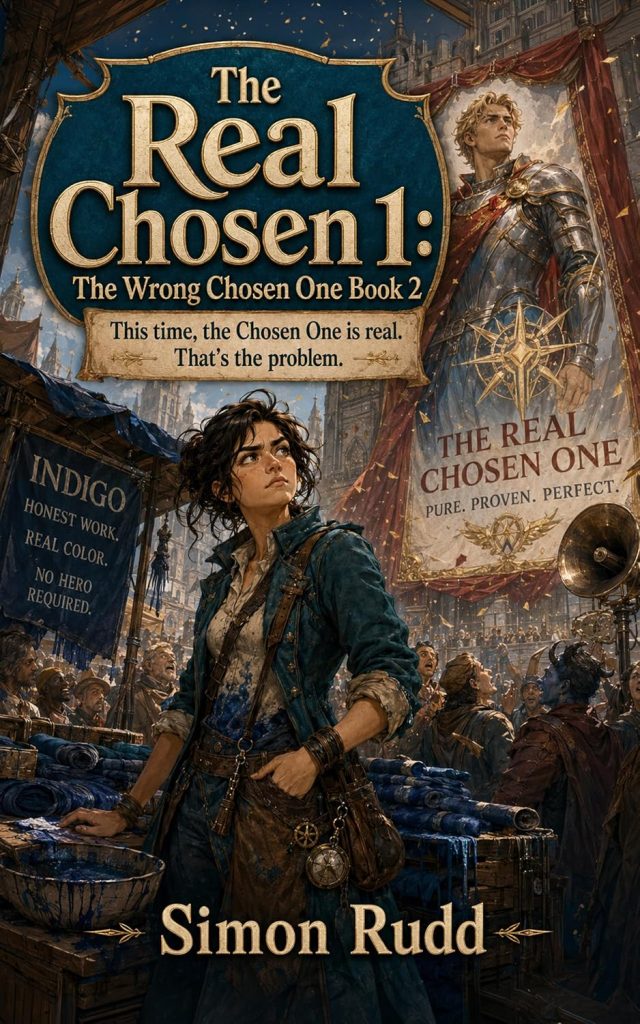
Andra beat the prophecy machine. She exposed the Guild of Auspices for the fraud factory it was, refused the crown, and went home to the dye-house to be nobody on purpose.
The Guild has not forgotten.
Its revenge isn't an assassin. It's a boy. Cael, the Verified — Certified Genuine, Authenticated Heir, the real Chosen One the fakers never were — packaged seal and all, and aimed squarely at the woman who made fraud a household word. The whole city adores him for it. Worse: he believes every word of it himself.
And Andra — who manufactured exactly this lie once — is the only person alive who can see the frightened kid under the brand.
She knows how to free him. She knows it the way she knows everything: too fast, too certain, with her hands already on the seam. But you cannot liberate a person by deciding the truth for them — and the staged Reckoning Cael was built to survive is about to stop being staged.
To save a believer who doesn't want saving, the girl who beat the machine by being right has to learn the one thing being right never taught her: when to take her hands off the wheel.
The second book in the Wrong Chosen One trilogy — sharper, darker, and just as funny. For readers in the tradition of Terry Pratchett, Diana Wynne Jones, and Jasper Fforde.
Read the first chapter
Chapter One — Cloth and Quiet
There is a particular smell to a life you have chosen on purpose, and in my case it was indigo.
It got into everything that first winter at the dye-house — the wood of the door, the wool of my coat, the creases of my hands no matter how I scrubbed. I’d wake with it. I’d go to sleep with it. For nineteen years I had wanted, more than food, more than safety, more than sense, to be somebody; and it turned out somebody smelled like a vat of fermented woad and went to bed too tired to admire herself. I want to be clear that I am not complaining. I had spent a year learning, at considerable cost, the difference between a life that looks like something and a life that is something, and the second one smells worse and I would not have traded it for the world.
Bex said I was getting sentimental about dye. Bex was usually right, which was one of the things I had finally learned to stand.
“You’re going blue again,” she said, not looking up. We were on the floor together that morning, the two of us, a vat between us and a length of cloth coming up out of it the colour of a bruise that hasn’t decided yet what it wants to be. “Your face. You get this look. Like the woad’s saying something profound.”
“It is, a bit.”
“It’s saying you left it too long.” She lifted her end. “Out. Out, out, come on, before it’s the colour of a magistrate.”
We hung it to oxidise, and watched it do the thing I never got tired of — green to teal to true blue as the air hit it, a small honest piece of alchemy that asked nothing of you but patience and didn’t care in the slightest who you were. No certificate. No seal. No verification desk. Just cloth, doing what cloth does, going the colour it was always going to go.
That was the life. I’m telling you about the cloth first, and at some length, because everything that came after was the story of people who could not leave the cloth alone — and because I want you to know I noticed it while I had it. Whatever else I got wrong in what follows, I knew, that winter, exactly how good it was. I just didn’t believe it would be allowed to last.
* * *
We sold at a stall in Tallow Square three mornings a week, under the great iron arm of the Amplifier, which broadcast the news of the city to anyone standing under it whether they’d asked for the news or not.
I had a complicated relationship with the Amplifier. It had, after all, carried my voice to the whole city the day everything came apart and came right — the one time in my life I’d pointed the only real gift I have at the truth instead of away from it. So I owed it something. But it was also the city’s enormous, tireless, beautifully impartial mouth, and it would say a true thing and a sold thing in exactly the same warm tone, and most people couldn’t tell which was which, and increasingly I suspected the Amplifier couldn’t either.
That morning it was selling.
“—and the reformed Guild of Auspices,” it was saying, in the voice they used for things they wanted you to find reassuring, “continues its programme of renewal under Magister Vane, with new transparency measures the Magister calls, and I quote, a covenant of honesty with every citizen.”
I had a customer’s coin half into my hand. I did not take it. I stood there with my mouth doing something.
“Don’t,” said Bex.
“I haven’t said anything.”
“You’ve got the face. You’ve gone and got the face.”
The thing is, a covenant of honesty. From them. From the people who had, within living memory — within my memory, within the scar tissue of it — manufactured eleven false saviours and arranged for the inconvenient ones to die on schedule. They had not stopped being that. They had simply hired someone to say covenant of honesty in a warm voice under a great iron arm, and the warm voice was working, I could see it working, I could see people’s shoulders coming down all over the square as they decided to be reassured. And every nerve I had stood up and said: correct it. Stand on the stall. Tell them. You did it once. You have the voice. Tell them what a covenant of honesty is worth from a man who sells covenants.
“I could,” I said, “just—”
“You could just nothing.” Bex put a bolt of cloth into my arms, which is a thing she does, weaponising the inventory, so that my hands are full and busy and incapable of gesturing at a crowd. “You won the argument already. Last year. In front of the entire city. Remember? The whole point was that you got to stop.”
“Being right in public isn’t the same as—”
“Being right in public,” said Bex, “is a thing you are addicted to, and it nearly got you killed, and we are selling teal. Sell some teal.”
I sold some teal. But I’ll be honest, because I’ve decided to be, even about myself: I wanted to climb on the stall so badly my teeth ached. It’s the worst kind of itch, the one that dresses itself up as virtue. It’s not vanity, it’s the truth, the truth deserves saying. I would spend a good deal of the year that followed learning, the hard way, the very hard way, that the truth can deserve saying and still not be yours to fling, and that there is a difference between handing someone a fact and hitting them with one. I did not know that yet. That winter I still thought being right was a complete sentence.
* * *
Pell turned up at the stall about midmorning with her arms full of pies she had not paid for in any way I wanted explained, and the particular face of someone who has good news and is going to make you ask.
She was sixteen and getting less frightened by the week, which I counted, privately, as the only unambiguously good thing I had done with my whole ridiculous reputation. She’d come to the dye-house a stranger in a doorway, sent to me by people who wanted to make her a symbol, and I had done the one thing nobody ever did for me: I’d told her the truth and then let her choose what to do with it. She had chosen, of all the unglamorous things in the world, to stay and learn to dye cloth. I don’t think a prophecy has ever been turned down for a fermented vat of woad before or since. I was prouder of it than of anything with my name on it.
“They’re free,” she said, of the pies, “before you ask, the man at the end’s a believer, he gives me things, it’s mortifying—”
“It is a bit,” I agreed.
“—he calls me ‘the one she saved,’ I keep telling him you didn’t save me, you just talked to me, and he looks at me like I’m being modest.” She handed Bex a pie with the unthinking ease of someone who’d decided, somewhere along the line, that this was her stall too, and I hadn’t corrected her, because it was. “Anyway. Heard the Amplifier. Covenant of honesty. I nearly threw a pie at it.”
“See,” I said to Bex.
“She’s sixteen,” said Bex. “Sixteen is allowed to throw pies. You’re not. You did your throwing.”
Pell looked between us, reading the weather the way she’d got good at, and some of the brightness went careful. “Is it starting again,” she said. It wasn’t quite a question. “The — them. Is it starting.”
And there it was, the thing I’d been not-saying all morning, said by a sixteen-year-old over a stolen pie. Because she felt it too. Of course she did. She had better reasons than most to watch the Guild’s weather, having been, however briefly, a front they’d tried to roll up. Is it starting again. I wanted to tell her no. I wanted to tell her we sold cloth now and the work didn’t stop for prophecy and the smell of woad was the only future either of us needed.
“I don’t know,” I said, because she’d earned the truth and I’d learned, just barely, to give it to her in the right size. “Maybe. The reform’s a coat of paint. Paint flakes. But it hasn’t flaked at us, and until it does, we sell teal and you stop stealing pies.”
“Accepting pies.”
“Stop accepting pies from men who think I’m a saint.”
“You’d accept the pies.”
“I would absolutely accept the pies, that’s not the point, the point is the theology.”
She laughed, which was what I’d been after, and the morning went back to being a morning. But I’d seen her file it away — maybe — and I was sorry I hadn’t had a better word.
* * *
Quill found me at the stall an hour later, which is never a coincidence. Quill does not stroll past your life. Quill circles it, at a height, and then descends.
“The fraud who beat the machine,” he said, with enormous fondness, helping himself to the good stool. Quill was a wholly-owned voice of the Amplifier now and dressed like it, in the soft expensive grey of a man who has learned that the next story is always worth more than the last one. “Selling cloth. The romance of it. The humility. You know I could get you four mornings of feed-time on that alone — the hero who chose the simple life — people eat that, they’d eat it raw—”
“No.”
“—it practically broadcasts itself, the woman who unmasked destiny, now hands stained honest blue, turning her back on—”
“Quill.”
He stopped, but only the way water stops at a dam, gathering. He looked at me, and for a moment the fondness had something underneath it, something almost like a warning, from a man whose entire trade was knowing which way the wind was about to blow before it blew.
“I’d take the feed-time, is all I’ll say,” he said, quieter. “While the offer’s the kind one. There’s a story building, love. I don’t know its shape yet. But I know when the air’s getting heavy, and the air’s getting heavy, and when it breaks it’s going to want a villain, and you’re standing in the open with your name already famous and your hands already dirty.” He stood. Brushed nothing off his expensive grey. “Sell your cloth. But keep one eye up.” He nodded at the great iron arm. “It’s where the weather comes from.”
Then he drifted off the way he’d drifted in, and I told myself he was selling me something, because Quill was always selling me something, and the telling-myself lasted right up until the middle of the afternoon.
* * *
It came across the Amplifier first as a change in tone.
You learn to hear it, if you’ve stood under that arm long enough — the small adjustment when the mouth stops reporting and starts preparing you. The warmth got warmer. The pauses got better-rehearsed. And then, threaded into the ordinary catalogue of the day, the city’s news and the city’s weather, it began, very gently, to talk about me.
Not by accident. I want to be precise, because precision turned out to matter enormously and I have spent a long time being precise about this since: it named me. Andra. The woman who built her name on the claim that no true heir exists. Said kindly. Said almost sympathetically — that was the genius of it, the awful new genius of the reformed thing, that it had learned to be kind — a woman who, understandably, after her ordeal, had perhaps overstated her case. Who had perhaps needed there to be no true Chosen One. Whose whole reputation, one might gently observe, depended on it.
A man near the stall looked over at me. Then away. Then back. I watched a thing happen behind his face that I would watch happen behind a great many faces in the weeks to come, the small private arithmetic of someone being handed a new way to understand a person they thought they’d already understood.
“Andra,” said Bex, low.
“I hear it.”
“Don’t get on the stall.”
“I’m not getting on the stall.”
And I wasn’t. That’s the part I’m almost proud of. I stood there with my blue hands and I did not get on the stall, even as the Amplifier explained, warmly, generously, ruinously, that the fraud who beat the machine might simply have been a frightened girl who couldn’t bear for the truth to be larger than she was — which, and this was the truly unbearable part, the part that closed my throat: was true. It was the most dangerous kind of lie. It was made almost entirely out of true.
Pell had gone very still beside the pies.
And then the square changed.
* * *
It happened the way the cloth happened, if you want to know — a colour arriving where there hadn’t been one, the air doing it all at once.
Across the whole north face of Tallow Square, where the cloth-merchants hung their banners and the Guild hung its notices, an Amplifier billboard came unrolled from top to bottom in one long shudder of bright fabric, the way they did it for a coronation or a war. People turned. People always turn. We are built to turn toward the big bright thing, it’s the oldest machinery in us, and the Guild has never once in its thousand years failed to use it.
It was a face.
A young man, perhaps my age, perhaps a little younger. Painted larger than any person has the right to be, looking down over the square with an expression I knew in my marrow because I had once spent every hour of every day arranging it on my own face: serene, certain, believing — the look of someone who has been told what he is and has decided, with his whole heart, to be worthy of it. He was beautiful in the specific way the Guild made things beautiful, which is to say expensively, and on purpose, and aimed.
I did not know him.
That was the thing my mind kept returning to, stupidly, while the rest of me went cold. I knew everyone in this business. I’d thought I knew everyone in this business. I had unmasked their machine and counted their fakes and learned their names and buried two of them, and here was a face, vast and serene and adored already — I watched the adoring start, I watched it move across the square like weather — and I did not know it at all.
Under the face, in the clean confident letters the Guild used when it wanted you to stop thinking and start belonging, ran the caption.
The Genuine Article.
And under that, smaller, the seal. Their seal. The Verification seal, the exact apparatus I had stood in front of and beaten and exposed and thought I had broken forever — turned, now, ninety degrees, from a thing that certified destinies into a thing that certified him. A stamp of realness. A guarantee.
The machine had heard me. That’s what I understood, standing in the suddenly-loud square with cloth going quietly blue behind me and Pell’s hand finding my sleeve. I had stood in front of the whole city and said there is no real one, it’s all manufactured, every saviour they ever sold you was a fake.
And the machine had thought about it. And the machine had gone away. And the machine had come back with a better lie than I had ever told, a lie with a face and a seal and a caption, a lie marketed on the one thing I’d staked my entire meaning on it never having — and the lie was real. Or near enough. Or sold as real. I couldn’t yet tell, and the not-being-able-to-tell was the whole point, was the trap, was the beautiful aimed cruelty of it.
They hadn’t come to argue with me.
They’d come to replace me.
“Andra,” Pell said, very quietly, her hand tight on my sleeve, looking up at the enormous serene believing face the way you’d look at weather coming in off the sea. “Who is that?”
The cloth oxidised behind us, green to teal to true. Going the colour it was always going to go, asking nothing of anyone, certain of nothing, real in the only way I’d come to trust.
I didn’t have an answer for her. For once in my life, standing in a public square with the city’s mouth wide open above me, I didn’t have a single word.
I’d find out his name soon enough.
Everyone would.