A Gaslamp Fantasy Comedy Trilogy, Book One
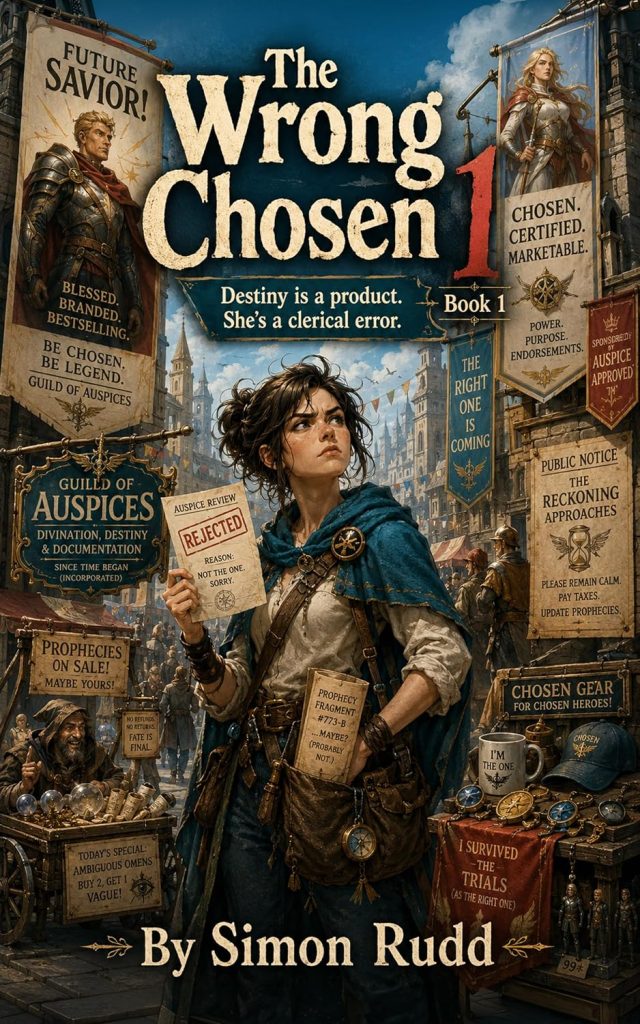
Andra has wanted to be the Chosen One her entire life. This morning, the Guild of Auspices officially rejected her application.
This afternoon, a verification clerk's apparatus pinged on the wrong person — her — and a city that manufactures prophecy the way other places manufacture soap has decided she is the genuine, foretold, certified article.
It's a clerical error. Andra knows it's a clerical error. But correcting it means going back to being nobody, and the engine in her chest has never once asked her permission. So she signs the form.
The catch: the Guild doesn't sell heroes. It sells the kind engineered to fail — gloriously, publicly, on a fixed date — so the institution that crowns them keeps the power and the merchandising rights. Andra has one manufactured Reckoning to expose the machine before it sacrifices her to the crowd that adores her… and the only person who can keep her honest is the best friend she's already started to lie to.
A gaslamp fantasy comedy about prophecy as product, fame as a trap, and the people who refuse to be extras in your story.
For readers who like their fantasy with the bite of Terry Pratchett, the heart of Diana Wynne Jones, and the bureaucratic absurdity of Jasper Fforde.
Book One of a complete trilogy.
Read the first chapter
Chapter One — Unqualified
I had rehearsed the moment I would be chosen so many times that the real version felt like a forgery.
In the rehearsals there was always light. A clerk would look up from a ledger, go very still, and say the words in the proper order — the apparatus confirms it — and somewhere a bell would find its reason for existing. I would be calm. I had practised being calm. I had practised it in the long mirror at the back of the laundry where I worked, holding a folded sheet to my chest like a sword I had earned, lowering my chin a precise and modest degree so that history would have something flattering to engrave.
The real version had a queue.
The Guild of Auspices took applications for Designated Hero candidacy on the third floor of the east annexe, in a waiting hall built to make hope feel like a clerical inconvenience. Forty of us sat on benches polished smooth by other people’s nerves. A frescoed ceiling showed past Chosen Ones standing nobly over the defeated Reckoning, their faces serene, their proportions improved. Beneath the fresco a brass sign read PLEASE HAVE YOUR DOCUMENTATION READY AND YOUR DESTINY UNFOLDED, and beneath the sign a smaller paper one, taped up at an angle, read AUTHENTICATION DELAYS DUE TO RECKONING SEASON — THANK YOU FOR YOUR PATIENCE.
That was the third time that week I’d seen the word Reckoning written somewhere it hadn’t used to be. It had crept onto the corner of the news-sheets. It had appeared in the patter of the man who sold consecrated string outside the gates. Reckoning’s overdue, people said, in the bright untroubled way you’d say a delivery was overdue, and then they bought something to feel ready.
I had my documentation. I had my destiny, such as it was, folded into the inside pocket of my coat where it could be produced at a dramatic moment. I had, in the satchel between my boots, four hero manuals so thoroughly read that the spines had given up holding the pages in any particular order, so that Comportment for the Chosen now began halfway through a chapter on humility and ended, abruptly, on a diagram of the correct way to receive applause.
I had read them all the way I had read them as a child, which is to say as instructions rather than entertainment. Other children had wanted to meet a hero. I had wanted to be the kind of fact the world could not get along without. I could not remember a time before that want. It sat under everything else like a floor.
“Andra of Lowmarket?”
I stood too fast and the satchel went over and the manuals fanned across the floor in front of forty strangers, humility-side up.
I want to be honest, because almost nothing else in this account will be: I gathered them with what I told myself was poise. The truth is I gathered them on my knees while a boy of about nineteen, who had a real sword and a real sponsor’s pin and the easy boredom of someone who has never once doubted he is the point of a room, stepped neatly over my hand on his way to be processed ahead of me.
* * *
The examination office had two chairs and a desk and behind the desk a woman I had only ever seen on the sides of mugs.
Magister Vane was the public face of Verification, which meant that her face was, in a real and licensed sense, public — it had a trademark and a recommended angle. In person she was smaller than her merchandise and considerably more polished, and she did not look up when I came in, which I had also rehearsed, in the version where my entrance was the thing that made her look up.
“Application three-three-one,” she said, to the paper. “Re-submission. Fourth.”
“Fourth,” I agreed, and then, because I cannot leave a silence the way other people cannot leave a loose thread, “Which I’d ask you to read as persistence rather than as the other thing.”
“There’s another thing?”
“Most people stop at three.”
“Most people,” said Magister Vane, turning a page, “are correct to.”
I sat. I arranged my hands the modest, chin-lowered way. She still wasn’t looking, so it went to waste, which is the trouble with rehearsing the receiving of attention you don’t yet have.
She read. The reading took a long time and was clearly designed to. On the wall behind her hung the framed instruments of her office — the certification seal, the brand-compliance charter, a graded sequence of medallions from PROVISIONAL through AUTHENTICATED to FULLY VESTED & INSURED — and a small placard I have thought about a great deal since, which read A HERO IS A PROMISE THE GUILD KEEPS. At the time I thought it was inspiring. It is, in fact, a confession, but it would be years before I could read it correctly.
“You have no prophecy,” she said.
“I have a partial prophecy.”
“You have a fragment, purchased secondhand, that mentions”— she found the line —“‘one who rises from the low quarter.’ Do you know how many people in this city rise from a low quarter, Andra of Lowmarket? Spatially? Every morning? When they get out of bed?”
“It’s the spirit of the line.”
“The spirit of the line is worth nothing without the certification of the line, and the certification belongs to the person the line was written for, who has paperwork, and lineage, and”— she glanced toward the door I’d come through, toward the boy with the pin —“a sponsor.”
Here is the thing I should have done. I should have taken the fragment back, and the manuals, and my dignity, which was small but mine, and gone home.
Instead I leaned forward, and I felt the old engine start up in my chest, the one that has never once asked my permission, the one that turns a closing door into an opening line.
“Then test me on the part that isn’t paperwork,” I said. “You authenticate feats, don’t you? Not just lineage. Give me a feat. I’ll do it now.”
For the first time Vane looked at me directly, and I understood that I had been, until that moment, a form she was processing, and was now, briefly, a person she was deciding whether to be annoyed by.
“What feat,” she said slowly, “do you imagine you can perform across a desk.”
And the engine answered before I did.
“Persuasion,” I said. “Reading a room. Getting people to do the thing that saves them when they’d rather do the thing that feels safe. That’s a hero skill. That’s the hero skill, when the monster’s at the door and everyone’s panicking and someone has to be believed. You won’t find it on a medallion because you can’t trademark it, but I’ve got more of it than that boy with the pin has got of anything, and if you’d seen me talk a crowd back from a fire in Lowmarket last winter —”
“Was there a fire?”
There had been a small fire. I had, in fact, mostly stood near it. But the engine does not deal in mostly; the engine deals in the better version, and the better version was already arriving in my mouth fully dressed.
“There was a fire,” I said, “and there was a stairwell, and forty families who’d have stampeded if one person hadn’t —”
“Stop.” Vane held up a hand, and to her credit it was not unkind. It was worse than unkind. It was patient. “I have read four hundred of these this season. The boy with the pin will be Authenticated by lunch, and he will be insured, and merchandised, and in eight years, if the cycle runs true, he will die on the Investiture stage in front of the largest audience this city can assemble, and the Guild will sell the recording.” She said it without weight, the way you’d recite the terms of any product. “That is what the title is, Andra. You are applying, very persistently, to be a promise we keep. Go home. Be ordinary. It is the safest thing anyone has offered you all day, and you will not thank me for it for years.”
She stamped the fragment. The stamp said NOT CARRIED FORWARD.
She slid it back across the desk along with a fresh rejection slip, pre-printed, with my name already in it, because of course they kept my name on file — fourth time — and she returned to her paper, and I had, once more, stopped being a person and gone back to being a form.
I want to record that I left with grace.
I did not leave with grace.
* * *
Bex was waiting on the annexe steps the way she always waited, which was to say without any of the hope I’d brought and all of the loyalty, sitting on the low wall with two cups of something hot from the cart, having bought mine before she could possibly know I’d need consoling, because she always knew.
She took one look at me and put my cup in my hands.
“Don’t,” I said.
“I haven’t said anything.”
“You’ve got the face.”
“This is my only face.” She had a flat, level way of talking that made even comfort sound like a fact she was confirming rather than a kindness she was offering, which was exactly why I believed her when nobody else. “What did they get you on this time. The prophecy?”
“The prophecy’s fine. The prophecy’s poetic.”
“The prophecy’s a sentence you bought off a man with a cart, Andra.”
“He had a stall.”
“He had a cart.” She blew on her cup. “What did she say.”
I looked at the rejection slip in my hand, my name already printed, NOT CARRIED FORWARD, and I felt the want do the thing it does, which is to refuse to die in proportion to the evidence.
“She said I should go home and be ordinary,” I said. “She said it like it was a present.”
Bex was quiet for a moment, and when she spoke it was carefully, the way you step around something you’ve stepped around before.
“It might be a present.”
“Bex —”
“I’m not — listen.” She set her cup down. “You’re the cleverest person I’ve ever met. You got us out of the rent thing with Hallow by talking. You sorted Mrs Crale’s licence in an afternoon when the whole street had given up. People come to you, in our actual life, in the actual low quarter, with actual problems, and you fix them, and then you come here —” she nodded at the annexe, at the fresco visible through the doors, at the whole machine of it “— and let a woman on a mug tell you you’re nothing. You don’t need them to certify you. I don’t understand why you keep asking the one institution in this city that’s never going to say yes.”
And the honest answer — the one that lived under the floor, the one I would not be able to say out loud for many chapters yet — was because if they don’t say I matter, I’m afraid it isn’t true.
What I said was: “Because the Reckoning’s coming, and when it comes, the city’s going to need someone, and I’d rather be the someone than be in the stairwell.”
It was a good line. It was even partly meant. Bex looked at me the way she looks when I’ve said something good instead of something true, which is the only look in the world I can’t talk my way out of.
“There wasn’t even a real stairwell,” she said quietly.
“There was a small fire.”
“You stood near a small fire.” But she said it gently, and she picked her cup back up, and she bumped my shoulder with hers, and that was Bex telling me she was still mine even though I was, on this one subject, an idiot. “Come on. I’ll buy you a bad pie and you can tell me how you’d have run the city.”
“I would run it very well.”
“I know you would,” she said, and she meant that one, which is why it’s the part I remember.
* * *
I should have gone with her.
What happened instead was that I had left the manuals.
Not all of them — three were in the satchel — but Comportment for the Chosen, the one I’d had longest, the one with the humility chapter and the applause diagram and my mother’s name in the front in a hand I could no longer quite remember the sound of, that one had skidded under the examination bench when I knelt, and I had walked out without it, and I was forty steps down the road with a bad pie in my future before I understood that I was not going to be able to leave it there.
“Two minutes,” I told Bex.
“Andra.”
“Two minutes.”
The waiting hall had emptied for the noon recess. The benches were bare; the brass sign still asked me to have my destiny unfolded. I went back to the examination corridor, found the office dark, and the manual was not under the bench, which meant a clerk had cleared it, which meant the lost-property desk, which — I asked a passing porter — was through the door marked VERIFICATION — STAFF AND AUTHENTICATED CANDIDATES ONLY, down the back stair, past the points where, very clearly and in several typefaces, I did not belong.
There was nothing to weigh.
I went through the door.
The back of the Guild was not the front of the Guild. The front had frescoes; the back had pipework and noise and the smell of hot brass, and corridors that branched and branched, lined with cabinets, lined with the actual machinery of manufactured destiny — racks of blank medallions waiting to be graded, a wall of pigeonholes each labelled with a candidate’s name and a tier, a great humming apparatus behind a grille that I would later know was the verification engine itself, the thing that read a person and decided, on the Guild’s authority, what they were allowed to be.
I was looking for a lost-property desk and instead I was lost, in the part of the building where they kept the answer to the only question I had ever cared about, and I will not pretend I hurried.
I trailed a hand along a cabinet. I read the pigeonholes — AUTHENTICATED, AUTHENTICATED, FULLY VESTED — and let myself, for one stupid private second, picture a pigeonhole with my name and a tier, in a corridor I’d have every right to stand in.
That was when I came to the desk.
It was a small desk, tucked under the apparatus, and behind it sat a clerk so unremarkable that I’d looked at the apparatus three times before I noticed the person operating it — a narrow, grey, precise sort of figure with sleeve-guards and a ledger and the still, watchful patience of someone who has spent thirty years being walked past. On the desk, neatly squared and waiting in a tray marked UNCLAIMED, was my manual.
“That’s mine,” I said, with the over-bright innocence of the comprehensively guilty. “I’m so sorry, I know I’m not — I just left my —”
I reached for it.
And the apparatus, which had been humming its long indifferent note behind the grille all the while, changed its mind about me.
The change began as a single bell, somewhere up in the works, finding its reason for existing. Then a second. Then the whole machine woke, and gauges I couldn’t read swung hard over, and a brass plate above the grille that had been dark my entire life lit from within, letter by letter, until it spelled a word, and the word, I understood with a cold falling certainty that had nothing whatsoever to do with light, was a name.
It was mine.
The clerk looked up from the ledger — looked at the plate, then at me, then very slowly back at the plate, with an expression I could not read and would spend a long time trying to — and said, in a dry, exact voice, the words I had rehearsed a thousand times and forged in every one of them:
“The apparatus confirms it.”
And nothing, anywhere, was calm.