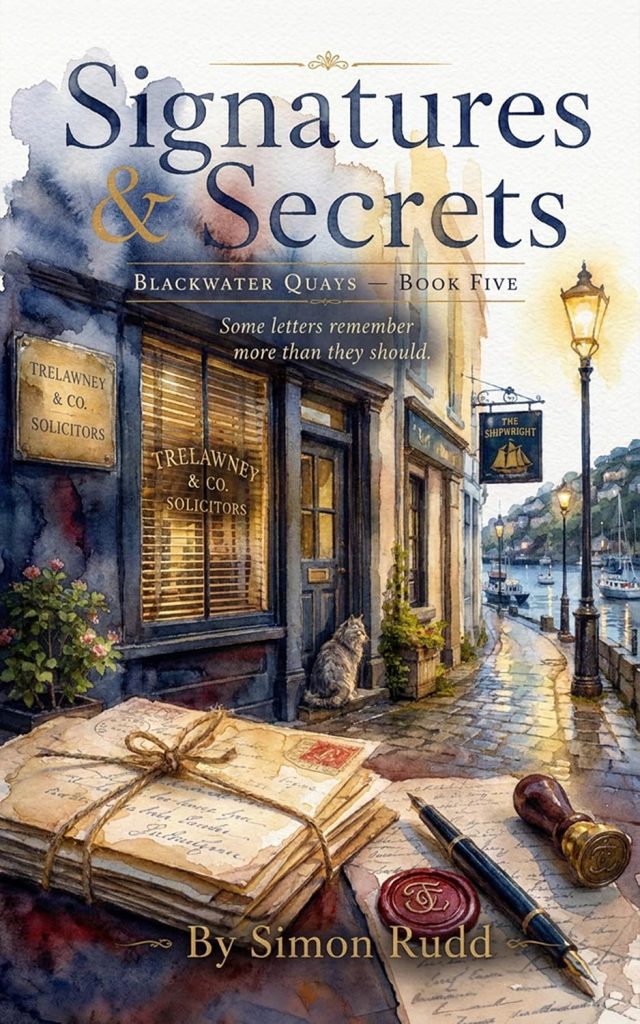
A Cornish Bookshop Cosy Mystery
The Blackwater Quay Mysteries Book 4
In a Cornish harbour town, the past speaks through ink — and something is trying to silence it.
Elowen Finch can read the feelings pressed into old paper. A love letter, a wartime note, a sister's confession written seventy years ago — she lifts the emotion from the page as easily as dust. But this February, something is wrong. Beneath every reading hums a faint, watchful interference she can neither name nor locate.
Then the town solicitor vanishes. His office goes dark, his cat left to the neighbours, a tidy story about a trip north that nobody quite believes. When Elowen discovers he disappeared while sorting a set of trust files no one was ever meant to open, she realises the wrongness in her gift and the empty office are the same thread — pulled tight.
With DI Rowan Hale, she follows it into a buried history: a decades-old arrangement, a report written to suppress people exactly like her, and a network that has been watching Blackwater far longer than she knew. Others in town are losing their memories. And someone has been sent to make sure Elowen stops looking.
To protect the town — and herself — she must finally master the one thing her inheritance was built to withhold. Because the man they sent is already here. And he only fails if she stops reaching for the answer, and learns instead to be still.
Signatures & Secrets is the fifth Blackwater Quays mystery: atmospheric, slow-burn, and warm at its heart. Perfect for readers who love a gifted amateur sleuth, a windswept Cornish setting, a quiet detective worth waiting for, and secrets that refuse to stay buried.
Read the first chapter
Chapter One: The Dark Office
Finch & Fable. The third week of February.
The Nancarrow commission was at its thirty-first letter when she noticed that the gift was reading slightly differently than it should be.
Not dramatically. Nothing that would have registered as a problem if she had not been keeping the assessment record in the way she had been keeping it — not what each document contained, but the reading itself, the depth and texture of what came back. She had been doing this since January, since the gift had returned after the Carver matter, because she understood now that the gift's condition was something to document rather than assume. She had been doing it carefully, the way she did most things: not because she was alarmed, but to record the accuracy.
The thirty-first letter was from a woman named Margaret Nancarrow to her sister in St Ives, dated 1947. It described, in the careful code of sisters who had been writing to one another through the war and had learned to ration their alarming content, the return of Margaret's husband from the mainland and the difficulty of re-learning a domestic proximity that had become unfamiliar. The gift gave her the surface of this cleanly — the mixture of relief and displacement, the tentative warmth of two people finding their way back to sharing a room, the texture of a woman who had managed very well on her own and was in the process of deciding what to do about that. All of this came back correctly, as it should.
It was, even after two years and several hundred commissions, a thing she had never entirely got used to: a woman seventy years dead handing her the exact weather of a Tuesday afternoon, trusting it to a stranger's hands without ever knowing the stranger would exist. She liked Margaret Nancarrow. You could not, she thought, help liking the people who wrote the way Margaret Nancarrow wrote.
Underneath it: something else. Not wrong, exactly. Not the absence she had known in January when the gift had gone dark between one reading and the next. A different quality, very faint and ambient, like the sound of a radio in another room that she could not quite tune out and could not quite locate. She had felt it for several days now. She understood, and had been attributing it to the fragility she had been managing since the autumn, the gift returning at its own pace and in its own way. But she had noted it on Thursday and again on Friday, and looking at the record this morning it was consistent. Fragility varied. This didn't.
She lifted her hand from the thirty-first letter. She sat for a moment. Then she made a note in the assessment record:
Reading: accurate and complete. Gift functioning. Textural wrongness present — ambient, consistent with previous three sessions, not source-specific. Not degradation. Something else. Location unknown.
She read the thirty-second letter.
She had passed Penhallow's office on Monday, coming back from the post office on the upper lane. The brass nameplate beside the door was as it had always been — E. Penhallow & Partners, Solicitors, established 1981. The blinds on the lower half of the window were drawn to the angle they were always drawn to in the afternoons, which she had noticed over the two years of passing without thinking about it. A predictable fixture of the lane. She had passed it and carried on.
On Tuesday at nine in the morning the blinds had been at the same angle. She had noted this as a slight wrongness but didn't stop to examine it.
On Wednesday she had spoken to Mrs. Rowe from the pharmacy, who had been feeding Penhallow's cat since last Thursday. A grey elderly animal named, as far as Elowen could tell, simply Cat. He'd gone up to his daughter's in Inverness by train leaving his car behind, Mrs. Rowe said, with the comfortable authority of someone who had been given this information by someone else and had no reason to question it. Mrs. Rowe added that Mr. Penhallow wouldn't be away long, as he was retiring at the end of March and there was all manner to sort out.
She wrote in the working journal's middle section, where she kept her notes.
Penhallow's office: dark since at least Thursday last week. Cat being fed by Mrs. Rowe — said trip to Inverness, timing and source unknown. Car in the lane off Harbour Street (Tuesday, this morning). No commission sent re: the Whitmore estate collection (expected before the end of the month).
What she had written. She did not add anything. She turned back to the Nancarrow commission in front of her.
Mrs. Tilling came in on Thursday afternoon, which was her usual day, and sat in the chair she always sat in and accepted the tea Elowen made while she admired Atlas, who was on the restoration room threshold and receiving admiration with the composure of a creature who considered admiration his due.
"You look well," Mrs. Tilling said. "Is the commission going well?"
"Forty-three letters from a Cornish family across eight decades," Elowen said.
"The Nancarrows? I knew a Nancarrow woman — Margaret, she'd have been in her eighties when I was in my twenties. Remarkable memory for detail." She settled in her chair. "Have you heard about poor Edward Penhallow? Such an inconvenient time to be away, with the retirement arrangements to settle."
"I noticed the office was dark. Mrs. Rowe said he was visiting his daughter in Inverness?"
"He'd mentioned wanting to go up before the spring," Mrs. Tilling said. "He'll be glad to have it done. He's been sorting through old files for weeks — you know what it is, forty years of professional papers." She shook her head with the comfortable affection of someone who had known Penhallow long enough to characterise his filing habits. "He'll be back before he knows it."
"Yes, probably," Elowen said, making a small note in the working journal's middle section.
Tilling: Penhallow has been sorting through old files. Trip to Inverness mentioned before departure. Origin of Inverness information unclear.
On Tuesday evening Rowan came to the shop at half past six. He had texted at five to say he would be passing and was she in. She let him in through the back and made tea while they stood in the kitchen for a few minutes — relaxed but not entirely casual, attentive in a way that was not entirely professional.
"How's the commission?" he said.
"Thirty-four letters in. Eight decades of a family. A woman named Margaret who managed a household through the war and has views on the difficulty of re-adjusting to a husband's return."
"Do they ask for your views on that?"
"The commission is an assessment for historical significance. They don't ask for my views on anything."
"What are your views?"
Him. "I think she was right and the letter was the wrong place to say so."
He considered this. He drank his tea. "Do you want to come to the cottage? I've got things."
Things meant food, which was how he approached the question of whether she had eaten: not by asking, but by having things and mentioning them without emphasis. She had learned this about him over the winter.
"Yes," she said. "Give me ten minutes."
They ate at the cottage table — something he had made from the contents of his refrigerator, which he managed with the same methodical efficiency he brought to most things — and she told him about Penhallow's dark office, the blinds at the wrong angle, the car in the lane. She told it without drama, as a list of observed facts.
"Any commission arrive?" Rowan said.
"The Whitmore estate collection was expected before the end of the month. He knew I was the person for it. He's reliable about that kind of thing — I've worked with his firm for two years."
"How long has the office been dark?"
"At least ten days, from what Mrs. Rowe said about the cat."
Rowan was quiet for a moment. The cottage was small and warm, the light had been left on at the worktable where he left whatever he was currently reading. There were two of his books on the shelf above the chair.
"The car in the lane is notable," he said finally.
"Yes."
"I'll make a note of it."
Neither of them said anything formal about this. A note was not an inquiry. It was a note, and it would be there if a note was needed. This was the way they worked, and it had become the way of other things as well.
She looked at the two books on the shelf above the chair. She had put them there herself, in the autumn, when he had left them on the table three visits running and she had decided that a thing left three times was a thing that lived there now. He had never remarked on it. She had never remarked on his not remarking on it. There was a whole conversation the two of them had been not-having for the better part of a year, conducted in books left on tables and doors left unlocked and too much supper made from the contents of a refrigerator, and she was aware of it, at the cottage table with the dark harbour beyond the window, as a pressure with no urgency behind it — a thing that was true, and was not going anywhere, and did not yet need to be said. She finished her tea. He watched her finish it. Neither of them hurried her into her coat.
She walked home along Harbour Street at nine. The harbour was dark and cold, the water reflecting the quayside lights in long shifting lines. The tourists were months away. The town was at its most honest to itself: the deli with its lights off, the post office closed, the Ship Inn warm at the quay end with the low sound of a Tuesday evening coming through the propped door. She could see Loveday behind the bar — leaning, talking, the familiar posture of a woman who ran a pub the way certain people ran pubs, by being present in it. Elowen raised a hand through the glass. Loveday raised hers. The lane by Penhallow's office was quiet beyond, the blinds still as they had been left.
She did not stop to look at the office. It was dark, as it had been dark for ten days.
The thirty-seventh Nancarrow letter was from Margaret's youngest son, written in 1969, and it had a different quality from the earlier letters in the collection — more compressed, the handwriting of a man in his mid-thirties who had learned to write quickly and meant it, and an emotional register that had the density of someone managing several things at once while trying to appear as though they were managing only one. The gift gave her the surface while underneath she felt the wrongness again, ambient, consistent, a presence she could not locate or name.
She lifted her hand from the thirty-seventh letter. She sat in the quiet of the restoration room and attended to what the gift was telling her.
It was not telling her anything new. It was telling her what it had been telling her for several days: that something was present in the room that she could not see. Not source-specific — not in the letters, not in any single document. Present in the room, or in the building, or in the air around the building, or in some combination of those things she did not yet have the language to describe.
She wrote in the assessment record:
Letter 37. Nancarrow. 1969. Reading: accurate. Gift functioning. Textural wrongness present — fifth session running. All around and consistent. Not degradation. Not source-specific. I am going to begin treating this as more than noise.
She read the thirty-eighth letter. She continued to work.
The middle section now had four entries. The dark office, the car, Mrs. Rowe's information about the Inverness trip, Mrs. Tilling's confirmation of it.
In the calibration record: five sessions' worth of documented wrongness, consistent, ambient, unlocated. She looked at both sets of notes. Something was coming together and had not yet resolved itself. She was not alarmed.
Penhallow's office was dark, and the gift was reading slightly off. She had been through enough by now to know that things which would not quite lie flat generally had a reason that would become apparent when there was enough of it to see.
She filed the day's assessment record, covered the worktable and locked the restoration room before going upstairs to her flat, Atlas with her. She did not look out the window at Harbour Street or at the lane where Penhallow's office was dark.
She went to bed.