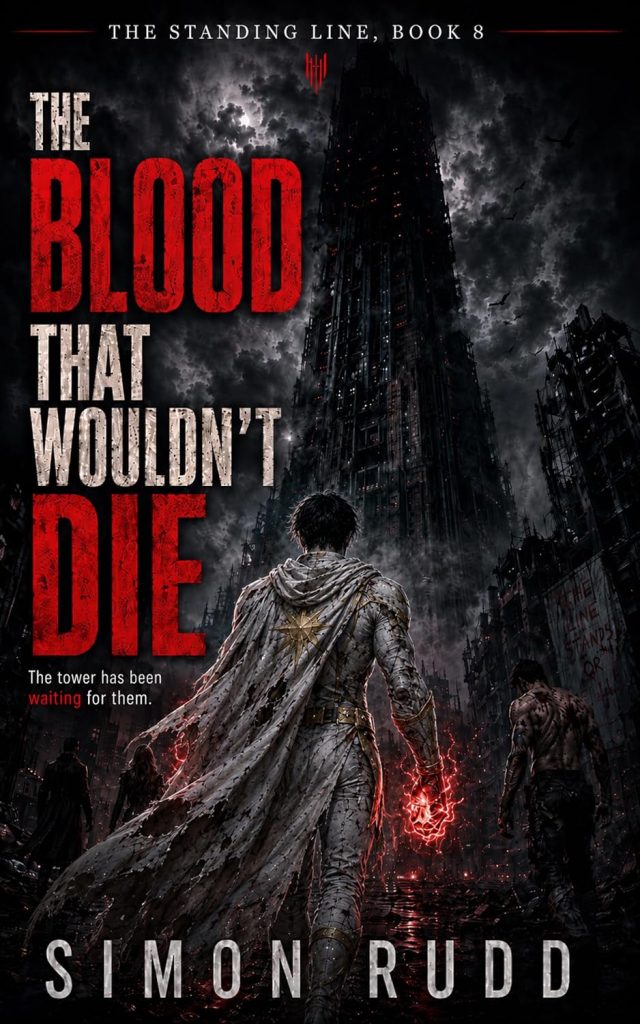
VAMPIRE HORROR · FALLEN SUPERHEROES
The Blood That Wouldn't Die
The Standing Line · Book 8
Eight of them walk into the tower at dusk. Kit’s card reads COUNT BEFORE DARK. COUNT INSIDE. NO LIFT. NO SOLO FLOOR.
About the book
Twenty floors, perhaps more. Every window above the ground floor blacked out with paint, board, filing cabinets and carpet. The east stair blocked on purpose, the west stair collapsed. The things inside use human voices as lures, and names, and knock patterns. When Jory finally finds a pen that works, they learn to use the sound of it clicking.
Jory has one rule for the record, and he keeps it on every floor: we do not write dead without a body or witness. We do not write rescued when they are not. We write where the route separated.
Somewhere in the tower is a room without a window, and Dream-Receiver is being kept in it. Above her is the man the records called Volunteer V, Patient 0 and the First Feeder, and what he has become. His blood does not stay where it is spilled. Cut it away from him and it finds a route back. The summons that brought Dawn here was built for one hero, arriving alone.
Dawn does not go alone.
The Blood That Wouldn’t Die is the eighth and final book of The Standing Line, a series about the heroes who outlived the end of the world, and what they have to become to keep anyone else alive.
Where this book fits
The Standing Line Book 8
Read an extract
Chapter 1 - Night Arrival
The tower had no light above the ninth floor.
That was how they knew the darkness was deliberate.
Lower down, broken windows caught the last reflections of the city. Streetlamps had been dead for ten years, shop signs had lost their letters and the road carried no moving vehicle, but evening still found scraps of glass to use. A dull grey remained in the reception frontage. Faded gold touched a metal railing. One cracked window held the western sky for several seconds longer than the buildings around it.
Above that, nothing.
The upper floors had been painted, boarded, curtained or filled.
Darkness had been constructed there.
Dawn stood behind the shell of an overturned tram-stop shelter and watched the tower refuse the night.
The bloodlight beneath his right palm moved once.
Not enough to show through the bandage.
Enough to hurt.
He closed his hand around the pain and discovered that closing it was worse. The skin had dried against the cloth during the walk from the southern split. Now the bandage pulled at the wound every time his fingers moved, opening small warm places Merrit had spent most of their remaining clean water trying to close.
She saw him flex the hand.
“Don’t.”
“I wasn’t doing anything.”
“You were preparing to.”
“For what?”
“Something unnecessary.”
“That is a broad diagnosis.”
“It has kept you alive.”
Merrit sat with her back against the shelter’s shattered advertising panel. The hospital case rested between her knees. Its replacement wire clasp was gone.
Jory had used the steel piece beneath Crown Span.
The case was now tied shut with a strip cut from the damaged sling. Merrit had knotted it twice and tucked the ends underneath, though there was little left inside worth stealing. Dressings. Two small bottles. One needle she trusted. One she did not. A folded square of plastic. Painkillers counted so carefully that Kit had written the number on the water board.
The tower stood beyond them.
Ordinary concrete.
Ordinary glass.
An ordinary office building tall enough to become terrible through use.
No turrets.
No walls built for defence.
No sign that anyone important had ever lived there.
Its entrance canopy had partly collapsed over a paved forecourt where dead ornamental trees remained fixed in square planters. A delivery road curved down the eastern side towards a loading area below street level. The western side faced a row of shorter office blocks and a multistorey building whose upper decks had fallen into one another.
The road between was open.
Too open.
Rhea watched it from beside the tram shelter.
She had returned from the southern route visible and stayed that way through the count. The effort of vanishing repeatedly had left the edges of her body uncertain. Her left shoulder blurred when she breathed too deeply. The sleeve below it appeared darker than the rest of her coat because rain had passed through part of the fabric before remembering where it belonged.
“They reached the red tram,” she said.
Jory looked up from his notebook.
“All five?”
“All five.”
“Barry?”
“Still breathing.”
“That wasn’t the question.”
“All five.”
Jory wrote the confirmation.
Susan.
Diane.
Sam.
Tamsin.
Barry.
He had already recorded the southern tram-block route, the old service wall and the painted depot mark Rhea found behind the abandoned ticket machine. He had recorded that no one had answered their first call. He had recorded the two fresh water containers hidden beneath the tram office stairs and the blanket hung across an internal doorway.
Evidence of survivors.
Not proof.
The five rescued civilians had wanted the mission group to wait until someone came.
Kit had refused.
Not because the civilians did not matter.
Because the tower had already begun mattering to the wrong kind of night.
They left Susan conscious, Diane able to hold pressure against her own shoulder, Sam shaking beneath two coats, Tamsin watching the doorway with a length of broken rail across her lap and Barry breathing badly but regularly beneath Merrit’s final thick blanket.
Rhea had led them to the southern split.
Cinder had marked the first section of the route with what he scraped from the lining of his coat.
Merrit had left instructions.
Kit had left rules.
Jory had left names.
The civilians had continued towards the tram-block refuge.
The eight had turned back towards the tower.
No one had said goodbye as though distance were death.
That had become another discipline.
Jory finished writing and pressed the pencil’s worn tip against the page.
“Did they understand the second turn?”
“Yes,” Rhea said.
“The road sign is down.”
“I showed Susan the wall mark.”
“She saw it?”
“She repeated it.”
“Which words?”
Rhea looked at him.
Jory waited.
“Three white lines,” she said. “Broken ticket office. Keep the rails on the left until the red tram.”
Jory nodded and recorded that too.
Dawn looked towards the tower.
“How long before they reach the depot?”
“Too long,” Merrit said.
“That wasn’t—”
“It is the only useful answer. Barry should not be moved. Susan should not be walking. Sam needs water we don’t have. Tamsin’s leg needed cleaning before the bridge, not after it. Diane’s shoulder is either out or broken, and I had neither the time nor the light to decide which.”
“They have a route,” Kit said.
They crouched on the other side of the shelter with the water board across both thighs. The old Saint Odran’s writing had long since been wiped away for Crownmarket routes, bridge sections, winch numbers and crossing orders. On the cleanest remaining corner, Kit had written:
TOWER ENTRY
Below it:
COUNT BEFORE DARK.
COUNT INSIDE.
NO LIFT.
NO SOLO FLOOR.
Jory read the last rule.
“We don’t know how many floors there are.”
“That does not improve solo travel.”
“I wasn’t disagreeing.”
“You were thinking in questions.”
“That is usually how questions happen.”
Clem would have answered that.
The absence of his voice entered the space without becoming a name.
He was at Crownmarket.
Alive.
Counted there.
Cinder sat at the edge of the shelter where he could see the delivery road. His ash-black coat had dried in stiff plates during the afternoon and cracked again during the walk. There was no loose ash left at his cuffs. None gathered when he breathed. Whatever remained belonged to his body rather than the route.
His injured ankle was stretched in front of him.
The swelling had forced Merrit to cut away part of the boot.
His blade was gone.
A length of sharpened gantry metal lay beside his hand instead. It had no grip, only cloth wrapped around one end. He had used it twice on the western shoulder and cleaned it once with rain.
Cinder touched two fingers to the ground.
Then pointed towards the tower.
Movement.
Dawn listened.
Nothing from the forecourt.
Nothing from the loading road.
Water dropped somewhere inside the collapsed entrance canopy.
Metal shifted high above them.
Not wind.
Wind moved objects without caring whether anyone heard.
This had stopped when Cinder raised his hand.
Bracework leaned against the rear wall of the shelter and tried not to put his full weight through it.
The wall had already cracked.
A fresh pale line extended from beneath his left sleeve into the concrete at shoulder height. He had not meant to reinforce the structure. His body had done it when his legs briefly failed.
The line was thinner than his old work.
Incomplete.
It ended after the length of a hand.
Merrit had covered both his forearms with the last broad dressings. Blood had travelled through them before they left the bridge and dried almost black along the edges. His fingers remained curled. When he wanted to use one hand, he had to straighten it with the other.
He caught Dawn looking.
“The shelter will survive me.”
“That isn’t what I was checking.”
“It should be.”
Bracework shifted his shoulder away from the reinforced patch. The concrete made a small sound as his body released it.
He breathed through his teeth.
Waymark sat beside him.
At first glance, he seemed less injured because his damage was older.
That illusion lasted until he moved.
One side of his mouth had swollen where another tooth had loosened during the suspended crossing. Dried blood marked the gaps between the teeth that remained. His scalp showed pale extraction pits beneath missing patches of hair. Only one nail remained on his left hand. It had split lengthways and been wrapped in a strip torn from Jory’s coat.
He had created no marker since Crown Span.
He had used no arrival.
His body still behaved as though both might be demanded.
Muscles jumped beneath the skin of his jaw. His right arm cramped without warning. Double vision made him close one eye whenever he studied the tower. His left leg took his weight a few steps at a time and then had to be argued with. Merrit had let him out of the sling at the southern split, on condition that he stopped when she said. The tower had no room for carrying.
He looked up at the blacked-out floors.
“That isn’t where she called from.”
Rhea turned.
“Dream-Receiver?”
Waymark nodded.
“You can tell?”
“No.”
The answer came slowly. His mouth did not form words cleanly around the missing teeth.
“I can tell where someone expected a road.”
He pointed towards the tower’s main entrance.
The collapsed canopy formed a broad black mouth over the reception doors. One glass panel remained intact. The others had been filled with office desks, metal filing cabinets and a double layer of timber boards.
A narrow gap remained beside the revolving door.
Too narrow for Bracework.
Too visible for everyone else.
“That is not an entrance,” Waymark said.
Kit looked at the water board. “The loading road.”
Rhea nodded. “It goes below reception.”
“Vehicle gate?”
“Half open.”
“Blocked?”
“Not from outside.”
“Watched?”
“Yes.”
Kit did not ask how many watchers.
Rhea would have said if she knew.
She vanished.
Not completely.
The outline of her boots remained on the pavement. One hand flickered beside her thigh. Her face disappeared last, leaving her eyes visible for a moment before the darkness took them.
Dawn resisted the urge to follow the movement.
They had agreed she would scout only the first approach.
No entry.
No internal stairs.
No searching for Dream-Receiver.
Not yet.
Rhea crossed the road.
The rain had stopped before sunset, leaving the tarmac wet enough to betray her feet. Small prints appeared and faded between abandoned cars. At the first planter, they turned towards the eastern side of the tower.
Nothing moved above.
That did not mean nothing watched.
Dawn could feel the building more clearly now that daylight had failed.
Not Victor.
Not a power.
Blood.
Old blood behind windows.
Fresh blood above it.
The scent should not have travelled through boarded floors and sealed rooms. It probably had not. Hunger was finding patterns rather than smells, taking every rust mark, dark doorway and remembered wound and turning them into one direction.
Up.
He pressed his damaged palm against the wet road.
Cold grit entered the bandage.
The hunger eased.
Merrit noticed.
She said nothing.
Jory closed the notebook.
On the cover, the bridge’s final words remained written in thick capitals:
THE ROAD ENDED.
WE DID NOT.
Below them, in smaller writing, he had added the names of the five living civilians.
Beneath those:
UNKNOWN CAPTIVE — DEAD BEFORE RECOVERY. BODY UNRECOVERED. COUNTED.
He placed the notebook inside his coat.
The movement exposed the tear across his back.
Merrit reached for him.
Jory shifted away.
“I’m fine.”
“You went under a bridge.”
“Not the whole bridge.”
“You used a pencil as part of a winch.”
“It worked.”
“That is not medical evidence.”
“It stopped Sam falling.”
Merrit caught the lower edge of his coat before he could move again and pulled it aside.
The drainage channel had opened his skin across the right ribs. The dressings were thin, improvised and already damp. His shoulder remained bound to reduce movement, though the sling had been sacrificed to the final cable system and replaced with a strip of coat lining.
Merrit pressed gently beside the rib.
Jory stopped breathing.
“Fine?” she asked.
“Mostly.”
“That isn’t a location in the body.”
“It is where Dawn has been injured for years.”
Dawn looked at him.
Jory did not apologise.
Merrit retied the cloth.
“You stay behind Bracework on entry.”
“There may not be room.”
“Then you become thinner.”
“That seems medically difficult.”
“Fear is excellent for posture.”
Cinder lifted his hand.
Stop.
Everyone turned.
Across the road, Rhea’s footprints had ceased.
For several seconds, nothing marked where she stood.
Then a small metal object fell from the side of the tower.
It struck the delivery road.
Once.
Rolled.
Stopped against the kerb.
A key.
Not old enough to have dropped by accident.
Dawn rose.
Merrit caught his coat.
He remained half-crouched.
The tower gave them no second sound.
Waymark closed one eye and watched the upper darkness.
“Thrown?”
Bracework asked.
Waymark shook his head.
“Dropped.”
“Difference?”
“A throw chooses where it lands.”
Cinder pointed towards the key.
Then held up two fingers.
Two?
No.
Pair.
Something with the key.
Jory saw it first.
“There’s a tag.”
A white plastic fob remained attached to the key by a rusted ring.
Even at a distance, writing showed across it.
Dawn could not read the words.
Rhea appeared beside the kerb.
She did not touch the key.
Her head lifted towards the tower.
Then she looked back and gave the return signal.
She crossed quickly.
Too quickly for stealth.
When she reached the shelter, only half of her face had returned. The other half showed the cracked advertising panel behind her.
“There’s blood on the loading ramp,” she said.
“Human?” Merrit asked.
“Yes.”
“Fresh?”
“Fresh enough.”
“How fresh?”
Rhea wiped one finger against her coat.
Red marked the fabric.
No one looked at Dawn.
That made him aware that everyone had chosen not to.
Kit pointed towards the key.
“What does it say?”
“PLANT.”
“Plant room?”
“Probably.”
“Floor?”
“No number.”
“Who dropped it?”
“I didn’t see.”
“Could it have been pushed from the roof?”
“No.”
Rhea’s missing cheek returned.
“It came from the fourth floor.”
“Human?” Jory asked.
“I didn’t see.”
“Vampire?”
“I didn’t see.”
“Dream-Receiver?”
Rhea looked upwards.
“No.”
The certainty changed the question.
Dawn studied the fourth floor.
Unlike the upper levels, its windows were not fully blocked. Several remained dark because the office beyond them had no light. One had been covered from inside with a grey sheet of material held at the corners.
The lower edge moved.
Only once.
A person could have released the key.
A vampire could have released it.
A trapped survivor.
A warning.
A lure.
A remembered habit continuing long after the person who began it had turned.
The key offered no proof.
Bodies counted.
Not objects.
Kit rubbed the final clear strip of the water board with one thumb.
“We leave it.”
Jory nodded reluctantly.
Dawn said, “It may open an internal route.”
“It may open the place someone wants us to enter.”
“We can take it without using it.”
“No.”
Kit met his eyes.
“You are smelling the blood.”
Dawn’s right hand tightened.
“That doesn’t make the key useless.”
“It makes your judgement part of the count.”
No one spoke.
The statement was not an accusation.
That was why it worked.
Dawn opened his hand, thumb first.
The bandage had darkened again.
“Leave it,” he said.
Waymark watched him.
Not approving.
Measuring.
A sound came from the loading road.
Three knocks.
Metal against metal.
Pause.
Two more.
The pattern was human enough to be dangerous.
Cinder tapped the sharpened gantry strip against the ground.
Three.
Pause.
Two.
He looked at Kit.
Kit shook their head.
“No answer.”
The tower waited.
Far above them, behind the blacked-out windows, something struck a wall.
Once.
A softer sound followed.
Dragging.
Dream-Receiver was inside.
Victor was waiting.
Mary was somewhere in the darkness or moving through it in a way the building could not record.
The group had crossed Crown Span to reach this place.
Waymark had emptied his body into a road that no longer existed.
Bracework had left blood in concrete, cable and a recovery truck now buried beneath the eastern carriageway.
Cinder had spent his final ash keeping other people’s routes visible.
Jory had crawled beneath moving machinery because a stranger named Sam was falling.
Rhea had carried civilians down from wires one body at a time.
Kit had turned collapse into sequence.
Merrit had used nearly everything she possessed to keep survivors alive long enough to leave her.
Dawn had burned himself for a road.
The tower offered a key and expected old habits to do the rest.
Kit turned the water board over.
“Entry order.”
They wrote as they spoke.
“Rhea scouts the loading threshold. No farther than the first internal door.”
Rhea nodded.
“Cinder behind her. You watch the low spaces.”
Cinder lifted two fingers.
“Dawn third.”
Merrit looked at Kit.
“Why?”
“Because if something reaches the first two, he has the clearest line without burning through the rest of us.”
Dawn looked at his palm.
One clear line might be more than the hand had left.
Kit continued.
“Me. Jory. Merrit.”
“I should be behind Dawn,” Merrit said.
“You should be where you can reach most bodies without being the first body hit.”
“Bracework can barely use his hands.”
“Bracework eighth.”
Bracework raised his head.
“Waymark last?” he asked.
“No. Waymark seventh. You eighth. I want you between him and anything following.”
“And who takes rear?”
Kit looked towards the tower.
“No one alone.”
They added another line.
REAR ROTATES AT EVERY LANDING.
Bracework considered it, then nodded.
Dawn said, “There may not be landings.”
“Then we rotate wherever the building gives us corners.”
“Fallback?”
“The loading ramp until we pass the first fire door. After that, the last counted room.”
“No rooms without two exits,” Jory said.
“Unless the second exit is vertical,” Waymark added.
Kit looked at him.
“Can you use another marker?”
Merrit answered first.
“No.”
Waymark’s mouth tightened.
Kit did not correct Merrit.
“I asked whether he can.”
Waymark examined his damaged hand.
“Once.”
“No,” Merrit repeated.
“Once,” he said, “if the material holds.”
“What material?”
He touched the swollen gap in his mouth where the tooth had loosened.
Jory looked away.
Kit did not.
“You do not make it without instruction.”
Waymark laughed once.
There was no humour in the sound.
“You think instruction stops it costing?”
“No. Instruction stops the cost belonging only to you.”
Waymark stared at them.
Then he lowered his hand.
“Fine.”
“Not fine. Agreed?”
A longer pause.
“Agreed.”
Kit wrote:
NO MARKER WITHOUT COUNT.
Jory read it.
“That doesn’t specify permission.”
“It specifies witnesses.”
“Waymark could count himself.”
“Then add shared.”
Jory took the water board and wrote one word between the lines.
SHARED.
Kit accepted the amendment.
Rhea’s head turned towards the loading road.
“Movement.”
The group lowered.
A shape crossed the ramp entrance.
Human height.
Bent forward.
Gone before Dawn could read it.
No footstep followed.
No breath.
Cinder pointed towards the tower, then touched his own ear and shook his head.
No heartbeat.
Dawn had heard none either.
One vampire, perhaps.
Perhaps more waiting below the road line.
Bracework pushed himself away from the shelter.
The concrete patch at his shoulder held after he left it.
He nearly fell.
Dawn caught him beneath one arm.
Bracework’s weight forced Dawn’s damaged hand against the wet canvas coat. Bloodlight flashed through the bandage.
Red entered the shelter.
For one instant, every face became visible.
Cinder grey with recurrence.
Rhea half absent.
Jory exhausted and upright through argument.
Kit watching everyone at once.
Merrit reaching for Dawn’s wrist.
Waymark staring at the light as though measuring a destination.
Bracework bent under the failure of his own body.
Then Dawn’s bloodlight withdrew.
The darkness returned.
Bracework straightened with Dawn’s help.
“You should not carry me,” he said.
“I’m not.”
“You’re doing it now.”
“I’m helping you stand.”
“There was a time you understood the difference.”
“There was a bridge yesterday.”
Bracework looked at him.
Then, carefully, transferred his weight back to his own legs.
“Still is,” he said.
Behind them, Crown Span was no longer visible.
The road did not lead back to it.
The tower filled what remained.
Merrit retied Dawn’s palm while he stood.
The cloth was not clean.
Nothing clean remained.
She pulled the knot tight enough to make him wince.
“Good,” she said.
“What?”
“You can still feel it.”
Rhea vanished again.
Cinder took the sharpened metal and moved after her, his bad ankle placing one foot carefully ahead of the other.
Dawn followed.
Kit counted him past the edge of the shelter.
One.
Kit moved behind him.
Two.
Jory.
Three.
Merrit.
Four.
Waymark rose with both hands against the tram panel and kept what weight he could off the left leg.
Five.
Bracework waited until the others had cleared enough space, then stepped into the road.
Six.
The count did not include Rhea and Cinder until they returned visible at the loading threshold.
It did not pretend disappearance was absence.
It did not pretend silence was death.
The group crossed beneath the tower’s lower windows.
No face appeared behind them.
The plant-room key remained beside the kerb.
At the entrance to the loading ramp, the blood became visible.
A narrow line ran from the half-open vehicle gate towards the darkness below. It had been made by something dragged on one side, lifted briefly, then dragged again.
Human blood.
Fresh over older brown layers.
The ramp walls carried handprints.
Some low.
Some high.
Several had no complete fingers.
Waymark stopped.
“Deliveries,” he said.
No one asked what kind.
The vehicle gate had jammed halfway into the ceiling. Bracework could pass beneath only by bowing his head. Rhea stood beyond it, fully visible for the count.
Cinder stood beside her.
Eight.
All present.
Inside, the loading bay smelled of wet concrete, rust, old fuel and blood carried upwards by warm air.
Two delivery cages stood against one wall.
A dead security light hung from the ceiling.
White arrows had once directed drivers towards GOODS IN and EXIT. Someone had painted over EXIT in black.
Not recently.
Not neatly.
Enough times that the word had become a raised dark block on the wall.
Kit lifted the hooded lamp but did not uncover it.
“Fallback is the ramp.”
Jory repeated, “Fallback is the ramp.”
“First internal door only.”
Rhea nodded.
“No lift.”
Waymark looked towards a pair of closed metal doors at the rear of the bay.
One had been forced apart by several inches.
Something dark filled the gap.
Not shadow.
Cloth.
The lifts had been blacked out from inside.
Kit pointed towards a green fire-door sign farther along the wall.
STAIRS.
The sign had been scratched.
Not removed.
The arrow still pointed left.
Cinder reached the first internal door.
He touched its lower edge with the sharpened metal strip.
Nothing moved beneath it.
He placed his fingertips against the surface.
No ash answered.
No route returned.
He looked at Dawn and raised one finger.
Listen.
Dawn listened.
Above them, floors held the ordinary sounds of a building settling after dark.
Water in pipes.
Metal cooling.
Wind pressing against blocked windows.
Something breathing through a damaged throat.
Farther up, a woman made a sound too weak to become a word.
Rhea vanished before anyone told her to.
The handle turned.
The door opened inward.
Darkness did not spill out.
It had already been waiting on both sides.
The Standing Line entered the tower.