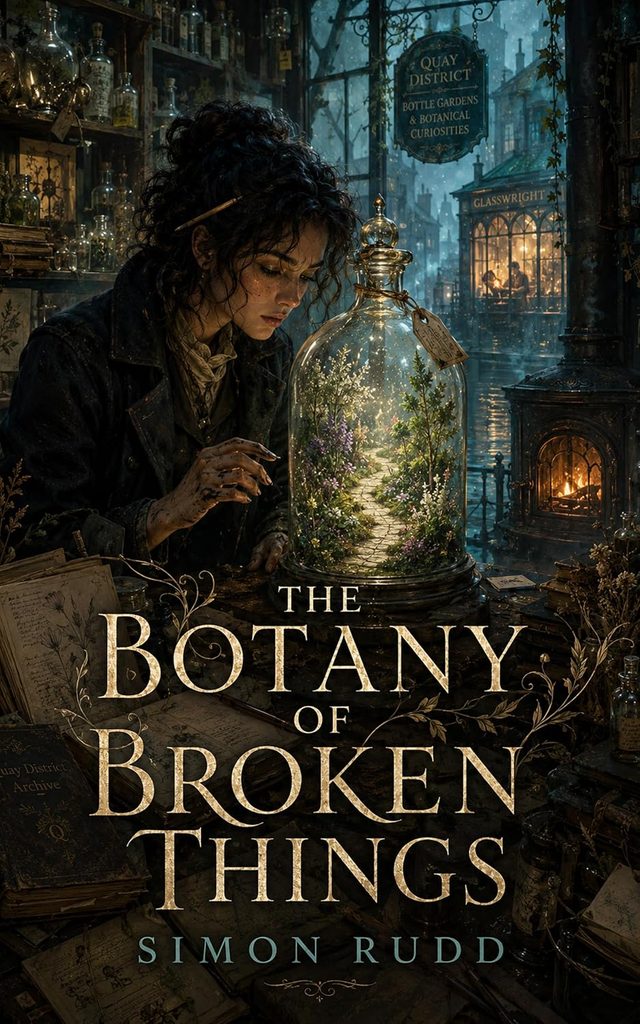
Cosy fantasy · Slow-burn romance
The Botany of Broken Things
Standalone Novels & Novellas
She came to sell a dead woman’s shop. She didn’t expect it to start breathing.
About the book
Mari Quay has spent twelve years in the capital’s civic archive, where everything is labelled, everything is filed, and nothing is ever felt if it can be documented instead. So when her estranged aunt Saffron leaves her a crumbling bottle shop in the misty canal city of Lume, Mari arrives with a notebook, a plan and no intention of staying.
The shop has other ideas.
Its shelves are crowded with memory-glass: laughter, quiet afternoons and long-lost goodbyes, wound into bottles by the glasswrights of the Quay District. Many of them are cracking in the cold. In the back room, on a plinth of its own, sits the Impossible Bottle, a living meadow sealed in glass that leans towards Mari’s breath. It is fading fast.
Saving it will take a master glasswright. The only one who’ll set foot in the place is Cael Emberwell, the taciturn craftsman across the alley. He has soot on his hands and a furnace that never goes out, and he has opinions about archivists.
Meanwhile the Guild has flagged the shop for review, the debts are mounting, and the frost is creeping up the walls. Mari begins to suspect that her aunt’s last and greatest creation was never meant to be mended by one pair of hands.
Some things can’t be catalogued. They have to be tended.
The Botany of Broken Things is a warm, slow-burn cosy fantasy about grief, second chances, stubborn neighbours and the quiet magic of choosing a place, and a person, to stay for. Perfect for readers who love cosy magic shops, grumpy-meets-precise romance, found family and a happy ending worth the wait.
For readers who want to live in the world AND want them to kiss.
Where this book fits
A standalone novel
Read an extract
Chapter 1 - The Archivist’s Arrival
The mist in the Quay District did not drift. It occupied space with a proprietary thickness that suggested decades of practice and an intimate knowledge of every cobblestone, every damp-stained lintel, every canal-slicked stair. I stood at the foot of the Humpbacked Bridge with my suitcase in one hand and Aunt Saffron’s brass shop key in the other, and I catalogued the mist as I would any unfamiliar archival environment: cold, saline, faintly sulphurous, and possessed of a turquoise tint that no meteorological textbook in the capital’s library had prepared me for.
The canal below the bridge was the source of that colour. The water moved with a sluggish, opalescent quality — someone might have dissolved a quantity of ground copper into the tide and neglected to stir. According to my research notes, compiled over three efficient days in the capital before my departure and cross-referenced against Harwell’s Guide to Provincial Craft Districts, fourth edition, the turquoise was a natural phenomenon related to the city’s aqueous magic. The canals of Lume absorbed ambient magical resonance from the glasswrights’ furnaces and reflected it back as bioluminescence during certain tidal phases.
I had written “investigate further” in the margin and underlined it twice. Standing here now, with the cold creeping through my boot soles and the mist settling into the wool of my coat like a persistent house guest, I amended the note mentally: investigate further, preferably from indoors.
The Quay District announced itself through texture rather than signage. The cobblestones shifted from the capital’s uniform grey to an uneven patchwork of sandstone and sea-smoothed granite, each one wearing a fine crust of salt. Buildings leaned toward the canal with the companionable slump of old friends sharing a bench, their facades a catalogue of peeling paint in colours that had once been ambitious: teal, ochre, a coral pink now faded to the approximate shade of watered-down tea. Shutters hung at angles that suggested philosophical disagreement with their hinges. Window boxes, empty this late in the season, jutted from second-storey sills like small expectant shelves waiting to be filled.
A neighbourhood left to age without the intervention of civic preservation. The capital’s Heritage Bureau would have categorised it as “atmospheric but structurally negligent.”
Two men sat on the bridge’s stone railing, bundled in heavy woollen coats that appeared to have been knitted by someone with strong opinions but limited patience with pattern consistency. They watched my approach with the frank, unhurried scrutiny of people for whom observing newcomers constituted both civic duty and entertainment.
“That’ll be the niece,” one said to the other, not troubling to lower his voice.
“The archivist,” the second corrected. He had a face like a walnut — deeply grooved and weathered to a uniform brown — and he squinted at my suitcase with the conviction that he could assess its contents through the leather. “Saffron said she’d send someone bookish.”
I had not been sent. I had been summoned by a solicitor’s letter informing me that my great-aunt Saffron Quay had died peacefully in her sleep three months prior, and that I had inherited the entirety of her estate: one bottle-garden shop (contents unknown, condition unspecified), one outstanding debt to the Merchant Guild of Lume (amount: significant), and one brass key, which I was currently gripping with sufficient force to leave an impression in my palm.
“Good morning,” I said, because an archivist, however displaced, maintains her professional courtesies. “I’m looking for number forty-two.”
The walnut-faced man pointed down the canal path without removing his other hand from the depths of his coat. “Past Bramble’s, past the mossy bit, second door after the alley. You’ll know it by the boards.”
“The boards?”
“On the windows.” He exchanged a look with his companion that contained an entire weather system of implication. “Emberwell’s been at it again.”
I did not ask who Emberwell was. My capacity for local intelligence on an empty stomach was limited, and my immediate priorities were ordered with an archivist’s precision: locate the shop, assess the inventory, determine whether the debt was survivable, and find a source of hot tea. Gossip would have to queue.
The shop was, as promised, past the mossy bit.
Number forty-two sat at the end of a narrow lane that branched from the canal path like a reluctant afterthought. It was taller than its neighbours, three storeys of water-stained brick crowned by a steep slate roof, and it wore its age with neither pride nor apology. The ground-floor windows, or what I could see of them, had been covered with rough-cut planks nailed at irregular intervals, giving the facade the appearance of a building that had attempted to cross its arms and not quite managed the geometry. A sign above the door read QUAY BOTTLE-GARDEN in painted letters that had once been gold and were now the colour of weak broth.
Pinned to the door, beneath a rusted iron knocker shaped like a curled leaf, was a document bearing the seal of the Merchant Guild.
I set down my suitcase and read it.
The language was bureaucratic — written by someone trained to obscure meaning behind a fortification of subordinate clauses. Stripped to its structural elements, the notice stated that Shop Forty-Two had been flagged for a licensing review following the death of its registered proprietor; that the shop’s operating certificate required the on-site presence of a certified Master in Vitreous Memory-Winding; and that failure to present said Master within thirty days would result in the seizure of all “unstable magical assets” for Guild assessment and possible decommissioning.
I noted the date of issue. Twelve days had already passed.
The key turned in the lock with a sound like a held breath being released, a soft metallic sigh that came from somewhere deeper than the mechanism. The door swung inward, and the shop exhaled.
The smell was the first thing. Lavender — old and complicated, a lavender that had been steeping in enclosed air for months, layering itself with dust and cold stone and a faint, glassy sweetness I could not identify. Beneath it, the ghost of wood smoke. Beneath that, something green and improbable, like crushed stems.
I stepped inside.
The shop floor was a disaster that would have reduced any certified archivist to a state of professional anguish, and I am, whatever else I may be, a certified archivist. Shelves lined every wall from floor to ceiling, and upon those shelves sat bottles — hundreds of them — in every conceivable size, shape, and state of neglect. Some were corked and labelled in a cramped, angular hand I recognised from Saffron’s infrequent letters — two a year, for as long as I could remember, answered dutifully by me. Others had lost their stoppers and sat open-mouthed, their contents long since evaporated. A fine layer of grey dust covered everything, disturbed in places by recent footprints that were not mine.
The footprints were large. Whoever had made them wore heavy boots and moved with the ground-claiming stride of someone who considered other people’s property a secondary concern.
At the centre of the shop, dominating the space like a cast-iron heart, stood the furnace. It was enormous — a squat, black-bellied cylinder of riveted metal that rose to chest height and radiated, even in its dormancy, the memory of tremendous heat. Its door hung open. The grate inside was cold, the ash undisturbed, and someone had begun nailing a plank across the opening.
The plank was half-attached. One nail driven in, the other hanging loose — the work of a person who had been interrupted mid-task or had simply run out of conviction.
I set my suitcase beside the furnace and removed my gloves. The air inside the shop was colder than the air outside, which struck me as thermodynamically aggressive. My breath was visible. The stone floor seeped through my boot soles, a deep, structural cold that had less to do with the season and more to do with the absence of a fire that had probably burned here without interruption for decades.
“Don’t touch the furnace.”
The voice came from the back of the shop, from a doorway I had not yet investigated. Low, rough, delivered with the compressed authority of someone accustomed to issuing commands to inanimate objects and expecting compliance.
A man emerged from the doorway. He was — and I recorded this with the same dispassionate precision I would apply to any notable environmental variable — large. Not tall in the ostentatious way of the capital’s ceremonial guards, but broad and dense, built like a structure designed to absorb and redistribute force. Soot marked his forearms in dark, deliberate stripes, applied by labour rather than art. His hands were extraordinary: wide-palmed, heavy-knuckled, mapped with old burns and fresh calluses, and they held a hammer with the casual familiarity of a man who considered it an extension of his skeleton.
His eyes were the colour of the canal, that same improbable teal, and they were looking at me with an expression I classified, after brief consideration, as territorial hostility.
“The furnace is not currently operational,” I observed. “I was not intending to touch it.”
“You were intending to open it. Everyone who walks in here tries to open it.” He crossed the shop floor with the same heavy stride that had left those boot prints in the dust. Up close, he radiated heat the way the furnace did not — a latent, banked warmth that rose from his skin rather than his clothing. It was distracting in a purely thermodynamic sense.
“I am the new owner,” I said. “Maribel Quay. Saffron was my great-aunt.”
“I know who you are.” He drove the loose nail into the plank with a single, efficient stroke that made the bottles on the nearest shelf chime in protest. “The solicitor sent a letter. You’re the archivist from the capital.”
“Former archivist.” The correction was automatic and, I realised immediately, unnecessary. My employment status was not his concern, and sharing it felt like offering a vulnerability to someone who had not earned it.
He gave me a look. It lasted approximately two seconds, but I felt it land with the specificity of a catalogued entry — a quick, thorough inventory that took in my ink-stained fingers, my tangled hair, the pencil I had forgotten behind my ear, and the suitcase that contained everything I owned. The disorienting sensation of being archived by someone who did not use paper.
“Cael Emberwell,” he said. Not an introduction. A fact, delivered with no expectation that it would be received warmly. “I’m the glasswright across the alley. Saffron’s furnace shares a flue with my workshop. I’m boarding it up before the Silver-Freeze settles in and the draught pulls my heat.”
“You’re boarding up my furnace,” I said, “to protect your workshop.”
“Your aunt hasn’t lit this furnace in four months. The flue’s been pulling cold air into my space since the Amber-Ebb. I’ve lost three windings to the temperature fluctuation.” He drove another nail. Precise, percussive, faintly hostile. “If you’re here to sell the place, I’ll buy the flue rights. If you’re here to play shopkeeper, you’ll need to light the furnace within the week or I’ll seal the connection permanently.”
“I am here,” I said, drawing myself to my full and admittedly unimposing height, “to assess the estate, settle the outstanding debt, and determine the appropriate course of action. None of which requires your input or your hammer.”
Cael Emberwell looked at me. The teal of his eyes darkened by a fraction — a contraction of the iris that I attributed to the shop’s poor lighting and not to any emotional response my words may have provoked. His jaw tightened. He set the hammer down on the furnace’s rim with a control that was, in its own way, more aggressive than if he had thrown it.
“The appropriate course of action,” he said, his voice dropping to a register that warmed the air between us by a degree I found difficult to justify scientifically, “is to light the furnace, stabilise the bottles on the east wall before the frost gets into the glass, and deal with the Guild before they send an inspector who doesn’t know the difference between a dormant winding and a dead one.” He nodded toward the notice on the door. “You’ve got eighteen days. You’re going to need a Master. There isn’t one in the district besides me.”
He picked up the hammer and walked past me toward the door. As he passed, I caught his scent — not cologne, not soap, but something occupational and specific: charcoal, heated sand, and a sweetness that might have been molten glass or might have been something I was not yet prepared to classify.
At the door, he paused. He did not turn around.
“The back room has something in it. Saffron’s project. Don’t open the case until the furnace is lit. The cold will kill it.”
The door closed behind him with the firm, unhesitating click of a man who had said precisely what he intended to say and not one syllable more.
I stood in the centre of my inheritance — the dust, the cold, the bottles watching from their shelves like an audience of small glass witnesses — and I pressed the brass key into my palm until the teeth left marks. The furnace was silent. The shop smelled of lavender and absence. Through the window, across the narrow alley, the amber glow of Cael Emberwell’s workshop burned steady and warm and utterly, infuriatingly self-sufficient.
My notebook came out of my coat pocket, opened to a fresh page. At the top, in my neatest archival hand, I wrote: Preliminary Field Notes — Quay District, Shop 42. Beneath it, a list.
Item one: the furnace (cold, partially boarded, structurally sound — to be confirmed).
Item two: the bottles (quantity unknown, condition variable, east wall apparently at risk — investigate).
Item three: the Guild notice (eighteen days remaining; Master required; implications considerable).
Item four: the back room (contents unknown; Saffron’s project; instructions received re: temperature sensitivity).
My pen hovered over the page. The mist pressed against the windows. The furnace ticked as its metal contracted in the cold. Across the alley, the amber light pulsed once, twice, like a slow and steady breath.
A fifth item.
Item five: Cael Emberwell (glasswright; territorial; thermal variable — uncontrolled; requires further observation).
The notebook closed. The furnace waited. And the back room — Saffron’s project, the sealed case, whatever impossible thing my great-aunt had left behind in her three-storey monument to lavender and neglect — waited too.
The door to the back room was at the rear of the shop, past a narrow corridor lined with more shelves and a staircase that presumably led to the living quarters above. A solid door, heavier than the others. It opened onto a room that was smaller and darker than the main shop floor. The air here was different — thicker, more humid, carrying a sweetness that was not lavender but something vegetal and alive.
In the centre of the room, on a stone plinth that looked built for this one purpose, sat a bottle.
It was the largest I had seen — roughly the size of a melon, with walls of clear glass so thick they distorted the light into prismatic arcs across the stone floor. It was sealed. The cork had been waxed and then sealed again with a substance I could not immediately identify, something dark and slightly iridescent, like the wing-case of a beetle.
Inside the bottle, a meadow grew.
I leaned closer, my breath fogging the glass. Not a painting, not an illusion, not a trick of light and coloured sand. Inside the sealed glass, rooted in a thin layer of dark soil, a miniature ecosystem existed in apparent defiance of every botanical principle I had studied. Tiny stems, no thicker than threads, supported bell-shaped flowers of a blue so deep it approached violet. The flowers moved — with the organic, responsive tremor of living things answering a breeze that could not possibly exist inside a sealed container.
My hands were shaking. I pressed them flat against the plinth and forced my breathing into the steady, four-count rhythm I used when handling fragile manuscripts. The flowers pulsed. The blue deepened for a moment, then faded — a slow, dormant respiration that matched the cold, quiet tempo of the room.
I did not open the case. Cael Emberwell was a territorial inconvenience with a proprietary attitude toward shared infrastructure, but his warning about the cold had carried the weight of someone who knew exactly what he was talking about. Whatever this was — this impossible, sealed, living garden — it was waiting for warmth.
I straightened. I looked at the bottle, and the bottle, in its dim and patient way, looked back.
“Well,” I said, to the meadow that should not exist, in the shop I had not asked for, in the district where I knew no one and owned nothing but a debt and a brass key. “I suppose we should both try to survive the night.”
I set my suitcase on the floor of the back room, within sight of the impossible meadow, and made a bed of my coat beside it. Three years of rented rooms had taught me to sleep with its latches undone, so that I could be packed and gone within a minute. That night, for the first time in three years, I fastened them.