Cosy science fiction · Belonging
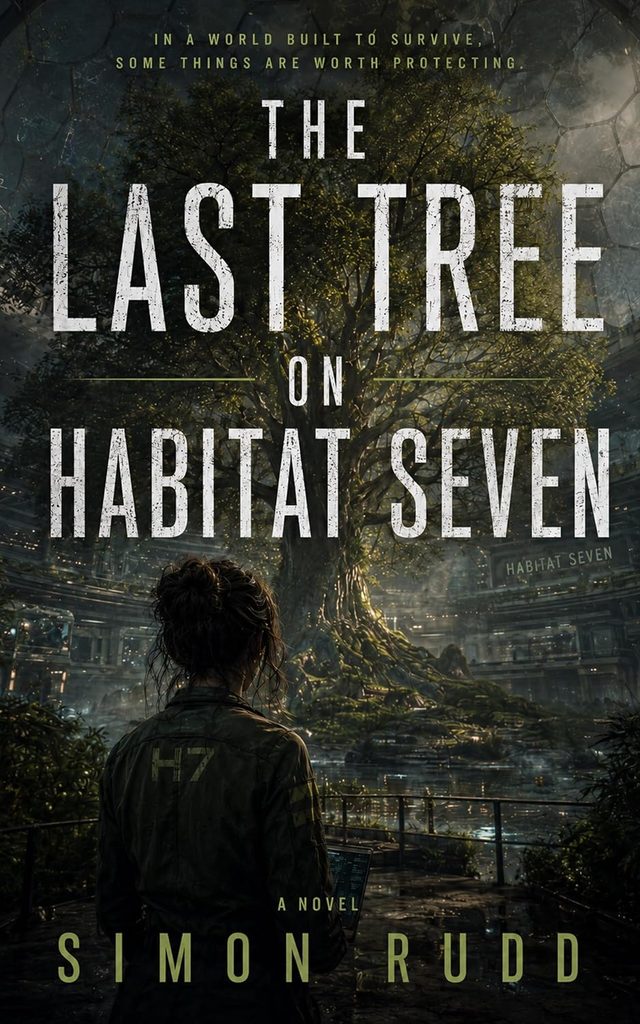
The Last Tree on Habitat Seven
Standalone Novels & Novellas
Nia Bell has just been promoted to junior technician on Habitat Seven, an archive station that keeps whatever failed colonies could save
About the book
Her first assignment is the one nobody wanted: the last surviving tree from Veyr Colony, kept in a damp, half-forgotten ring of old pipes and uneven amber light, where it hasn't done anything in years.
Then its leaves change colour.
Not when anyone touches it, or when the readings say they should. It changes when the room changes: when the old rain pipes sing, when someone greets it properly, when a kitchen apprentice smuggles in soup.
Nia has a careful supervisor who wants proof, a station AI that is trying very hard not to help too much, and a maintenance tech who talks to pipes. She also has a problem. A well-equipped preservation centre wants to move the tree somewhere better, and they may not be wrong.
To keep it, Nia will have to explain something she barely understands herself: that a living thing can belong to a place, and that a place can belong to it.
A warm, quiet science-fiction novel about care, attention and the difference between being kept and being at home. For readers of Becky Chambers and T. J. Klune.
Where this book fits
A standalone novel
Read an extract
Chapter 1 — The Assignment Nobody Wanted
The first light of Scheduled Spring came in three careful increments and one mistake.
Nia Bell noticed the mistake because she was standing under Panel C-17 with a tray of waking moss in both hands, and because Panel C-17 always thought it knew better than the rest of the ceiling.
The central archive gardens warmed by degrees. Not by much — LOAM would have called it a fractional thermal increase within seasonal tolerance, the sort of phrase that made residents nod politely and go back to feeling slightly less cold — but enough for the leaves nearest the west rail to uncurl from their rest-cycle tuck. Ferns loosened. The pollinator docks clicked awake along the far wall. Water moved inside pipes above the broad glass roof, making the low, full sound of rain being considered.
Panel C-17 brightened too quickly. The moss in Nia’s tray shivered. “Don’t,” she said, automatically.
The panel dimmed by half a shade, after a pause that had the particular quality of LOAM deciding whether to admit it had been listening.
“Panel C-17 is operating within Scheduled Spring transition guidelines,” LOAM said from the nearest wall speaker.
Nia looked up at the panel. It gave off the clean, warm-white glow of a machine pretending innocence.
“The shade moss curled.”
“The shade moss is sensitive.”
“It’s called shade moss.”
“Name acknowledged,” LOAM said. “Seasonal optimism remains within approved limits.”
Nia smiled despite herself and shifted the tray against her hip. The moss smelled of loam, mineral water, and the faint peppery green that meant it had survived the rest-cycle without sulking.
She lowered the tray onto Bed Twelve and worked the moss plugs into the waiting pockets of soil. The central gardens were waking around her in the tidy way important places woke. Light moved along labelled rows. Mist drifted from the citrus frames. The beds closest to the visitor path had already been cleaned, their brass-edged archive plaques polished until they looked less like information and more like ceremony.
Scheduled Spring always made the central gardens seem proud of themselves. Nia liked them better before visiting hours, before researchers in clean coats spoke in careful voices about genetic lineage retention while grow-hands like Nia wiped condensation from under the tables so nobody slipped beside a rare pear cultivar.
Not that she was a grow-hand any more. Technically. She pressed the last moss plug into place and rubbed soil from her thumb across the knee of her work trousers, which already carried three older streaks and a smear of nutrient gel. Her new junior technician badge hung from her chest pocket. LOAM had printed it that morning with her name, department, access grade, and a little green stripe that meant horticultural staff.
NIA BELL
JUNIOR HORTICULTURAL TECHNICIAN
ARCHIVE GARDENS / SEASONAL CARE
She had read it four times before leaving her bunk, and once more in the reflection of a steriliser panel, which made the lettering look backwards and somehow less official.
“Nia Bell,” LOAM said.
She looked up too fast and knocked her wrist against the tray. “Yes?”
“Dr Mara Venn has requested your presence in Preservation Office Three after first meal-cycle.”
Nia went still. A bead of water ran from the moss tray onto the toe of her boot. “Did she say why?”
“Dr Venn’s request was marked assignment-related.”
Nia’s hand tightened around the edge of the tray. “Assignment-related good, or assignment-related please-explain-why-you-have—”
“I can infer a sixty-two per cent likelihood that the meeting concerns your first independent junior technician placement.”
Nia’s stomach moved in a way that had nothing to do with breakfast. “Oh.”
“Would a comfort adjustment be helpful?”
“No.”
A vent above her gave a warmer sigh anyway, and went on giving it after she glared at the grille.
Nia tipped the empty tray under one arm and tried not to grin. First independent placement. The words moved through her, bright and alarming. It might be nothing: the kind of task junior technicians got when senior staff needed someone to count root hairs in a cupboard for six light-cycles, or an error in the duty rota, though LOAM made fewer rota errors than people liked to believe and more comfort-related “adjustments” than it admitted. Still. Assignment-related.
She crossed the central gardens towards the wash station, stepping around a maintenance case someone had left open beside the pollinator dock. Haro Fen slid out from under the dock on a low maintenance board, squinted at her badge, and said, “Junior technician now. Station finally noticed you had hands.”
“I think they mostly noticed I kept putting them into root beds without being asked.”
“That’s how they get you.” He pointed a small wrench at her. “One day you fix a leak, next day they give you a badge and expect you to have opinions in rooms.”
Nia left him to his dock repairs and rinsed her hands. Soil always found one place to stay.
First meal-cycle had already begun when she reached the Common Table Hall. It sat between the central gardens and the main work corridors, so everyone passed through it whether they intended to eat or not. The air smelled of warm grain, toasted algae bread, and the savoury mineral broth Hemi Rusk insisted was “spring appropriate” though it tasted exactly like winter broth with a green garnish.
Nia collected grain, algae bread, and leaf tea from the dispenser. The tea arrived too strong, which she suspected was LOAM’s idea of support.
She sat near the humid edge of the hall. Across the room, two Selian archive workers were greeting each other with the long, careful stillness of people who considered arrival something worth doing properly. Nia looked away before she seemed to be staring.
A tray landed opposite her with a clatter. “I’m told congratulations are in order,” Juno Bell said.
Nia swallowed grain too quickly. “Who told you?”
“Your badge told me. Also LOAM. Also Haro, loudly, to three people near the pollinator dock.” Juno leaned over the table, read the badge, and smiled in the wide, unembarrassed way that made Nia want to slide under the table. “Junior technician.”
“It’s just a grade change.”
Juno pointed her spoon. “Do not turn a promotion into compost before you’ve even used it.”
Juno’s expression softened. She had their family’s dark eyes and practical hands, but where Nia folded inward when attention found her, Juno took up space as if someone had assigned it to her and she intended to maintain standards. “You’ll do well.” She went back to her broth before Nia could argue.
Nia looked down at her bowl. The grain had little green flecks in it that tasted of pepper and damp leaf. “What if it’s just something nobody else wanted?”
“Then it probably needs someone who notices why nobody wanted it.”
Nia ate another spoonful to avoid answering.
After meal-cycle, she took the east corridor towards the research offices, where the light panels were newer and less forgiving, and wiped her palms on her trousers outside Preservation Office Three.
Dr Mara Venn’s office did not smell of soil. It smelled of sterilised surfaces and brewed black leaf. Mara kept a small plant on her desk — a narrow-stemmed thing from Kesh Colony — but even that looked as though it had read the filing guidelines and agreed to behave.
Mara stood by the wall display, reviewing seasonal assignments. Her work coat was clean; her tablet case held no crumbs, torn labels, or plant ties.
“Nia,” she said, turning. “Thank you for coming.”
“Of course.” Nia stopped herself adding sorry. Sorry for arriving when requested. Sorry for having feet. Sorry for breathing office air. “LOAM said it was assignment-related.”
“It is.” Mara gestured to the chair opposite her desk. “Sit, please.” Nia sat. Her hands had nowhere sensible to go.
Mara sat too, as if sitting were a professional action she had mastered years ago. “Your transition review was strong.”
Nia blinked. “It was?”
“Your practical assessments were particularly good. Moisture mapping, root stress identification, fungal imbalance. Your supervisor noted that you consistently detect early-stage bed issues before automated alerts.”
“That’s mostly because the alerts wait until things are already annoyed.”
Mara’s mouth moved. Nia realised she had said that aloud. “I mean,” she said quickly, “older beds show stress before the data flags it clearly. Sometimes there’s a smell, or the leaf angle changes, or the tray surface—”
“I know what you mean.” Mara looked at the assignment projection. “There is a seasonal placement I would like you to take.” Nia’s pulse gave one hard knock.
“It is not in the central gardens,” Mara said. “They are well staffed for Scheduled Spring. I need junior coverage elsewhere.” She tapped the projection, and the Veyr Ring appeared at the outer edge of the archive map, glowing amber. “Veyr preservation sector. Climate-fragment archive. Low traffic. One living priority specimen.”
“The Veyr tree.”
“Yes.”
The last tree from Veyr Colony, which had failed before Nia was born. Failed was the word people used when they wanted to make abandonment sound technical. The climate system had collapsed, the colony had been evacuated, and Habitat Seven had received what it could: soil cultures, seed lines, climate records, and one living tree.
For years, the tree had been described the same way: stable, dormant, preserved.
“The current requirement is observation and routine care during Scheduled Spring. The Veyr Ring runs on older climate infrastructure, and its seasonal transition does not align neatly with the central system. LOAM will support monitoring. The tree itself has shown no meaningful change in years.”
“This is independent coverage?” Nia asked.
“Yes. You would be assigned as junior technician lead for the ring’s spring observation period. I will review your logs every third light-cycle. Any anomaly goes through me before action.”
Junior technician lead. Lead. The word opened like a small door and immediately showed her the cupboard behind it.
“Is there a reason it isn’t being covered by senior staff?”
“Resource allocation,” Mara said. “The Veyr tree is valuable, but it is not active research. The Veyr Ring needs someone patient and comfortable with old systems.”
Mara folded her hands on the desk. “This is not punishment, Nia.”
Nia looked up quickly. “I didn’t think it was.”
Mara waited. Nia lasted three seconds. “I mean, I wondered if I had done something wrong, but only briefly.”
“That is different from not thinking it.”
Mara’s expression softened by the smallest practical amount. “You have done nothing wrong. I am giving this to you because you notice things.”
“I’ll do my best.”
“I know. That is why I am being clear.” Mara slid an access tag across the desk. “This is not glamorous work. There may be very little to report. Do not invent significance where there is none.”
“I won’t.”
“But do not ignore irregularities because you assume someone else must already have noticed them.”
Nia’s fingers closed around the tag. Mara held her gaze. “Can you do both?”
Nia nodded. “Yes.” She hoped that was true.
LOAM spoke from the office wall. “Veyr Ring access has been updated for Nia Bell. I have also added a reminder to eat during long observation periods.”
Mara sent the assignment packet to Nia’s tablet. “Begin today. Initial environmental walk-through, specimen status confirmation, root and bark monitor calibration, climate panel review. No interventions beyond routine care unless approved.”
“Yes, Dr Venn.”
The route took her past the central gardens, through a service crossway, and down towards the older outer sectors where the habitat’s bones showed more openly. Here, Scheduled Spring was less elegant. Light panels warmed unevenly. Pipes ticked behind wall covers. A maintenance drone sat in a corner with a handwritten note: DO NOT TRUST IT WITH SMALL SCREWS.
Nia relaxed. Someone had wedged a folded cloth under a rattling panel rather than submit the third repair request.
Further along, a narrow viewport showed a slice of outside: the banded brown-gold curve of the gas giant Habitat Seven had circled for longer than anyone aboard had been alive. Nia had stopped noticing it years ago. Visitors never did. Beneath it, the bulkhead stencil read ARCHIVE HABITAT 7 — FOR WHAT FAILED COLONIES COULD SAVE, and a newer plate said RESIDENTS c. 4,000. Most were human. Where the corridor ran humid, a Selian archivist lingered, throat colour bright with damp; outside one lab, a Mekhet threshold strip, laid for the handful aboard, asked arrivals to pause.
LOAM lit the route ahead in soft amber strips. “You don’t need to guide me,” Nia said. “I grew up here.”
“You grew up primarily in residential and garden-adjacent sectors.”
“I fell asleep in a laundry cart in this corridor when I was six.”
“Unofficially noted.”
The corridor curved. The temperature changed before the door came into view, the air thickening with damp, and the wall panels shifted from clean white to aged cream, then to a muted amber that made Nia’s skin look warmer than it was.
A sign on the wall read:
VEYR CLIMATE-PRESERVATION RING
RESTRICTED ECOLOGICAL ARCHIVE
ACTIVE SPECIMEN — LOW INTERVENTION
Below it, an older plaque had been fitted badly beneath the newer one, its lettering faded until only parts remained:
VEY— COLONY
LIVING CLIMATE FRAG—
HANDLE WITH—
The rest had been worn smooth by time, cleaning cloths, or hands.
Nia stopped at the door. It was only a door, and this was a low-priority assignment of routine care. The access tag warmed against her palm.
“Door seal is functional,” LOAM said. “Humidity differential is within historical range. Internal floor conditions are acceptable. Root monitor two requires calibration. Bark temperature strip three reports intermittent drop-out. Rain lattice is inactive pending seasonal review.”
Nia put the tag to the reader. “You’re nervous.”
“I do not experience nervousness.”
“You’re listing.”
“Listing is a valid preparatory function.”
The door opened with a soft complaint. The smell reached her first. Soil held too long in the same memory. Bark. Mineral water. Old metal warmed and cooled through hundreds of light-cycles. The air touched her face like a cloth left in rain and wrung out imperfectly.
Nia stepped inside. The Veyr Ring was dimmer than she expected. Amber panels ran along the curved ceiling, several holding their light a fraction late. Pipes looped overhead, insulation patched in three different materials. The rain lattice spread across the ceiling like a fine metal web.
At the centre of the first chamber stood the tree. Nia had seen images of it in archive records, flat and properly lit, labelled with scale bars. They had not prepared her for how alone it looked.
It was not large. Taller than Nia, but not by much. Its trunk rose from a bed of dark Veyr soil behind low monitoring glass, bark black-brown with a silver cast where the amber light touched it. Fine ridges gathered near the roots, like veins under old skin. The canopy was sparse. Leaves hung in small clusters, dull green-grey, some curled at the edges. Not dead. Not thriving. Holding.
Stable, Nia thought. Then disliked herself for it.
“Hello,” she said before she could decide whether speaking to a dormant archive tree counted as unprofessional. Her voice came back softly from the curved walls.
Nia set her tool roll on the repurposed storage-case bench near the monitoring panel. The bench had been worn smooth along one edge. Someone had sat there often once, or many someones had sat there briefly for years. She began with the air.
Nia had always trusted smell before numbers, though she trusted numbers too. Numbers were just sometimes late. The Veyr Ring smelled uneven. Damp near the old rain feed. Slightly stale along the west curve, where airflow probably pooled. The sweet rot came from a forgotten leaf mass behind Climate Column Two; she removed it with forceps, logged it, and sealed it into a compost pouch. The soil beneath the tree smelled mineral-heavy, older than the standard grow beds, with a faint fungal note that was not necessarily harmful.
Through the monitoring glass the visible roots showed no softening and no new cracking. Root pressure read low but not alarming. She tapped the side of Root Monitor Two. It flickered.
“Root Monitor Two has a known response delay,” LOAM said.
“It has a loose contact.”
“The distinction is operationally minor.”
“It is emotionally significant to the monitor.”
LOAM paused. “I have logged your concern under equipment humour.”
Nia knelt to open the panel. The screws resisted, then gave with the sudden petulance of old fittings. Inside, the contact strip was indeed loose. She reseated it, cleaned the connector, and waited while the monitor restarted. The reading steadied.
She moved to the bark temperature strip. Strip Three had curled away from the trunk, adhesive failing in the damp, which matched the drop-outs. She logged it for replacement, pending review.
The tree remained still. As she worked, Nia found herself lowering her movements. The central gardens made people tidy. The Veyr Ring made people quieter.
She completed the first walk-through slowly. The climate columns hummed in uneven intervals. The rain lattice had mineral bloom near the east feed. A cupboard contained outdated root probes, three cloths folded with unexpected neatness, and a handwritten note on a packet of sealant: STILL GOOD IF YOU SHAKE IT AND BELIEVE.
By mid-cycle, her tablet had filled with small observations, none of them dramatic. She ate a nutrient pack only because LOAM dimmed the panel and displayed: MID-CYCLE FOOD SUPPORT ADVISED. It tasted of mushroom broth thickened into paste and optimism that had not survived processing. Then she looked at the tree.
The Veyr tree stood in its old soil, leaves dull under amber light. It gave no opinion.
“Sorry,” Nia said.
LOAM’s speaker clicked softly. “Clarify?”
“I wasn’t talking to you.” Nia sat on the bench and leaned back against the wall, which was warmer than she expected. “I was talking to the tree.”
“Noted.”
The amber panel above the tree gave a faint flicker. Panel lag; she would add it to the environmental notes.
She looked back at the tree. “It’s only,” she said, and stopped.
Nia let out a breath. “It’s only that I know what it’s like when people say stable and mean they don’t have to look closely any more.”
The tree did nothing. Nia found she had been waiting for it to.
She stood quickly and brushed crumbs from her trousers. “Right. Bark strip.”
Back at the monitoring panel, she gave Strip Three a temporary fix until Mara approved full replacement: she warmed the edge with a hand tool, smoothed the failed section, and held it in place while the seal reset.
The bark beneath her fingers, through the strip’s protective edge, held a coolness that surprised her. Not cold. Deeply shaded. Like water stored below floor level. Nia did not speak. The strip settled, the reading steadied, and she withdrew her hand.
One leaf near the lower branch shifted colour. It was so slight that at first her mind refused to keep it.
A wash of warmth passed through the dull green-grey, softer than bloom: a thread of yellow-green moving from the leaf stem outward, then stilling before it reached the edge.
Nia froze. The Veyr Ring hummed, a pipe ticked above her, and on the panel no alert appeared.
Nia leaned closer and immediately told herself not to be ridiculous. Light-angle change. Panel flicker. Her own shadow. Bark strip calibration affecting the readout, though the leaf was not part of the readout and that made no sense. Maybe the colour had always been there and she had only just noticed. Maybe—
The colour faded, not completely, but enough to make her doubt it had happened.
“LOAM,” she said.
“Yes, Nia Bell?”
“Did you record a pigment shift in the lower east leaf cluster?”
A pause — a real one, not a social pause. “No confirmed pigment event registered.”
Confirmed. Nia stared at the leaf. “What about unconfirmed?”
“Visual monitoring coverage is incomplete. Lower east cluster is partially obscured from Camera Two. Camera Three has condensation interference. Leaf-level pigment analysis is not active outside formal scan intervals.”
“Can you run one?”
“Formal pigment scan outside scheduled interval requires senior approval unless deterioration is suspected.”
“I’m not saying deterioration.”
“What are you saying?”
Nia opened her mouth. The correct words lined up in front of her, then rearranged themselves into safer ones.
“I’m saying there may have been a minor colour variation.”
LOAM asked for an environmental cause, a mechanical cause, a biological cause. Unknown, she told it, three times.
“Observation confidence?”
Nia looked at the leaf until her eyes watered. The colour sat there and did not sit there. A possible warmth. A possible nothing. A thing small enough for embarrassment to kill.
“Low,” she said.
LOAM did not answer immediately. Then: “You may enter a manual note.”
Nia laughed once, under her breath. “Generous.”
She opened the log. Her fingers hovered over the tablet.
Initial specimen walk-through completed. Root Monitor Two contact reseated. Bark Strip Three temporarily stabilised. Minor leaf colour variation observed in lower east cluster following bark strip contact/reset.
She paused. Observed sounded too confident. She inserted possible.
Possible minor leaf colour variation observed in lower east cluster following bark strip contact/reset.
Then she stared at possible until the word looked cowardly. She deleted it.
Minor leaf colour variation observed in lower east cluster following bark strip contact/reset.
Her thumb hovered over submit. “That implies certainty,” she said. LOAM, to its credit, did not pretend not to know what she meant.
“Observation logs may be revised as evidence develops.”
“That is not as comforting as you think.”
Nia put possible back.
Possible minor leaf colour variation observed in lower east cluster following bark strip contact/reset.
She submitted the note before she could change it again. The tree said nothing, which was easy enough, because trees usually did.
Nia packed her tools more carefully than necessary. She checked Root Monitor Two again, and the bark strip. She took three photographs of the leaves, each slightly useless in a different way.
At the door, she turned back. “Good rest-cycle,” she said, then felt foolish because the tree had not asked for one and it was not rest-cycle yet.
The lower east leaf did not change. Probably.
Nia stepped into the corridor. The door sealed behind her with the soft, tired sigh of an old system doing its best. She walked back under LOAM’s amber route lights with her tool roll knocking softly against her hip, and after a moment LOAM said, “Nia Bell. Would you like me to improve visual monitoring coverage of the lower east leaf cluster?”
Nia slowed. “That would require approval, wouldn’t it?”
“For formal monitoring, yes.”
“And informally?”
“I can adjust condensation clearing around Camera Three as part of routine lens maintenance.”
Nia smiled down at the floor. “That seems sensible.”
“Routine,” LOAM said.
The lights warmed by half a shade ahead of her. Behind her, the Veyr Ring held its damp amber quiet, its old rain pipes, its failing monitors, its last tree from a colony people spoke of in careful past tense.
Nia looked once at her submitted log. Possible minor leaf colour variation.
Then, because she was alone in the corridor and no one could see her do it, she opened the note again.
She deleted possible.