Dark science fiction · Time-travel novella
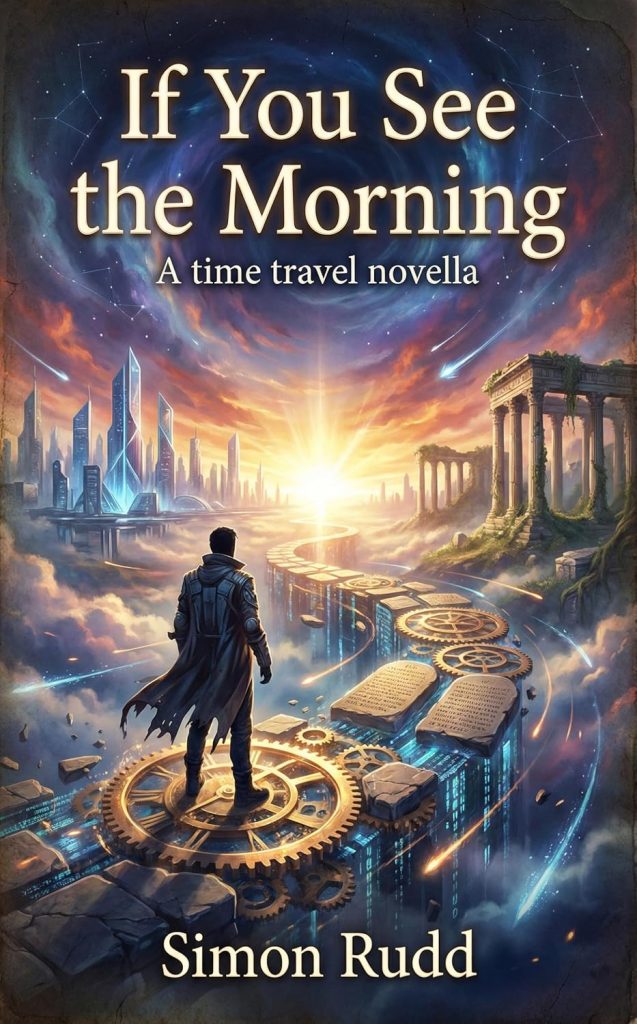
If You See the Morning
Standalone Novels & Novellas
Stop looking for the sun, Leo. If you see the morning, you lose the day.
About the book
Leo Vance is twenty, a little drunk, and walking home through the rain in South London when he stops to help a dying old man slumped by a storm drain. The stranger grips his wrist, whispers a warning that makes no sense, and crumbles into ash, leaving behind a cracked grey band that will not come off.
The next time the light finds Leo, he loses ten minutes. Then ten weeks. Then ten years.
Every dawn, every headlight, every switch flicked on after the dark throws him further forward, while the people he loves age, grieve and move on without him. His mother’s messages pile up unanswered. His sister keeps putting up posters. And the jumps are getting longer.
From a blind woman who teaches him to hear his way through the tunnels beneath a changed London, to a tower of glass where the last post-human intelligence wants to read him like a hard drive, to a green world where a luminous stranger weaves him a song, Leo is carried across centuries and then millions of years towards the end of everything. Every kindness he finds costs something. And the band is keeping its own count.
If You See the Morning is a dark, emotional science fiction novella about grief, memory and the choices we cannot take back. It’s for readers who like their time travel heartbreaking, their futures strange, and their endings earned.
Where this book fits
A standalone novella
Read an extract
Chapter 1 - The Zero Hour
The neon sign above the kebab shop flickered with a sickly violet hue, casting shifting shadows across the wet pavement. Leo felt the world tilting—not unpleasantly, just a slow, alcoholic roll that made the streetlights blur into soft halos of amber and the rain sound like static.
“Right then,” he muttered to no one, steadying himself against the cold brick wall. His fingers found the rough texture of old mortar, grounding him for a moment. “Home. Definitely going home.”
He’d only meant to stay for one pint. Maybe two. It was Tuesday, after all—or was it Wednesday? The distinction seemed unimportant now, lost somewhere in the pleasant fog between his third and fourth drink. His head would give him grief in the morning, but that was morning’s problem. Tonight, Leo Vance was twenty years old, gloriously drunk, and invincible.
The street was nearly empty. A police siren wailed somewhere in the distance, dopplering into silence. A night bus rumbled past, windows full of tired faces lit by phone screens, an advert along its side for some new earpiece that promised you’d never need to look at a screen again. Leo watched it go, thinking vaguely about catching it, then decided the walk would sober him up. His mum always said fresh air did wonders. He set off, humming something he’d heard in the pub, badly.
That’s when he saw the heap.
At first, Leo thought it was just rubbish—a pile of bin bags someone had dumped by the storm drain. The council was always on about illegal dumping. But then he heard it: a wet, rattling wheeze, like air being pulled through a collapsed straw.
“Christ,” Leo breathed.
He stumbled forward, his vision sharpening with sudden adrenaline. It wasn’t rubbish. It was a person—an old man, slumped in a twisted heap against the grating. His clothes were rags, layers upon layers of what might have once been a coat, now just strips of stained fabric held together by filth and time. His beard was a matted thicket of grey, streaked with something darker. His skin had the colour and texture of old parchment left too long in the rain.
“Oi, mate?” Leo dropped to one knee, immediately feeling the cold wetness seep through his jeans. “You alright?”
The man was clearly not alright. His chest rose and fell in irregular, painful-looking spasms. One of his hands was clutched to his ribs, the other splayed out on the pavement, fingers twitching.
“Let’s get you up, yeah?” Leo reached for the man’s arm, trying to find purchase that wasn’t just bone and wet fabric. “We’ll get you sorted. There’s a hospital not far—”
As Leo’s fingers closed around the man’s wrist, something snapped. Not a bone breaking—sharper than that, a sound like a heavy stapler firing into wood, mechanical and precise. Leo felt it more than heard it: a sudden release of tension, like a wire cutting loose.
The thing around the old man’s wrist moved. Leo had barely registered it before—a cracked grey band sunk into the mottled skin. But now it was sliding, flowing like something alive, darkening and constricting as it went. It wrapped around Leo’s wrist with a heat that was immediately, searingly alien. A heat that seemed to reach through his flesh and grip his bones.
“What the—”
Leo snatched his hand back.
The old man’s eyes snapped open.
They didn’t match. The right was bloodshot and yellowed, the white threaded with broken vessels. The left was pale and bright and far too clear, catching more of the neon than an eye should. There was something in them—a terrible intensity, as if the old man were trying to communicate something vast and urgent in the space of a heartbeat.
The old man lunged. His bony fingers—impossibly strong—grabbed Leo’s jacket and pulled him down until their faces were inches apart. The smell hit Leo like a physical blow: ozone and ancient dust, the metallic tang of old copper, and underneath it all, something organic and rotten, like soil from a grave.
“The lights!” The old man’s voice was a dry rasp, the sound of wind through dead trees. His breath was cold. “Stop looking for the sun, Leo! If you see the morning, you lose the day!”
Leo tried to pull back, but the grip was iron. “How do you—how do you know my name?”
But the old man wasn’t listening. His eyes had gone distant, looking past Leo at something Leo couldn’t see. His cracked lips moved, forming words without sound. His grip tightened for one more desperate second, and Leo could feel the trembling in those ancient fingers, could see something like grief—or pity—flicker across that ravaged face. Then, as if he had decided something, he let go.
Headlights swept across them.
A car—just a taxi, looking for a late-night fare—turned the corner. Its full beam cut through the rain, painting the street in harsh white light that hit Leo full in the face, blinding him, and the band on his wrist grew unbearably hot.
Leo squeezed his eyes shut against the glare—and when he opened them, everything was wrong.
The taxi was gone, as if it had never been there. The old man was gone. Leo was still kneeling on the pavement, but now he was alone, his hand extended towards nothing.
“What—”
Where the old man had been, there was only a small pile of grey ash, already being washed away by the rain, trickling towards the storm drain in dark rivulets. The pile was oddly uniform, too fine to be ordinary ash, with a faint smell of ozone rising from it.
Leo scrambled backwards, his trainers slipping on the wet pavement. His heart was hammering—two beats a second—loud enough to drown out the rain. He looked around wildly. The street was empty. The kebab shop’s neon sign still flickered its sickly violet, but the light seemed dimmer somehow, or the shadows deeper.
He pulled out his phone with shaking hands. 2:25 AM. That couldn’t be right. When he’d left the pub, it had been just past two. He’d walked maybe five minutes, found the old man, spent two or three minutes trying to help. It should be 2:10, 2:15 at the latest. He refreshed the screen. 2:25 AM. The numbers didn’t change.
Leo looked at his wrist. The band sat there, dark and inert, as if it had always been part of him. In the violet light, it seemed to pulse with its own internal rhythm, though that might have just been the blood rushing in his ears.
Stop looking for the sun, Leo.
“Oh, Christ,” he whispered. His voice sounded very small.
He stood on shaking legs, nearly slipping again. The ash was almost gone now, just a dark smear on the wet pavement. In a few more seconds, the rain would erase even that.
If you see the morning, you lose the day.
Leo started walking, then jogging, then nearly running through the empty streets. His building was close—had to be close—though the streets seemed subtly rearranged, the furniture shifted a few inches. He kept looking at the band, expecting it to do something—tighten, burn, anything. But it just sat there, a strip of dark leather against his pale skin, innocent as a watch strap.
His building was one of those converted Victorian terraces, divided into flats that were too small and too expensive. Leo fumbled with his keys, his hands still shaking, finally getting the door open. He took the stairs two at a time to the second floor—a studio with a kitchenette and a bathroom the size of a broom cupboard. Home.
He locked the door behind him, throwing both the deadbolt and the chain. As if locks could keep out whatever had just happened.
The flat was dark. Leo didn’t turn on the lights. He went straight to the sink, running cold water over his wrist, trying to work his fingers under the band’s edge. Nothing. It was sealed to him, grown into him. He grabbed the washing-up liquid, slicking his hand, trying to slide it off. The leather didn’t even shift.
“Come on, come on, come on—”
He yanked hard enough to bruise, but all he accomplished was making his wrist throb. The band sat there, maddeningly still, its dark surface reflecting nothing. Leo gave up. He slumped against the counter, staring at his reflection in the window above the sink. A twenty-year-old kid looked back at him, beard scruffy, hair plastered to his forehead with rain, eyes too wide. On his wrist: a leather band that shouldn’t be there.
How did he know my name?
The old man’s voice echoed in his memory. The intensity of those mismatched eyes. The way his fingers had trembled with desperate urgency.
If you see the morning, you lose the day.
What did that even mean? It was—he checked his phone again, hoping the numbers would be different—2:33 AM. Morning was hours away. He had time. Time to figure this out, time to—
Across the back yards, a neighbour’s security light snapped on—a hard white glare straight through the window above the sink, full in his face.
The world lurched again. The same freefall as before, that stomach-drop feeling of missing a step in the dark. His vision blurred at the edges, and for just a moment, everything seemed to be moving very, very fast while he stood perfectly still.
Then it stopped. Leo was still in his flat, still standing at the sink. But now his phone read 2:43 AM. Another ten minutes, gone in a blink.
“No,” he whispered. “No, no, no—”
He grabbed the band, trying to pry it loose with both hands, his fingers slipping on the leather. It didn’t budge. It might as well have been part of his skeleton. Leo backed away from the sink until his shoulders hit the wall. He slid down to sit on the floor, knees pulled up to his chest, and stared at the leather band in the dim light filtering through his window.
He tried to think. Ten minutes gone on the street. Ten minutes gone in his flat. Both times after light—the taxi’s headlights, the security light through the window. And the window on the far wall, the one that faced east. The window where, in a few hours, the first light of morning would come creeping across the London skyline.
Stop looking for the sun.
Leo looked around his flat with new eyes. The windows. The overhead light. The lamp by his bed. Every source of illumination suddenly seemed dangerous.
He pulled the curtains shut—all of them, every window, even though his flat only had three. He checked the seal at the bottom of the door, where light from the hallway might seep through. Then he sat back down on the floor, in the darkest corner of his flat, and pulled his knees tight against his chest.
The band sat quiet on his wrist, patient as stone.
On the street below, a car drove past, its headlights briefly illuminating the edges of his curtains. Leo flinched, squeezing his eyes shut, his whole body tensing for that sickening lurch—but nothing happened. The darkness held. The moment passed. He opened his eyes. Still 2:43 AM.
So not all light, then. Direct light. The sun.
Leo sat in his dark flat and watched the shadows, terrified of the moment when black would turn to grey, and grey would turn to gold, and the first ray of morning would find its way through some gap in his curtains that he hadn’t noticed, some crack in his defences that would steal another ten minutes, or ten hours, or worse.
So he waited, and the leather band waited with him, warm against his skin.
Two beats a second. Sixty minutes an hour. Two and a half hours until sunrise.
He pulled his jacket tighter and tried not to think about the pile of ash on the pavement, already washed away by the rain, already forgotten by the city. Tried not to think about the old man’s eyes, that last look of pity as cracked lips mouthed unheard words.
He didn’t understand that look. Not yet.