Undersea fantasy · Conspiracy
The Archivist of the Abyss
Standalone Novels & Novellas
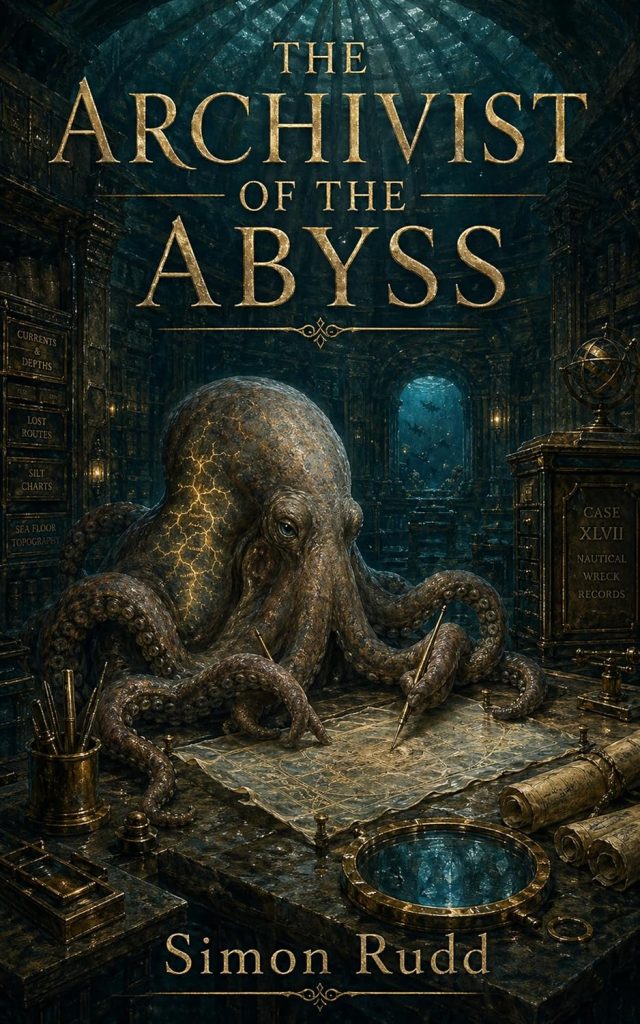
The truth was hidden in his skin. The institution that trained him put it there.
About the book
Barnaby is a junior archivist in the Great Submerged Library — a cephalopod devoted to the preservation of records, meticulous in his work, content in his solitude. Then his body begins producing marks he cannot control. Routes appear beneath his skin. Maps of corridors that no official chart acknowledges. Evidence of ships that the historical record says never existed.
When a surface cartographer named Mira arrives with three years of research pointing to the same erasure, Barnaby is drawn into an investigation that reaches far beyond a single hidden route. Below the ocean floor lies a network of engineered currents, prison hulks, and silenced testimony — the infrastructure of a conspiracy that did not merely conceal a crime but built it into the foundations of a peace treaty the world has trusted for fifty years.
The deeper Barnaby digs, the more his body reveals. And the more it reveals, the closer he comes to a truth that will shatter his understanding of who he is: he is not merely carrying the evidence. He was designed to carry it. His entire life has been a managed archive, curated by the institution he serves.
Now Barnaby faces an impossible choice. The truth could bring justice to two hundred forgotten names. It could also destroy the fragile peace that millions depend on. And the people who buried the secret have no intention of letting a junior archivist and his involuntary skin decide the fate of nations.
For readers of Piranesi, The City & the City, and The Traitor Baru Cormorant.
Where this book fits
A standalone novel
Read an extract
Chapter 1 - The Fading Record
The wreck-record was dying in the usual way: edges first, then inward.
Barnaby held the membrane flat with three arms and traced what remained with his fourth. The salvage vault’s light fell at a shallow angle across his work table, blue-green and cold, filtered through the ceiling ribs until it arrived with just enough strength to show damage without worsening it. He preferred that angle. Direct light burned fading pigment faster than carelessness did.
The record had come up that morning from the outer kelp channels. A merchant brig, thirty-seven years sunk, its legal skin-script already soft at the borders where copper salts had eaten into the colour bands. A diagonal tear crossed the lower quadrant – hook damage, probably, from a shard of hull catching it on the way to the surface. The salvage team had packaged it correctly, at least. Wet cloth, sealed case, no folding. Barnaby had seen worse arrive in better packaging and better records arrive ruined by clumsy hands.
He worked upper left to lower right. That was the approved order. It also happened to be the order that reduced transcription error when his eyes began to tire, which they would, because he had been at the table since second bell and the filtration hum in the walls had already begun to sound like his own breathing.
Registry sigil. Cargo exemption code. Two taxation waivers, one partially overwritten by mineral deposit. A witness seal he could read only in relief, pressing the membrane gently until the indent showed against the flat light.
He transferred each mark to the preservation sheet with the same even pressure he had been taught six years earlier, when he was still new enough to the work that his stylus shook. It did not shake now. His hand moved with the patience of someone who understood that the record would not wait for him to feel ready, and that readiness was, in any case, a luxury the dying did not offer.
Two tables away, Senior Preserver Itham turned a cracked treaty skin with small bone clamps that clicked against the stone slab beneath it. The sound was rhythmic and familiar. No one spoke. Speech disturbed the shape of work, and the salvage vault respected that unwritten rule with the solemnity of a place that understood itself to be sacred.
Barnaby liked the quiet. He had always liked it. Some of the other junior preservers treated vault shifts as dull rotations to be endured between more visible assignments. Barnaby treated them as the point.
Here, history had not yet admitted defeat. Here, a fading mark could still be coaxed into legibility if your hand was steady and your eye was trained and you did not rush. Rushing was the enemy. Rushing and direct light and the impatience that mistook speed for competence.
He reached the lower band of the record and felt the first resistance.
Not in the membrane. In the catalogue tag fastened to its edge.
He stopped.
The tag was sound vellum, surface-made and lacquered against water damage. Salvage number, recovery zone, date of extraction, routing stamp. All ordinary. But the routing stamp had been struck twice. Not over itself, the way it looked when a careless clerk repeated a motion, but beside itself by half a nail’s width. The newer impression sat darker against the vellum. The older one had not quite disappeared beneath it.
Barnaby lowered his head until one eye was close enough to see the grain of the lacquer.
Two stamps. Two different dates, weeks apart, pressed by the same seal but assigned to different processing channels. One would have routed the record through standard municipal review. The other directed it into a diplomatic holding annex, a category Barnaby had encountered only twice in six years, both times on materials far more sensitive than merchant shipping records.
He raised his head.
Itham had not looked up. The vault hummed. The water moved behind the walls with its distant cloth-sound.
Barnaby returned to the membrane.
He had nearly finished the lower band when something happened beneath his own skin.
It began on his left flank, just below the harness strap where his hide was thinner and more responsive to temperature shifts. A warmth first. Then a tightening, as though a muscle he could not name had contracted without his permission. Then – colour.
He looked down.
A line had appeared under his skin. Surface chromatophore shifts were ordinary and controllable; this was deeper, in the layer where pattern changes came slower and meant more. The line was faint. It curved once, branched, and faded before he could follow it to an end.
It looked like a coastline.
No. It looked like a route.
Barnaby set down the stylus. His other arms kept the membrane flat by reflex while the rest of him went very still.
The line held for three seconds, four, five. Then it softened and sank back into the ordinary mottled brightness of his skin, leaving behind nothing visible and a sensation he could not quite name. It was neither pain nor pleasure, only the discomfort of a body doing something it had not been asked to do.
He waited.
Nothing else came.
After a full minute of silence and stillness, Barnaby picked up the stylus and finished the transcription. His hand did not shake. He noted this with the same care he gave everything, and filed it alongside the observation that his left flank still felt warm, and that the warmth had a shape, and that the shape had looked, for a few seconds, like something he should have been able to read.
* * *
He sealed his tools, logged the completion in the vault register, and walked into the corridor.
The Library at mid-shift had a sound that Barnaby knew as well as his own breathing. The low hum of the pressure-stabilisation system in the outer walls. The click of harness clasps from archivists moving between levels. Somewhere above him, the muffled percussion of a classification stamp being applied to processed material – a steady, rhythmic beat that meant someone on Level Four was working through a backlog. From the commissary corridor, the smell of heated broth and the mineral-sweet scent of pressed kelp rations, and with it the murmur of voices – colleagues eating together between shifts, discussing vault assignments and harness maintenance and the small administrative complaints that constituted normal working life.
The Library kept two elements. Below the waterline, the vaults, the stacks and the long working corridors were sea, tempered and filtered and held still for the sake of the records. Above it, the commissary, the dormer galleries and the surface-access floors kept air, and the staff passed between the two through wet locks without thinking about it, the way surface people climbed stairs. Records were made of membrane and skin, which the water preserved. Paper belonged to the dry floors and to the surface, and most archivists treated it with the mild suspicion they reserved for anything that dissolved.
Barnaby rarely stopped at the commissary. He ate at his niche, alone, which his colleagues attributed to dedication and which was, in truth, the preference of a person who found sustained social contact more tiring than a double vault shift. He had been this way since his apprenticeship. Thalor had once described it, with characteristic gentleness, as “a productive introversion.” Barnaby had filed the description alongside the other things Thalor said that were both kind and slightly wrong.
He passed two junior preservers comparing harness modifications outside the binding workshop. One of them – Oris, a small-bodied archivist with meticulous membrane work and an unfortunate tendency to narrate his own technical decisions – raised a hand in greeting. Barnaby returned it and kept walking.
He stopped at the commissary after all, for the kelp broth rather than the company. It was hot and slightly too salty, and he drank it standing at the far end of the counter where the light was worst and the traffic was lightest. A senior classifier whose name he could never remember nodded at him from three places down. Barnaby nodded back. The broth was good. The quiet was good. The feeling of doing a small ordinary thing in the correct ordinary way was, at this particular moment, the most comforting sensation available to him.
He finished the broth, returned the cup, and kept walking.
The reflection basin stood in a side alcove off the main vault corridor, screened by a curtain of woven kelp fibre that had gone stiff with mineral deposits and no longer hung straight. Barnaby pushed through it and let it swing shut behind him.
The basin was shallow, brass-rimmed, filled with still water kept clear by a drip filter in the ceiling. Its purpose was utilitarian – preservers used it to check for contamination on their hands or tools after handling damaged records. No one used it for vanity. The light here was worse than in the vault, a single glow-lamp mounted too high and angled too far left, which meant that anything reflected in the water came back slightly distorted and yellow at the edges.
Barnaby leaned over the basin and looked at his left side.
Nothing. His skin showed its usual layered colour, brighter than most archivists his age, more intricate in its banding. Senior staff had remarked on it when he first took formal duties. Unusual patterning, they had said. Decorative, one of them had added, in a tone that made the word sound like a minor professional liability.
He shifted, angling his flank towards the lamp.
Still nothing. The warmth had faded. The shape was gone. He was looking at ordinary skin doing ordinary things under bad light, and the rational conclusion was that he had experienced a minor chromatophore spasm brought on by fatigue, cold water exposure, or the chemical residue that old copper-salt records sometimes left on the hands of people who handled them without full membrane gloves.
He did not wear full membrane gloves. Almost no one at his level did. The gloves reduced tactile sensitivity, which reduced accuracy, which reduced the quality of the transcription. Senior Preserver Itham had once said that gloves were for clerks, and that preservers who needed them were admitting they could not feel the difference between living pigment and dead stain.
It was truer than the surface scholars ever believed. Living pigment tasted of salt and something faintly green, like kelp early in the season; dead stain tasted of nothing at all. Every sucker on a preserver’s arm read as well as held. A gloved preserver read half blind.
Barnaby had taken this to heart. He now wondered, briefly, whether taking it to heart had been a mistake.
He was about to straighten up when the line came back.
Fainter this time, but steadier. It rose through the deeper layer of his skin with the slow deliberation of something surfacing rather than something firing. The curve was the same. The branch point was the same. But now, in the basin’s still water, under the yellow-shifted light, he could see more of it, an extension past the first branch, a second fork, and at the terminus of the longer arm, a small dense cluster of marks that looked, from this angle and in this light, like notation.
His reflection stared back at him: a large octopus bending over a brass basin in a dim alcove, lit from beneath by a pattern that should not have existed.
Barnaby made himself count what he saw.
One primary line, curving southeast to northwest if the orientation matched standard maritime charting, which it might not, because the orientation was based on his own body and his body was not a chart. Two branches. The cluster at the terminus was too small to read without magnification, but its density suggested compressed information rather than decoration. The whole thing covered an area roughly the size of his open hand.
And it was, unmistakably, a route.
He had spent six years reading records. He knew what a route looked like.
The line held for perhaps ten seconds, then dimmed. The cluster at the end went last, contracting to a point before it vanished.
Barnaby straightened up.
The basin reflected only his face, his arms, the underside of a glow-lamp that needed replacing.
He reached inside his harness and found, by touch, the scrap of notation paper he kept there for stray observations. He wrote nothing on it. He held it for a moment, then put it back.
* * *
The main corridor of the Great Submerged Library ran north-south through the heart of the building for a distance that Barnaby had once measured, out of professional curiosity, at four hundred and eleven body-lengths. He had measured it on a rest day and had told no one, because measuring the corridor was not precisely forbidden and not precisely encouraged, and because the answer had satisfied a private question he preferred not to explain.
The corridor was beautiful.
He thought this without embarrassment. The stone had been cut from deep volcanic shelves and fitted without visible mortar, its surfaces polished to a dull warmth that caught the filtered light and held it in long, soft bands along the walls. Overhead, the vaulted ceiling carried the weight of the ocean above with the calm of a structure that had forgotten how to be impressed by pressure. Brass fittings marked the junctions where side passages opened into reading halls, classification floors, binding chambers, and the older sections that predated the current administrative generation by decades or centuries, depending on which dating system one trusted.
Barnaby moved through it now with the rest of the afternoon shift, keeping pace with the current of archivists and attendants flowing towards the inner sections. He carried his transcription case under one arm and his harness tools in their proper pouches and his face arranged in the expression of mild professional focus that was, in this corridor, the closest thing to invisibility.
A pair of senior archivists paused ahead of him to allow a custodial litter through. Barnaby stopped with the others and lowered his gaze, as protocol required when ranked staff were present.
His left flank tightened.
It was not a flare. He told himself that immediately. No colour, no line, no route. Only the muscle memory of one. A ghost-contraction in the deeper skin, the body remembering a shape it had recently held and checking, perhaps, whether it was expected to hold it again.
He kept his gaze down. The litter passed. Movement resumed.
At the junction where the corridor split towards the preservation dormers, Barnaby turned left and let the main current carry on without him. The side passage was narrower, cooler, less polished. The stone here had been left with its original texture, and the brass fittings were older and green at the edges where salt had worked into the alloy over years of indifferent maintenance.
He passed two colleagues without speaking. One nodded. The other was reading a classification tablet and did not look up.
Barnaby reached his work niche, a small alcove off the dormer corridor, assigned to him because he was junior enough to warrant one and quiet enough not to have complained about its size. He entered, fastened the door screen, and stood in the dark.
The rational options were these: report the anomaly to the duty supervisor, who would log it as a physiological irregularity and refer him to the medical examiner. Request a contamination check on the merchant brig record, which would explain the incident as chemical exposure and end the matter with a notation in his file. Or say nothing, observe, and wait to see whether the pattern recurred.
The first option was correct. The second was plausible. The third was the one he had already chosen, standing at the reflection basin with a route drawn under his skin in a language he did not recognise, holding a blank scrap of paper he had not written on.
He unfastened his harness, hung it on the wall hook, and sat in the dark for a while, feeling the place on his left side where the warmth had been.
The record, for now, was his.