Cosy Fantasy · Ghosts
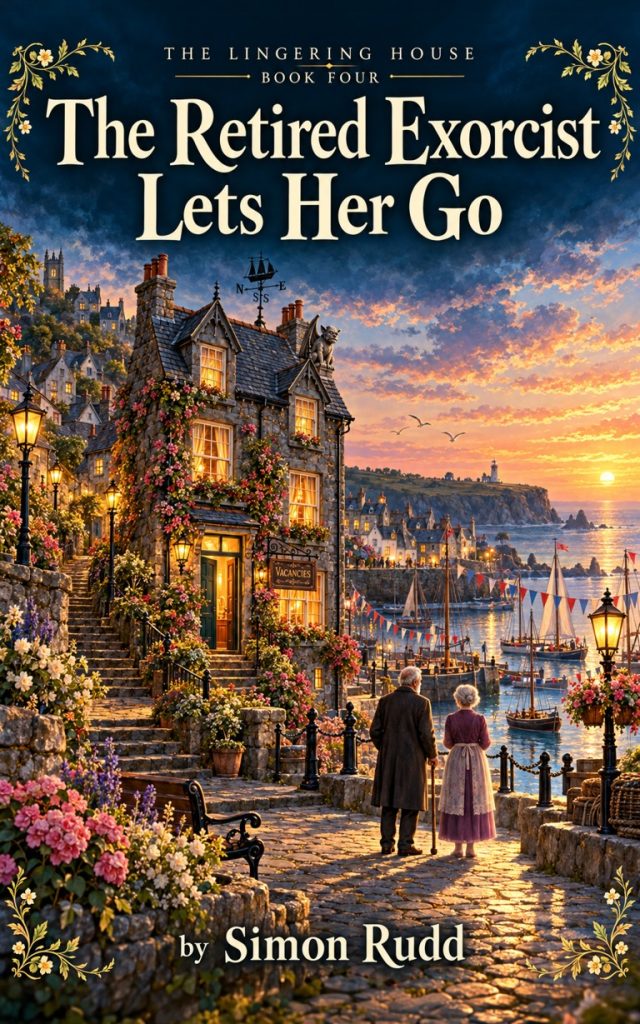
The Retired Exorcist Lets Her Go
The Lingering House · Book 4
Fifty years ago, a frightened boy spent five nights in a seaside lodging house. The woman who took him in never left.
About the book
It is midsummer in Saltgrave. The rooms are booked, the sweet peas are climbing, and Abel Crane has finally let himself believe he is home. Then two things arrive at once: a letter from the Order asking him to take on one last job, and a confession from Joyce Stemp, the ghost who has shared his house since the day he moved in.
She has known him far longer than he realised.
As the regatta draws near, Abel must answer the Order, answer Lottie, who has asked him to stay, and learn what Joyce has been waiting all these years to say. And when Joyce makes a decision of her own, the man who once ended things for a living will have to discover what it means to let someone go well.
The Retired Exorcist Lets Her Go is the moving final book of The Lingering House: a story about gratitude, love and goodbyes freely given, told with the warmth and gentle humour that readers of the series have come to love. Keep tissues close.
Where this book fits
The forth and final book in The Lingering House series
Read an extract
Chapter 1 - Summer Rooms
The woman who had booked Room Two wanted to know whether breakfast included an egg. Abel had answered this in his first letter, along with her questions about the distance from the harbour and drying a wet coat. Her reply lay on the chest while he opened the window on the morning air and a gull which appeared to be considering the arrangement from the opposite roof.
‘The room is taken,’ he told it, and lowered the sash a little.
He had thirteen days before the visitor arrived. The bed was clean, the washstand sound, the window willing to open without an apology or a shoulder beneath it. The acceptance had come with Saturday’s post, and he had brought it up to look at the room knowing someone had chosen it. Ten nights, three shillings and sixpence a night, breakfast included. He had offered a place to stay and been believed.
Joyce stood beside the bed, faint in the window light, the edge of the pillow showing through her sleeve. Since the mornings had brightened, he had taken to looking towards her voice first; she disliked being asked to move whenever the sun inconvenienced him.
‘An egg is a reasonable question,’ she said. ‘Some places say breakfast and mean that a person will be given an opportunity to buy it.’
‘I said what was included.’ Abel folded the letter along its creases. ‘And that any other meals would have to be arranged separately. She seems satisfied.’
‘Then perhaps you could stop looking for something she ought to have objected to. That drawer shuts, if that’s what you’re wondering. I watched you shut it yesterday.’
He took his hand off the chest and examined the room more honestly: the handle of the lower drawer worn where generations of fingers had found it, a pale rectangle where a picture had hung. He sat where the visitor might sit to remove her boots, testing the space between chair and bed.
Joyce watched him with interest. ‘Will you be trying the egg as well?’
‘I have eaten eggs before.’
‘There you are, then. Something you needn’t practise.’ She turned to the window, where the gull was now working at something beneath one wing. ‘You could air the blanket while the weather holds. It won’t need to stay on the bed all summer, but people do arrive with very firm ideas about sea air.’
Abel folded the blanket over his arm. Joyce followed him out, discussing how many towels a wet coat might reasonably require. At Room Three he pushed the door wider.
The green-striped cover was still on the bed, and a thin piece of harbour water shone between the roofs. He no longer expected Hettie to be in the chair by the window, but the small disappointment of finding it empty had not quite left him. He left the door open to the landing and carried the blanket downstairs.
It was five days since Albert and Pip had potted the mint. The kitchen chairs had been back at the table since Lottie went home, and the tray and tools were long since returned to the almshouses. At his eleven-o’clock call three days later, Albert had shown him two new leaves and then produced a plate from an old nursery catalogue, with two flower colours printed so differently that Abel had at first taken them for different plants. Albert had wanted to know which he preferred.
Once Abel understood that there would be no order placed, no ground measured and no judge consulted, he had chosen the darker one. They had spent a pleasant quarter of an hour disagreeing. The plate stayed within reach of Albert’s chair while Abel moved the mint an inch from the lettuce at the old man’s direction.
He thought of it as he spread the blanket over two kitchen chairs set in the sun, clear of the garden path. He had grown used to Albert asking him to do things. It had taken longer to become used to being asked what he liked.
The sweet peas had climbed farther up their twine, the upper leaves separating into shapes he could pick out from the kitchen window, though there were no flowers yet. Beneath them Abel removed one spent pansy and decided the watering could wait until evening. Joyce had stopped beside the label.
‘That gold one has opened properly,’ she said. ‘You couldn’t see much of it yesterday.’
He crouched beside her. The flower tipped towards the path, showing the darker markings at its centre. Hettie had chosen the violet ones first, but the two russet plants had become part of what she wanted too. He had not moved any of them. Joyce went on to examine the sweet peas, and he rose, brushing earth from his fingers.
The front-door knocker sounded before he reached the step. Abel washed his hands quickly. Joyce came through the passage with him at a pace which suggested she had already formed hopes about the caller.
Agatha Thorne stood on the doorstep with a slim folder under one arm. Her straw hat had a narrow blue ribbon, and she held its brim with two fingers against the wind running up Harrow Street. Behind her, the house’s sign swung once and settled. She regarded its offer of vacancies briefly before looking back at him.
‘Mr Crane. I need to know which rooms you are prepared to offer during the regatta. If this is inconvenient, I can return, but I shall need an answer by Tuesday.’
In the parlour she chose the chair with its back to the window and laid the folder across her knees, leaving the little table and its two paper drawings undisturbed. Joyce took her usual interest in the space between them, where Agatha could not see her.
‘The harbour office will have a list. Visitors have a habit of getting off a packet before deciding where they intend to sleep. We would like to direct them somewhere suitable without sending them up three hills first.’ Agatha opened the folder. ‘I am collecting the rooms people intend to offer. It is not a promise that those rooms will remain empty until someone from my list arrives.’
‘Two is booked,’ Abel said. ‘From the Friday eight days before the racing until the Monday afterwards. Ten nights. Four and Five can be listed for enquiries.’
Agatha wrote the room numbers and the rate, with a short line beneath the figure. It was strange to hear an arrangement he had made with one stranger becoming something other people might use.
‘Three shillings and sixpence for each?’
‘For one person in each, with breakfast. I would need to discuss anything further before agreeing to it.’
‘If either room is taken, please send word to the harbour office. The list will be of very little use if it merely describes how fortunate an earlier visitor has been.’
Joyce leaned nearer to see what she had written. ‘Ask her whether they’ve put the band by the fish scales again.’
Agatha had another question first. Was Room Three unavailable for the whole summer, or only during the regatta? He said he was keeping it out of the printed list for now. She waited, but he had no further explanation he wished to give, and she wrote only the two rooms.
‘You will need to be here when people arrive, or leave them a definite arrangement. I have no wish to persuade anyone to climb Harrow Street in order to read a note saying you have gone out.’
‘I shall arrange it with anyone who books. My visitor hasn’t yet told me which packet she expects to take.’
‘Then ask before the week itself.’ Agatha closed the accommodation sheet. ‘Was there something else? You looked as though you were trying to remember a question.’
Abel indicated Joyce’s place beside the hearth. ‘Mrs Stemp is here. She would like to know where the band will be.’
She could see only the hearthrug, the empty grate and the edge of the chair beyond, but she addressed her answer there.
‘The present intention is the harbour end of the quay, far enough from the weighing place to leave access for the men still working. The final positions have not been settled.’ She looked back at Abel. ‘Was there a difficulty with the band?’
‘Only with hearing it,’ Joyce said. ‘If they face the water, the boats get the best of the cornet and everyone behind has to make what they can of the drummer. And I’d like to see the small rowing race. The larger boats are gone before you’ve decided which one you mean to encourage.’
Abel passed on both, taking care that the rowing did not disappear inside the complaint. Agatha opened a second sheet: a rough line for the quay, with pencilled rectangles along it.
‘There may be space near the landward end of the shelter. I cannot promise a view from a particular seat yet. The committee has not agreed where the spectators will stand, and if we put everybody where they first request, the boats will have to come ashore.’
Joyce considered this. ‘I don’t mind standing for a little while. I should like somewhere quieter to go afterwards, though. And I don’t want to spend the afternoon behind a tent.’
He relayed that too. This time Agatha did not write immediately. She asked whether Mrs Stemp meant to attend, and Abel turned to Joyce for the answer.
‘Part of it,’ she said. ‘I’ve heard about quite enough afternoons after they’ve happened. I’d like to hear the band while it’s playing.’
When he repeated this, Agatha held her pencil still for a moment. ‘Very well. I shall know more once the positions are agreed. Speak to me nearer the time, and we can see what is possible. I cannot undertake to hold an entire stretch of quay clear.’
‘She isn’t asking for that,’ Abel said.
‘Good. Several people who are perfectly able to be seen already have.’ Agatha made a small note and put the sheets away. ‘I shall leave you a programme for your visitors when it is settled.’
At the door she asked after the sweet peas, and said she would like to see them when they flowered, if he remembered to tell her. Then she glanced up Harrow Street towards her next call, secured the folder beneath her arm and set off, one hand returning to the brim of her hat.
Joyce waited in the hall while he closed the door. ‘Near the shelter might suit. You can see the boats coming round from there, provided nobody has brought an exceptionally tall relative.’
‘We could go and look before the day.’
‘I should like that. When there are fewer people carrying things. I don’t enjoy being walked through by men with poles.’ She followed him back into the parlour. ‘Did you notice she asked me whether I meant to go?’
He had. Agatha had still needed his voice to hear the answer, and her pencil had hovered as if unsure what belonged on a committee sheet. But she had asked.
He put the visitor’s letter in his desk with a sheet for forthcoming bookings, and at the bottom worked out the charge: thirty-five shillings, one pound fifteen, due on departure. He weighed it against breakfasts and washing, then stopped before spending money he had not received.
The afternoon warmth had reached the kitchen by the time he put the aired blanket away. Lottie called from the open back door, the shop’s busiest hours over, to ask whether he was making tea. She came in empty-handed.
Joyce watched him refill the kettle. Lottie sat at the table and loosened the top fastening of her collar, turning her face towards the draught from the garden.
‘Agatha came in,’ she said. ‘She wanted to know how much bread we could promise for the regatta. I told her I could promise more accurately when someone decided how many people she expected to feed.’
‘Did that help?’
‘She had a number. She always has a number somewhere.’ Lottie smiled at him. ‘I hear you’ve taken a booking.’
He told her about the ten nights and the visitor’s questions, and she asked whether he was pleased. He had been thinking about the rate and the arrival time, and about the eggs before that. Looking towards the stairs, he found he was pleased in a way none of those details quite accounted for.
‘Yes,’ he said. ‘I think it will be pleasant to have somebody stay because she wants to spend ten days by the sea.’
Lottie took the cup he put before her. ‘You might enjoy some of them yourself. You are allowed to go down to the harbour even when nobody needs fetching.’
‘Mrs Stemp has already been discussing that.’ He told her about the rowing race and the shelter, though nothing was settled, and while he poured his own tea he added that Joyce meant to hear the band.
‘I’d like a little time for the music,’ Lottie said towards Joyce’s place. ‘I can’t promise which part of the afternoon until I know what we’re supplying, but if we manage the same hour, I’d be glad of the company.’
Joyce would like that too. Abel gave Lottie the answer and sat down. Beyond the open door, the blanket’s chairs had gone back to their places, leaving warm stone where their shadows had been. A stem moved against the twine beneath the window. Farther along the street somebody was trying to shut a gate which needed lifting before its latch would catch.
Lottie had to go before she finished a second cup. At the door she rested her hand briefly on his arm and told him she hoped his visitor liked her egg. She left him with the pot and Joyce’s opinion that this was becoming an unreasonable amount of attention to breakfast.
He cleared Lottie’s place and took his cup to the window. He could see the pansies, the turn by the cold frame and the lower ground he had left alone for several days. Joyce stood beside him, easier to see away from the direct light, though the garden showed faintly through the edge of her shoulder.
‘Will you want to watch the rowing?’ she asked.
‘I don’t know much about it.’ He was already working out which part of the quay would give her the best view, and where they might rest, when she turned to face him.
‘You needn’t tell the rowers what to do. There are usually plenty of people offering that. I meant would you enjoy coming with me?’
He thought about the quay, the music reaching them between the shouts, and the boats Joyce would have time to choose between. If he arranged his day properly, there could be an hour in it that was not fitted around somebody else’s arrival.
‘Yes,’ he said. ‘I would.’
Joyce turned back to the garden and the moving upper leaves. ‘Then we must find out when it starts. I don’t mind missing the speeches, but I should be very annoyed to arrive just as somebody was being given the prize.’
Abel promised to look when the programme came. He stayed beside her with his tea, and together they considered where they might hear the cornet without being quite so close to the drum.