Cosy Fantasy · Ghosts
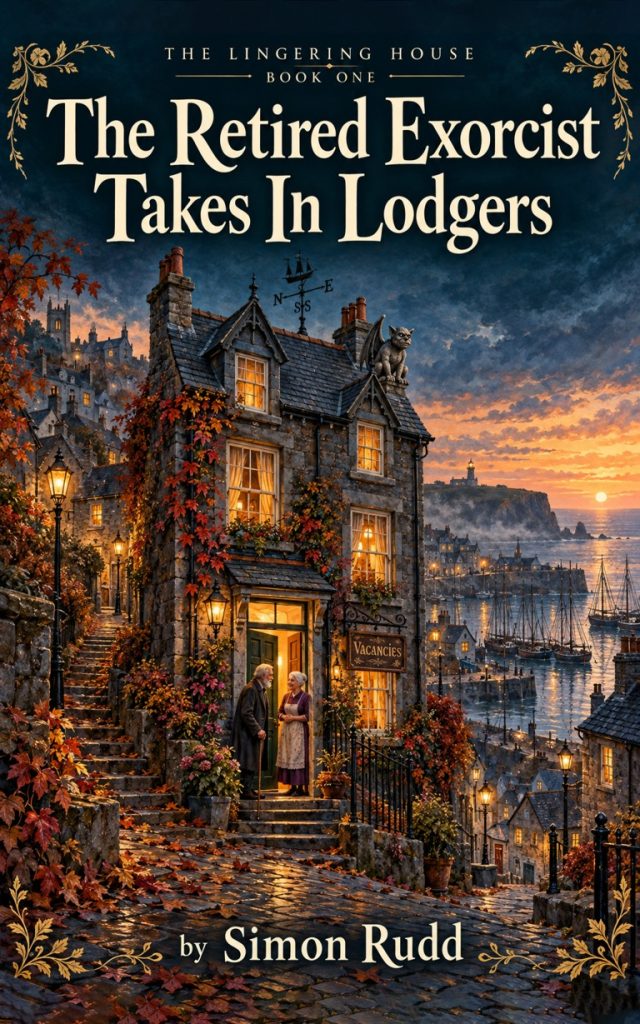
The Retired Exorcist Takes In Lodgers
The Lingering House · Book 1
He spent his career sending the dead away. Now he has bought a house full of them.
About the book
After a lifetime with the Order, Abel Crane wants nothing more than a quiet house by the sea, a decent armchair and to be left alone. The narrow house at the end of Harrow Street in Saltgrave seems ideal. It is cheap, it is solid, and it has a sign over the door: THE LINGERING HOUSE.
The previous residents have not left.
Joyce Stemp kept the rooms for most of her life and has firm opinions about where the kettle belongs. Captain Jory Rourke, in Room Three, wants to know what became of his boat. And on the gutter outside sits Mortimer, a stone gargoyle with a grievance about leaves.
Abel could send them all on with a single note of the silver bell in his coat pocket. He doesn't want to. Instead, with the help of Lottie Pargeter from the bakery, a curious boy named Pip who can hear what others cannot, and a harbour committee that will not be hurried, he sets out to learn what Jory is really waiting for.
The answer is not the one Abel expects, and it will change what he thinks a retired exorcist is for.
The Retired Exorcist Takes In Lodgers is a warm, gently funny cosy fantasy about found family, second chances and a man learning that the dead, like the living, deserve to choose their own way home. Perfect for readers who love low-stakes fantasy, seaside settings and stories where kindness is the greatest magic of all.
Where this book fits
The first book in The Lingering House series
Read an extract
Chapter 1 - The House at the End of Harrow Street
‘If we take the feet off, sir, it ought to go.’
Abel Crane looked at the armchair, which lay on its side between the removal men with one carved foot pressed against the doorframe. He had spent twenty-seven years sitting in it without considering that it might one day require dismantling. Beneath the striped blanket protecting its upholstery, a small patch of green wool showed where his right hand had worn the fabric thin.
‘Are they intended to come off?’ he asked.
The older carrier bent to examine the underside. Rain ran from the brim of his cap and landed on the blanket. ‘These are. Screwed in, see? We’ll have them back on before you need to sit down.’ He glanced at Abel’s travelling bag, still held firmly in his left hand. ‘Might be easier if you went inside and put that somewhere. We can manage here.’
Abel moved out of their way, then found himself standing in the way of the younger man, who was trying to reach the tool bag. He stepped into the house at last, taking the brass key from the lock as he went. It was longer than his forefinger, with a bow polished by other people’s thumbs. For the first time in his life, he had a front-door key that nobody expected him to return.
The hall smelled of furniture wax, cold plaster and the sea. Water darkened the tiles beneath his boots, picking out the blue pattern around their edges. Ahead, a staircase rose past a tall window whose lower panes had been clouded by salt; to his right, an open door showed a hearth, a round table and a faded rug. The room on the left contained a dining table large enough to make his solitary breakfast look rather foolish.
He put his bag beside the stairs and returned to hold the door. Outside, Harrow Street sloped between close-set houses towards the harbour, where the masts stood in a grey tangle above the roofs. A thread of smoke came from the packet’s funnel. Somebody was calling on the quay, the words lost beneath the rattle of the cart and the scrape of a chair foot being unscrewed.
Next door, on the townward side, a woman was drawing a blind halfway down a shop window. Pargeter’s Bakery, the lettering said. Three round loaves remained behind the glass, and a boy in an apron was brushing flour from the doorstep. Abel had eaten a railway sandwich several hours earlier. The smell reaching him now was mostly wet horse and tarpaulin, but the sight of the bread made him remember its deficiencies.
‘Nearly there, Mr Crane.’
The older carrier passed him four wooden feet. Abel accepted them in both hands while the men lifted the chair again, turning it beneath the lintel with a care that made him grateful he had not attempted to help. One corner brushed the paintwork. He said, ‘Sorry,’ before he could stop himself.
‘That’s nothing,’ the younger man assured him. ‘Won’t even show once it’s dry.’
Abel had been addressing the chair. He saw no reason to explain this, and followed them into the parlour carrying its feet.
They placed it beside the empty hearth, where a square of paler carpet showed that something substantial had stood for a long time. The older man knelt to reattach the feet while his companion went back for the boxes. Abel watched the chair settle into its proper shape. Away from the green walls of his former rooms, its upholstery looked brighter and rather more shabby. He touched the worn arm, then turned to the window before either carrier could ask whether he wanted it moved.
From here the sea was visible beyond the low wall at the end of the street. A strip of stony ground separated the wall from the cliff path. Sea pinks had dried in the cracks, leaving brown heads that nodded in the wind, and a gull stood on a post with its feathers lifted by the rain. He had imagined the view on a clear morning often enough over the past month, sitting among packing cases with the house particulars open on his knee.
The photograph had been taken in sunshine and at an angle that concealed the gutter. He had noticed both things before paying for a survey. Its account of the roof was reassuring, its account of the windows less so, and there were several paragraphs about ventilation which he intended to read again when he was warm. The living owners who had inherited the house wanted it sold before winter. He had wanted somewhere he could afford to be left alone. Between those two requirements, a price had been agreed.
He had spent a few days in Saltgrave as a boy. The name in the advertisement had brought back steep streets and the sound of ropes knocking against masts. He remembered little else, but he had kept that page when he threw the others away.
‘Books here, is it?’ The younger carrier stood in the doorway with a box against his chest. ‘I wouldn’t put them by that outside wall just yet. Feels a bit damp.’
Abel indicated a space beside the inner door. The man lowered the box there, and Abel noticed the wet cloth clinging across his shoulders. He ought to offer them something, but he could not remember which box contained the tea, and the kitchen was still an unexplored region at the rear of the house.
‘Would you like...’ he began, then stopped when the older carrier appeared with his small writing desk. ‘There is a bakery next door. I could fetch something while you finish.’
‘We’ve bread in the cart, thank you. My wife packed enough for the journey back as well.’ The man set down his end of the desk and rubbed his wrist. ‘A bit of dry weather would be welcome, if you can arrange it.’
Abel looked through the window. ‘I’m afraid not.’
The carrier smiled and went back outside. Abel wondered whether he had been expected to say something more entertaining. In his former employment, people had seldom minded a literal answer. They had usually been too anxious to notice.
The last of his possessions came in under the tarpaulin: two trunks, a narrow bookcase and a wooden box containing the few kitchen things he had owned. The house’s beds and most of its furniture were included in the sale. Someone engaged by the agent had aired one bedroom that morning and left linen, kindling and a small scuttle of coal. Abel had read the list on the train with more attention than he had given the deed of conveyance.
Once the trunks were upstairs, he paid the balance, adding enough for a hot meal on their return, despite the bread waiting in the cart. The older man folded the paper into his coat and looked up at the house.
‘You’ve plenty of room for visitors, anyway.’
Abel followed his gaze. Above the first-floor windows, a crooked iron weathervane stood against the cloud. Nearer the eaves, a stone creature crouched over the seaward gutter, its chin propped on broad knuckles. Water dripped from one of its ears. The face had been carved with deep-set eyes and a heavy, discontented mouth, though somebody had taken surprising care over the little folds beneath its chin.
‘I don’t expect many,’ Abel said. The man wished him well and gathered the reins. The cart rolled away downhill, its wheels leaving clean tracks through the loose grit, and Abel watched until the tall stack of folded blankets disappeared beyond the bakery.
The house sign hung beside his shoulder. THE LINGERING HOUSE had been painted in cream letters across dark wood. Beneath it, a smaller board read VACANCIES. He lifted the board from its hooks and found the reverse blank. That would do until he could take it down properly. He rehung it with the empty side facing the street, then stepped inside and closed the door.
For a little while he stayed in the hall, listening. Somewhere water ticked into a basin or bucket. The parlour clock made a steady, modest sound, and the cart could still be heard faintly below the hill. Nobody needed him to inspect a room before they would enter it. Nobody was waiting to describe a voice in the wall.
He loosened his scarf. He could have a fire, unpack one box and leave the rest until morning. The sense of permission was unfamiliar enough that he repeated the arrangement to himself while taking off his gloves.
Then a kettle began to whistle at the back of the house. Abel looked towards the passage. Perhaps the woman who aired the bedroom had stayed to make sure he arrived. There was only so much gratitude he could express while cold, tired and holding a damp scarf.
‘Hello?’ he called. ‘I’m sorry. I didn’t realise anyone was still here.’
A movement in the hall mirror made him turn. A man in a dark wool coat stood just inside the front door. His cap sat low over a broad forehead, and his left shoulder was turned towards the wall as though he had needed its support. Abel had heard neither the latch nor a knock. In the next moment he saw the bright brass of the umbrella stand through the man’s coat.
The man looked up. His face was lined and tired, with the fixed concentration Abel had seen in people trying not to show that they had walked too far. One hand rested against his thigh. The wall remained visible through the fingers.
Abel’s right hand went to the inner pocket of his coat. Beneath the lining, his fingers closed around the shape of the silver bell, still wrapped in its handkerchief. The movement had happened before he had decided to make it. He stood with his hand there while the stranger watched him.
The kettle whistled more urgently. Abel released the bell and brought out his empty hand. ‘There’s a chair in the front room,’ he said. He heard the stiffness in his own voice and tried again. ‘If you would like to sit down.’
The man’s gaze moved from Abel’s hand to his face. After a moment he inclined his head, a small acknowledgement rather than an agreement, and started towards the staircase. His outline was faint against the pale tiles, but grew firmer in the shadow beneath the landing. Abel stepped aside. A low note sounded from the stairs throughout the man’s slow ascent, although the carpet did not depress beneath his boots.
Abel waited until the figure had passed out of sight. He had chosen this house from a photograph, a survey and a fondness for a name. It was becoming clear that none of those had been sufficient enquiries.
‘You’ll want to move the kettle,’ a woman called from the passage. ‘It will carry on until you do.’
He found her in the kitchen, beside a broad table scarred with years of chopping. She was an elderly woman with grey hair pinned at the back of her head and a pale apron over a plum-coloured dress. Her sleeves were rolled to the elbow. She looked at him with an expression he could not immediately interpret; then she smiled and indicated the range. ‘There’s a cloth on the rail. The handle gets hot.’
Abel took the cloth and lifted the kettle onto the iron stand beside the hob. Its whistle subsided into a rattle of cooling metal. The range gave off no warmth at all. Through the open fire door he could see a clean grate and a small drift of old ash. ‘It isn’t lit,’ he said.
‘No. The kindling’s under the sink, once you’re ready. The water’s fresh. The woman who did the bedroom filled it this morning. She was very thorough, considering what she was paid.’
A narrow window above the sink looked into the back garden. Its fading light lay across the woman’s shoulder, and through the fold of her sleeve Abel could distinguish the edge of the dresser. He had known before he saw it. Still, he took a moment to set down the cloth neatly, leaving no corner near the empty grate.
‘You must be Mr Crane,’ she said. ‘I’m Joyce Stemp. I hope they haven’t scratched your chair getting it in. I heard rather a lot of discussion.’
‘The feet came off.’ He looked at her offered smile and made himself answer it. ‘They have been put back.’
‘Good. It’s a proper sitting chair. There are one or two here that look very fine, but you wouldn’t thank anyone for an evening in them.’ She glanced towards the passage, then back at him. ‘You’ve had a long journey. Take your coat off before you start doing things.’
Abel had been told to take off his coat in hundreds of houses. Usually the request had come after he had finished what he was there to do. He unbuttoned it slowly, conscious of the weight in the inner pocket, and laid it over the back of a kitchen chair. ‘Were you the landlady?’ he asked.
‘For a good many years. You’ll find the linen cupboard on the first landing, but I shouldn’t attempt it tonight. The key has a red thread through it. Did they give you all the keys?’
He took the smaller ring from his trouser pocket. She leaned towards it, keeping her hands loosely together, and identified the linen key, the coal-store key and one whose lock had been replaced. When he held the ring out, she drew back just far enough for him to understand. He lowered his hand, embarrassed by an offer he would once have known better than to make. ‘Of course,’ he said. ‘Forgive me.’
‘You can put them in the drawer yourself. The shallow one at the end.’ Her voice remained easy, but her fingers closed briefly against her palms before she turned towards the dresser. ‘There’s tea in the blue caddy, if it’s still fit to drink.’
He preferred his own. The small packet was near the top of his travelling bag, wrapped beside half a loaf, some cheese and two pears. He fetched it from the hall and returned to find Joyce looking through the garden window. Beyond the glass, the last flowers leaned among tall grass, and a chair lay on its back beside a cold frame. It would take weeks of work to put the garden into any sort of order. He thought he might enjoy that, provided nobody expected him to do it quickly.
‘The gentleman who came in,’ he said, setting down his bag. ‘Is he staying here?’
‘Room Three. He went down towards the harbour this afternoon. He generally feels better once he’s been home a little while.’ She turned from the window. ‘I’ve had the front room made ready for you. You’ll have the sea to look at when the weather clears.’
Abel unwrapped the tea. The practical assumptions in her answer troubled him more than a declaration of supernatural ownership would have done. He could not find a courteous place to insert the fact that he had purchased an empty house. ‘The agent told me there were no lodgers.’
‘No paying lodgers,’ Joyce said. ‘There haven’t been for some time.’
He opened the cupboard above the dresser and found cups stacked beside a brown teapot. In the doorway, a little of the day’s light still reached the woman’s apron; where it faded, her outline became more distinct. She watched him choose a cup with an unchipped rim.
‘Mrs Stemp, I ought to tell you that I’m retired. I didn’t come here professionally.’
Her gaze rested on the coat hanging over the chair. ‘I’m glad to hear it,’ she said. ‘Shall I show you where the plates are?’
Abel set the cup beside the teapot. In his bag, the cheese had come loose from its paper, and he folded the corners around it again with unnecessary care. Upstairs, a door settled against its frame. He was suddenly aware of how long it had been since he had arrived anywhere with no work to finish and somebody expecting him to eat.
Joyce waited until he looked up. ‘What time were you thinking of serving supper, Mr Crane?’