Cosy Ghost Stories: What Makes a Haunting Feel Like Home
 simon Rudd
A haunted house can offer company as well as a chill. The stories I love make room for both the comfort of belonging and the sadness of saying goodbye.
In this article
Beyond the jump scare
If you hear footsteps pacing the floorboards above your bed at two in the morning, the horror playbook is clear. Barricade the door. Find a crucifix. Sell the house at a loss.
In a cosy ghost story, your first thought is more practical: has anyone told the Captain there's still no news of his boat?
We tend to think of the supernatural as something that arrives to wreck domestic peace. A cosy ghost story turns that around. The haunting becomes part of the household: a presence in the hallway, a cold patch by the window seat, an opinion about the wallpaper from someone who died in 1931.
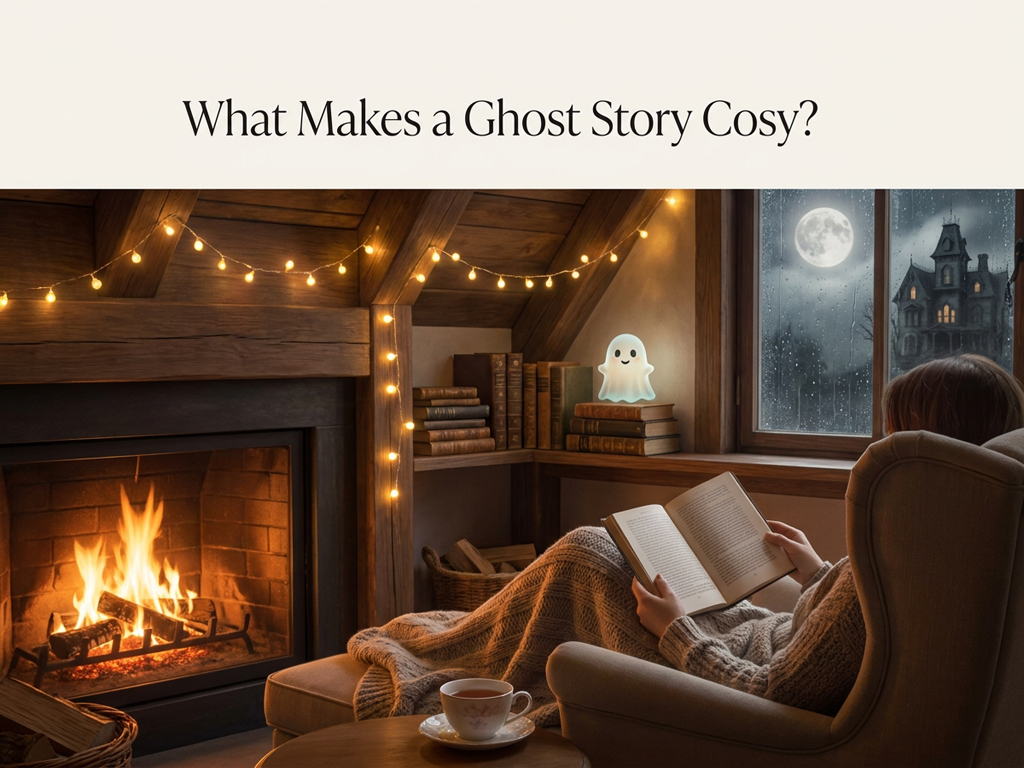
That isn't the same as horror with the teeth pulled. A cosy ghost story is horror re-centred around sanctuary. It trades dread for character, isolation for company, and the castle on the moor for a draughty house by the sea. The sadness stays. It just has somewhere warm to sit.
So what actually makes a ghost story cosy? Here are five ingredients, followed by ten stories that explore different parts of that territory.
1. The hearth, not the crypt: setting as sanctuary
In gothic fiction the setting often feels like an enemy. The castle crumbles, the moor howls, the corridor goes on longer than it should. The place can seem to want you gone.
In a cosy ghost story the setting is on your side. It's a kitchen with a kettle that's always just boiled, a bay window streaked with sea spray, a staircase that creaks in the same three places. The ghost lives inside that comfort rather than threatening it.
The trick is contrast. Rain against the glass only feels good when you're indoors. A cold spot in the hallway only feels gentle when the rest of the house is warm. Cosy ghost fiction builds the shelter first, then lets something strange wander through it.
2. Ghosts as unfinished people, not monsters
A horror ghost often draws its power from what it might do to you. A cosy ghost is more likely to draw your interest through what it never got to do.
That's the shift that makes the genre work. The spectre stops being a force and becomes a person, with habits, grudges, a favourite chair and a sentence they never finished. They linger because of an argument left open, a letter never sent, a brother they were waiting for.
This is how cosy ghost stories handle grief without sinking into despair. The dead can still have something to say, or something they need to hear. The question shifts from "how do we get rid of it?" to "what does she need before she can go?" Fear gives way to familiarity, and familiarity, often, to love.
3. Domestic stakes, not damnation
In epic supernatural fiction, failure can mean the end of the world or the loss of a soul. In cosy ghost fiction the stakes are deliberately human-sized. Will the family get through Christmas without a row? Can two old people meet one more time? Will anyone fix the gutter?
Small stakes aren't low stakes. They're the stakes most of us actually live with, which is why they land.
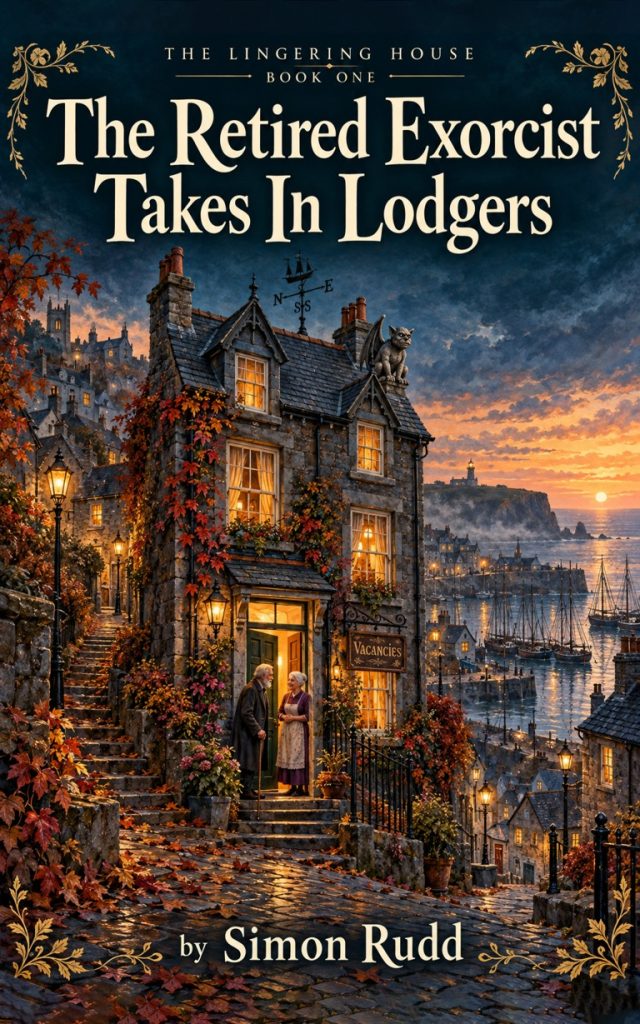
This is the territory I wanted to write in with The Lingering House. Abel Crane spent his working life sending ghosts away. When he retires to a seaside house at the end of Harrow Street in Saltgrave, he finds it already occupied. Joyce Stemp still keeps an eye on the rooms. Captain Jory Rourke wants news of his boat. Mortimer the gargoyle has complaints about the gutter.
An exorcist's instinct is to clear the house. Abel's slow lesson, over four books and four seasons, is to listen instead: to ask why his lodgers have stayed, and what they need before they can go. The hauntings are never catastrophes. They're questions of patience, hospitality and boundaries, the same questions anyone faces when sharing a home.
4. Found family among the living and the dead
Horror often isolates its characters. The phone line is down, the friends have gone home, nobody believes you. Being alone leaves them with fewer places to turn.
Cosy ghost fiction runs the other way. It gathers people. The widower, the lonely child, the baker next door, the woman who died in the back bedroom: each is a little out of step with the world, and the haunted house becomes the one place where that doesn't matter.
Living with ghosts means making room for odd habits rather than fearing them. Someone needs the window open at night. Someone won't sit in that chair. Over time the accommodations become a kind of affection, and the household becomes a family nobody planned.
5. Where the chill still lives
The cosy ghost stories that stay with me never quite forget that someone is dead.
The best of the genre keeps a cold thread running under the warmth. It might be a room the ghost won't enter, a memory she won't discuss, or the plain fact that every ghost in the house is waiting for something that may not come. The reader is comforted, but never fooled.
And the ending often costs something. When a ghost is ready to leave, the household has to make room for that loss too. A goodbye can give the story its weight, even when the journey towards it has been gentle.
For me, that is where the comfort becomes most convincing. The story gives its characters time to live with grief, and company while they do it. The kettle can still go on after a goodbye.
Gothic horror vs cosy ghost fiction at a glance
These are useful tendencies rather than firm boundaries. Many ghost stories draw on both traditions.
| Element | Gothic horror often emphasises | Cosy ghost fiction often emphasises |
|---|---|---|
| Main feeling | Terror, dread, paranoia | Warmth, curiosity, melancholy |
| Setting | Hostile ruin, wild landscape | Lived-in home, shop or boarding house |
| The ghost | Vengeful, corrupting, monstrous | Unfinished, eccentric, often lonely |
| What's at stake | Survival, sanity, the soul | Belonging, closure, getting along |
| The living | Isolated, disbelieved | Gathered into a household |
| The ending | Exorcism, destruction, escape | Reconciliation, release, a goodbye |
Ten ghost stories to explore
Cosy ghost fiction is older than the label. These ten suggestions range from comic domestic hauntings to stories of grief and release, with two darker choices at the end. They offer different kinds of company; they are not all equally gentle.
Comic and mischievous hauntings
- The Canterville Ghost by Oscar Wilde (1887). An American family buys an English manor and refuses to be frightened by its ghost, who is mortified. Funny, then unexpectedly tender.
- Topper by Thorne Smith (1926). A buttoned-up banker is adopted by a pair of party-loving ghosts who are determined to loosen him up.
- Blithe Spirit by Noël Coward (1941). A play, not a novel, but the blueprint for the comic domestic haunting: a séance goes wrong and a novelist's first wife moves back in.
- The Ghost of Thomas Kempe by Penelope Lively (1973). A boy in a country cottage is blamed for the mischief of a cantankerous seventeenth-century sorcerer. A children's classic that adults will enjoy too.
Warmth, love and loss
- A Christmas Carol by Charles Dickens (1843). The great British Christmas ghost story, and proof that spirits can come to help rather than harm.
- The Ghost and Mrs. Muir by R. A. Dick (1945). A widow rents a seaside cottage haunted by its former owner, a sea captain. Coastal, romantic and quietly sad.
- Under the Whispering Door by T. J. Klune (2021). A hard-hearted lawyer dies and finds himself in a tea shop between this world and the next. The modern touchstone for the genre.
- A Fine and Private Place by Peter S. Beagle (1960). A man who lives in a cemetery, a talking raven, and two ghosts who meet too late. Gentle and wistful.
Further into the dark
These last two broaden the list beyond a gentle domestic haunting. Choose them when you are open to more unease or a more challenging treatment of death and grief.
- The Uninvited by Dorothy Macardle (1942). A brother and sister buy a clifftop house on the Devon coast and find it occupied. More shiver than cosy, but warm at its heart.
- Lincoln in the Bardo by George Saunders (2017). A graveyard full of ghosts who won't admit they're dead. Strange, moving, and the most melancholy book on this list.
If you prefer to watch rather than read, the BBC sitcom Ghosts offers another version of the crowded, argumentative household shared by the living and the dead.
Cosy ghost stories: common questions
What is a cosy ghost story?
A ghost story where the haunting is gentle rather than terrifying. The setting feels safe, the ghosts are people rather than monsters, and the story centres on community, grief and closure instead of survival.
Are cosy horror books actually scary?
Usually the emphasis is on atmosphere, affection and an occasional shiver rather than sustained terror. The label is used loosely, though, so it is worth checking the description if you want to avoid violence or upsetting themes. Some of the books listed above are darker or more emotionally demanding than others.
Is "cosy ghost story" the same as "cozy ghost story"?
Yes. "Cosy" is the British spelling and "cozy" the American; both describe the same genre, and you'll often see it shelved as cozy fantasy or cozy paranormal.
How is it different from paranormal romance?
Romance can feature, but it isn't the engine. Cosy ghost fiction is driven by household and community, and the central relationship is as likely to be a friendship or a family bond as a love affair.
Why are ghost stories a Christmas tradition in Britain?
Telling ghost stories on long winter nights is an old custom, and Victorian writers such as Dickens made the Christmas ghost story a fixture. The darkest weeks of the year have always suited a good haunting, especially one that ends in warmth.
THE LINGERING HOUSE · BOOK 1
Ready for a gentler haunting?
Begin with The Retired Exorcist Takes In Lodgers. Abel Crane retires to a seaside house in Saltgrave, where the ghosts have their own ideas about sharing a home.
Follow the household through autumn, Christmas, spring and summer in a complete four-book series.
\ Get the latest news /