A Cornish Bookshop Cosy Mystery
The Blackwater Quay Mysteries Book 1
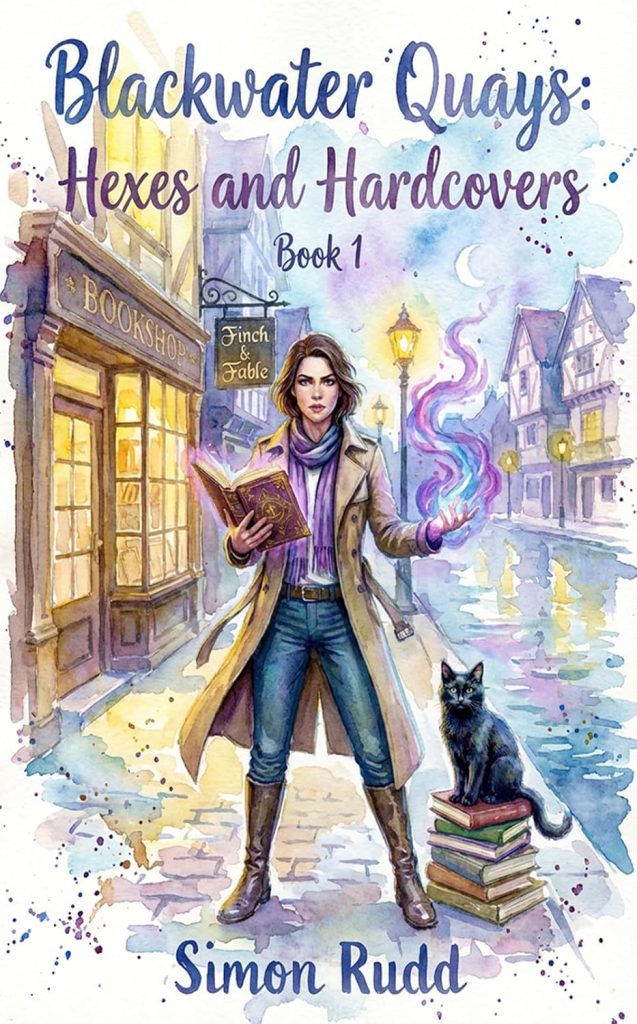
Some bookshops just sell books. Finch & Fable reads them.
When Elowen Finch inherited her great-aunt's magical bookshop on the Cornish coast, she got the shop cat, a lifetime supply of ink-stained cardigans, and an ability she'd never quite claimed: the power to read the emotional residue left behind in old documents.
She also got a problem.
A mysterious annotated property record turns up in an estate donation — and two days after Elowen sells it to a nervous historian named Percival Alder, he turns up dead at the foot of the harbour wall. The book is gone. And the records inside it, if genuine, would prove that Blackwater Quay's most powerful family built their fortune on two centuries of fraud — right where a fifty-million-pound development is about to break ground.
Aided by Atlas, her magically perceptive cat, Benji the café owner who commits to the sidekick role with alarming enthusiasm, and the formidable Mrs. Tilling — retired headmistress, unofficial town historian, devastatingly accurate gossip — Elowen must use her gift to uncover what the ink remembers before someone decides she knows too much.
Hexes & Hardcovers is the first book in the Blackwater Quay cozy mystery series — warm, witty, and steeped in the atmosphere of a Cornish harbour town where the secrets run centuries deep and the margins of old books remember everything.
Perfect for fans of T.E. Kinsey, Paige Shelton, and Juliet Blackwell.
Read the first chapter
Chapter 1: Ink-Stained Inheritance
The book had moved again.
Elowen stood on the rolling ladder and looked at the gap in the maritime disasters section where Tides and Times: A Maritime History had no business being, and then at the gap in the local history section where it did, and then at the book itself, which sat between two volumes about shipwrecks with what she could only describe as an air of satisfaction.
"Fine," she said. "Stay there, then."
It was twenty to seven on a Tuesday. She hadn't had tea yet. This was not the morning for a principled stand.
She climbed back down and Atlas watched her from the counter, amber eyes tracking her in that way he had, like he was keeping score.
"Don't."
His tail moved.
She'd inherited him along with the shop. Along with everything — the stock, the debts, the rolling ladder with the wheel that stuck, the radiators that clanked through the night, and whatever understanding of the world came from growing up watching Marigold Finch treat books like they were worth being careful with. Atlas had been Marigold's cat first. Some mornings Elowen got the impression he still thought he was.
The morning light was coming in thin and watery through the front windows — March not quite committing to anything yet — and it caught the dust in long slanting lines and made the whole shop look slightly unreal. She'd stopped noticing it, mostly. Two years and it had become just the way the place looked before eight o'clock.
Finch & Fable had been on this corner of the high street since 1847. The building leaned. The floors had one note — F-sharp, always, Marigold had pointed it out once and now it was impossible to unhear. It smelled of paper and old glue and damp that had been accumulating since before damp-proofing was invented, and underneath that, salt from the harbour. And cold tea, currently, because she'd made a cup at six and forgotten it on the windowsill.
She made a fresh pot, set the timer this time, and dragged the first Morris box through to the work table.
Mrs. Edith Morris. Ninety-two. Three weeks gone. Her grandson had been emptying the cottage in stages and this was the last of it — three big boxes in shaky handwriting, MORRIS - BOOKS - CHARITY. Elowen had done enough estate donations to know not to expect much. Recipe binders, Reader's Digest condensed novels, The Da Vinci Code in duplicate. But you had to look.
Atlas appeared on the edge of the table before she'd sat down.
"You can stay if you don't interfere," she said.
He settled, tail curling round his paws, white patch under his chin catching the light. She'd said the same thing yesterday and the day before. He always stayed and he always interfered. It was a ritual they both understood.
The Secret Garden, Puffin Classics, 1987. Cracked spine, dog-eared throughout. Inside front cover: To Edith, Christmas 1987, Love Gran. Elowen looked at it. She always did, with inscriptions. Couldn't quite help it. Then she put it in the stock pile and reached for the next one.
The first box took until half seven. Recipe binder, three Catherine Cooksons, a Watership Down with water damage bad enough that she couldn't save it — she held it for a beat before putting it in recycling, which was probably excessive — and a complete run of 1994 National Geographics that she added to stock knowing nobody would buy them for months.
The second box was better. A Jane Eyre in a proper old hardback. Wuthering Heights to match. A leather-bound journal, empty, too good to throw away. Several botanical guides—
Atlas hissed.
His ears had gone flat. He'd gone rigid in that way cats did before they either bolted or attacked, and he was staring into the box.
"What?"
He didn't look at her.
She reached in and found it — a thin volume in faded blue cloth, no title on the spine. She opened it.
Property Records and Harbour Boundaries: Blackwater Quay, 1823.
"Oh, riveting."
Atlas's tail had puffed up enormous.
She turned the pages. Dense surveying language, technical measurements, hand-drawn maps of the harbour with boundary markers she didn't have the knowledge to interpret. The kind of thing that was presumably fascinating to someone. Not to her, not at seven-thirty in the morning without enough tea in her.
Except.
She stopped. Held the book closer to the lamp.
The margins. Someone had been through the whole thing, cramped careful handwriting, corrections and alternative measurements and questions written small in the white space around the official text. Not casual annotations — deliberate ones. Someone checking the record against something else they knew.
She felt the pull at the base of her spine. The thing Marigold had called the ink speaking, which Elowen had always privately felt was a bit of a dramatic name for something that mostly felt like mild unease.
She'd first noticed it at seven, holding a letter Marigold had handed her — 1872, yellowed, fragile — and she'd known before she'd properly read it that the person who wrote it had been crying. Not guessed. Just known, the way you knew your own name.
Emotional residue, Marigold had said, perfectly matter-of-fact about it, the way she was matter-of-fact about most things that should have been extraordinary. Ink holds what people feel when they write it. It's in your blood, love.
Elowen had never got Marigold's precision with it. Her great-aunt could tell you what kind of sad, and how long they'd carried it, and whether they'd ever told anyone. Elowen got impressions. The general shape of something. Occasional headaches.
This book felt wrong. Something sitting slightly crooked underneath the surface, like a picture hung a degree off level in a room you couldn't leave.
Atlas was still staring at it.
She put it in the pile she kept for things she wasn't sure about. Not stock, not recycling. Just aside, for later. She hadn't told anyone about that pile.
The third box was straightforward. Agatha Christies, a stack of Wodehouse, and at the bottom, wrapped loosely in tissue paper, a first edition Pride and Prejudice in remarkable condition. She made a noise. Atlas looked up.
"Sorry," she said. "It's good."
By quarter past eight she'd logged everything in the inventory ledger — handwritten, the way Marigold had always done it. By twenty past she'd dressed the window. Detective novels and cloth daffodils — the real ones were toxic to cats and Atlas got into everything. Marigold had always done romance novels in March. Mrs. Tilling would certainly mention it. But this felt right to Elowen and it was her window now.
She unlocked the front door at eight-twenty exactly and discovered she'd forgotten to drink her tea again.
She looked at the cold cup on the counter, then looked at Atlas on the biography shelf, who looked back at her.
She poured it down the sink.
Marigold had made terrible tea. Elowen had never told her. It had seemed important to let her have that.
The bell went at eight-thirty.
Mrs. Agnes Tilling. Dove-grey skirt suit, pearls, floral umbrella despite clear skies — Elowen had never worked out if this was habit or optimism or just a very good umbrella that deserved regular outings. She came in the way she came everywhere, like the room had been expecting her.
"Elowen, dear. Not too early?"
"Never," Elowen said, which was mostly true.
Agnes Tilling had been Marigold's closest friend for forty years. Former headmistress. The kind of woman who made you want to sit up straighter without quite knowing why. She'd terrified Elowen at eleven and still made her feel faintly assessed, though she'd come to understand that was just what Agnes Tilling did, and that underneath it was something much warmer.
"I've brought the parish newsletter." She produced it from her bag. "And I wanted to see how you were getting on."
Elowen said she was getting on well. What else was there to say.
Mrs. Tilling's eyes moved around the room at a methodical pace, taking in the local author section, the restoration services sign, the window.
"Marigold always had romance novels in March," she said.
"Did she?" Elowen's smile held.
"Spring, you know." A small pause. "Though detective novels are—" Another pause. "A different approach."
"Tea?" said Elowen.
"Lovely."
She put the kettle on — actually on this time — and came back to find Atlas settled in Mrs. Tilling's lap, purring elaborately.
"Traitor," she said, not quite quietly enough.
"Sorry?"
"Nothing. Just the cat."
"He's been restless lately." Mrs. Tilling stroked him without looking down, the ease of someone who'd done it many times. "Marigold always said he knew when something was coming."
Elowen set the cups down. The blue willow ones, Marigold's guest cups. She wasn't sure why she'd reached for those. "Coming?" she said.
"Oh, you know cats." A vague wave. "They pick things up."
"Right."
She sat. Outside, the harbour was starting to catch the light properly. A Tuesday in March. Nothing particular about it.
"Now," said Mrs. Tilling. "Have you given any more thought to my suggestion?"
Elowen had given it no thought. She'd been hoping the situation would resolve itself, which was not, she knew, a strategy.
"The suggestion," she said.
"The historical society. The Finch legacy talk." Mrs. Tilling sipped her tea. "Marigold gave the most wonderful one, years ago. People still mention it. I thought you might consider doing the same."
Elowen's eye drifted to the blue book sitting in the review pile. Just sitting there.
"I'll think about it," she said.
Mrs. Tilling smiled in a way that suggested she had heard, and translated, exactly that answer many times before. She finished her tea, returned Atlas to the counter with a small ceremony he tolerated, and left with a reminder about the newsletter and a suggestion that Elowen eat something proper for lunch.
The bell chimed behind her. The shop settled.
Elowen stood at the counter, and then looked at the blue book again. It hadn't moved. It didn't need to. It just sat there in the review pile with that faint wrongness coming off it like heat from a stone.
She wrote the entry in the ledger. March 18th. Estate donation — Morris. General stock, mixed condition. One item requires further review.
Her handwriting looked narrow beside Marigold's older entries. It always did.
Atlas jumped down from the counter and crossed to the review pile. He sat beside the blue book without touching it and looked at her.
"Not yet," she said. "I'm not ready."
He kept looking.
"Fine," she said. "After lunch. Maybe."
She went to make more tea. The blue book waited.